


Server Rack Cooling Manifolds: Custom CNC Manufacturing from SunOn
A server rack cooling manifold distributes coolant between a rack-level supply system and multiple server or cold-plate loops. Because rack dimensions, port layouts, connector interfaces, materials, and operating requirements vary, many projects require a custom manifold rather than a standard component.
SunOn manufactures custom CNC-machined rack manifold components from customer-supplied 2D drawings and 3D CAD models. We support suitable projects from a single prototype to pilot batches and repeat production. Our team reviews machining access, port geometry, sealing features, tolerances, material requirements, finishing, and inspection needs before production begins.
Send your drawings, CAD files, and rack manifold specifications to SunOn for a manufacturability review and quotation.
Custom Server Rack Cooling Manifolds from SunOn
SunOn provides drawing-based CNC manufacturing for custom rack-mounted liquid cooling manifolds. Each component is produced according to the buyer’s rack design, fluid interface, and acceptance requirements rather than a fixed catalog configuration.
Depending on the design review, we can manufacture:
- Custom manifold blocks, bodies, rails, or related components
- Separate or combined supply and return manifold parts
- Vertical or horizontal rack-mounted configurations
- Customer-defined port counts, spacing, and orientation
- Threaded ports for specified fittings or quick disconnects
- Spot faces, sealing surfaces, and O-ring grooves
- Mounting holes, brackets, datum features, and alignment interfaces
- Prototypes, low-volume batches, and repeat production quantities
- Customer-specified surface treatments and inspection reports
All geometry, materials, testing, assembly, and secondary operations remain subject to drawing and process review.
Manifold Features That Can Be Customized
Rack Dimensions and Mounting Interfaces
A server rack cooling manifold must fit the available installation envelope without interfering with servers, hoses, cables, doors, or service access. SunOn machines the component according to the dimensional and mounting requirements shown in the approved drawings.
Important inputs may include:
- Overall length, width, and thickness
- Rack height and available mounting space
- Vertical or horizontal installation
- Front, rear, or side mounting position
- Top-feed or bottom-feed coolant routing
- Mounting-hole pattern and bracket locations
- Required datums and alignment surfaces
- Clearance around hoses, connectors, and service areas
The drawing should identify which features control the manifold’s position inside the rack. Clearly defined datums help maintain the relationship between mounting points, branch ports, and connector interfaces.
Port and Connector Interfaces
Port layout is one of the most important areas of a custom rack manifold. The number and position of branch ports must match the connected server loops and allow sufficient access for installation or maintenance.
Buyers should specify:
- Number of supply and return ports
- Port pitch, position, and orientation
- Thread type, size, depth, and tolerance
- Connector manufacturer and model, when applicable
- Hand-mate or blind-mate interface requirements
- Required spot-face or sealing dimensions
- Supply and return identification
- Bleed, vent, or drain ports
- Clearance needed for fitting installation
Quick-disconnect terms such as QD, UQD, or UQDB should not be used alone. The RFQ should include the exact connector specification, supplier drawing, or controlled interface dimensions.
Internal Flow-Path Geometry
Custom manifolds may contain a main bore, multiple branch passages, cross-drilled channels, or intersecting internal features. Some designs also require access holes that are later sealed with threaded plugs or another approved method.
During DFM review, SunOn evaluates:
- Tool access to internal passages
- Bore depth and diameter
- Intersections between main and branch channels
- Wall thickness around ports and threads
- Burr-removal access
- Plugged-hole geometry
- Inspection access for critical features
SunOn manufactures the customer-approved geometry. Flow rate, pressure drop, and branch balancing remain the responsibility of the system designer unless separate engineering work is specifically agreed.
Materials for CNC-Machined Rack Manifolds
Material selection depends on coolant compatibility, system pressure, weight, strength, corrosion requirements, cost, and the materials already used elsewhere in the cooling loop.
| Material | Potential Buyer Reason | Manufacturing Consideration | Required Buyer Input |
|---|---|---|---|
| Aluminum | Low weight and efficient machinability | Alloy and finish must suit the coolant and connected components | Exact alloy and surface treatment |
| Stainless steel | Strength and corrosion resistance in suitable systems | Heavier and generally requires more machining time | Stainless grade and surface requirement |
| Copper or brass | May match certain existing cooling loops or interfaces | Higher weight and possible mixed-metal compatibility concerns | Exact grade and approved system use |
| Engineering plastic | May provide chemical resistance or electrical isolation in specialized designs | Pressure, temperature, thread strength, and creep require careful review | Material grade and operating conditions |
SunOn can machine aluminum, stainless steel, copper, brass, and selected engineering plastics through its precision CNC machining services. The buyer should confirm that the selected material, coating, seals, fittings, and other wetted components are compatible with the specified coolant.
SunOn’s CNC Manufacturing Process
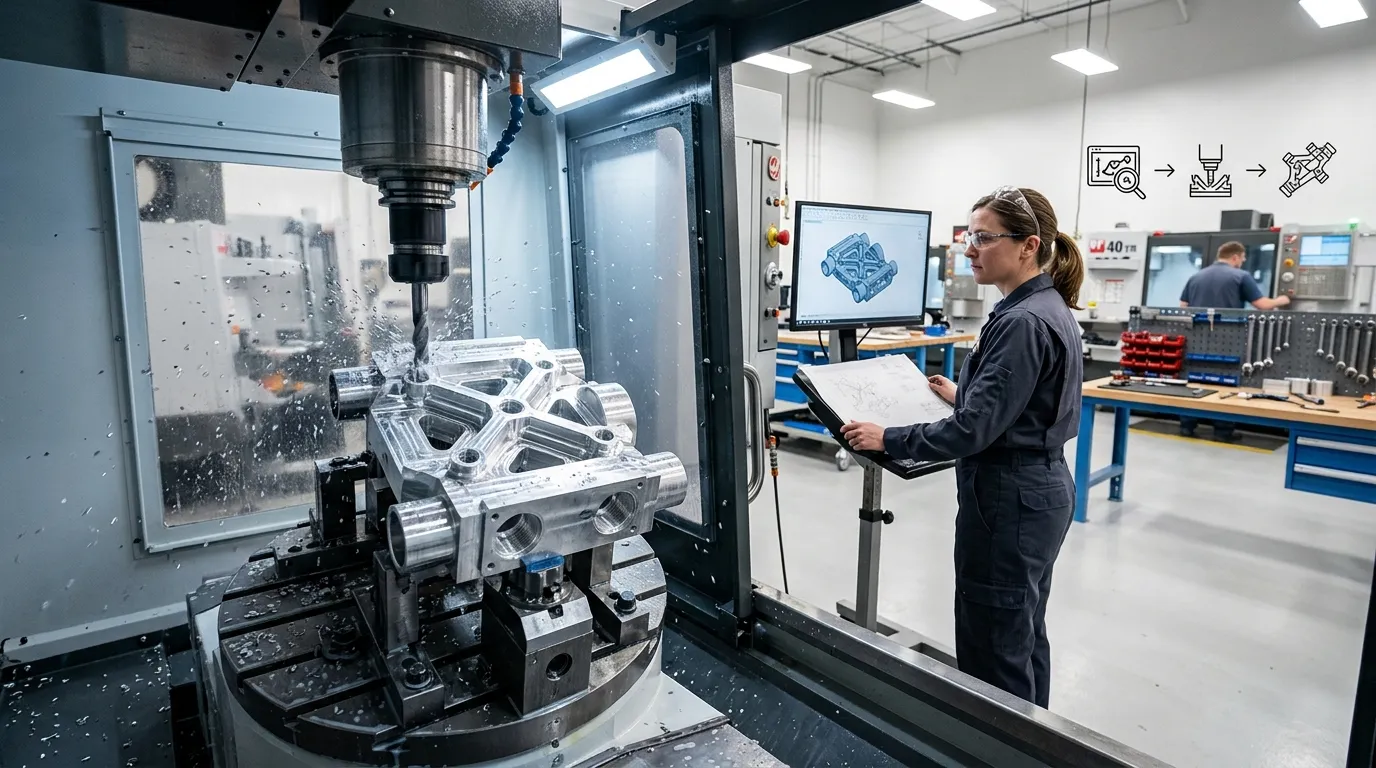
1. RFQ and Drawing Review
The process begins with a review of the technical files and commercial requirements. For an accurate quotation, send:
- 3D CAD model
- Fully dimensioned 2D drawing
- Material grade
- Prototype and production quantities
- Critical tolerances and GD&T
- Port and thread specifications
- Surface-finish requirements
- Connector-interface details
- Inspection and testing requirements
The 3D model defines the geometry, while the 2D drawing should define the acceptance criteria.
2. DFM and Risk Review
Before machining, SunOn reviews whether the design can be manufactured and inspected reliably. The review may identify:
- Deep or difficult-to-access bores
- Intersecting internal channels
- Thin walls around fluid passages
- Limited tool clearance
- Excessive thread depth
- Tight positional tolerances
- Critical sealing faces
- Features affected by anodizing or plating
- Areas that are difficult to deburr or inspect
When a feature creates unnecessary cost or manufacturing risk, practical DFM feedback can be provided for the buyer’s approval.
3. Material and Process Confirmation
After the drawing review, SunOn confirms the material, machining route, secondary operations, finishing, inspection scope, and agreed documentation.
Depending on the part, production may involve:
- CNC milling
- Multi-face or multi-axis machining
- Deep-hole drilling
- Thread milling or tapping
- O-ring groove machining
- Surface finishing
- Plug installation or related secondary work, when approved
4. CNC Machining and Finishing
The manifold body is machined according to the released drawing and revision. Critical port locations, threads, sealing features, and mounting interfaces are controlled during production.
Surface treatment must be specified clearly because anodizing, plating, passivation, or another finish may affect dimensions, threads, sealing faces, or coolant-contact areas.
5. Inspection and Prototype Approval
Inspection can include:
- Overall dimensional checks
- Port-position inspection
- Thread-gauge verification
- Flatness and datum checks
- O-ring groove dimensions
- Sealing-face inspection
- Surface-finish verification
- Material and inspection documentation
Pressure or leak testing can only be included when the method, pressure, medium, duration, sealing arrangement, and acceptance criteria are agreed before quotation.
Prototype and Low-Volume Manifold Manufacturing
A prototype allows the buyer to check rack fit, mounting alignment, port position, connector access, and assembly sequence before approving a larger order.
SunOn’s custom CNC machining for prototyping supports suitable one-off and low-volume projects without dedicated mold tooling. This can be useful for:
- New server-rack designs
- Pilot liquid-cooling installations
- Laboratory validation systems
- Connector-interface testing
- Rack-integration trials
- Replacement or revised manifold components
After the prototype is evaluated, drawing revisions can be incorporated before pilot or repeat production. Single-part and no-minimum-order support depends on the material, geometry, testing scope, and overall project feasibility.
Critical Specifications to Include in Your RFQ
| RFQ Item | Details to Provide | Why It Is Needed |
|---|---|---|
| 3D model | STEP, STP, IGES, or another supported format | Defines the complete geometry |
| 2D drawing | Datums, tolerances, threads, finishes, and notes | Defines manufacturing acceptance |
| Rack configuration | Rack type, available envelope, and mounting position | Prevents installation conflicts |
| Port layout | Quantity, spacing, orientation, and supply/return identification | Controls server-loop connections |
| Connector interface | Supplier, model, drawing, or controlled standard | Defines thread and sealing geometry |
| Material | Exact grade and wetted-material requirement | Supports material sourcing and process planning |
| Coolant | Fluid type and compatibility requirements | Supports material and finish review |
| Operating conditions | Pressure and temperature range defined by the buyer | Supports manufacturing and test planning |
| Validation | Leak, pressure, cleanliness, and dimensional requirements | Defines quotation and acceptance scope |
| Quantity | Prototype, pilot batch, and expected repeat volume | Supports production planning |
| Delivery | Destination and target schedule | Supports quotation and logistics planning |
Unclear or incomplete port, thread, tolerance, and testing requirements are common causes of quotation delays. Providing controlled drawings at the beginning reduces assumptions and revision cycles.
Quality and Inspection for Fluid-Distribution Parts
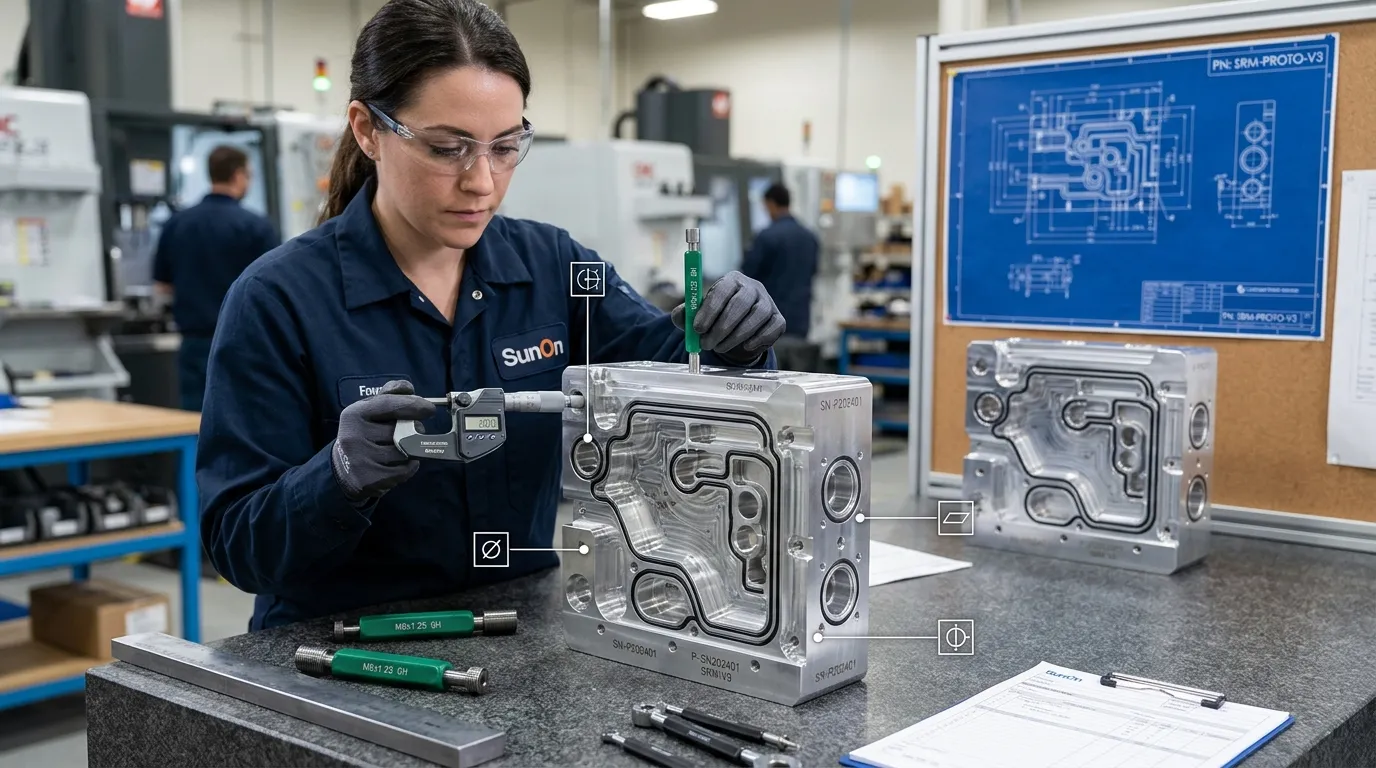
Rack manifold components require control of more than their external dimensions. Port alignment, thread quality, sealing surfaces, internal intersections, and mounting relationships can directly affect assembly.
SunOn’s quality process can include:
- Incoming material verification
- First-article dimensional inspection
- In-process checks of critical features
- Thread and port inspection
- Datum and positional verification
- Sealing-face inspection
- Final dimensional reporting
- Drawing-revision control
- Protective packaging for ports and finished surfaces
Material certificates, dimensional reports, and other records should be requested during quotation so they can be included in the production plan.
Fluid testing is not assumed automatically. When pressure or leak testing is required, the test conditions and acceptance criteria must be stated clearly and confirmed by SunOn before production.
Why Source Custom Rack Manifolds from SunOn?
SunOn combines CNC machining with broader prototype and production support. For custom server rack cooling manifold projects, buyers can work with one manufacturing team for drawing review, material confirmation, machining, finishing, inspection, and repeat-order planning.
Key capabilities include:
- Manufacturing from customer CAD files and drawings
- DFM review before production
- Machining of multiple metals and engineering plastics
- Multi-axis capability for complex, multi-face features
- Prototype and small-batch support
- Surface finishing and secondary-process coordination
- Dimensional inspection and reporting
- Support from initial sample through repeat production
SunOn manufactures the approved part design. Rack thermal design, coolant selection, system flow calculations, connector qualification, and final installation validation should remain under the control of the buyer or system engineering team.
Server Rack Manifold Applications
Custom CNC-machined rack manifolds may be used in:
- Direct-to-chip server cooling loops
- HPC and AI server-rack prototypes
- Custom laboratory computing racks
- OEM liquid-cooling assemblies
- Rack integration and validation projects
- Retrofit or replacement components made from controlled drawings
A rack manifold commonly connects an upstream coolant distribution unit to several server or cold-plate branches. Related components such as micro-channel cold plates or other liquid cooling manifolds should be specified and validated as part of the complete system rather than treated as interchangeable parts.
Frequently Asked Questions
Can SunOn manufacture a server rack cooling manifold from my CAD model?
Yes. SunOn can review a 3D CAD model and 2D drawing for custom CNC manufacturing. The drawing should include material, tolerances, threads, sealing features, finish, inspection requirements, and quantity.
Can I order one CNC-machined prototype?
Suitable projects can begin with one prototype or a small batch. Feasibility depends on the material, geometry, secondary operations, testing requirements, and project scope.
Which materials can be machined for rack manifolds?
SunOn machines aluminum, stainless steel, copper, brass, and selected engineering plastics. The buyer must confirm coolant compatibility and specify the exact material grade.
What port and connector information should I provide?
Provide the port count, spacing, orientation, thread type, size, depth, sealing dimensions, and the connector supplier’s controlled drawing or model.
Can SunOn manufacture to an OCP or proprietary rack specification?
SunOn can manufacture against customer-supplied drawings and specifications after technical review. Compliance should only be claimed when all relevant dimensions, materials, tests, and acceptance requirements are defined and verified.
Are pressure and leak testing available?
Testing may be quoted when the required pressure, test medium, duration, sealing setup, and acceptance criteria are provided and the capability is confirmed during review.
Can SunOn support repeat production after prototype approval?
Yes. After prototype validation and drawing approval, SunOn can plan pilot batches or repeat production based on the confirmed process and quality requirements.
Request a Custom Server Rack Manifold Quote
Send SunOn your 3D CAD model, 2D drawing, rack dimensions, port layout, connector specification, material requirement, coolant information, operating conditions, inspection criteria, quantity, and delivery target.
Our team will review the design for manufacturability, identify any machining or inspection risks, and prepare a quotation for prototype or production machining.
Upload your drawings and request a custom server rack cooling manifold quote from SunOn today.
