


Why Some Materials Do Not Bond in Two Shot Molding
Materials fail to bond in two-shot molding primarily due to chemical incompatibility between the polymers. If the molecular structures of the substrate and overmold materials cannot form intermolecular bonds, strong chemical adhesion is impossible. Other critical factors, such as incorrect processing temperatures and surface contamination, can also prevent even compatible materials from bonding correctly.
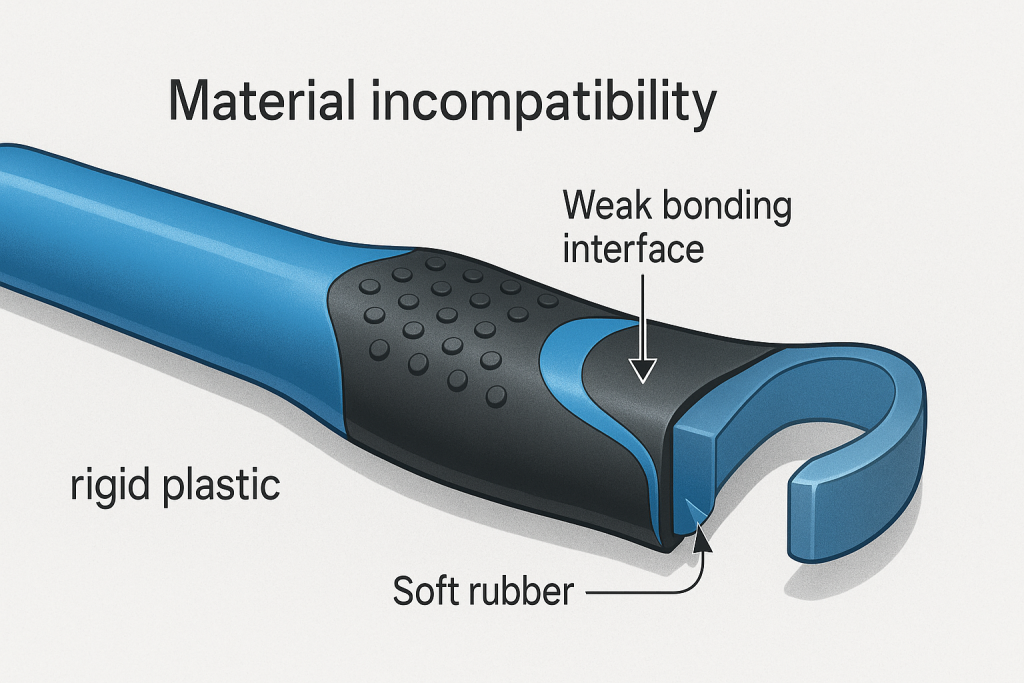
With decades of experience in multi-material molding, we've seen firsthand that a successful bond is the result of a careful synergy between material science and process control. A failed bond is a critical defect that compromises the integrity and function of the entire part. Understanding the scientific and practical reasons why materials fail to bond is the first step in preventing this costly problem.
This guide will delve into the science of polymer compatibility. We will explore common processing errors that lead to bond failure and discuss design strategies for those situations where chemically incompatible materials must be used together.
The Science of Bonding: Chemical Compatibility
The ability of two different plastics to form a permanent, molecular-level bond is rooted in their fundamental chemical makeup. A strong bond is not merely about two materials being pressed together; it's about creating an environment where their polymer chains can fuse. This fusion is governed by principles of chemistry, polarity, and thermal dynamics.
The Concept of Polymer Polarity
In chemistry, the principle of "like dissolves like" is a guiding rule, and it applies directly to polymer bonding. Every polymer has a characteristic known as polarity, which describes the distribution of electrical charge within its molecules.
Licensed by Google
Some polymers are polar (like ABS, PVC, and Polycarbonate), while others are non-polar (like Polypropylene and Polyethylene).
For a strong chemical bond to form, the polarity of the two materials should be similar. Polar polymers adhere well to other polar polymers. Likewise, non-polar polymers bond well to other non-polar polymers. Attempting to bond a polar material to a non-polar material is like trying to mix oil and water; their molecular structures are not naturally attracted to each other, resulting in very poor adhesion.
How Melt Temperatures Affect Fusion
Even if two materials are chemically compatible, a bond will not form without the right thermal conditions. The core principle of chemical bonding in the 2k injection molding process is that the hot, molten overmold material (the second shot) must have enough thermal energy to slightly re-melt the surface of the solid substrate (the first shot).
This momentary surface melting allows the long polymer chains from both materials to intermingle and entangle. As the part cools and solidifies, these entangled chains create a permanent, welded bond at the interface. This requires a carefully controlled processing window. The overmold's melt temperature must be high enough to soften the substrate's surface but not so high that it causes the substrate to degrade or deform.
Why Some Polymer Families Never Bond
Based on these principles, certain families of polymers are known to be incompatible. For example, Polypropylene (PP), a non-polar olefin, has virtually no natural chemical adhesion to ABS, a polar terpolymer. Without using special additives or designing for a mechanical interlock, these two materials will easily peel apart. A detailed understanding of which materials work together is the foundation of successful part design, as explained in our guide to 2k injection molding materials. Material suppliers provide detailed compatibility charts that are an essential resource for any designer.
Common Processing Errors that Prevent Adhesion
While material science dictates if a bond is possible, the molding process determines if that bond will actually be achieved. Many bonding failures are not due to an incorrect material choice but to errors in the process settings that create conditions where a bond cannot form.
Incorrect Temperature Settings
Temperature is the most critical processing variable for adhesion.
- Substrate Too Cold: The time between the first shot and the second shot is critical. If the substrate is allowed to cool for too long before the overmold is injected, its surface will be too cold. The incoming molten plastic of the second shot will not have enough energy to re-melt this cold surface, and a proper fusion will not occur.
- Overmold Too Cold: Similarly, if the melt temperature of the second material is set too low, it will not have the thermal energy required to soften the substrate's surface. This can result in what is known as a "cold weld," a weak bond that looks complete but has very little structural integrity.
The Problem of Surface Contamination
A successful chemical bond requires intimate, molecule-to-molecule contact between the two materials. Any foreign substance, even a microscopic layer, on the surface of the substrate will act as a barrier and prevent a bond from forming.
Common sources of contamination in a molding facility include mold release agents sprayed onto the mold surface, hydraulic oil from the machine, or even fingerprints from manual handling. Another major culprit is moisture. If hygroscopic plastics (materials that absorb water) are not properly dried before molding, this moisture can turn to steam on the substrate's surface, creating a gas barrier that prevents adhesion.
Insufficient Injection Pressure or Speed
Proper injection pressure and speed are necessary to ensure that the overmold material makes complete and intimate contact with the substrate surface. If the injection or packing pressure is too low. The second material may not be pressed firmly enough against the first. This can leave microscopic gaps at the interface, preventing the polymer chains from entangling effectively. This is a key difference in the automated control required for 2k injection molding vs overmolding.
When Incompatible Materials Must Be Used: Mechanical Bonding
Sometimes, the best material for the substrate (for strength) and the best material for the overmold (for feel or chemical resistance) are chemically incompatible. In these common situations, the designer must create a bond through purely mechanical means.
What is a Mechanical Interlock?
A mechanical interlock, or mechanical bond, bypasses the need for chemical adhesion entirely. The strategy is to design the substrate with physical features that the overmold material can flow into, around, or through. Once the overmold solidifies, it is physically trapped or locked onto the substrate. This creates a robust connection based on shape and geometry rather than chemistry.
Common Design Strategies for Mechanical Bonds
Creating a strong mechanical bond requires careful planning during the initial part design phase. It cannot be added as an afterthought. For a broader context, it is helpful to understand the fundamentals of all injection moulding.
- Through-Holes: Designing holes that pass completely through the substrate is a highly effective method. The overmold material flows through these holes, creating plastic "rivets" that anchor the overmold to both sides of the substrate.
- Undercuts and Grooves: This involves creating channels, ledges, or grooves in the substrate. The second material flows into these features and, once solid, is physically prevented from being pulled or peeled away.
- Textured Surfaces: Applying a rough or matte texture to the bonding area of the substrate increases its surface area and creates thousands of microscopic peaks and valleys for the overmold to grip.
- Encapsulation: A very common and robust strategy is to design the overmold to wrap around one or more edges of the substrate. This physically traps the substrate, making it impossible to separate without destroying the part. This is a primary technique used for making durable Soft Touch Grips 2K Molding.
Final Thought
When the chemistry is right and the temperatures are controlled, polymers can fuse at a molecular level to create strong, permanent bonds. When incompatibility or processing errors intervene, the result is weak adhesion, peeling, or outright bond failure that compromises the entire part.
The key takeaway is that adhesion must be engineered from the very start. Material compatibility charts, carefully tuned process parameters, and proactive contamination control are essential tools in preventing failed bonds.
In the end, the science of bonding is as much about foresight as it is about processing skill. By combining material science with disciplined manufacturing practices. Designers and molders can consistently achieve the strong. Reliable bonds that make 2K injection molding such a powerful and versatile technology.
