


How to Calculate Cost for 2K Injection Molding
Calculating the cost for 2K injection molding involves adding up three main expenses. These are the one-time tooling cost, the recurring material cost for two polymers, and the machine time cost per part. Understanding each of these components is essential for accurate budgeting and project planning. As a specialized manufacturer of 2K molded parts, we know that a precise cost calculation is vital for project success. A clear cost breakdown prevents surprises and ensures a project is financially viable.
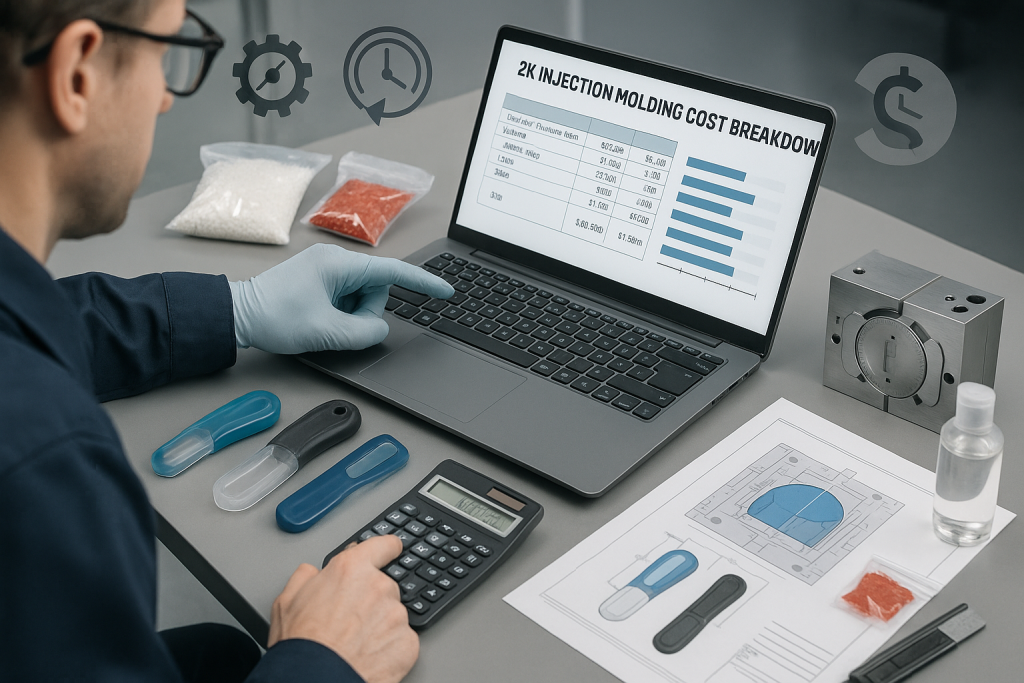
This guide will break down each cost component in detail. We will explore the key factors that drive the initial tooling investment. We will then provide clear formulas for calculating the material and machine time costs for each part produced. By understanding how part design, material choice, and production volume influence the final price, you can make informed decisions to optimize your manufacturing budget.
The Largest Investment: 2K Mold Tooling Cost
The single largest upfront expense in any injection molding project is the mold itself. For 2K molding, this investment is even more significant. A 2K mold is not just a tool; it is a highly complex piece of precision machinery engineered to perform multiple functions in a single cycle. This complexity is the primary driver of its cost.
Why are 2K Molds More Expensive?
A standard injection mold has one core and one cavity. A 2K mold, in its most common configuration, has one stationary side with two distinct cavities and a moving side with two cores. This moving side must rotate or transfer the first-shot part from one cavity to the other. This requires an integrated mechanism, such as a rotary platen or an index plate.
This complexity means more design time, more high-precision machining, and more skilled assembly. The tool requires two separate runner and gate systems, as well as more intricate cooling channels and ejection systems. All these additional components and engineering requirements directly contribute to a higher initial cost compared to a single-shot mold. The entire 2K Injection Molding approach is built around this sophisticated tooling.
What Factors Determine Mold Cost?
Several key factors influence the final price of a 2K mold.
- Part Complexity: The more intricate the part design, the more complex the mold. Features like undercuts, threads, and tight tolerances require additional mechanisms like side-actions or lifters, which add to the cost.
- Mold Size: The overall size of the part dictates the size of the mold. Larger parts require more steel, more machining time, and a larger machine to run, all of which increase the price.
- Mold Material: The type of tool steel used is a major cost factor. Softer steels like P20 are suitable for lower production volumes (up to 500,000 cycles). Hardened steels like H13 are more expensive but are necessary for high-volume production runs of a million cycles or more.
- Mechanism Type: The method used to transfer the substrate (rotary, index plate, core slide) affects the mold's complexity and, therefore, its cost.
How to Calculate the Per-Part Material Cost
Once the mold is built, the primary recurring cost is the raw plastic resin. In 2K molding, you must calculate the cost for two separate materials. This calculation is straightforward and is based on the weight of the plastic in the final part and the price of the resin.
Calculating the Cost of the Substrate (Material 1)
The first step is to determine the weight of the first-shot part, or substrate. This is typically calculated by the design software. The formula to find its cost is:
Substrate Cost = Part Weight (in kg) × Price of Material 1 (per kg)
It is also important to account for the material used in the runner system. The runner is the channel that carries the plastic from the machine nozzle to the part cavity. This material is often reground and reused, but there is always some waste, which should be factored into the total cost.
Calculating the Cost of the Overmold (Material 2)
The exact same calculation is then performed for the second material, the overmold. You must know the weight of this second shot and its price per kilogram.
Overmold Cost = Part Weight (in kg) × Price of Material 2 (per kg)
The prices of the two materials can be very different. A project might use a common, inexpensive rigid plastic like Polypropylene for the substrate and a specialized, expensive medical-grade TPE for the overmold. This is why it's crucial to consult a 2k injection molding materials guide to understand the options. This is a vital calculation for parts like Soft Touch Grips 2K Molding.
Total Material Cost
The total material cost for one finished part is simply the sum of the two individual material costs.
Total Material Cost per Part = Substrate Cost + Overmold Cost
Understanding the Machine Time Cost
The third major cost component is the price of operating the injection molding machine. This is calculated as an hourly rate, known as the machine rate. This rate covers all the operational expenses associated with running the production process.
What is the Machine Rate?
The machine rate is the cost per hour to run a specific injection molding press. This rate includes the cost of electricity, factory overhead, the labor of the machine operator, and routine maintenance. The rate varies significantly based on the size and type of the machine. Larger machines (measured in tonnage) have higher rates. Specialized 2K machines with rotary platens also command a higher hourly rate than standard single-shot presses due to their higher initial cost and complexity.
The Importance of Cycle Time
Cycle time is the total time it takes to produce one finished part. It begins with the mold closing, includes both injection and cooling times, the rotation of the core, part ejection, and ends when the mold closes to start again. The cycle time is a critical factor in determining cost. A shorter cycle time means more parts can be produced per hour, which directly lowers the machine time cost allocated to each individual part. Optimizing the 2k injection molding process is focused on safely minimizing this time.
The Machine Time Cost Formula
The formula to calculate the machine time cost per part is:
Machine Time Cost = (Machine Rate per Hour / 3600 seconds) × Cycle Time (in seconds)
For example, if a machine has a rate of $90 per hour and the cycle time is 30 seconds, the machine time cost per part would be $0.75.
Putting It All Together: The Total Cost Formula
To get a complete picture of the cost, you must combine the recurring per-part costs with the one-time tooling investment. The tooling cost is typically amortized, or spread, across the total number of parts in the production run. This is a key difference to consider when weighing 2k injection molding vs overmolding.
The True All-In Cost
The final, comprehensive cost per part is the sum of the material cost, the machine time cost, the amortized tooling cost, and any secondary costs for assembly or packaging. Understanding all types of injection moulding is useful for context.
- Total Cost per Part =
- (Cost of Substrate Material + Cost of Overmold Material)
- + (Machine Time Cost per Part)
- + (Total Mold Cost / Total Number of Parts Produced)
- + (Secondary Costs like Assembly, Packaging, Shipping)
This formula shows how production volume dramatically impacts the final price. For a small run of 10,000 parts, the amortized tooling cost will be a very large component of the price. For a run of 1,000,000 parts, the tooling cost per part becomes a very small fraction, and the material and machine time costs become the dominant factors.
Final Thought
Accurately calculating the cost of 2K injection molding requires a disciplined approach that considers every major expense: tooling, materials, and machine time. While the tooling cost represents the largest upfront investment, its impact on per-part price is highly dependent on production volume. Material and machine costs, on the other hand, are recurring and scale directly with the number of parts produced.
By applying clear formulas for each cost component and understanding how part design, resin selection, and cycle optimization affect the final outcome, manufacturers can make informed decisions that balance performance with profitability. The key is to view cost not as a barrier but as a strategic tool—one that helps justify the initial investment, optimize production efficiency, and ensure long-term project viability.
A precise cost breakdown transforms uncertainty into clarity. It equips project planners, engineers, and business leaders with the data needed to confidently move forward, protect margins, and deliver high-quality 2K molded parts at a sustainable price point.
