


What Tolerances Are Achievable with 2K Injection Molding
With 2K injection molding, it is possible to achieve tight tolerances, often within ±0.05mm to ±0.1mm for well-designed parts. However, the final achievable tolerance is not a single, universal number. It depends heavily on part complexity, material selection, and the quality of the mold. The process involves managing the behavior of two different materials, which adds layers of complexity compared to single-shot molding.
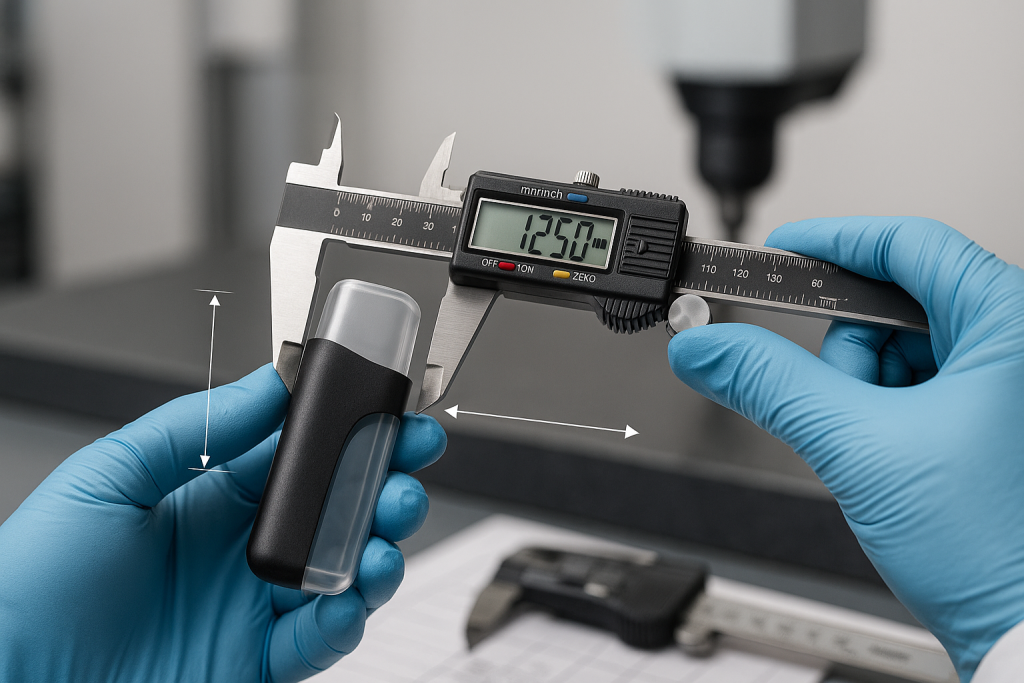
As precision mold makers with extensive experience in multi-shot technology, we understand that managing tolerances is a core challenge. It requires a holistic approach that balances the principles of design for manufacturability with the functional needs of the final component. Simply demanding the tightest possible tolerance is rarely the most effective or economical approach.
This guide will explore the factors that influence tolerances in the 2K molding process. We will provide realistic guidelines for what can be achieved and explain how part design, material choice, and mold engineering all play a critical role in the final dimensional accuracy of a component.
Why Are Tolerances More Complex in 2K Molding?
Achieving tight tolerances in standard injection molding is already a challenge. In 2K molding, that challenge is amplified. The process requires controlling the behavior and interaction of two separate materials and two distinct injection processes within a single cycle. This introduces several variables that are not present in single-shot molding.
The primary challenge is managing differential shrinkage. Every plastic shrinks as it cools from its molten state. In a 2K process, you are often molding two different materials with two different shrinkage rates. For example, a rigid polypropylene substrate might shrink by 1.5%, while the soft TPE overmold bonded to it might shrink by 2.0%. This difference can induce internal stress in the part, leading to warpage and making it difficult to hold tight dimensional tolerances.
Furthermore, the stability of the first shot is paramount. The substrate, once molded, becomes a core component of the mold for the second shot. Any dimensional variation, warping, or instability in the substrate will be directly transferred to the final 2K part. The precision of the entire 2K Injection Molding system depends on the quality of this first shot.
What Are Standard vs. Fine Tolerances in 2K?
To have a meaningful discussion about tolerances, it is helpful to group them into general classifications. The plastics industry often refers to different grades of tolerance based on the application's needs and the cost associated with achieving them.
Commercial or Standard Tolerances
This is the baseline level of precision suitable for the vast majority of consumer products and general industrial applications. A typical commercial tolerance for a well-designed 2K part would fall in the range of ±0.1mm to ±0.25mm (or ±0.004" to ±0.010"). This level of accuracy is achievable with a high-quality mold and a well-controlled molding process, without resorting to extraordinary and costly measures. Most non-critical dimensions should be assigned a standard tolerance.
Fine or Precision Tolerances
This level of tolerance is reserved for high-performance applications where precision is critical to function. This includes medical devices, electronic connectors, and automotive sensor housings. A fine tolerance for a 2K part would typically be in the range of ±0.025mm to ±0.05mm (or ±0.001" to ±0.002").
Achieving this requires a significant investment at every stage of the 2k injection molding process. It demands a superior-grade mold, a highly stable and repeatable machine, advanced process monitoring, and meticulous control over the raw materials. Attempting to apply fine tolerances to non-critical features will dramatically and unnecessarily increase the cost of the project.
Key Factors That Influence Achievable Tolerances
The final dimensional precision of a 2K molded part is not determined by a single factor. It is the result of a careful balance between material science, part design, and the quality of the tooling.
The Role of Material Selection
The choice of polymers is one of the most significant factors influencing tolerance control. Different plastics behave in very different ways.
- Shrinkage Rate: Materials with low and predictable shrinkage rates, such as Polycarbonate (PC), ABS, and Acrylic (PMMA), are inherently easier to mold to tight tolerances. Materials with high and variable shrinkage rates, like Polypropylene (PP), Polyethylene (PE), and Nylon (PA), are much more challenging. Choosing stable, low-shrink materials from the start is a key strategy for precision parts. This is a critical step when selecting 2k injection molding materials.
- Fillers: Adding fillers like glass or carbon fiber can drastically reduce the shrinkage rate, which is good for tolerance control. However, these fibers tend to align with the direction of plastic flow. This can cause the part to shrink differently in the direction of flow versus perpendicular to the flow, a phenomenon known as anisotropic shrinkage, which can lead to warping.
- Compatibility: As mentioned, the difference in shrinkage rates between the substrate and overmold is a major source of stress and warpage. Choosing material pairs with closely matched shrinkage rates is essential for high-precision applications.
How Part Design Impacts Precision
The design of the part itself has a profound impact on how tightly its dimensions can be controlled.
- Wall Thickness: Uniform wall thickness is the single most important design rule for dimensional stability. Thick sections cool much slower than thin sections, causing differential shrinkage that leads to sink, voids, and warping.
- Complexity: Simpler, more open geometries are inherently more stable than complex parts with many features like thin ribs, bosses, and sharp corners.
- Tolerance Location: It is much easier to hold a tight tolerance on a feature that is formed entirely within one solid piece of the mold (e.g., the diameter of a hole). It is much more difficult to control a dimension that is formed across the mold's parting line, as any slight misalignment between the mold halves will affect that dimension.
The Critical Importance of Mold Quality
A precision part requires a precision mold. The quality of the tooling is a non-negotiable factor in achieving fine tolerances. For a broader context, it is helpful to understand the fundamentals of all injection moulding.
- High-Quality Steel: The mold must be constructed from high-grade, stable tool steel (like H13) that has been properly heat-treated. This ensures the mold does not deform or wear under the high pressures of injection over hundreds of thousands of cycles.
- Precision Machining: The cavities, cores, and all moving components must be machined to extremely high precision using advanced CNC milling, grinding, and EDM technologies. Tolerances for the mold itself are often ten times tighter than for the final part.
- Robust Interlocking: The mold must have robust interlocks and guiding systems to ensure the two halves align perfectly every time the mold closes. This is especially critical for features that cross the parting line.
- Optimized Cooling: Each shot in the mold should have its own dedicated cooling channels. Precise temperature control is essential for managing shrinkage, and this requires a well-engineered cooling design.
- Scientific Gating: The location and size of the gate (where plastic enters the cavity) must be carefully chosen, often with the help of mold-flow simulation software. Proper gating ensures the cavity fills uniformly, which minimizes stress and warpage.
How Tolerances Differ Between Substrate and Overmold
In 2K molding, it is helpful to think about the tolerances for each material shot separately. The requirements and achievable precision are often different for the substrate and the overmold.
Tolerances on the Substrate (First Shot)
The substrate must be molded to the tightest possible tolerance. This part acts as a precision insert or core within the mold for the second shot. Any deviation or variation in the substrate's dimensions will directly impact the location and thickness of the overmold. Therefore, the most critical tolerances of the entire assembly are typically applied to the first-shot component.
Tolerances on the Overmold (Second Shot)
The tolerances on the overmolded material, especially if it is a soft and flexible TPE or TPU, are generally looser. These elastomeric materials have much higher shrinkage rates and are inherently more variable. Their flexible nature also makes them difficult to measure with high precision, as they can deform under the pressure of measuring tools. For these reasons, tolerances for soft features, like those found on Soft Touch Grips 2K Molding, are typically two to three times looser than those on the rigid substrate.
The Concept of Tolerance Stack-Up
Designers must also account for tolerance stack-up. The final tolerance of a dimension that is influenced by both materials is a combination of the tolerance of the substrate plus the tolerance of the overmold. This accumulation of tolerances is one of the key challenges that makes 2K precision difficult and is a major point of analysis when comparing 2k injection molding vs overmolding.
Frequently Asked Questions
No, it is not realistic to expect the same level of precision. Soft thermoplastic elastomers (TPEs) have significantly higher and less predictable shrinkage rates than rigid plastics like ABS or PC. This inherent material property makes them less dimensionally stable.
The type of 2K molding process can have an impact on precision. Rotary platen and index plate systems, which use two distinct cavities, generally offer the best potential for tight tolerances. This is because the cavity for each shot can be independently machined, cooled, and optimized for that specific material.
Cpk and Ppk are statistical measures of process capability. They do more than just show if a part is within its tolerance band; they measure how centered and stable the process is relative to that band.
No, and you should not. Applying unnecessarily tight tolerances to every feature is one of the most common and costly mistakes in part design. Tight tolerances should only be applied to critical-to-function dimensions that affect the part's assembly, fit, or performance.
Yes, absolutely. The dimensions of a plastic part are not always stable immediately after molding. Some materials, particularly semi-crystalline plastics like nylon, are hygroscopic, meaning they absorb moisture from the atmosphere.
