


5-Axis CNC Machining Services
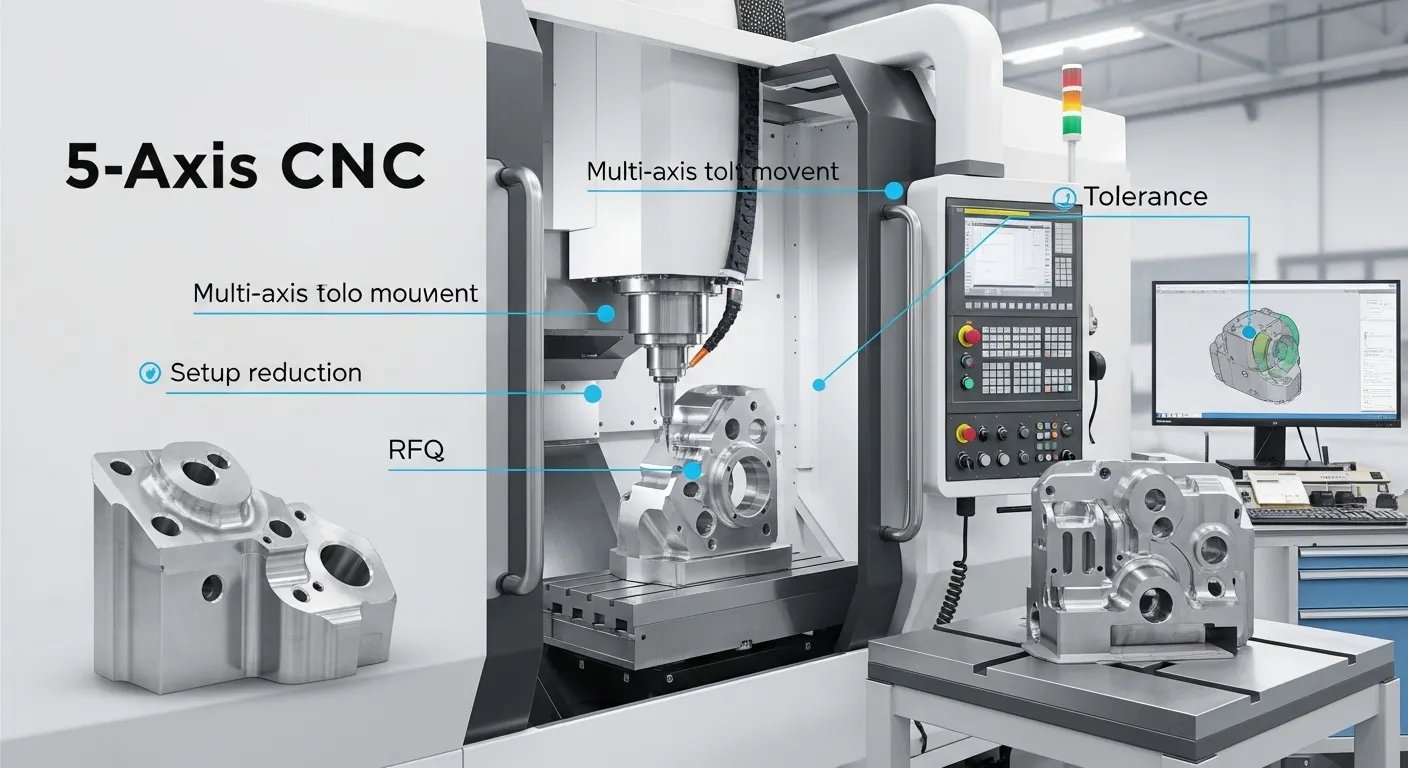
For a reliable quote, buyers should confirm the part material, quantity, tolerance requirements, surface finish, inspection needs, application, and production stage. SunOn can review 2D drawings and 3D CAD files to help check manufacturability before machining.
This page is designed for buyers who already have a part concept, drawing, sample, or CAD model and need to decide whether 5-axis CNC machining is the right process for prototype, low-volume, or production-ready custom parts.
When Should Buyers Choose 5-Axis CNC Machining?
5-axis CNC machining is most useful when the part cannot be machined efficiently from only one or two directions. It allows the cutting tool to approach the workpiece from more angles, which can reduce re-clamping and improve access to complex surfaces.
Buyers should consider 5-axis machining for parts with:
- Angled holes or compound-angle features
- Curved or freeform surfaces
- Multiple machined faces that must align accurately
- Deep cavities or hard-to-reach areas
- Undercuts or difficult tool access
- Tight relationships between holes, slots, pockets, and external faces
- Complex brackets, housings, mold inserts, impellers, fixtures, or structural parts
However, not every part needs 5-axis machining. A simple plate, spacer, cover, block, or turned part may be more cost-effective with 3-axis CNC milling or CNC turning. A DFM review helps confirm the most practical process before quotation.
3-Axis vs 5-Axis CNC Machining: Which Fits Your Part?

Choosing the wrong machining method can increase cost, setup time, tolerance risk, or communication problems. The table below helps buyers decide when 5-axis machining is worth discussing.
| Buyer requirement | 3-axis CNC may fit when | 5-axis CNC is better when | RFQ note |
|---|---|---|---|
| Simple pockets, holes, and flat surfaces | Features are reachable from one main direction | Multiple faces need machining in one setup | Send a 3D model and 2D drawing |
| Angled holes or compound angles | Angles can be made with simple fixtures | Angled features appear on several faces | Mark critical angles and hole tolerances |
| Curved or freeform surfaces | Surface shape is simple | Smooth complex contours need controlled tool access | Share surface finish expectations |
| Tight feature relationship across faces | Re-clamping does not affect function | Alignment between faces is critical | Identify critical dimensions |
| Deep cavities or hard-to-reach areas | Tool access is open and simple | Tool length, collision, or reach is a concern | Send full CAD data for DFM review |
| Cost-sensitive simple parts | Geometry is basic | 5-axis adds no clear technical benefit | Ask for process selection support |
For broader CNC process support, buyers can also review SunOn’s CNC machining manufacturer service page.
5-Axis CNC Machining Capability for Custom Parts
SunOn supports custom CNC machining for buyers who need precision parts, prototype components, small-batch runs, and OEM/ODM manufacturing support. For 5-axis projects, the main goal is not only to machine complex shapes. It is also to reduce setup risk, improve tool access, and support better consistency between related features.
Typical 5-axis CNC machining projects may include:
- Custom metal parts with complex geometry
- Plastic machined parts for functional testing
- Lightweight brackets and structural parts
- Housings with multi-side features
- Mold components and inserts
- Robotics and automation components
- Fixtures, jigs, and production support parts
- Engineering validation parts before tooling
If the part also includes cylindrical features, shafts, threads, or round profiles, CNC turning or a combined machining approach may be reviewed during the DFM stage. SunOn can also support related manufacturing needs such as rapid prototyping, surface finishing, assembly, mold making, injection molding, die casting, and OEM/ODM production support when the project moves beyond CNC parts.
Materials for 5-Axis CNC Machined Parts
Material choice affects machining strategy, cost, surface finish, tolerance control, and final part performance. Buyers should not select a material only because it is common. The correct choice depends on strength, weight, corrosion resistance, heat resistance, wear behavior, electrical needs, cosmetic expectations, and application environment.
SunOn can discuss CNC machining projects involving common metal and plastic material categories, including:
- Aluminum for lightweight parts, housings, brackets, prototypes, and machined covers
- Stainless steel for strength, corrosion resistance, and functional components
- Brass and copper for electrical, thermal, fitting, or decorative applications
- Titanium for lightweight and high-strength applications where machining difficulty must be reviewed
- ABS, POM/Delrin, nylon, PC, PMMA, PEEK, PTFE, and other engineering plastics for prototypes, fixtures, insulating parts, wear parts, or functional test components
Some materials are easier to machine than others. Copper may need careful tool selection because of its ductility. Thin plastic parts may deform if geometry is not designed well. Titanium and stainless steel may require more controlled cutting conditions. For this reason, buyers should share both material requirements and part function during RFQ review.
Tolerance, Surface Finish, and Inspection Planning
Tolerance should be treated as a design and inspection requirement, not only as a machining claim. A complex 5-axis part may include both critical and non-critical dimensions. If every dimension is marked with tight tolerance, cost and inspection effort may increase unnecessarily.
Buyers should clearly identify:
- Critical dimensions that affect assembly or function
- Hole, slot, thread, and insert requirements
- Flatness, parallelism, concentricity, or positional needs
- Cosmetic surfaces versus hidden functional surfaces
- Thin walls, sharp internal corners, deep pockets, or fragile features
- Inspection report requirements
Surface finish also matters. A part may be acceptable as-machined, or it may need bead blasting, anodizing, polishing, plating, powder coating, painting, passivation, or another finishing process. The right finish depends on corrosion resistance, appearance, wear, conductivity, assembly fit, and end-use environment.
Inspection expectations should be confirmed before production. Buyers should provide 2D drawings with tolerance notes, GD&T if required, and any dimensional report requirements. This helps SunOn review which features need focused inspection and which features can follow general manufacturing expectations.
Prototype, Low-Volume, and Production Fit
5-axis CNC machining is often used when the buyer needs a real material part before committing to tooling. It can support functional prototypes, engineering validation samples, test fixtures, low-volume production, and bridge production before mold or die-casting investment.
For product development teams, this is useful when a design is still changing. CNC machining can help test fit, strength, assembly, and surface requirements before production tooling is finalized.
For procurement teams, 5-axis CNC may support lower-volume parts where mold tooling is not economical. It can also support complex production components when geometry, tolerance, or material requirements make machining the right process.
If the project later moves into plastic injection molding, die casting, sheet metal fabrication, finishing, or assembly, SunOn can review the manufacturing path and help buyers plan the next stage.
Application Examples for Complex 5-Axis CNC Parts
5-axis CNC machining is relevant across many industrial and product development applications. The process is especially useful when a part has complex geometry and multiple functional surfaces.
Common project areas include:
- Industrial equipment components
- Automation and robotics parts
- Automotive and EV-related components
- Electronics housings, heat-related parts, and fixtures
- Medical device development parts
- Mold inserts and tooling components
- New energy and battery equipment components
- Aerospace-related brackets, housings, and lightweight machined parts
For aerospace-related CNC component planning, buyers can also visit SunOn’s aerospace CNC machining page. Buyers should confirm any regulated industry requirements, inspection needs, documentation, and material traceability expectations before quotation.
Common Project Risks to Review Early
Many machining problems appear before production starts. They often come from unclear drawings, unrealistic tolerances, poor material selection, or missing finish requirements.
Before requesting a quote, buyers should review these risks:
- The part may not actually need 5-axis machining
- Tight tolerances may be applied to non-critical features
- Thin walls may deform during machining
- Deep pockets may require long tools and increase vibration risk
- Internal sharp corners may not be machinable as designed
- Surface finish may affect final dimensions
- Threads, inserts, holes, and slots may need clearer drawing notes
- Cosmetic requirements may not be visible from the CAD model alone
- Inspection expectations may be missing from the RFQ
A clear DFM review helps reduce these risks before machining starts.
What Should Buyers Send for a 5-Axis CNC Machining Quote?
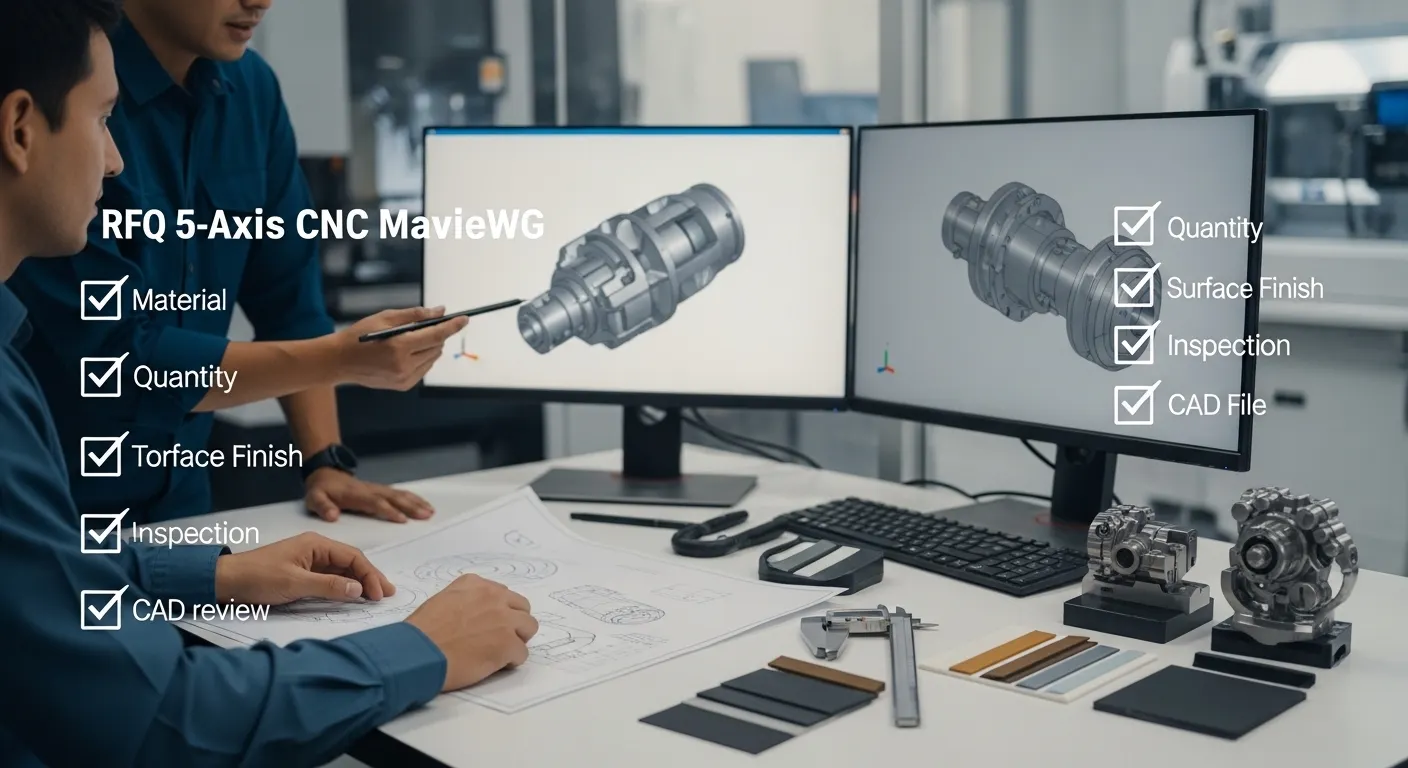
A complete RFQ helps SunOn review process fit, material choice, tolerance risk, finish requirements, and inspection needs more accurately.
Please prepare:
- Product or part name
- Quantity required
- Prototype, small-batch, or production stage
- Application or industry
- 3D CAD model
- 2D drawing with critical tolerances
- Material requirement and grade if known
- Surface finish requirement
- Color, coating, plating, anodizing, or polishing needs
- Threading, inserts, holes, slots, undercuts, or assembly notes
- Inspection report requirement
- Functional testing requirement if relevant
- Delivery destination
- Target schedule if relevant
- Existing mold, tooling, sample, BOM, NDA, or project specification if available
If you are unsure whether the part should use 3-axis CNC, 5-axis CNC, CNC turning, injection molding, die casting, or another process, send the drawings and project background for review.
Why Work With SunOn for Custom 5-Axis CNC Machining?
SunOn Mould supports buyers who need more than a simple machined part. Many OEM/ODM projects require process selection, material review, tolerance discussion, finishing, assembly, and production planning.
Our team can help buyers review the part geometry, confirm whether 5-axis CNC is suitable, check manufacturability risks, and prepare the project for quotation. This is useful for engineers who need technical feedback and procurement teams who need clear manufacturing communication.
SunOn’s wider manufacturing scope also helps when a project moves from prototype to production. CNC machining can be connected with rapid prototyping, mold manufacturing, injection molding, die casting, post-processing, surface finishing, mechanical assembly, and OEM/ODM manufacturing support.
Frequently Asked Questions
When should I choose 5-axis CNC machining?
Choose 5-axis machining when your part has angled features, multi-side machining, curved surfaces, deep cavities, or tight relationships between faces. If the part is simple, 3-axis CNC may be more practical.
Is 5-axis CNC machining always more expensive?
Not always. The machine and programming cost may be higher, but fewer setups can reduce alignment risk and rework for complex parts. The best choice depends on geometry, quantity, tolerance, and inspection needs.
What files are needed for a quote?
Send a 3D CAD model and a 2D drawing. Also include material, quantity, tolerance, surface finish, application, inspection needs, and any assembly or functional requirements.
Can SunOn support prototypes and production parts?
Yes. SunOn can support CNC prototype machining, small-batch CNC machining, and production-related custom manufacturing support. The best workflow depends on your design stage, quantity, material, and final application.
What materials can be used?
Common project materials include aluminum, stainless steel, brass, copper, titanium, ABS, POM/Delrin, nylon, PC, PMMA, PEEK, and PTFE. Final material selection should match strength, weight, wear, heat, appearance, and cost requirements.
Can surface finishing be included?
Yes, surface finishing can be reviewed with the CNC quote. Buyers should specify whether they need as-machined finish, bead blasting, anodizing, polishing, plating, powder coating, painting, or another finish.
Request a 5-Axis CNC Machining Quote
Send SunOn your 3D CAD file, 2D drawing, material requirement, quantity, tolerance notes, surface finish requirement, inspection needs, and application details. Our team can review the part for 5-axis CNC machining, DFM risks, prototype support, low-volume production, finishing, assembly, or broader OEM/ODM manufacturing planning.
