


Aluminum Cooling Plates: Custom CNC Machining Services by SunOn
SunOn provides custom CNC machining services for aluminum cooling plate projects based on your 2D drawings, 3D CAD models, and technical requirements. We can review machined channels, ports, threaded holes, mounting features, sealing areas, surface requirements, and critical dimensions before production.
Manufacturability depends on the plate geometry, aluminum specification, tolerances, finishing requirements, testing scope, and order quantity. SunOn supports drawing review, DFM feedback, prototype machining, production planning, finishing, and dimensional inspection as part of a project-specific manufacturing process.
Send your drawings and project requirements to request an aluminum cooling plate quotation and DFM review.
Custom Aluminum Cooling Plate CNC Machining by SunOn
Every cooling plate project has different dimensions, channel layouts, interfaces, and operating requirements. SunOn manufactures custom parts according to approved engineering files rather than limiting buyers to fixed standard designs.
Depending on the drawing and manufacturability review, your aluminum cooling plate may include:
- Custom plate dimensions and external profiles
- Machined cooling channels, pockets, or flow paths
- Inlet and outlet features
- Threaded ports and mounting holes
- Counterbores, slots, grooves, and assembly features
- Controlled contact or mounting surfaces
- Defined sealing surfaces
- Requested surface finishes
- Prototype or lower-volume production quantities
- Project-specific inspection requirements
CNC milling may be combined with drilling, tapping, and multi-face machining. Multi-axis machining can also be considered when features are located on several faces or are difficult to access through a simpler setup.
Exact geometry, tolerance, finish, inspection, and testing requirements are confirmed after SunOn reviews the submitted files.
Request a manufacturing review for your custom aluminum cooling plate.
Why Aluminum Is Used for Custom Cooling Plates
Aluminum is commonly considered for machined cooling plates because it offers a practical combination of low component weight, machinability, availability, and finishing flexibility.
Its machinability allows manufacturers to create custom pockets, holes, ports, mounting features, and channel geometry directly from CAD data. This makes aluminum suitable for prototypes and drawing-based components that may need several design revisions before the final production version is approved.
Aluminum can also be used where overall assembly weight matters. Different surface treatments may be considered depending on the operating environment, appearance, corrosion concerns, and dimensional requirements.
However, material selection should not be based on broad assumptions. Cooling performance depends on the complete design, including the plate dimensions, channel layout, contact area, coolant conditions, flow requirements, assembly method, and operating environment.
Material Grade Must Match the Project
The aluminum grade and condition should be stated on the engineering drawing whenever the design team has already selected them.
When the material has not been finalized, buyers should provide enough project information for a technical discussion, including:
- Intended application
- Operating environment
- Mechanical requirements
- Surface-finish requirements
- Coolant information where relevant
- Contact and sealing conditions
- Prototype or production quantity
SunOn’s broader aluminum CNC machining services page covers aluminum machining, material considerations, available finishes, and general RFQ requirements in more detail.
SunOn does not treat one aluminum grade as the universal choice for every cooling plate. The final specification should be confirmed through the drawing and engineering review.
Cooling Plate Features to Define Before Machining
Clear engineering files help SunOn evaluate machining access, setup requirements, inspection scope, and potential production risks.
| Cooling Plate Feature | What the Buyer Should Specify | Why It Affects Manufacturing |
|---|---|---|
| Overall dimensions | Length, width, thickness, and dimensional tolerances | Determines raw material, setup, and machining strategy |
| Channel or pocket geometry | Width, depth, routing, spacing, and corner requirements | Affects tool access, machining time, and achievable internal geometry |
| Wall thickness | Minimum material between channels and external surfaces | Influences rigidity and machining risk |
| Ports | Position, size, thread type, depth, and orientation | Affects machining access, sealing, and assembly |
| Mounting holes | Diameter, thread, position, and datum references | Controls alignment with the final equipment |
| Contact surface | Functional area, flatness, and roughness requirements | Influences fit and contact with the mounted component |
| Sealing area | Groove geometry, interface details, and surface requirements | Important for reliable assembly |
| Surface finish | As-machined condition or requested treatment | May affect appearance, protection, and final dimensions |
| Inspection | Critical dimensions and required reports | Defines the quality-control scope |
| Functional testing | Test pressure, medium, acceptance criteria, and reporting | Must be reviewed and confirmed before quotation |
Dimensions that affect assembly, sealing, contact, or channel integrity should be clearly marked as critical. Applying very tight tolerances to every feature can increase manufacturing complexity without improving the function of the part.
SunOn’s CNC Machining Process for Aluminum Cooling Plates
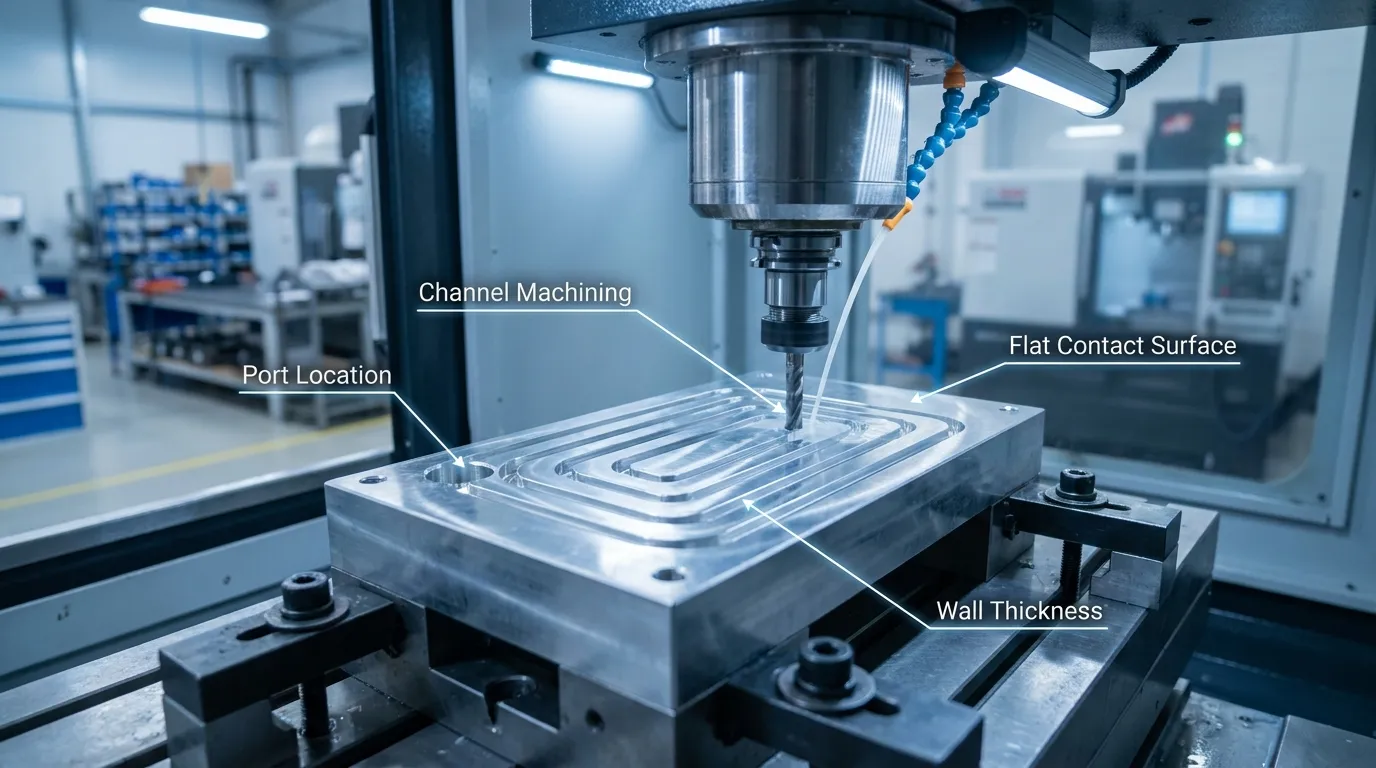
1. Drawing and CAD Review
The process begins with a review of the available engineering information. Buyers should provide a 2D drawing and a 3D CAD model where possible.
The initial review may cover:
- Aluminum specification
- Overall dimensions
- Cooling-channel geometry
- Port and thread details
- Critical tolerances
- Flatness and surface requirements
- Requested finish
- Inspection requirements
- Order quantity
- Prototype or production stage
A 3D model defines the complete geometry, while the 2D drawing should identify tolerances, threads, datums, surface conditions, and inspection requirements that may not be clear from the model alone.
2. DFM and Quotation Review
SunOn reviews the design for manufacturability before preparing a project-specific quotation.
The review may consider tool access, internal corner radii, channel depth, thin walls, port placement, thread requirements, plate rigidity, setup complexity, sealing surfaces, and finishing allowances.
When a feature creates unnecessary machining difficulty, the engineering team may suggest a practical adjustment that preserves the intended function.
3. CNC Machining
After the design and quotation are approved, machining operations are planned according to the part geometry.
A cooling plate project may involve:
- CNC milling
- Pocket and channel machining
- Drilling
- Tapping
- Multi-face setups
- Multi-axis machining where required
SunOn’s precision CNC machining services support custom components produced from buyer drawings, defined tolerances, material specifications, and inspection requirements.
4. Finishing and Secondary Requirements
After machining, the project may include deburring, cleaning, marking, or a requested surface treatment.
Finishing requirements should be defined before production because a coating or treatment may affect critical dimensions, threaded areas, sealing surfaces, or component appearance.
Masking requirements and post-finish dimensions should be clearly identified on the drawing.
5. Inspection and Delivery
Finished parts are inspected against the approved drawing and agreed quality requirements.
Inspection may include critical dimensions, hole positions, threads, surface requirements, flatness, or other defined features. Buyers should state whether they need a dimensional report, material documentation, or another project-specific record.
Packaging and delivery requirements can then be planned according to the component, quantity, and destination.
Cooling Plate DFM Risks to Review Early
Cooling plate designs can appear simple while still containing features that create machining or inspection challenges.
Important risks to review include:
- Very deep or narrow channels
- Sharp internal corners that standard cutting tools cannot reproduce
- Thin walls between adjacent channels
- Large, thin plates that may move during machining
- Tight flatness requirements across non-functional areas
- Threads positioned too close to channels or plate edges
- Features with insufficient cutting-tool access
- Poorly defined sealing surfaces
- Finishing requirements without dimensional allowance
- Missing pressure or leak-test specifications
- Tight tolerances applied to non-critical dimensions
- Unclear datums or inspection references
Early DFM review helps identify these issues before material is machined. It can also reduce unnecessary setups, inspection difficulty, and design revisions.
Prototype and Production-Stage Support
CNC machining is often practical for aluminum cooling plate prototypes because it does not require dedicated production tooling. Buyers can use machined samples to check dimensions, equipment fit, port positions, assembly conditions, and general design suitability.
SunOn’s custom CNC machining for prototyping supports drawing-based parts for functional testing and design validation.
After prototype approval, CNC machining may continue to support low-volume requirements. When quantities increase, SunOn can review the geometry, annual demand, quality requirements, and production goals to determine whether the existing machining plan remains suitable.
The manufacturing process should be selected according to the actual project rather than assuming that one method is appropriate for every quantity.
Why Work With SunOn for Aluminum Cooling Plate Machining?
SunOn has provided custom manufacturing services since 1997. Its capabilities include product development support, rapid prototyping, precision CNC machining, tooling, molding, die casting, sheet-metal fabrication, finishing, inspection, and assembly.
For aluminum cooling plate projects, this broader manufacturing background can support:
- Engineering-file review
- DFM feedback
- Prototype machining
- Production-stage planning
- Finishing coordination
- Dimensional inspection
- Communication between design and manufacturing teams
SunOn reports a 32,000-square-metre manufacturing facility, more than 1,000 professionals, and quality certifications including ISO 9001, ISO 14001, and IATF 16949. Buyers with certification requirements should confirm which certificates, facilities, and production scopes apply to their specific project.
For stronger technical evaluation, buyers may also request relevant manufacturing photos, inspection examples, factory information, or an online factory review.
What to Send for an Aluminum Cooling Plate Quote
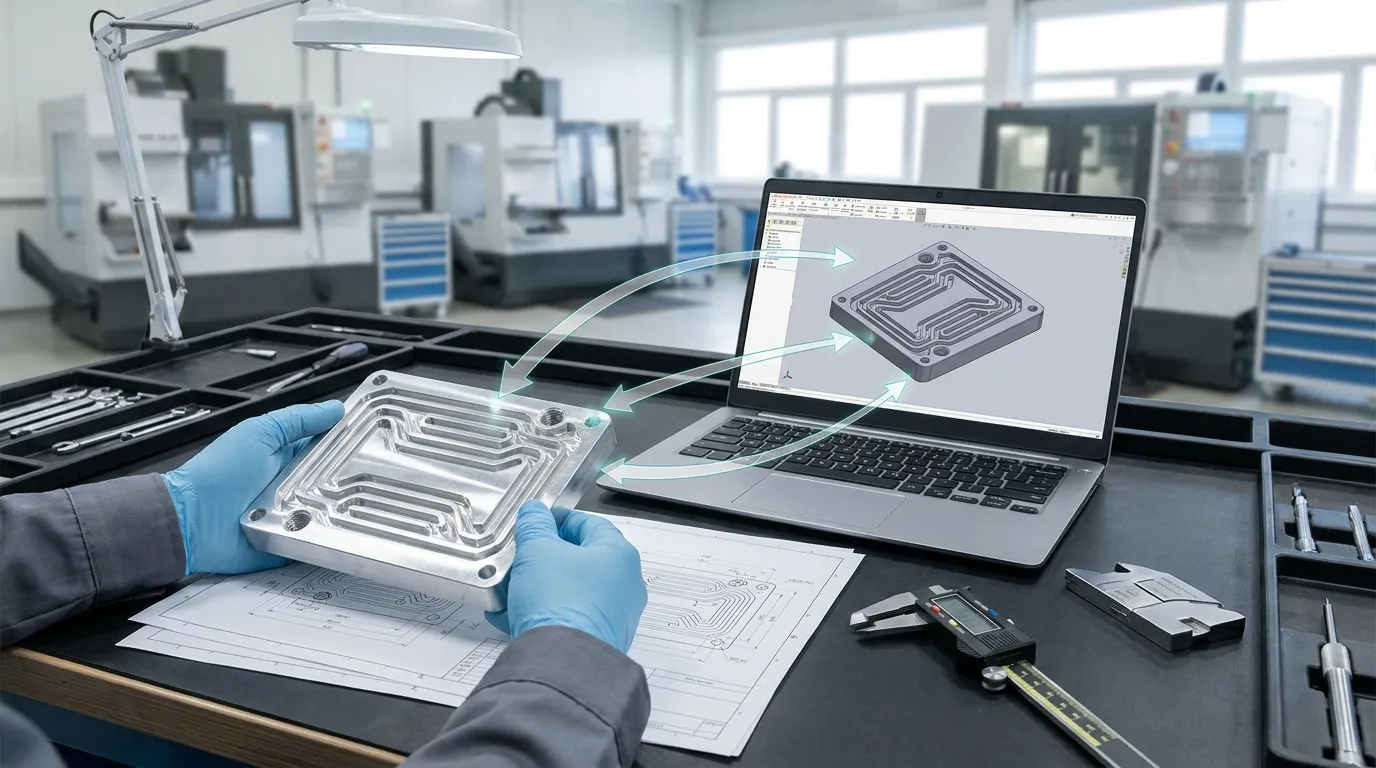
A complete RFQ helps SunOn review the project more accurately and reduces follow-up questions.
Please provide:
- 2D engineering drawing
- 3D CAD model, such as a STEP file
- Required quantity
- Prototype or production stage
- Aluminum grade, if already specified
- Overall plate dimensions
- Cooling-channel or pocket geometry
- Port positions and thread details
- Mounting-hole requirements
- Critical flatness and surface requirements
- Sealing-interface details
- Requested surface finish
- Coolant and operating-environment information where relevant
- Pressure or leak-test requirements, if needed
- Inspection and reporting requirements
- Delivery location
- Target schedule
- NDA or documentation requirements
Critical features should be clearly identified instead of leaving the manufacturer to determine which dimensions affect function.
Frequently Asked Questions
Can SunOn machine custom aluminum cooling plates?
Yes. SunOn can review custom aluminum cooling plate projects based on buyer drawings, CAD models, material requirements, tolerances, quantities, finishes, and inspection needs. Final manufacturability is confirmed after technical review.
What files should I send for a quote?
Send a 2D engineering drawing and a 3D CAD model where possible. Include the quantity, aluminum specification, critical dimensions, finish, channel details, port information, inspection requirements, and project stage.
Can cooling channels and ports be customized?
Yes. Channel paths, pockets, inlet and outlet positions, threaded ports, and mounting features can be manufactured according to the submitted design, subject to machining access and DFM review.
Can SunOn help with an aluminum cooling plate prototype?
Yes. CNC machining can support functional prototypes and design validation without dedicated production tooling. SunOn can review the design, manufacture the prototype, and discuss later production requirements.
Can I request specific flatness and surface requirements?
Yes. Clearly identify the functional contact areas, sealing surfaces, flatness tolerances, roughness requirements, and inspection method on the drawing. SunOn will review whether the requirements are practical for the design and manufacturing process.
Does SunOn provide pressure or leak testing?
Include the required test pressure, test medium, test duration, acceptance criteria, and reporting requirements in the RFQ. SunOn must review and confirm the applicable testing scope before quotation.
Can SunOn recommend an aluminum alloy?
SunOn can discuss material requirements based on the application, environment, finish, mechanical needs, and production plan. The final aluminum grade should be confirmed through the engineering drawing and project review.
Send SunOn your aluminum cooling plate drawing, 3D CAD file, quantity, material specification, finish, critical dimensions, and inspection requirements. Request an Aluminum Cooling Plate Quote and upload your drawings for DFM review.
