


CNC Machined Liquid Cooling Heat Sinks | Precision Manufacturing at SunOn
SunOn manufactures custom CNC machined liquid cooling heat sinks from customer drawings for prototypes, design validation, pilot production, and lower-volume projects. CNC machining is a practical choice when a component requires precise cooling features, flat thermal-contact surfaces, custom ports, threaded holes, or frequent engineering changes without investing in production tooling.
Send your 2D drawings, 3D models, required material, quantity, and critical specifications to SunOn for a DFM review and quotation.
Custom CNC Machined Liquid Cooling Heat Sinks from SunOn
SunOn produces custom liquid-cooled heat sinks based on the customer’s design rather than supplying a fixed standard product. Our engineering team reviews the part geometry, machining access, material, tolerances, cooling features, surface requirements, and expected production quantity before manufacturing begins.
Depending on the design, we can evaluate features such as:
- Machined cooling channels and cavities
- External fins or heat-dissipation surfaces
- Flat thermal-contact areas
- Inlet and outlet port geometry
- Mounting holes and threaded features
- Alignment points, bosses, and pockets
- Equipment-specific clearances
- Custom external dimensions
- Surface finishing requirements
- Critical-dimension inspection
Manufacturability depends on the complete geometry. Channel depth, internal corner radii, wall thickness, tool access, and sealing requirements must be reviewed from the actual CAD model and drawing.
| Requirement | SunOn Manufacturing Scope |
|---|---|
| Design input | Customer 2D drawings, 3D models, and technical specifications |
| Primary process | CNC milling, drilling, tapping, and precision surface machining |
| Typical material focus | Aluminum, with other materials reviewed by project |
| Quantity | Prototypes, pilot runs, and lower-volume production |
| Surface treatment | Anodizing, plating, polishing, painting, or coating where suitable |
| Inspection | Critical-dimension checks, CMM inspection, and available reports |
| Customization | Manufactured to customer drawings rather than standard stock dimensions |
For a broader overview of heat-sink types and production methods, see our guide to heat sink types and manufacturing methods.
When CNC Machining Is the Right Manufacturing Route
Prototype and Engineering Validation
CNC machining allows engineers to produce functional metal parts before committing to a mold or die. The machined component can be used to check fit, mounting positions, coolant connections, thermal-contact areas, and overall system integration.
When test results lead to a design change, the CAD model and machining program can usually be updated without modifying expensive production tooling.
Low-Volume or Uncertain Demand
For prototypes, pilot production, replacement components, or products with uncertain annual demand, CNC machining may offer a more practical starting point than die casting.
There is no requirement to amortize a dedicated production mold across a large number of parts. Buyers can order smaller quantities while validating the product and market demand.
Designs That May Change
Cooling products often go through several revisions during development. Port positions, mounting holes, channel geometry, external clearances, or thermal-interface dimensions may need to change after testing.
CNC machining supports these revisions more easily than a tooling-dependent process. This flexibility reduces the risk of investing in a mold before the design is stable.
Tight-Tolerance Custom Features
CNC machining is suitable for components that require controlled mounting surfaces, hole positions, threads, alignment features, pockets, and other drawing-defined dimensions.
Not every feature needs the same tolerance. SunOn’s DFM review helps separate critical dimensions from general dimensions so unnecessary machining and inspection costs can be avoided.
Projects Requiring No Mold Investment
A CNC-machined heat sink is produced directly from metal stock. This removes the initial mold-development stage and makes CNC machining suitable for development projects, specialized equipment, and lower-volume requirements.
CNC does not always provide the lowest unit cost. Its main advantage is flexibility, precision, and reduced tooling commitment during the early or uncertain stages of a project.
CNC Machining vs. Die Casting for Liquid-Cooled Heat Sinks
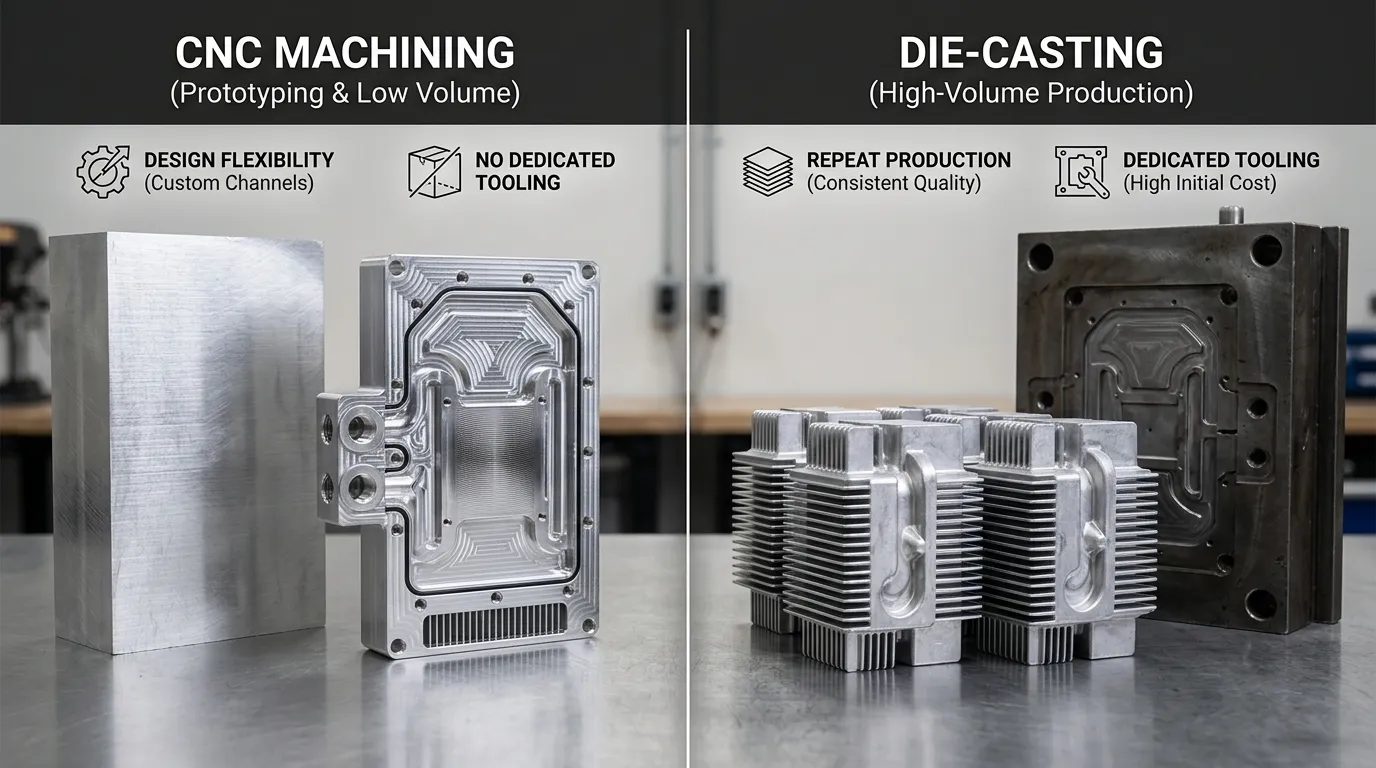
CNC machining and die casting solve different manufacturing problems. CNC is generally better suited to changing designs, prototypes, and lower quantities. Die casting becomes more attractive when the design is stable and production volume can justify the tooling investment.
| Decision Factor | CNC Machining | Die Casting |
|---|---|---|
| Initial tooling | No dedicated production mold normally required | Requires production tooling |
| Design changes | Relatively easy to revise | Tool modifications can be costly |
| Prototype suitability | Strong fit | Full tooling is usually less practical |
| Lower-volume production | Commonly suitable | Economics depend on tooling and order volume |
| High-volume unit economics | Usually less favorable | Often stronger after tooling is amortized |
| Precision surfaces | Machined directly | May require secondary CNC machining |
| Complex repeat geometry | Limited by tool access and machining time | Suitable for repeatable near-net-shape parts |
| Production stage | Development, pilot runs, and selected production | Stable, repeat high-volume programs |
SunOn’s existing die cast heat sink manufacturing page explains how casting supports repeat production and why secondary CNC machining may still be required for flat thermal interfaces, holes, threads, or other precision features.
CNC First, Die Casting Later
A project does not always need to use one process for its entire lifecycle. A practical development route may include:
- CNC machining the first functional prototypes
- Testing fit, coolant connections, and thermal performance
- Revising the design based on test results
- Confirming expected production demand
- Evaluating die-casting tooling after the design is stable
- Retaining CNC machining for critical secondary features
This approach allows the engineering team to validate the component before making a larger tooling commitment.
SunOn’s CNC Manufacturing Process
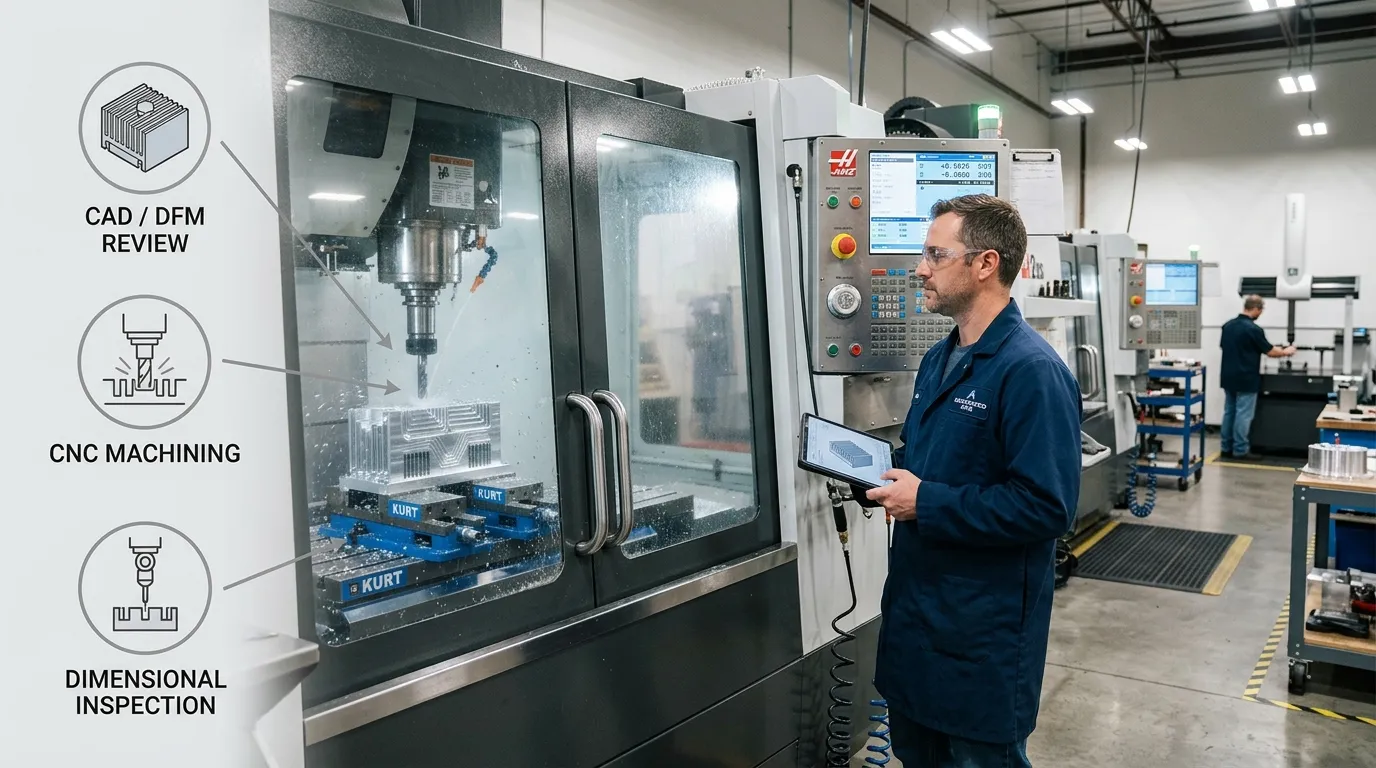
1. Drawing and Requirement Review
The process begins with the customer’s 2D drawing, 3D CAD model, material requirement, quantity, and application specifications.
SunOn reviews critical tolerances, thermal-contact areas, cooling-path geometry, mounting features, ports, surface finish, and inspection requirements.
2. DFM and Cost-Risk Review
The DFM review identifies features that may affect machining difficulty, cost, or dimensional stability. These may include:
- Deep or narrow channels
- Small internal corner radii
- Thin walls
- Limited cutting-tool access
- Multiple machining orientations
- Difficult workholding areas
- Large amounts of material removal
- Tight tolerances applied to non-critical features
Where necessary, the engineering team can recommend practical geometry adjustments before production.
3. Material and Stock Preparation
The selected material is prepared according to the approved dimensions and production plan. Aluminum is commonly considered because it provides a useful balance of machinability, weight, corrosion behavior, cost, and thermal performance.
Other materials can be reviewed according to the drawing, operating environment, and purchasing requirements.
4. CAM Programming and CNC Setup
The approved CAD model is converted into machining operations. Toolpaths, cutting tools, fixtures, workholding, and machining sequences are planned according to the component geometry.
Complex parts may require several setups or multi-axis machining to reach features from different directions.
5. Milling, Drilling, Tapping, and Precision Surfacing
CNC milling is used to create the main external geometry, pockets, channels, cavities, fins, and mounting features.
Drilling and tapping operations produce holes, threads, and port-related features. Precision surfacing may be applied to thermal-contact areas or other interfaces identified as critical in the drawing.
6. Deburring, Cleaning, and Surface Treatment
After machining, accessible edges and features are deburred. The part is cleaned and prepared for any specified surface treatment.
Available finishing options depend on the material, component geometry, and operating environment. Anodizing, plating, polishing, painting, or coating must be confirmed during quotation.
7. Dimensional Inspection and Delivery
Critical dimensions are inspected against the approved drawing. Depending on the project, inspection may include calipers, gauges, CMM equipment, surface checks, and dimensional reports.
Parts are then packaged according to the project and delivery requirements.
Design Information Needed for an Accurate Quote
A complete RFQ helps SunOn evaluate machinability, production cost, and inspection requirements accurately.
Please provide:
- 2D manufacturing drawing
- 3D CAD model
- Preferred material
- Prototype quantity
- Expected repeat or annual quantity
- Overall component dimensions
- Cooling-channel or cavity geometry
- Heat-source location
- Thermal-contact surface requirements
- Critical dimensions and tolerances
- Surface roughness requirements
- Inlet and outlet configuration
- Coolant type
- Expected flow conditions
- Operating pressure
- Sealing or assembly requirements
- Requested surface finish
- Inspection and reporting requirements
- Delivery destination and required schedule
Pressure, sealing, joining, internal cleaning, and leak-testing requirements should be stated clearly. These operations are not automatically included with standard CNC machining and must be confirmed for the specific project.
Design Factors That Affect CNC Machining Cost and Feasibility
CNC machining cost depends on more than the overall size of the heat sink. Important factors include:
- Total amount of material removed
- Number of machining setups
- Deep or narrow cooling channels
- Small-diameter cutting tools
- Tight internal corner radii
- Thin walls and long fins
- Hard-to-reach features
- High flatness or surface-finish requirements
- Tight tolerances across the entire part
- Material type
- Complex inspection requirements
- Order quantity
Applying tight tolerances only where they affect assembly, sealing, alignment, or thermal contact can reduce unnecessary machining time.
Tool access also matters. A channel or cavity that appears simple in a CAD model may require a long cutting tool, several setups, or a geometry change to machine reliably.
Materials and Surface Finishing
Aluminum
Aluminum is commonly used for CNC-machined thermal components because it is relatively lightweight, machinable, and suitable for many heat-transfer applications.
The exact aluminum grade should be selected according to machining requirements, corrosion conditions, mechanical strength, surface treatment, and the liquid-cooling environment.
Other Materials
Other machinable materials may be evaluated when the application requires different thermal, mechanical, weight, or corrosion properties.
Material availability and suitability must be confirmed from the drawing and operating requirements. A material used in a general CNC project is not automatically appropriate for every liquid-cooling system.
Surface Finishes
Possible finishing options may include anodizing, plating, polishing, painting, or coating. The final selection depends on the material, required appearance, corrosion environment, electrical requirements, and coolant exposure.
A surface finish should not be assumed to improve thermal performance or coolant compatibility without application-specific evaluation.
Quality Control for Precision Liquid Cooling Components
SunOn applies inspection during and after CNC machining to verify that the component matches the approved drawing.
Quality-control steps may include:
- Raw-material verification where required
- In-process dimensional checks
- Inspection of critical holes, threads, and interfaces
- CMM measurement
- Flatness and position checks
- Surface and visual inspection
- Drawing revision control
- Final dimensional reports where requested
- Protective packaging before shipment
Product-specific tolerances depend on material, size, geometry, tool access, setup strategy, and measurement method. Exact capability should be confirmed during the DFM and quotation stage.
Typical Applications
Custom CNC-machined liquid cooling heat sinks may be used in:
- Power electronics
- Industrial control equipment
- Telecommunications hardware
- Computing and server systems
- Automotive and new-energy equipment
- Laser equipment
- High-power electronic assemblies
- Custom machinery
Application suitability depends on the complete thermal system, coolant conditions, mounting design, and operating environment.
Why Work with SunOn
SunOn supports custom manufacturing from prototype development through repeat production. Buyers can use one supplier for CNC machining while also evaluating tooling-based production when quantities increase.
Our relevant capabilities include:
- Manufacturing from customer drawings
- DFM and engineering review
- Prototype and lower-volume CNC production
- Multi-axis CNC machining
- Milling, drilling, tapping, and precision surfacing
- Surface-finishing options
- CMM and dimensional inspection
- Die-casting-related manufacturing capability
- International OEM project support
- Company-level quality-management systems
The final manufacturing plan is based on the actual drawing rather than a general promise. Features, tolerances, finishes, inspection requirements, and production quantities are reviewed before quotation.
Request a CNC Machining Quote
Upload your 2D drawing and 3D model and include the required material, quantity, coolant conditions, critical tolerances, surface finish, and inspection requirements.
SunOn’s engineering team will review the design for manufacturability, identify possible cost or machining risks, and prepare a project-specific quotation.
Frequently Asked Questions
What is a CNC-machined liquid cooling heat sink?
It is a custom thermal component produced from solid metal stock using CNC machining. The part may include cooling channels, cavities, ports, mounting features, external fins, and precision thermal-contact surfaces.
When should CNC machining be used instead of die casting?
CNC machining is commonly preferred for prototypes, pilot production, changing designs, lower quantities, and components that require precise custom features without a dedicated production mold.
What files does SunOn need for a quotation?
Provide a 3D CAD model and a 2D manufacturing drawing. The drawing should identify material, critical tolerances, surface finish, quantity, coolant conditions, and inspection requirements.
Can SunOn manufacture prototype quantities?
Yes. CNC machining is suitable for one-off prototypes and small production batches because it normally does not require dedicated die-casting tooling.
Which material is commonly used?
Aluminum is commonly considered because of its machinability, weight, cost, and thermal properties. The correct grade depends on mechanical, corrosion, finishing, and coolant requirements.
Which factors affect CNC machining cost?
Major factors include part size, material removal, setup count, channel depth, wall thickness, tool access, internal radii, tolerances, surface finish, inspection requirements, and order quantity.
Can a CNC-machined design later move to die casting?
Yes, in suitable projects. CNC machining can be used to validate the design before evaluating die-casting tooling for stable, higher-volume production. Some precision features may still require secondary machining.
How are critical dimensions inspected?
Inspection may include calipers, gauges, CMM measurement, visual inspection, and dimensional reports. The exact inspection plan is agreed according to the drawing and quality requirements.
Are surface treatments available?
Surface treatments such as anodizing, plating, polishing, painting, or coating may be available depending on the selected material and application. The required finish should be stated in the RFQ.
Does SunOn provide leak or pressure testing?
Leak testing, pressure testing, sealing, joining, and specialized internal cleaning are project-specific requirements. Include the test conditions and acceptance criteria in your inquiry so SunOn can confirm the available scope.
Send SunOn your 2D drawings, 3D models, material, quantity, coolant conditions, and critical specifications today to receive a DFM review and quotation for your custom CNC machined liquid cooling heat sink.
