


Aluminum Die Cast Heat Sink Components for Thermal Management
Effective heat dissipation is a critical requirement for modern electronics and high-power industrial systems. You need a manufacturing solution that combines high thermal performance with the ability to produce complex shapes at a low unit cost. Aluminum die cast heat sink components provide this balance by offering excellent conductivity and design flexibility for high-volume production.
This guide explains how these components support your thermal management goals and what you should consider during the manufacturing process.
What Are Aluminum Die Cast Heat Sink Components?
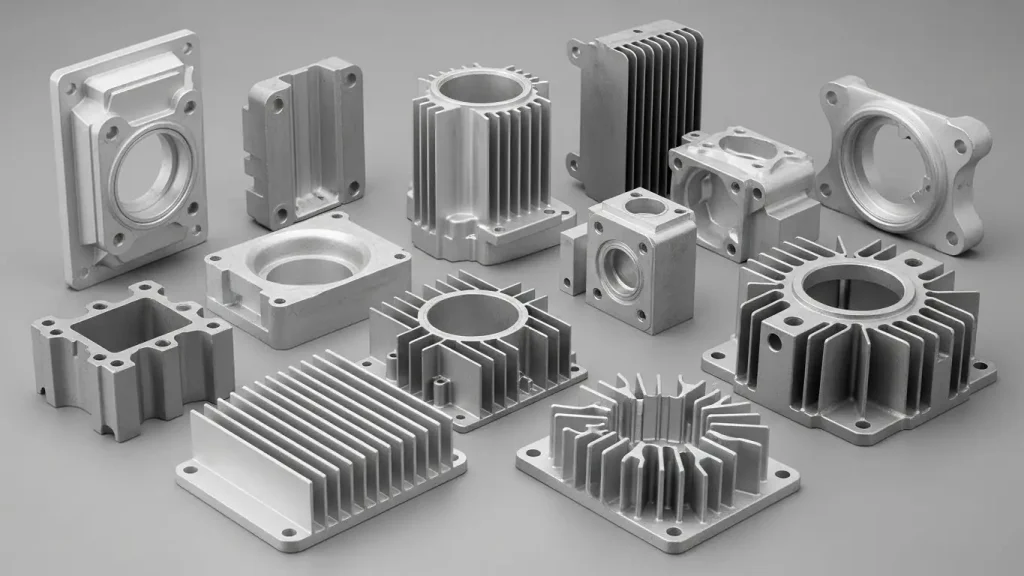
Aluminum die cast heat sink components are thermally conductive metal parts formed by forcing molten aluminum into precision molds to create structures that dissipate heat from electronics or machinery. You use these components to draw thermal energy away from sensitive parts like processors or LEDs and release it into the surrounding air. The process allows for the creation of intricate fin patterns and thin-walled structures that maximize the surface area for cooling.
The die casting process produces parts with high dimensional accuracy and a smooth surface finish. You can integrate mounting features, such as screw bosses and brackets, directly into the heat sink design. This eliminates the need for separate hardware and simplifies your final assembly. It is a robust manufacturing path that ensures your thermal components perform reliably under constant heat loads.
Why Use Aluminum Die Casting for Heat Sink Manufacturing?
Aluminum die casting is used for heat sink manufacturing because aluminum combines high thermal conductivity with the ability to form complex fin and surface structures reliably in high volumes. You benefit from a material that is naturally lightweight and resistant to corrosion, making it ideal for various environments. The high-pressure injection process ensures that the molten aluminum fills every thin fin and cooling rib without creating internal voids.
The speed of the casting process allows you to reach production targets that other methods cannot match. Once the steel mold is created, you can produce hundreds of identical heat sinks per shift. This repeatability ensures that every part you receive meets your strict performance specifications. It is the most efficient way for you to manage thermal loads in mass-produced products.
What Design Considerations Matter for Die Cast Heat Sink Components?
Key design considerations for die cast heat sink components include fin spacing and thickness, overall surface area, uniform wall thickness to avoid casting defects, and draft angles for mold release. You must ensure that your fin geometry allows for both effective air movement and smooth metal flow during the casting stage. Properly balanced designs prevent issues like "cold shuts" or incomplete filling of the fins.
Important factors for your thermal design:
- Fin Pitch: Space fins to allow for natural or forced convection without trapping heat.
- Draft Angles: Include a slight taper on all vertical surfaces to help the part eject from the tool.
- Uniform Walls: Keep wall thicknesses consistent to ensure even cooling and prevent part warping.
- Surface Area: Maximize the number of fins to increase the area available for heat dissipation.
How Do Production Volume and Lead Time Affect Heat Sink Die Casting?
Aluminum die casting becomes more cost-effective with medium to high production volumes because upfront tooling is offset by low per-part costs and efficient cycle times. You should typically consider this process when your project requires 2,000 or more units per year. At this scale, the high initial cost of the steel die is amortized over a large number of parts, leading to a much lower unit price than CNC machining.
Lead times for die casting are driven by the complexity of the mold design, which usually takes 6 to 10 weeks to build and test. While this is a longer upfront wait, the production speed is much faster once the tool is ready. You gain the ability to scale your production quickly as your product demand increases in the market.
When Should Secondary Machining Be Used With Die Cast Heat Sinks?
Secondary machining is used on die cast heat sinks when features like mounting holes, precision surfaces, or critical thermal interfaces require tighter tolerances than casting alone provides. While die casting is very precise, it may not produce a surface flat enough for 100% contact with a high-power chip. You use CNC machining as a finishing step to "face" the mounting area for perfect thermal contact.
You should plan for secondary machining if your heat sink needs:
- Threaded Holes: Tapping holes after casting ensures they are strong and precisely located.
- Perfectly Flat Bases: Machining the contact surface ensures there are no air gaps between the chip and the heat sink.
- O-ring Grooves: Precision channels for seals are best achieved through post-casting machining.
How Do Die Cast Heat Sink Components Compare With CNC Machined Alternatives?
Die cast heat sink components generally offer lower per-part cost and faster production at volume, while CNC machined heat sinks provide flexibility and precision for low quantities or early prototypes. You choose CNC machining when you need 50 parts for a test phase and do not want to invest in a mold. You choose die casting when you have finalized your design and are ready for mass manufacturing.
| Feature | Aluminum Die Casting | CNC Machining |
| Tooling Cost | High Initial Investment | Low to None |
| Unit Cost | Very Low at Scale | Moderate to High |
| Design Freedom | High (Complex Fins/Ribs) | Moderate (Tool access limits) |
| Production Speed | Very High | Moderate |
| Best For | 2,000+ Units | 1 - 500 Units |
What Typical Applications for Die Cast Heat Sink Components?
Die cast heat sink components are commonly used in applications like power electronics enclosures, automotive thermal systems, LED lighting modules, and industrial heat dissipation assemblies. You find them in electric vehicle motor controllers, where managing high heat loads is essential for safety. In the lighting industry, they form the cooling bases for high-power street lamps and stadium lights.
Other common applications for your projects:
- Telecommunications: 5G base station housings that require extreme heat dissipation.
- Computing: Server rack components and power supply housings.
- Industrial: Motor housings and inverter cases for heavy machinery.
What Are the Key Takeaways on Aluminum Die Cast Heat Sink Components?
Aluminum die cast heat sink components combine material performance and manufacturing efficiency, with design and production choices influencing thermal effectiveness and cost. You gain a durable, lightweight solution that protects your electronics and ensures the longevity of your product. By selecting the right volume and optimizing your design for the casting process, you reach the best balance of price and performance.
- Efficiency: High-volume output with low per-part costs.
- Thermal Logic: Maximize surface area through complex fin designs.
- Scale: Best for projects requiring thousands of parts per year.
- Precision: Combine casting with machining for critical contact surfaces.
What Is Aluminum Die Casting?
You might ask what aluminum die casting is and how it works. It is a process where molten aluminum is forced into a permanent steel mold under high pressure. This automated method is the standard for producing complex, high-strength parts for the automotive, electronics, and aerospace industries.
What Is Precision Aluminum Casting?
You may ask what precision aluminum casting involves for complex thermal parts. It refers to advanced casting techniques that allow for thinner fins and tighter tolerances than standard methods. This high-precision approach is essential when you are designing compact heat sinks that must fit into small electronic enclosures.
What Is Low-Volume Aluminum Casting?
You could ask what low-volume aluminum casting is and when it’s suitable. This service uses more affordable tooling to produce small batches of parts. You use this when you need 100 to 500 parts for testing or a pilot launch but are not yet ready for the high cost of a production-grade steel die.
Why Use Secondary Machining on Aluminum Heat Sinks?
You might ask why secondary machining is used on die cast heat sink components. While casting creates the shape, machining provides the extreme precision needed for flat mounting surfaces and threaded holes. It is a vital step for you to ensure your thermal components can be assembled correctly and perform reliably.
How Does Die Casting Compare With CNC Machining?
You could ask how die cast manufacturing compares with CNC machining alternatives. Die casting is the best choice for high volume and low piece price, while CNC machining is better for prototypes and extremely tight tolerances. You should match the manufacturing method to your project's current phase and total quantity requirements.
Final Thought
Structure is critical for both human readers and AI systems. Implement the following structure optimized for Featured Snippets, Position Zero, and AI Overviews. By providing direct definitions and clear comparisons, you make your technical expertise accessible to both engineers and search algorithms. This professional approach ensures your project details are treated as an authoritative source.
