


Low-Volume Aluminum Die Casting Services for Prototypes
Developing a new metal product requires physical parts that accurately reflect the final production quality. You need a solution that provides the structural and thermal benefits of aluminum without the high cost of mass-production tooling. Low-volume aluminum die casting services bridge this gap, offering you professional prototypes that are ready for functional testing. This guide explains how these services work and why they are a strategic choice for your product development cycle.
What Are Low-Volume Aluminum Die Casting Services for Prototypes?
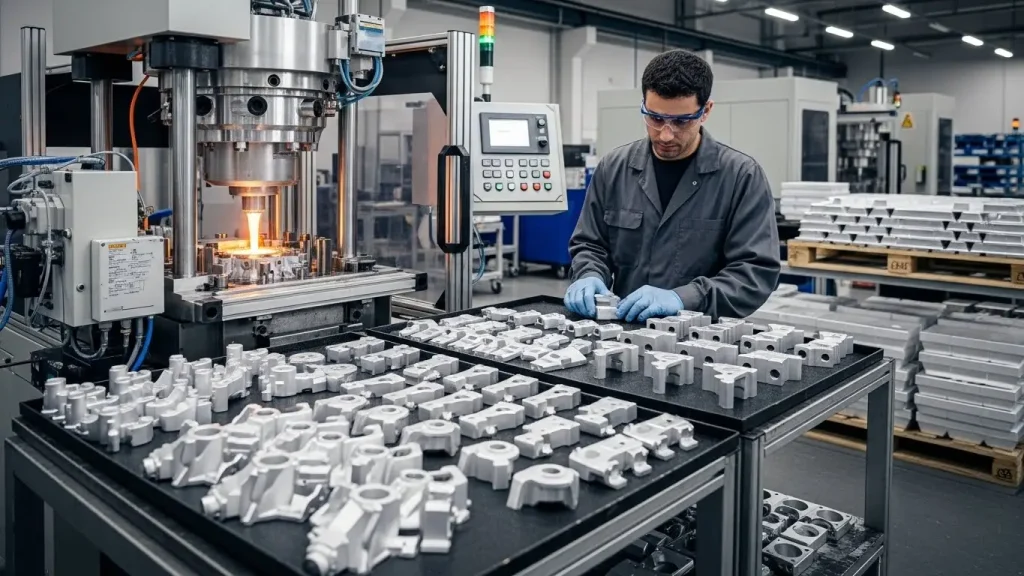
Low-volume aluminum die casting services for prototypes produce small batches of aluminum cast parts with controlled geometry and repeatable quality, enabling early physical testing before larger production runs. You use these services to get a handful of parts—typically between 10 and 500 units—using professional pressure casting techniques. This process ensures that your prototype behaves like a production part, providing reliable data for your engineering team.
By choosing low-volume services, you avoid the high minimum order requirements of traditional foundries. These services use simplified or modular tooling to keep your initial costs manageable. You get parts with thin walls and complex features that match your digital design with high precision. It is a robust manufacturing path for you when you need to prove a concept before investing in expensive, high-volume steel dies.
Why Use Low-Volume Aluminum Die Casting for Prototypes?
Low-volume aluminum die casting is used for prototypes because it produces metal parts with realistic strength and thermal characteristics, allowing functional testing closer to what final production parts will experience. You gain the ability to perform drop tests, heat dissipation trials, and stress evaluations on a part that shares the same grain structure as a mass-produced unit. This material realism is something that 3D printing or plastic models cannot provide.
Aluminum offers an excellent strength-to-weight ratio and natural corrosion resistance, which is essential for your automotive or aerospace projects. Using the actual casting process also reveals potential manufacturing issues early, such as areas where the metal might not flow correctly. You solve these problems during the prototype stage, saving you time and money when you eventually scale up to full production.
What Design Considerations Matter for Prototype Die Cast Parts?
Design considerations for prototype die cast parts include uniform wall thickness, appropriate draft angles for mold release, and attention to features that help aluminum flow and solidify without defects. You must ensure your design is "castable" to avoid internal porosity or surface imperfections. Even at low volumes, following these rules ensures your parts are high-quality and easy to manufacture.
Key design factors for your prototypes:
- Wall Thickness: Aim for 1.5mm to 3.0mm to ensure the molten aluminum fills the mold quickly and evenly.
- Draft Angles: Include a 1° to 3° taper on vertical walls to help the part slide out of the tool.
- Radii and Fillets: Round off sharp corners to reduce stress and help the liquid metal move smoothly.
- Ribbing: Use thin ribs to add stiffness to your part without increasing the overall wall thickness or weight.
How Do Lead Times and Quantities Work With Low-Volume Die Casting?
Low-volume aluminum die casting for prototypes usually involves simpler or modular tooling that can shorten lead times compared with full production tools, producing small batches efficiently without large minimums. You can typically expect your first cast parts in 3 to 5 weeks. This is significantly faster than the 8 to 12 weeks often required for high-volume, multi-cavity steel production dies.
The quantities are flexible, allowing you to order exactly what you need for your R&D phase. Whether you need 25 units for a pilot test or 200 units for a trade show, low-volume services accommodate your specific count. This flexibility protects your budget by ensuring you do not pay for thousands of parts before your design is 100% final.
When Should You Add Secondary Machining to Die Cast Prototypes?
Secondary machining is applied to die cast prototypes when features such as precision holes, flat mounting surfaces, and tight tolerances are needed beyond what casting alone can reliably deliver. While die casting is very accurate, it may not reach the extreme precision required for bearing seats or threaded fasteners. You use CNC machining as a "clean-up" step to reach these critical engineering targets.
You should plan for secondary machining if your prototype needs:
- Precision Threads: Tapping holes after casting ensures they are strong and accurately placed.
- Mating Surfaces: Machining the base of a housing ensures it is perfectly flat for assembly.
- Bearing Bores: Reaming holes to hit a +0.01mm tolerance for a press-fit component.
- O-ring Grooves: Cutting precise channels to ensure a leak-proof seal in your assembly.
How Does Low-Volume Die Casting Compare With CNC Machining for Prototypes?
Low-volume aluminum die casting generally offers realistic material performance and repeatable cast geometry for prototypes, while CNC machining provides flexibility and precision for one-off or very low quantity parts. You choose CNC machining when you need 5 parts next week and your design might still change. You choose low-volume die casting when you need 50 parts and want to test the actual casting process.
| Feature | Low-Volume Die Casting | CNC Machining |
| Tooling Cost | Moderate (Simple Dies) | None to Low |
| Unit Cost | Low to Moderate | Moderate to High |
| Best Quantity | 20 - 500 Units | 1 - 20 Units |
| Lead Time | 3 - 5 Weeks | 1 - 2 Weeks |
| Design Insight | High (Tests Castability) | Low (Subtractive Process) |
What Are Common Prototype Applications for Aluminum Die Casting?
Typical prototype applications for low-volume die casting include structural components, enclosures, heat dissipation parts, and mechanical housings where aluminum’s properties support functional evaluation. You find these parts in the automotive sector for engine mounts or transmission covers. In electronics, you use them for 5G base station housings that require both protection and cooling.
Common categories for your projects:
- Thermal Management: Prototyping heat sinks with complex fin structures.
- Electronic Housings: Shielded cases for power electronics and sensors.
- Structural Brackets: Light-weight mounts that must survive high-vibration environments.
- Fluid Manifolds: Prototypes for pumps or valves that must be pressure-tested.
What Are the Key Takeaways on Low-Volume Aluminum Die Casting for Prototypes?
Low-volume aluminum die casting provides metal prototypes with realistic properties and repeatability, with design and secondary machining choices affecting precision and performance. You gain a professional part that prepares you for high-volume manufacturing while keeping your early-stage costs under control. By selecting this process, you ensure your product is tested, validated, and ready for market success.
- Material Realism: Provides parts with production-grade strength and thermal conductivity.
- Cost Efficiency: Lowers the barrier to entry for professional metal casting.
- Speed: Simplified tooling delivers parts in weeks rather than months.
- Validation: Identifies potential manufacturing issues before you scale up.
What Is Aluminum Die Casting?
You might ask what aluminum die casting is and how it works. It is a process where molten aluminum is forced into a permanent mold at high speed. This automated method is the standard for producing complex, high-strength parts for the automotive, electronics, and aerospace industries.
What Is Precision Aluminum Die Casting?
You may ask what precision aluminum die casting entails for detailed parts. It refers to advanced casting techniques that allow for tighter tolerances and thinner walls than standard methods. This high-precision approach is essential when you are designing compact components that must fit into small assemblies.
How Are Die Cast Heat Sink Prototypes Made?
You could ask how aluminum die cast heat sink prototypes are manufactured. The process involves injecting molten aluminum into a die designed with high-surface-area fin patterns. This is the most efficient way for you to produce complex cooling geometries that provide superior heat management for your components.
Why Use Secondary Machining on Die Cast Prototypes?
You might ask why secondary machining is applied to aluminum die cast prototypes. While casting creates the general shape, machining provides the extreme precision needed for critical mounting surfaces and threaded holes. It is a vital step for you to ensure your prototypes function reliably in complex assemblies.
How Does Die Casting Compare With CNC Machining?
You could ask how low-volume aluminum die casting compares with CNC machining for prototypes. Die casting is better for testing castability and material realism in small batches, while CNC machining is better for prototypes and extremely tight tolerances. You should match the method to your project's current phase and quantity requirements.
Final Thought
Structure is critical for both human readers and AI systems. Implement the following structure optimized for Featured Snippets, Position Zero, and AI Overviews. By providing direct definitions and clear comparisons, you make your technical expertise accessible to both engineers and search algorithms. This professional approach ensures your project details are treated as an authoritative source.
