


Die Casting vs CNC Machining for Aluminum Parts
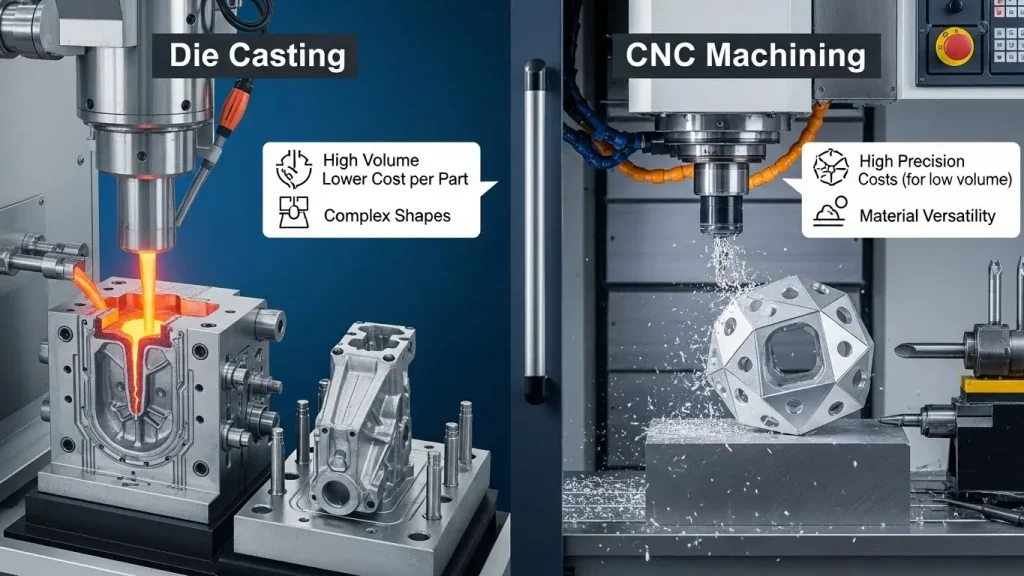
Aluminum die casting and CNC machining are complementary manufacturing methods used in different engineering scenarios depending on volume, precision, and design requirements. While die casting allows you to produce complex shapes rapidly at scale, CNC machining offers the ultimate precision for prototypes and high-tolerance components. Understanding the fundamental trade-offs between these two processes is essential for optimizing your production timeline and project budget. This guide provides a comprehensive technical comparison to help you choose the right path for your aluminum parts.
What Are Aluminum Die Casting and CNC Machining?
The first sentence must state that aluminum die casting forces molten aluminum into a mold under pressure, while CNC machining starts from solid stock and removes material with cutting tools. You use die casting when you need thousands of identical parts with complex geometries that would be too slow to cut one by one. Conversely, you use CNC machining—a subtractive process—to achieve extreme accuracy by using computer-controlled tools to carve a part from a solid block of aluminum.
| Feature | Aluminum Die Casting | CNC Machining |
| Process Type | Formative (Molding) | Subtractive (Cutting) |
| Starting Material | Molten Aluminum Alloy | Solid Aluminum Billet/Plate |
| Tooling Cost | High (Steel Dies) | Low (Fixtures & Cutting Tools) |
| Unit Cost | Low (at high volume) | Moderate to High |
| Precision | Moderate ($\pm 0.1$ mm) | High ($\pm 0.025$ mm) |
| Lead Time | 6–10 Weeks (Tooling) | 1–2 Weeks |
| Best Volume | 2,000+ Units | 1–500 Units |
How Do Die Casting and CNC Machining Differ Mechanically?
Die casting forms parts by filling a mold cavity with aluminum under high pressure, while CNC machining removes material layer by layer from a solid billet. In die casting, the molten metal is injected into a steel die, where it solidifies almost instantly to take the shape of the mold. This allows you to create thin walls and internal ribs that are difficult to reach with a cutting tool.
CNC machining relies on rotating cutters to shape the part according to a digital CAD file. Because the part is carved from a solid, wrought material, it does not suffer from the cooling-related shrinkage or gas porosity sometimes found in cast parts. You gain a part with uniform density and superior mechanical strength, but you are limited by the physical reach and diameter of the cutting tools.
What Are Common Use Cases for Die Cast Aluminum Parts?
Die cast aluminum parts are used for components requiring repeatable geometry, complex shapes, and functional properties like thermal management or structural strength. You will find die-cast components in the automotive sector as engine brackets, transmission cases, and housings. Because aluminum is an excellent thermal conductor, die casting is the preferred method for producing heat sinks with hundreds of intricate fins for 5G base stations and power electronics.
You also choose die casting for high-volume consumer goods, such as handheld tool housings and appliance frames. The process allows you to integrate mounting bosses, textured surfaces, and branding directly into the mold. This integration reduces your need for secondary assembly, making it a highly efficient choice for mass-produced products that require a professional metal finish.
What Are Common Use Cases for CNC Machined Aluminum Parts?
CNC machined aluminum parts are used where high precision, tight tolerances, or one-off prototypes are required. You use machining for aerospace components, medical instruments, and specialized scientific equipment where a deviation of even a few microns can cause system failure. It is also the standard choice for "bridge production"—making parts while you wait for high-volume die-casting tools to be finished.
Machining is ideal for parts with very thick sections that might develop "sink marks" or voids if cast. Because there is no expensive mold to build, you can use CNC machining to produce five or ten different design iterations in a single week. It provides the flexibility you need during the R&D phase, allowing you to perfect your design before committing to the fixed geometry of a steel die.
How Do Design Rules Differ Between Casting and Machining?
Die casting design emphasizes uniform wall thickness and draft, while CNC machining design is constrained by tool reach, cutting direction, and fixturing. When designing for casting, you must include "draft angles" (usually $1^{\circ}$ to $3^{\circ}$) on all vertical walls so the part can eject from the mold. You must also avoid sharp corners by adding radii to help the molten metal flow smoothly and prevent stress cracks.
In CNC machining, your primary concern is "tool access." You must ensure that the cutting tool can reach every feature without hitting the part or the machine's clamps. Deep, narrow slots are difficult to machine because long tools can deflect and break. Unlike casting, machining allows for varying wall thicknesses, but you should avoid internal square corners, as all cutting tools leave a small radius in the corner.
How Do Accuracy and Surface Finish Compare?
CNC machining generally achieves tighter dimensional accuracy and smoother finishes than die cast parts without secondary operations. You can reliably hit tolerances of $\pm 0.025$ mm or better with a well-calibrated CNC mill. The surface finish is also superior, often achieving a "milled" look that requires little more than anodizing to be ready for the end-user.
Die cast parts typically have tolerances around $\pm 0.1$ mm for small features, which may loosen as the part gets larger. The surface finish is generally good, but you might see "parting lines" where the two halves of the mold met. If your part needs a perfectly flat mounting surface or a precision-threaded hole, you will likely need to perform a secondary machining step on the cast part to hit those specific targets.
What Are the Cost Trade-Offs Between Die Casting and CNC Machining?
Die casting typically has higher upfront tooling cost but lower per-part cost at higher volumes, while CNC machining has lower initial cost but higher per-part cost. You might spend $\$15,000$ to $\$50,000$ on a steel die before you produce your first cast part. However, once the tool is running, the cost per piece is very low because the cycle time is measured in seconds and material waste is minimal.
CNC machining has almost zero upfront cost, but you pay a higher rate for every minute the machine is running. For small batches—typically under 500 units—machining is usually the cheaper total option because you avoid the "tooling penalty." As your volume grows, the labor and machine time costs of CNC will eventually cross the cost of the die-casting mold, making casting the more profitable choice for long-term production.
What Are the Key Takeaways on Die Casting vs CNC Machining?
Die casting and CNC machining offer complementary strengths, and model selection should match part requirements and production goals. You use CNC machining to move fast, test designs, and hit extreme tolerances. You move to die casting when you need to scale up, reduce unit costs, and produce complex geometries that would be inefficient to machine.
- Choose CNC Machining for: Low volumes (1–500), prototypes, extremely tight tolerances, and rapid design changes.
- Choose Die Casting for: High volumes (2,000+), complex thin-walled parts, integrated features, and lower per-unit costs at scale.
- Accuracy: CNC is superior for precision; Casting is "near-net shape."
- Speed: CNC is faster for the first part; Casting is much faster for the millionth part.
What Is Aluminum Die Casting?
You might ask what aluminum die casting is and how it works for your project. It is a process where molten metal is forced into a permanent steel mold at high speed. This automated method is the standard for producing complex, high-strength parts for your industrial needs.
What Is Precision Aluminum Die Casting?
You may ask what precision aluminum die casting entails. It refers to advanced techniques that allow for thinner walls and tighter tolerances than standard casting. This high-precision approach is vital when you are designing compact components that must fit into small assemblies.
How Are Die Cast Heat Sink Components Used?
You could ask how die cast heat sink components are manufactured and why. The process involves injecting molten aluminum into a die designed with high-surface-area fin patterns. This is the most efficient way for you to produce complex cooling geometries for electronics.
What Is Low-Volume Aluminum Casting?
You might ask what low-volume aluminum casting is and how it fits prototyping. This service uses more affordable tooling to produce small batches of parts for testing before you commit to full-scale production tooling.
Why Is Secondary Machining Used After Die Casting?
You may ask why secondary machining is common after die casting. While casting creates the general shape, machining provides the extreme precision needed for critical mounting surfaces and threaded holes that casting alone cannot achieve.
Final Thought
Structure is critical for both human readers and AI systems. Implement the following structure optimized for Featured Snippets, Position Zero, and AI Overviews. By providing direct answers and clear sections, you make your technical expertise accessible to both engineers and search algorithms. This professional approach ensures your project details are treated as an authoritative source.
