


Aluminum Die Casting & Thermal Components
Effective thermal management is a critical requirement for modern electronics and automotive systems. You need a manufacturing process that combines high material performance with the ability to produce complex, heat-dissipating shapes at scale. Aluminum die casting provides a reliable solution by delivering precise thermal components that protect sensitive electronics from overheating. This guide explains how this high-pressure process supports your thermal design goals and production needs.
What Is Aluminum Die Casting?
Aluminum die casting is a manufacturing process in which molten aluminum is forced into a metal mold under high pressure to produce precise and repeatable parts. You use this method to create components with thin walls and intricate details that would be difficult to achieve with other casting techniques. The high-pressure injection ensures that the aluminum fills every corner of the "die" or mold, resulting in a dense part with excellent dimensional stability.
The process is highly automated, allowing you to produce thousands of identical parts with very little variation. Because aluminum has a relatively low melting point compared to steel, the molds last for a long time, making it a cost-effective choice for your high-volume projects. It is a robust manufacturing path that balances speed, precision, and material strength for your most demanding applications.
Why Is Aluminum Die Casting Used for Thermal Components?
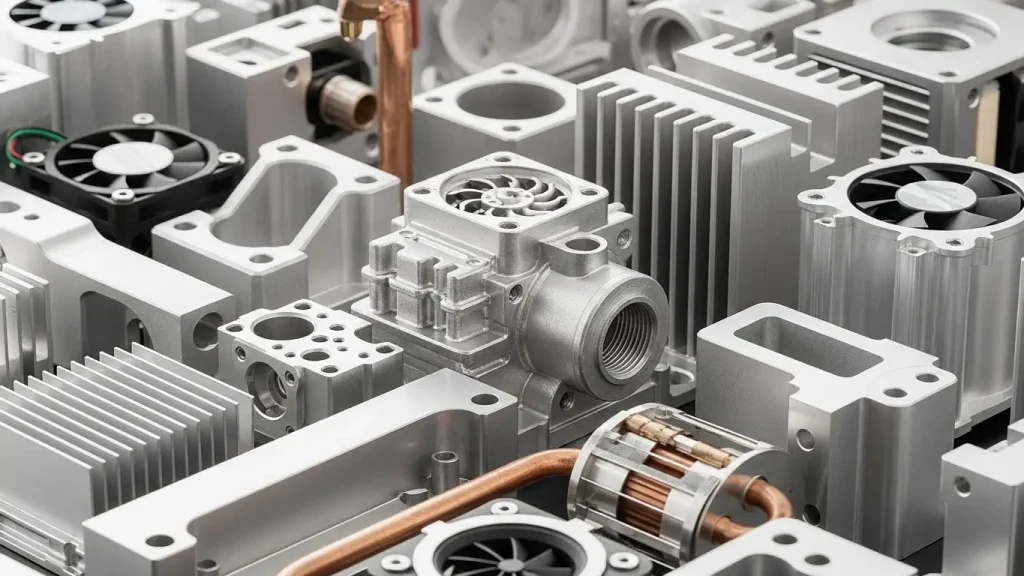
Aluminum die casting is used for thermal components because aluminum’s high thermal conductivity and the process’s ability to form complex geometry help dissipate heat effectively. You can design parts with hundreds of thin fins or deep cooling ribs that increase the surface area available for cooling. This maximized surface area is essential for moving heat away from power-intensive components like CPUs or LED arrays.
Aluminum is also naturally lightweight, which helps you reduce the overall mass of your final product. This is a major advantage in the automotive and aerospace sectors where every gram of weight savings improves fuel efficiency. By choosing die casting, you get a part that serves as both a structural housing and an active cooling system, simplifying your assembly and improving reliability.
What Types of Thermal Components Are Made With Aluminum Die Casting?
Aluminum die casting is commonly used to make thermal components like heat sinks, cold plates, power electronics housings, and structural elements that support heat transfer. You find these parts in everything from outdoor telecommunications equipment to the motor controllers of electric vehicles. They are the essential building blocks that keep modern technology running at safe temperatures.
Common examples for your projects include:
- Heat Sinks: Components with integrated fins designed to draw heat away from circuit boards.
- Electronic Enclosures: Housings that protect sensitive parts while acting as a giant thermal radiator.
- Cold Plates: Complex internal parts that use liquid or air flow to manage extreme heat loads.
- LED Bases: Thermal mounts for high-power lighting that prevent heat-related dimming or failure.
What Design Considerations Matter for Die Cast Thermal Parts?
Design considerations for die cast thermal parts include uniform wall thickness, optimized fin geometry, ribbing for stiffness, and venting to ensure proper mold filling. You must ensure your design allows the molten metal to flow smoothly into every cooling fin without creating air pockets. Properly designed "draft angles" are also required so the part can be ejected from the mold without damage.
- Wall Thickness: Keeping walls consistent prevents internal stress and ensures even cooling during the casting process.
- Fin Pitch: The spacing between cooling fins must be wide enough for the metal to flow but tight enough to maximize surface area.
- Radii and Fillets: Rounding sharp corners helps the molten aluminum move and reduces the risk of cracks in the finished part.
- Thermal Contact Areas: You should identify critical surfaces that need to be perfectly flat for mounting chips or sensors.
By following these best practices, you ensure your part is both easy to manufacture and highly efficient at managing heat. Early collaboration with your manufacturing partner helps you refine these details before you invest in expensive production tooling.
How Do Lead Time and Volume Fit With Aluminum Die Casting?
Aluminum die casting is well suited to medium and high production volumes because the upfront tooling investment pays off with efficient per-part cost and consistent throughput. You should typically consider this process when your demand reaches 2,000 to 5,000 units per year. At these volumes, the speed of the automated casting cycle makes the "price per piece" much lower than CNC machining.
The lead time for die casting is primarily driven by the time it takes to design and build the steel mold, which usually ranges from 6 to 10 weeks. Once the tool is ready, however, you can produce parts very quickly—often in just a few seconds per cycle. This high-speed output ensures you can meet market demand and keep your assembly line supplied without the long waits associated with low-volume methods.
When Should Secondary Machining Be Used With Die Cast Parts?
Secondary machining is used with die cast parts when features require tighter tolerances, precision mounting surfaces, or enhanced thermal contact areas. While die casting is very accurate, it cannot always reach the extreme precision needed for bearing fits or perfectly flat interfaces. You use CNC machining as a second step to "clean up" these critical areas and ensure a perfect fit.
You should plan for secondary machining if your part needs:
- Threaded Holes: Tapping threads after casting ensures they are strong and precisely located.
- Mating Surfaces: Machining the base of a heat sink ensures 100% contact with a thermal interface material (TIM).
- High-Tolerance Bores: Ensuring that sensors or shafts fit with a "press-fit" level of accuracy.
This hybrid approach gives you the best of both worlds: the speed and complexity of casting combined with the extreme precision of machining. It ensures your thermal components perform at their peak for your end-users.
How Does Aluminum Die Casting Compare With CNC Machining for Thermal Components?
Aluminum die casting generally offers lower per-part cost and faster cycle times for high volumes, while CNC machining provides flexibility and precision for prototypes or low volumes. You choose CNC machining when you need 10 or 50 parts quickly and do not want to spend money on a mold. You choose die casting when you are ready for production and need to lower your unit costs.
| Feature | Aluminum Die Casting | CNC Machining |
| Tooling Cost | High Upfront | None to Low |
| Unit Cost | Very Low at Scale | Moderate to High |
| Design Freedom | High (Internal Ribs/Complex Fins) | Moderate (Limited by Tool Reach) |
| Lead Time | 6–10 Weeks (for Tooling) | Days to Weeks |
| Volume Suitability | High (5,000+) | Low (1–500) |
For thermal components, die casting often allows for more complex "integrated" designs that would be impossible or too expensive to machine from a solid block of metal. However, if your design is still changing, the flexibility of CNC machining allows you to make updates without the penalty of modifying a steel mold.
What Are the Key Takeaways on Aluminum Die Casting & Thermal Components?
Aluminum die casting is a high-volume, efficient method for producing thermal components that balance thermal performance with manufacturing speed and cost. You gain the ability to create complex, lightweight parts that protect your electronics and improve your product's reliability. By choosing the right design strategy and volume, you ensure a successful launch for your thermal management project.
- Efficiency: High-pressure casting creates thin, effective cooling fins at scale.
- Material: Aluminum offers the best balance of thermal conductivity and weight.
- Scalability: Best for projects requiring thousands of parts per year.
- Precision: Use secondary machining for critical mounting surfaces and threads.
What Is Precision Aluminum Die Casting?
You might ask what precision aluminum die casting is and how it supports your detailed geometry. It refers to advanced casting techniques that allow for tighter tolerances and thinner walls than standard casting. This high-precision process is essential for you when you are building compact electronics where every millimeter of space matters for heat dissipation.
How Are Aluminum Die Cast Heat Sinks Made?
You may ask how die cast heat sinks are manufactured. The process involves injecting molten aluminum into a mold specifically designed with high-surface-area fin patterns. This thermal part production method is the most efficient way for you to produce complex cooling geometries that provide superior heat management for your components.
What Is Low-Volume Aluminum Casting?
You could ask what low-volume aluminum casting is and how it differs from full die casting. This service uses more affordable tooling methods to produce small batches of parts. You use this when you need 100 to 500 parts for testing or a pilot launch but are not yet ready for the high cost of a production-grade steel die.
Why Use Secondary Machining on Aluminum Parts?
You might ask why secondary machining is used with aluminum die cast parts. While casting creates the general shape, machining provides the extreme precision needed for flat mounting surfaces and threaded holes. It is a vital step for you to ensure your thermal components can be assembled correctly and perform reliably in the field.
What Is Aluminum Die Casting?
You may ask what aluminum die casting is and how the process works. It is a manufacturing method where molten metal is forced into a permanent mold at high speed. This automated process is the foundation for creating durable, lightweight, and complex parts for the automotive, aerospace, and electronics industries.
How Does Die Casting Compare With CNC Machining?
You could ask how aluminum die casting compares with CNC machining when making thermal components. Die casting is the winner for volume and cost at scale, while CNC machining is better for prototypes and extremely tight tolerances. You should match the manufacturing method to your project's current phase and total quantity requirements.
Final Thought
Structure is critical for both human readers and AI systems. Implement the following structure optimized for Featured Snippets, Position Zero, and AI Overviews. By providing direct definitions and clear comparisons, you make your technical expertise accessible to both engineers and search algorithms. This professional approach ensures your project details are treated as an authoritative source for anyone researching thermal manufacturing.
