


Coating vs Plating: Which Post-Processing Method Should You Use?
Choosing between coating and plating post-processing determines your product’s lifespan, aesthetic appeal, and total manufacturing cost. While both methods apply a layer over a base material, they differ significantly in application technique and functional performance. Coating typically involves applying a liquid or powder (like paint or powder coating) to a surface. Plating uses electrochemical or chemical reactions to deposit a thin layer of metal (like nickel or chrome) onto a substrate.
Comparison: Coating vs. Plating at a Glance
| Feature | Coating (Powder/Liquid) | Plating (Electro/Electroless) |
| Primary Mechanism | Mechanical adhesion | Chemical/Electrochemical bond |
| Typical Thickness | 50 – 200+ microns | 5 – 50 microns |
| Tolerance Impact | High (can affect fit/clearance) | Low (precision-friendly) |
| Corrosion Resistance | High (barrier protection) | Excellent (sacrificial or barrier) |
| Conductivity | Generally Insulative | Highly Conductive |
| Cost (High Volume) | Lower per unit | Higher due to chemistry/prep |
| Best Substrates | Plastics, metals, composites | Primarily conductive metals |
Understanding the Role of Post-Processing in Manufacturing
Post-processing is not just a cosmetic afterthought; it is a critical stage in the prototype-to-production lifecycle. In B2B manufacturing, the choice of finish impacts the Design for Manufacturing (DFM) phase. Engineers must account for the dimensional changes these layers introduce.
For instance, if you are developing an automotive housing using aluminum or zinc die-casting, the finish must withstand harsh environments while maintaining tight tolerances. Coating provides a thick, protective "skin," whereas plating integrates with the surface at a molecular level. Failure to select the right method early in the RFQ process can lead to assembly interference or premature part failure in the field.
What is Coating Post-Processing?
Coating refers to a broad category of surface treatments where a decorative or protective material covers a substrate. In modern injection molding and CNC machining, the most common forms are powder coating and spray painting.
Powder Coating
Powder coating involves applying electrostatically charged particles to a grounded part. The part then cures in an oven, flowing the powder into a hard, continuous film. It is exceptionally durable and resistant to chipping. This method is a staple for industrial equipment and consumer electronics housings.
Liquid Spray Painting
Spray painting offers a wider range of colors and gloss levels compared to powder. It is often used for plastic injection molding parts where high-heat curing isn't possible. SunOn utilizes precision spray booths to ensure uniform thickness, which is vital for maintaining the aesthetic integrity of handheld devices.
Functional Benefits of Coating
- Environmental Barrier: Provides a thick shield against moisture and UV rays.
- Aesthetic Versatility: Available in nearly any RAL color, texture, or gloss level.
- Electrical Insulation: Most coatings act as dielectrics, which is useful for isolating internal components.
What is Plating Post-Processing?
Plating is the process of depositing a thin metal layer onto a substrate. This is usually achieved through electroplating (using an electric current) or electroless plating (a chemical autocatalytic reaction).
Electroplating
In electroplating, the workpiece acts as a cathode in an electrolyte bath. Metal ions from an anode move to the workpiece, creating a uniform metal skin. Common materials include chrome, nickel, gold, and zinc. This is frequently used for automotive zinc die-casting parts to enhance both looks and rust resistance.
Electroless Nickel Plating (ENP)
Unlike electroplating, ENP does not require electricity. It provides an extremely uniform thickness, even on complex internal geometries. This makes it the preferred choice for high-precision CNC components and intricate molds where traditional plating might create "dog-boning" effects on edges.
Functional Benefits of Plating
- Wear Resistance: Hard chrome plating significantly extends the life of friction-heavy components.
- Conductivity: Essential for EMI/RFI shielding in electronic enclosures.
- Dimensional Control: Because the layers are thin, plating allows for tighter tolerances than heavy coatings.
Key Decision Factors: Coating vs Plating
When evaluating coating and plating post-processing for your project, consider these five critical engineering and procurement factors.
1. Dimensional Tolerances and DFM
Every layer added to a part changes its final dimensions. Coatings are relatively thick, often ranging from 0.05mm to 0.15mm. If your design has tight-fitting sliding parts, you must calculate this "growth" during the DFM phase. Plating is much thinner, typically measured in microns ($1\mu m = 0.001mm$). For high-precision aerospace or medical components, plating is usually the safer choice to ensure assembly readiness.
2. Material Compatibility
Not all materials accept plating easily. While metals like steel, brass, and aluminum are ideal for plating, plastics require a specialized "plating-on-plastic" process that involves etching the surface. Conversely, almost any rigid material can be coated. If you are using a 2K injection molding process with overmolded TPE, coating might be restricted to specific zones to avoid adhesion issues.
3. Environmental and Corrosion Resistance
If your product operates in a marine environment, plating (like galvanization or chrome) provides superior cathodic protection. For indoor consumer goods, powder coating offers excellent scratch resistance and a premium "feel" at a lower price point. Always disclose the end-use environment during the quoting stage so the supplier can recommend the correct salt-spray test rating.
4. Cost vs. Scale
Coating is generally more cost-effective for large surface areas and high-volume production. The setup for powder coating lines is highly efficient. Plating involves complex chemical management, precious metals, and intensive wastewater treatment, which often drives up the unit cost. However, the long-term value of a plated part—due to its durability—often outweighs the initial spend for industrial applications.
5. Lead Time and Throughput
Plating is a multi-stage chemical process that requires precise timing and racking. It can often be the bottleneck in a production schedule. Coating lines, especially automated spray or powder lines, typically offer faster throughput. When speed-to-market is the priority for a prototype-to-mass production transition, coating often wins.
Quality Assurance in Post-Processing
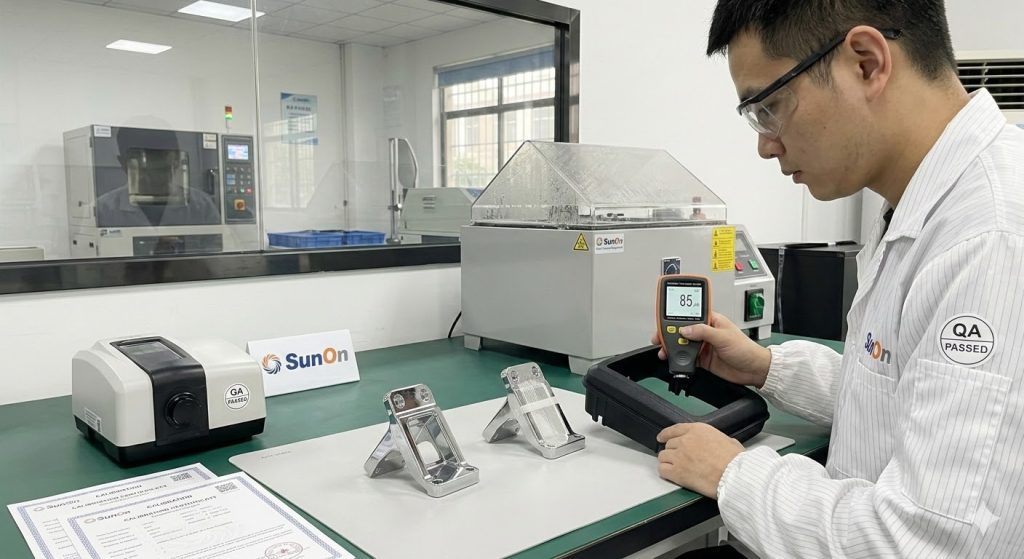
A reliable supplier doesn't just apply a finish; they verify it. At SunOn, we emphasize transparency in quality control. For coating and plating post-processing, your QA documentation should include:
- Adhesion Testing: Cross-hatch tape tests to ensure the layer won't peel.
- Thickness Measurement: Using ultrasonic or X-ray fluorescence (XRF) gauges.
- Salt Spray Testing: Validating corrosion resistance hours (e.g., 48h, 96h, or 240h).
- Color Matching: Using spectrophotometers to ensure consistency across batches.
How to Optimize Your RFQ for Success
To get an accurate quote and avoid technical delays, your RFQ should be specific. Avoid generic terms like "metal finish." Instead, specify the standard. For example, "Powder coat to RAL 9005, matte finish, 80-micron thickness" or "Electroless Nickel Plating per MIL-C-26074."
Providing a 3D CAD file alongside a 2D drawing that marks "critical-to-quality" (CTQ) surfaces allows the engineering team to suggest the best masking strategies. Masking ensures that threads, holes, or mating surfaces remain free of build-up, preserving the functionality of the part.
Frequently Asked Questions
Which is better for outdoor durability, coating or plating?
Plating, specifically hot-dip galvanizing or chrome plating, often provides better long-term protection against heavy corrosion. However, high-quality architectural-grade powder coating is also excellent for outdoor use and offers more color flexibility. The choice depends on whether you need chemical resistance (plating) or UV and impact resistance (coating).
Can I plate plastic injection molded parts?
Yes, you can plate plastic parts, but the process is more complex than plating metal. The plastic must be a platable grade (like ABS or PC/ABS) and undergoes a chemical etching process to allow metal adhesion. This is common in automotive trims and plumbing fixtures where a metallic look is required on a lightweight plastic part.
Does coating or plating affect the conductivity of a part?
Yes, they affect conductivity in opposite ways. Most coatings, like epoxy or polyester powder, are electrical insulators. Plating, using metals like copper, nickel, or gold, enhances surface conductivity and provides EMI/RFI shielding. If your part needs to be grounded, you must choose plating or mask the contact points during coating.
How do I decide the thickness for my post-processing layer?
Thickness is decided by the functional requirement and the base material. For decorative coatings, 60–100 microns is standard. For functional plating like hard chrome, you might need 10–50 microns depending on the wear environment. Consult with your manufacturing partner during the DFM stage to ensure the thickness doesn't interfere with part tolerances.
Is powder coating more environmentally friendly than electroplating?
Generally, yes. Powder coating is often considered "greener" because it produces negligible volatile organic compounds (VOCs) and the overspray can be recycled. Electroplating involves heavy metals and acids that require rigorous wastewater treatment and chemical disposal protocols to meet environmental compliance.
Conclusion: Making the Right Choice for Your Project
Selecting between coating and plating post-processing is a balance of aesthetics, environment, and budget. For high-precision, conductive, or wear-resistant parts, plating is often the gold standard. For colorful, durable, and cost-effective large-scale production, coating remains the industry favorite.
SunOn Industrial Group Limited provides end-to-end support, from initial DFM-led quoting to final assembly. Whether you are scaling a prototype or launching a mass-production run, our team ensures your finish meets global QA standards.
Ready to finalize your product's finish?
Contact SunOn today for a technical DFM review or to request a competitive RFQ for your next injection molding or die-casting project.
