


Custom Liquid Cooling Plates Built to Your Spec | SunOn CNC Manufacturing
SunOn manufactures custom liquid cooling plate components around your drawings, CAD models, mechanical interfaces, and production requirements. Instead of adapting your system to a standard plate, you can specify the dimensions, channel layout, mounting features, ports, materials, tolerances, and surface requirements your application needs.
You can begin with one prototype or a custom low-volume order. There is no fixed minimum order quantity. After the design is validated, SunOn can support the transition from prototype machining to pilot batches and repeat production.
- Made to your dimensions and component layout
- Custom channels, ports, threads, and mounting features
- Prototype and low-volume orders supported
- No fixed minimum order quantity
- DFM review before machining
- Aluminum CNC machining and finishing support
- Dimensional inspection before delivery
- Prototype-to-production manufacturing
Upload your cold plate drawing for a manufacturability review and quotation.
Custom Liquid Cooling Plates for Unique OEM Designs
Standard cold plates may not match the available space, heat-source locations, mounting points, fluid connections, or assembly requirements of a new OEM product. SunOn provides made-to-spec cold plate manufacturing for projects that require a unique mechanical design.
Production is based on your 2D drawings, 3D CAD files, or existing design package. The plate can be manufactured around the shape of your enclosure, electronic assembly, battery module, power device, industrial system, or other equipment.
Depending on the confirmed design and manufacturing route, customizable features may include:
- Overall plate length, width, and thickness
- Internal coolant channel geometry
- Channel width and depth
- Inlet and outlet positions
- Port sizes and thread specifications
- Mounting holes and counterbores
- Threaded assembly features
- Heat-source contact areas
- Sealing surfaces
- Flatness and surface roughness
- Material grade
- Surface finishing
- Critical tolerances
- Inspection and documentation requirements
SunOn reviews these requirements before machining. Features that affect tool access, wall thickness, sealing, dimensional stability, or production repeatability can be identified during the DFM stage.
Start with One Prototype or the Quantity Your Project Needs
A custom cold plate often needs to be physically tested before a larger production order is approved. The first unit may be used to check fit, mounting, fluid connections, flow behavior, sealing, or thermal performance inside the complete system.
SunOn supports custom quantities without requiring a fixed minimum order. You can begin with one CNC-machined prototype, order a small validation batch, or move directly into a planned production quantity when the design is already approved.
This approach is suitable for:
- New product development
- Engineering validation
- Laboratory equipment
- Assembly and interface testing
- Thermal testing
- Pilot production
- Low-volume industrial systems
- Specialized replacement components
- Products with changing design revisions
No minimum order quantity does not mean that a one-piece component will have the same unit cost as a production batch. Custom programming, machine setup, raw material, inspection, finishing, sealing, and testing requirements can create initial project costs. The advantage is that you do not need to commit to a large quantity before confirming the design.
| Project Stage | Typical Requirement | SunOn Support | What You Should Provide |
|---|---|---|---|
| Initial prototype | Check fit, interfaces, channels, and function | DFM review and CNC prototype machining | Current CAD model, drawing, material, and application details |
| Revised prototype | Correct issues found during testing | File review and manufacture of the updated revision | Revised files and clear change notes |
| Pilot batch | Validate repeatability and system integration | Low-volume machining and dimensional inspection | Approved revision and inspection requirements |
| Production | Manufacture the accepted design repeatedly | Controlled machining, finishing, inspection, and packaging | Forecast quantity, batch size, and delivery requirements |
For more information about low-volume design validation, review SunOn’s custom CNC machining for prototyping capabilities.
From Cold Plate Drawing to Production
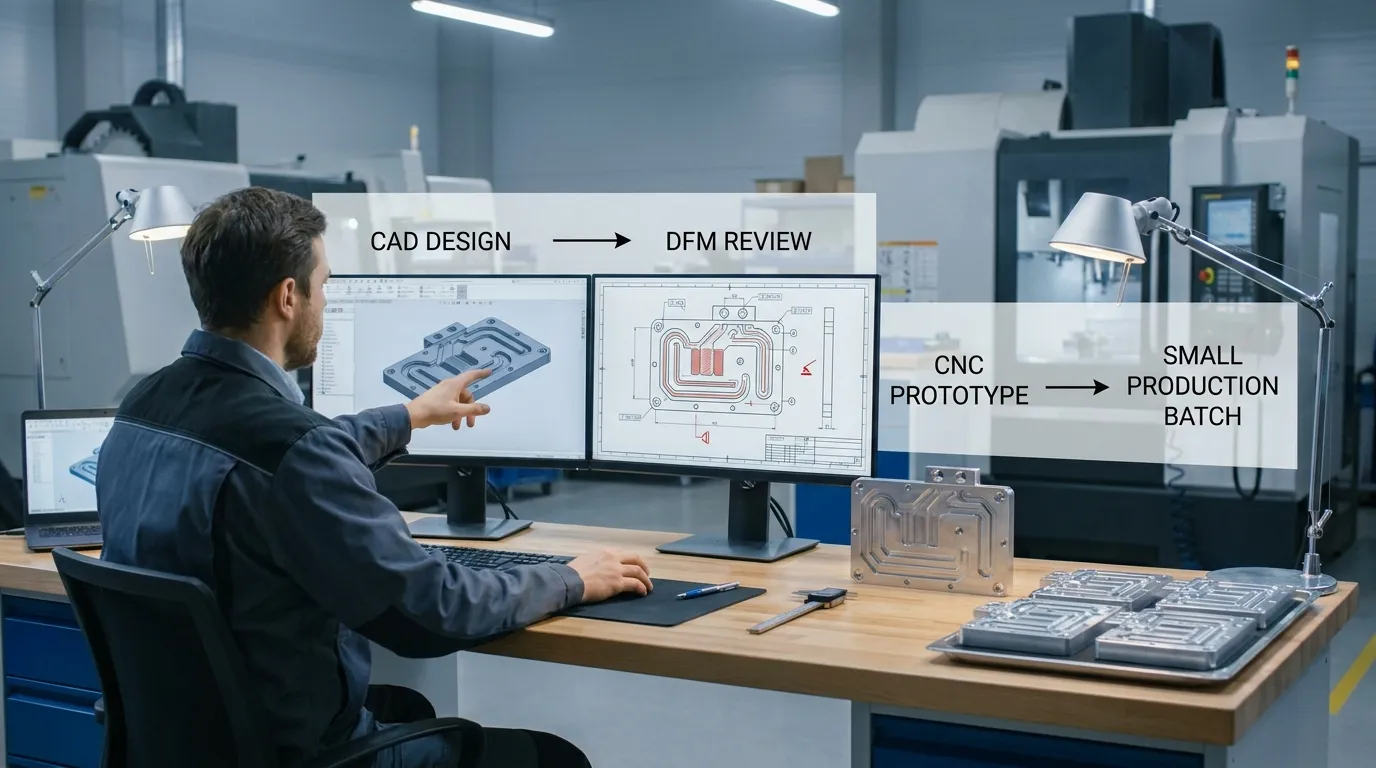
1. Submit the Design Package
A complete technical package helps SunOn evaluate feasibility and prepare a more accurate quotation.
Send:
- 3D CAD model
- 2D manufacturing drawing
- Required quantity
- Material and grade
- Critical dimensions and tolerances
- Port sizes and threads
- Surface finishing requirements
- Inspection requirements
- Application information
- Available thermal and fluid requirements
STEP or STP files can define the geometry, but a 2D drawing is still important. It should identify datums, tolerances, flatness, surface roughness, threads, sealing surfaces, finishes, and other acceptance requirements that may not be clear in the 3D model.
2. Engineering and DFM Review
SunOn reviews the design from a manufacturing perspective before machining begins.
The review may consider:
- Cutting-tool access
- Channel depth and wall thickness
- Deep holes and intersecting passages
- Thread engagement
- Port position
- Sealing surfaces
- Contact-surface flatness
- Tight tolerance concentrations
- Multi-setup alignment
- Deburring access
- Surface finishing allowances
- Joining and sealing requirements
The purpose of DFM is not to change the function of your design. It is to identify features that may increase machining risk, inspection difficulty, cost, or production variation.
SunOn’s precision CNC machining services provide additional information about drawing-based manufacturing, tolerance review, and inspection planning.
3. Confirm the Material and Manufacturing Route
The manufacturing route depends on the plate geometry, material, internal channel design, production quantity, sealing method, and acceptance requirements.
The review should confirm:
- Base material
- CNC milling requirements
- Drilling and tapping operations
- Multi-side or multi-axis machining
- Method used to close the internal flow path
- Surface finishing
- Inspection points
- Functional testing requirements
The joining or sealing method must be agreed upon before production. Do not assume that a particular process, such as vacuum brazing or friction stir welding, is available until it has been confirmed for your project.
4. Machine the Prototype
After the quotation, design review, and production details are approved, SunOn machines the prototype from the controlled drawing revision.
The prototype may include:
- Internal channels
- Pockets
- Mounting features
- Threaded ports
- Contact surfaces
- Sealing faces
- Finishing
- Part identification
- Dimensional inspection
The completed part is then delivered for system-level testing or further validation.
5. Test, Review, and Revise
Depending on the project, the prototype may need to undergo:
- Assembly testing
- Fit verification
- Flow testing
- Pressure testing
- Leak testing
- Thermal testing
- Coolant compatibility evaluation
The quotation and production documents should clearly state which tests SunOn will perform and which tests remain the buyer’s responsibility.
When changes are needed, provide an updated drawing revision and a clear list of modifications. Revision control helps prevent an outdated design from being manufactured during later production.
6. Move into Pilot and Production Manufacturing
Once the prototype is approved, the controlled design can move into a small pilot batch or repeat production.
At this stage, confirm:
- Approved drawing revision
- Batch quantity
- Inspection plan
- Finishing requirements
- Part marking
- Packaging
- Required documentation
- Reorder and forecast requirements
Using the same manufacturing partner from prototype through production can reduce file-transfer errors and preserve the knowledge gained during the first machining and inspection cycle.
CNC Machining Capabilities for Custom Cold Plates
Custom cold plates may require machining on several faces, accurate alignment between features, and controlled contact surfaces. SunOn can review CNC milling, drilling, tapping, pocketing, and multi-side machining requirements based on the supplied design.
Relevant operations may include:
- CNC milling of the plate profile
- Machining internal channels and pockets
- Drilling fluid passages
- Tapping inlet and outlet ports
- Machining mounting holes and counterbores
- Producing sealing faces
- Controlling contact-surface flatness
- Multi-side machining
- Five-axis machining where geometry requires it
- Deburring
- Surface finishing
- Dimensional inspection
Complex geometry does not automatically require five-axis machining. SunOn will evaluate the most practical setup based on feature access, tolerances, quantity, and cost.
Aluminum and Other Material Options
Aluminum Liquid Cooling Plates
Aluminum is often selected for custom liquid cooling plates because it combines relatively low weight, good machinability, useful thermal properties, and access to several finishing options.
The final aluminum grade should be selected according to:
- Thermal requirements
- Mechanical strength
- Weight limits
- Machining requirements
- Coolant compatibility
- Corrosion risk
- Joining method
- Surface finishing
- Availability
- Project budget
SunOn’s aluminum CNC machining services provide further information about machining custom aluminum components and applying appropriate finishes.
Anodizing or another finish may be suitable for certain surfaces, but the treatment of internal wetted channels must be reviewed carefully. Finishing can affect dimensions, sealing surfaces, corrosion behavior, and coolant contact.
Copper and Other Materials
Copper may be considered when higher thermal conductivity is required, while stainless steel or other materials may be selected for specific mechanical, fluid, or environmental conditions.
Material selection should consider the complete wetted fluid path, not only the cold plate. Different metals in the same cooling loop can increase galvanic corrosion risk when the coolant and operating conditions are not properly controlled.
Copper or other material options should be confirmed with SunOn before the design is finalized.
What to Include in Your Custom Cold Plate RFQ
The fastest way to receive a useful quotation is to provide both manufacturing files and operating requirements.
| Requirement | Information to Send | Why It Matters |
|---|---|---|
| Geometry | 3D CAD model | Defines the overall shape and internal features |
| Critical specifications | 2D drawing | Defines tolerances, threads, datums, finishes, and inspection points |
| Heat source | Location, size, and heat load | Shows where heat must be removed |
| Thermal target | Maximum acceptable plate or component temperature | Defines the required operating result |
| Coolant | Fluid type and concentration | Affects material and sealing compatibility |
| Flow | Target or available flow rate | Influences channel and system requirements |
| Pressure | Operating pressure and allowable pressure drop | Affects channel and mechanical decisions |
| Ports | Size, thread type, position, and direction | Ensures compatibility with the cooling loop |
| Material | Required grade or performance criteria | Affects machining and final use |
| Contact surface | Flatness and roughness | Affects contact with the heat source or thermal interface material |
| Quantity | Prototype, pilot, and estimated production quantity | Supports process and pricing decisions |
| Finish | Anodizing, plating, or other treatment | Affects dimensions, corrosion, and appearance |
| Validation | Inspection, pressure, leak, flow, or thermal test requirements | Defines acceptance criteria |
| Documentation | Inspection report or material records | Supports supplier and quality approval |
Do not leave critical port threads, sealing faces, flatness requirements, or pressure conditions unspecified. Missing information can delay the quote or create avoidable assembly problems.
Send your CAD files and cold plate requirements for review.
Quality and Inspection for Drawing-Based Cold Plates
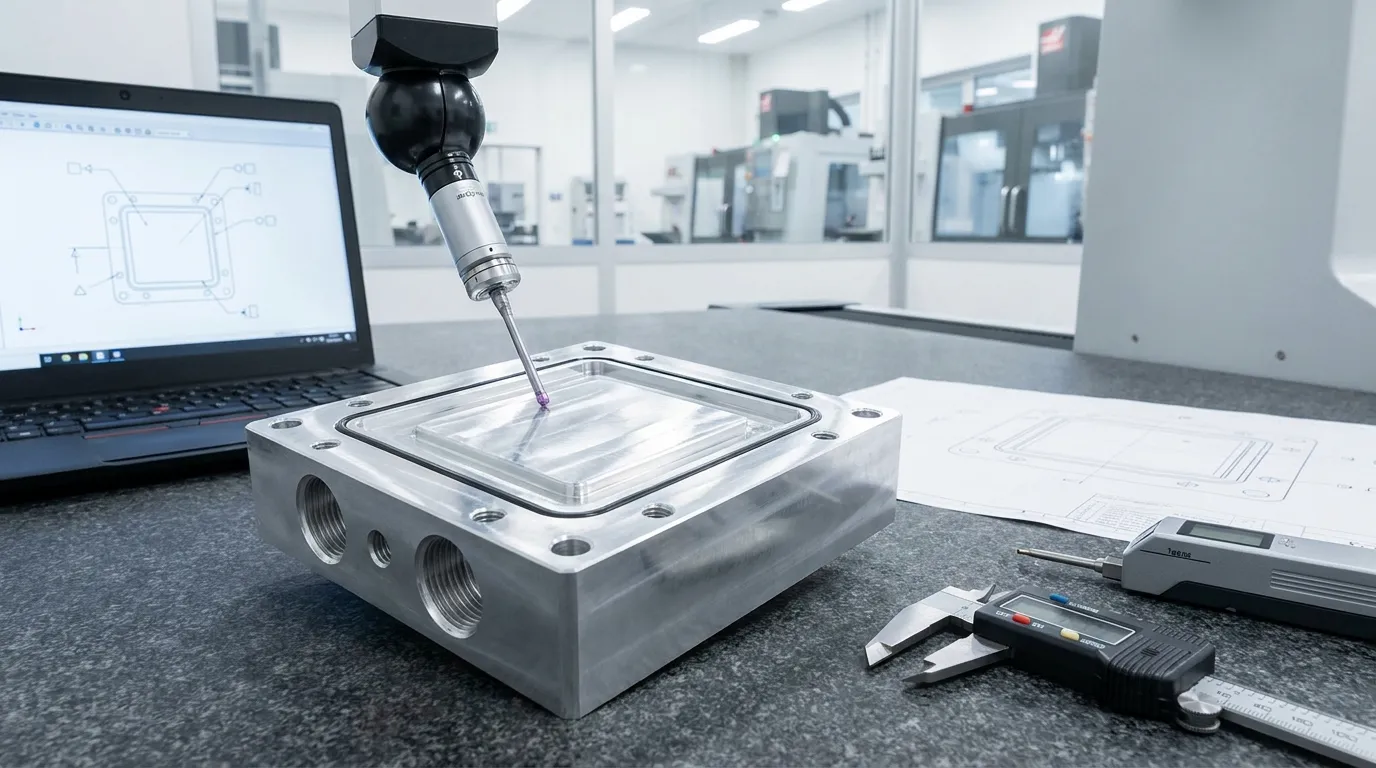
Cold plate quality involves more than checking the external dimensions. The part must match the drawing, fit the assembly, align with the fluid connections, and meet the agreed acceptance requirements.
Depending on the project, quality control may include:
- Raw-material verification
- In-process dimensional checks
- Final dimensional inspection
- CMM inspection where appropriate
- Thread and port inspection
- Flatness measurement
- Surface-finish checks
- Drawing-revision verification
- Inspection reports
- Packaging inspection
Pressure, leak, flow, cleanliness, or thermal testing should be listed separately in the RFQ. Their availability, method, test conditions, and reporting requirements must be confirmed before the order is placed.
For example, a request for “leak testing” should identify the test medium, pressure, hold time, allowable leakage, connection method, and required report. Clear acceptance criteria prevent different interpretations during production.
Why OEM Buyers Work with SunOn
SunOn supports custom manufacturing projects from early prototypes through repeat production. Its broader capabilities include CNC machining, rapid prototyping, surface finishing, inspection, assembly, and other manufacturing services for OEM customers.
For a custom liquid cold plate project, buyers can benefit from:
- Drawing and CAD-based quotation
- DFM review before machining
- Prototype and custom-quantity support
- No fixed minimum order quantity
- Aluminum machining capability
- Multi-process manufacturing support
- Dimensional inspection
- Surface finishing options
- Prototype-to-production continuity
- International OEM manufacturing experience
SunOn operates as a custom manufacturer rather than a seller of standard stocked cold plates. Each project must therefore be reviewed according to its geometry, quantity, material, operating requirements, joining method, and validation plan.
Request a Custom Liquid Cooling Plate Quote
Upload your 2D manufacturing drawing and 3D CAD model. Include the required material, prototype or production quantity, channel layout, port specifications, tolerances, surface finish, coolant, operating pressure, flow requirements, inspection criteria, and target delivery schedule.
SunOn will review the files for manufacturability and prepare a quotation based on the confirmed production requirements.
Frequently Asked Questions
Does SunOn require a minimum order quantity for custom liquid cooling plates?
No fixed minimum order quantity is required. You can request one prototype, a small validation batch, or a larger production quantity. The final quotation will depend on the design, material, setup, inspection, finishing, sealing, and testing requirements.
Can I order one custom cold plate prototype?
Yes. A single CNC-machined prototype can be used to verify dimensions, mounting, port positions, assembly fit, flow-path design, and system performance before a pilot or production order is approved.
What files are required for a quote?
Send a 3D CAD model and a detailed 2D drawing. The drawing should identify material, tolerances, datums, threads, flatness, surface roughness, finish, quantity, inspection requirements, and any critical sealing or contact surfaces.
Can SunOn machine my supplied channel design?
SunOn can review the supplied channel geometry for CNC manufacturability. Tool access, channel dimensions, wall thickness, intersecting passages, sealing requirements, and the method used to close the flow path must be evaluated before production.
Can SunOn help improve manufacturability?
SunOn can provide DFM feedback related to machining access, tolerances, wall thickness, hole depth, threads, setups, finishing, and inspection. Thermal or fluid-design responsibility should be discussed separately when requesting the quote.
Which aluminum grades are available?
The appropriate grade depends on thermal, mechanical, corrosion, finishing, joining, and availability requirements. Include your preferred grade in the RFQ, or provide the performance requirements so available options can be reviewed.
Which joining and sealing methods are supported?
The available method depends on the channel design, material, pressure, quantity, and manufacturing route. Submit the design for review rather than assuming a specific brazing, welding, bonding, tube-embedding, or mechanical-sealing process is available.
Can SunOn provide leak and pressure testing?
Leak and pressure-testing requirements must be confirmed during quotation. Specify the test medium, pressure, hold time, allowable leakage, connection method, and documentation needed so SunOn can evaluate the required test procedure.
Which inspection reports are available?
Dimensional inspection requirements and reporting can be discussed during the RFQ process. Mark all critical dimensions, datums, threads, flatness requirements, and acceptance criteria on the drawing.
Can the same design move into repeat production?
Yes. After the prototype is tested and the drawing revision is approved, the project can move into pilot or repeat production. Controlled files, inspection requirements, finishing specifications, and packaging instructions should be finalized before production begins.
Upload your 2D drawing and 3D CAD model to request a custom liquid cooling plate manufacturability review and quotation from SunOn.
