


How to Test Adhesion in Dual Material Parts
Testing adhesion in dual-material parts involves both qualitative and quantitative methods. Qualitative tests, like the manual peel test, are used to quickly assess the quality and nature of the bond. Quantitative tests, such as a 90-degree peel test using a tensometer, provide precise, numerical data on the bond's strength. A comprehensive validation plan will typically use a combination of both approaches.
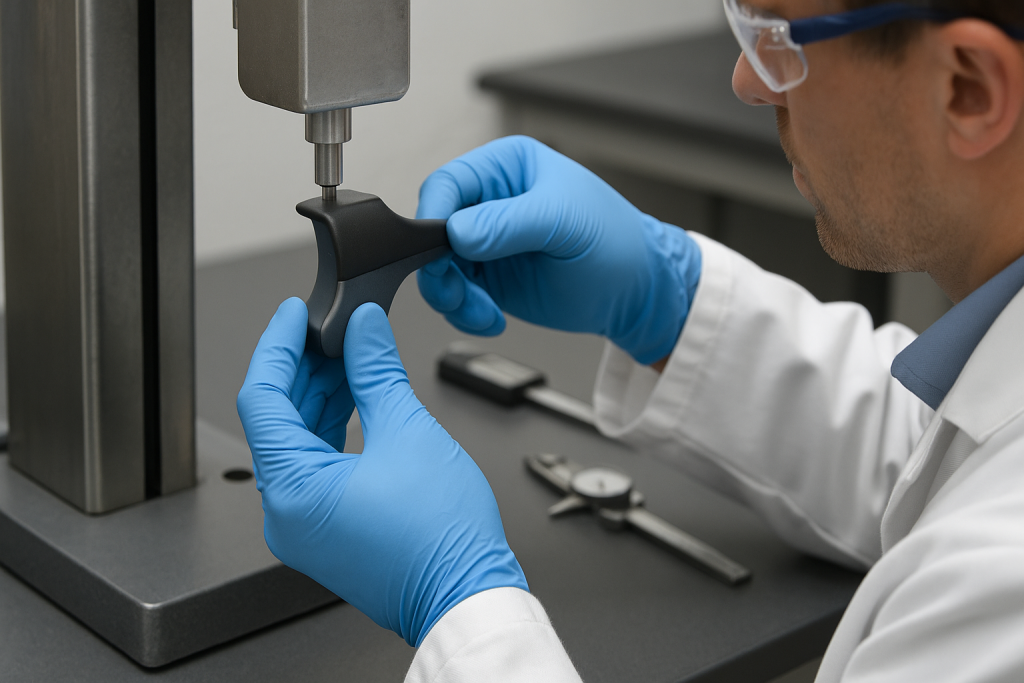
As manufacturers of high-performance 2K components, we consider adhesion testing to be a non-negotiable step in our quality control process. It is the only way to definitively prove that the material bond meets the demands of the application, ensuring product safety, functionality, and longevity. A visually perfect part with a weak bond is a critical failure waiting to happen.
This guide will detail the most common and effective methods for testing bond strength. We will cover everything from simple, manual checks that can be performed on the production floor to the advanced laboratory analysis required for the most demanding applications.
Why is Adhesion Testing So Critical for 2K Parts?
In any dual-material component created through the 2K Injection Molding process, the interface between the two materials is a potential point of failure. The purpose of adhesion testing is to verify and validate the strength and integrity of this interface. This is crucial for several reasons.
First, it is a key part of process qualification. Testing proves that the chosen materials and machine settings are working together to create a robust chemical or mechanical bond. Second, it serves as an ongoing quality control check during production. Regular testing can catch process deviations or issues with raw materials before a large number of defective parts are made.
Finally, for many industries, it is a matter of safety and reliability. Imagine the soft-touch grip on a power tool peeling away during use, or a watertight seal on an electronic device failing due to a poor bond. Adhesion testing provides the documented evidence needed to ensure a part is fit for purpose and to mitigate the risk of product failure in the field.
Qualitative Testing: Fast, Effective, and Essential
Qualitative tests do not provide a numerical strength value. Instead, they assess the nature of the bond. These tests are fast, require minimal equipment, and are incredibly effective for making a quick pass/fail judgment. They are an essential first line of defense in any production environment.
The Manual Peel Test: A First Line of Defense
The simplest and most common adhesion test is the manual peel test. It is a highly effective way to determine if you have achieved a true chemical bond.
The process is straightforward. A technician uses a sharp utility knife to carefully cut a small tab of the overmolded material (typically a soft TPE or TPU). This tab is then gripped firmly with a pair of pliers. The technician then attempts to peel the overmold away from the rigid substrate at a consistent speed and angle. The result is not about how hard it is to pull, but about how it fails.
- Desired Outcome: Cohesive Failure. This is the hallmark of a strong bond. As the material is peeled back, the bond interface itself does not fail. Instead, the overmolded material tears, leaving a thin, hazy layer of itself still permanently bonded to the substrate. This proves that the adhesive force between the two materials is greater than the internal, or cohesive, strength of the overmold material itself.
- Failure Outcome: Adhesive Failure. This indicates a weak or non-existent bond. The overmold material peels away cleanly from the substrate, often with very little effort. The two surfaces separate perfectly at the bond line, leaving the substrate surface clean. This is a clear sign of a process or material compatibility problem.
The Cross-Hatch Adhesion Test (ASTM D3359)
For a more standardized, semi-quantitative approach, the cross-hatch test is often used. This method is borrowed from the coatings industry but is well-suited for testing the adhesion of thin overmolded layers.
First, a lattice pattern is cut through the overmold layer down to the substrate using a special multi-bladed cutting tool. Then, a specified high-strength pressure-sensitive tape is applied firmly over the grid. After a short period, the tape is pulled off rapidly at a specific angle. The grid area is then inspected and rated based on how many squares of the material were lifted off by the tape. The rating is on a scale from 5B (no detachment at all) to 0B (more than 65% of the area detached). This provides a more consistent result than a purely subjective manual peel test. This is a common test for parts like Soft Touch Grips 2K Molding.
Quantitative Testing: When You Need Hard Numbers
For critical applications in the medical, automotive, or electronics industries, a simple pass/fail test is not enough. A precise, numerical value for bond strength is often required. Quantitative tests are performed in a laboratory using specialized equipment to provide objective, repeatable data.
The 90-Degree or 180-Degree Peel Test
This is the most common quantitative test for flexible-on-rigid 2K parts. It is a more controlled and instrumented version of the manual peel test. A specially prepared sample is clamped into a tensometer or a universal testing machine. The flexible overmold layer is then peeled from the rigid substrate at a constant speed and at a fixed angle (typically 90 or 180 degrees).
A highly sensitive load cell in the machine measures the force required to propagate the peel along the bond line. The test provides a graph of force versus displacement, and the average peel force is calculated. The final result is expressed as force per unit of width, such as Newtons per millimeter (N/mm) or pounds-force per inch (lbf/in). This data is invaluable for comparing the bond strength of different 2k injection molding materials or for proving that a part meets a specific engineering requirement.
The Lap Shear Test (ASTM D1002)
When testing the bond between two rigid materials, a peel test is often not possible. In these cases, the lap shear test is used. For this test, two sample strips are molded and bonded together with a specified amount of overlap. These samples are then clamped into a tensometer and pulled apart longitudinally.
The machine measures the maximum force required to shear the two materials apart. The result is typically expressed as shear strength in units of stress, such as megapascals (MPa) or pounds per square inch (PSI). This test is crucial for validating the strength of 2K parts that are designed for structural or load-bearing applications. It's a key consideration when evaluating 2k injection molding vs overmolding for structural parts.
Implementing a Robust Testing Protocol
Effective adhesion testing is not a one-time event; it is an ongoing process. A robust testing protocol should be established that defines when, how, and by whom the tests are performed. The success of the entire 2k injection molding process depends on this disciplined approach to quality.
A Sample Testing Protocol
A well-rounded quality control plan integrates testing at every stage, from development to full production. For a broader context, it is helpful to understand the fundamentals of all injection moulding.
- Step 1: Visual Inspection: Every part should be visually inspected for obvious bonding defects like gaps, lifting edges, or bubbles at the interface.
- Step 2: Manual Peel Test: This should be performed on a specified number of parts at the start of every production run and at regular intervals (e.g., every hour).
- Step 3: Define Acceptance Criteria: The quality plan must clearly and unambiguously state that only "cohesive failure" is acceptable for the manual peel test. A visual standard should be provided for reference.
- Step 4: Quarantine Failures: If any part fails the test, the process must be stopped immediately. All parts produced since the last successful check must be quarantined and inspected.
- Step 5: Advanced Testing: For critical parts, a schedule should be set to send production samples to a lab for quantitative testing (e.g., weekly or monthly) to monitor for any process drift over time.
Final Thought
Adhesion testing is not just a box to check—it is the safeguard that ensures dual-material parts perform as intended in real-world applications. From the quick, qualitative peel test on the production floor to advanced, quantitative laboratory methods, each testing approach serves a vital role in building confidence that bonds are reliable, repeatable, and strong enough for the demands of their application.
A robust testing protocol transforms adhesion from an assumption into a proven fact. By establishing clear acceptance criteria, integrating frequent checks into production, and validating performance with hard data, manufacturers can prevent failures before they occur. Whether the application is structural, cosmetic, or safety-critical, adhesion testing provides the assurance that a 2K molded part will not just look right, but function reliably over its entire lifespan.
In the end, consistent adhesion testing is the foundation of quality in multi-material molding. It protects the integrity of the part, the safety of the end user, and the reputation of the manufacturer.
