


Liquid Cooling Cold Plates: Custom CNC-Machined Manufacturing from SunOn
A liquid cooling cold plate is a metal component with an internal coolant path designed to transfer heat away from an electronic device, battery module, power component, or industrial assembly. For OEM projects, its performance depends not only on the cooling concept but also on accurate channels, ports, mounting features, sealing surfaces, and contact-face dimensions.
SunOn provides custom CNC machining for liquid cooling cold plate components based on customer drawings and 3D CAD files. We support one-piece prototypes, low-volume orders, pilot batches, and production planning without requiring a fixed minimum order quantity.
Our team can review aluminum cold plate designs, internal channels, threaded ports, mounting holes, sealing grooves, surface treatments, and critical dimensional requirements. Joining, sealing, leak testing, pressure testing, and complete assembled cold plate requirements are reviewed individually according to the project specification.
Upload your drawing to request a custom cold plate manufacturing quote.
Custom Liquid Cooling Cold Plate Manufacturing for OEM Projects
SunOn works with OEM engineers, product developers, and procurement teams that need drawing-based cold plate manufacturing rather than a standard off-the-shelf product.
You can provide an existing production drawing, an early prototype design, or a revised CAD model. Our team reviews the geometry, material, tolerances, quantity, finishing requirements, and manufacturing risks before quotation.
What SunOn Can Manufacture From Your Drawing
Depending on the design, SunOn can review and machine features such as:
- External plate geometry
- CNC-milled coolant channels
- Internal pockets and cavities
- Inlet and outlet holes
- Threaded ports
- Mounting holes and counterbores
- Recesses and locating features
- O-ring grooves
- Mating and sealing faces
- Flat contact surfaces
- Features located on multiple sides
- Identification and marking details
The exact manufacturing scope depends on the drawing. A machined open-channel plate may require a cover, bonded assembly, welded closure, mechanical seal, or another specified construction method before it becomes a complete sealed cold plate.
For that reason, the RFQ should clearly state whether SunOn is quoting a machined component, a multi-part assembly, or a complete cold plate with defined sealing and testing requirements.
Prototype, Small-Batch, and Production Support
Cold plate projects often begin with a small number of parts. Engineers may need to confirm mounting positions, fitting orientation, sealing interfaces, assembly clearance, or contact-surface dimensions before approving production.
SunOn’s no-minimum-order model allows buyers to start with:
- One prototype
- Several engineering samples
- A revised prototype
- A small pilot batch
- A repeat production order
After the prototype is evaluated, updated drawings and revision information can be used for the next manufacturing stage. This creates a clearer path from early validation to repeat production without forcing the buyer to commit to a large initial quantity.
This service is suitable when:
- A new cold plate design needs physical validation
- An existing design requires a new manufacturing supplier
- A thermal assembly needs a custom machined plate or base
- A project requires a small batch before production
- The buyer wants one manufacturing partner for several project stages
Send your CAD files to SunOn for a manufacturability review.
What to Send for a Cold Plate Manufacturing Quote
A complete RFQ helps our engineers identify manufacturing risks and prepare a more accurate quotation. The 3D model shows the geometry, while the 2D drawing defines dimensions, tolerances, threads, finishes, and inspection requirements.
| Required Project Input | What to Specify | Why It Is Needed |
|---|---|---|
| 3D CAD model | Complete part and channel geometry | Machining and setup review |
| 2D manufacturing drawing | Dimensions, tolerances, GD&T, threads and finish | Critical requirement control |
| Material | Alloy, grade and temper when known | Material sourcing and machining planning |
| Quantity | Prototype quantity, batch size and estimated annual demand | Process and production planning |
| Channel design | Width, depth, route, radii and transitions | Tool-access and DFM review |
| Ports | Thread type, position, depth and fitting direction | Connection and assembly accuracy |
| Sealing design | O-ring, cover, bonded plate, welded cover or another method | Manufacturing-scope confirmation |
| Flatness | Contact-face and sealing-face requirements | Machining and inspection planning |
| Surface treatment | As-machined, anodized, plated, polished or coated | Finished-dimension review |
| Operating information | Coolant, pressure, temperature and application | Material and testing discussion |
| Testing requirements | Test pressure, medium, hold time and acceptance criteria | Capability and quotation confirmation |
| Delivery details | Destination and required schedule | Production and shipping planning |
When the Design Is Not Final
You can still submit a project for review when the design is at an early stage. Include the information already available, such as:
- Available installation space
- Heat-source or component location
- Mounting requirements
- Intended material
- Port locations
- Expected quantity
- Existing concept or CAD model
- Known critical dimensions
- Required surface treatment
SunOn can review the design from a manufacturing perspective. However, heat-load calculations, coolant selection, pressure-drop targets, channel optimization, and thermal-performance validation should be provided or approved by the buyer unless separate engineering support has been confirmed for the project.
CNC Machining Capabilities Relevant to Cold Plates
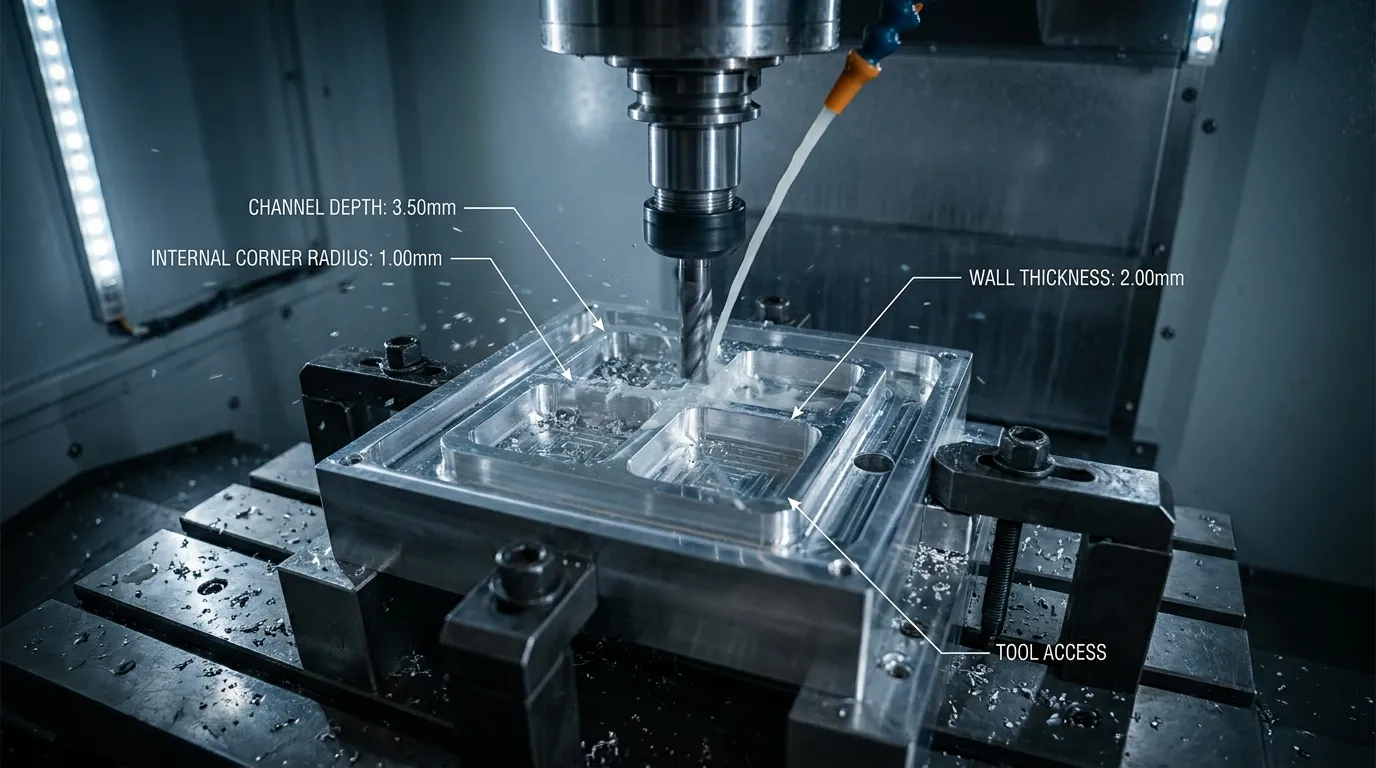
Cold plates commonly contain flat surfaces, internal channels, threaded ports, sealing features, and mounting interfaces. Producing these features may require several CNC operations and controlled relationships between multiple surfaces.
CNC Milling for Plates, Channels, and Pockets
CNC milling can be used to produce:
- Flat plate profiles
- Open coolant channels
- Internal pockets
- Recessed areas
- Mounting surfaces
- O-ring grooves
- Cover interfaces
- Sealing faces
- Controlled internal corner radii
Channel width, channel depth, corner geometry, tool reach, and minimum wall thickness must be reviewed together. Very deep channels, narrow passages, sharp internal corners, or thin walls may require design changes or a different manufacturing approach.
Drilling and Tapping for Ports and Assembly Features
Drilling and tapping operations may be required for:
- Coolant inlet and outlet ports
- Threaded fitting connections
- Mounting holes
- Fastener locations
- Counterbores
- Locating features
- Threaded inserts
Port thread, depth, orientation, and position should be clearly identified on the drawing. The buyer should also define how each fitting seals and whether the final port position must align with tubing, manifolds, or nearby components.
Multi-Axis Machining for Complex Geometry
Multi-axis CNC machining may be useful when a liquid cooling cold plate includes angled ports, features on several faces, complex external geometry, or dimensions that must remain aligned across different setups.
Not every part requires 5-axis machining. The process should be selected according to the actual geometry, tolerance relationships, quantity, and inspection requirements.
DFM Review Before Production
A cold plate design may look complete in CAD but still create avoidable machining risks. SunOn reviews relevant manufacturing details before production, including:
- Channel depth and tool access
- Minimum wall thickness
- Internal corner radii
- Thin areas that may distort
- Port-to-channel relationships
- O-ring groove geometry
- Clamping and workholding surfaces
- Number of machining setups
- Tolerance requirements
- Finishing allowance
- Inspection access
For projects with demanding dimensions, our precision CNC machining services page provides additional information about drawings, tolerances, finishing, and inspection planning.
Material and Surface-Finish Options
The correct material depends on the approved design, operating environment, coolant, weight target, corrosion considerations, joining method, and production quantity.
Aluminum Cold Plates
Aluminum is commonly considered for machined cold plate components because it combines relatively low weight with good machinability. The buyer should specify the required alloy and temper whenever these are already defined by the product design.
Material selection should also consider:
- Availability
- Corrosion exposure
- Coolant compatibility
- Joining method
- Structural requirements
- Surface-treatment needs
- Finished dimensions
- Inspection requirements
SunOn can review the drawing and material specification through its aluminum CNC machining services.
No single aluminum grade is automatically suitable for every cold plate. The final choice should follow the product’s engineering requirements rather than a general material recommendation.
Copper and Other Materials
Copper or other machinable materials may also be considered when required by the design. Feasibility depends on the grade, component dimensions, feature complexity, material availability, surface requirements, and order quantity.
Buyers requesting a copper cold plate should submit the complete drawing for project-specific review. Copper manufacturing capability, finishing, assembly, and testing requirements should be confirmed before an order is placed.
Finishing and Post-Processing
Available post-processing may include:
- As-machined surfaces
- Deburring
- Polishing
- Anodizing
- Plating
- Painting
- Project-specific coating
- Masking of selected areas
Surface treatment can change final dimensions, edge conditions, hole sizes, and sealing interfaces. Critical dimensions should therefore be identified as either pre-finish or post-finish requirements.
A finish should not be selected only for appearance. Coolant exposure, electrical requirements, corrosion risk, assembly interfaces, and sealing surfaces should also be considered.
From One Prototype to Full Production
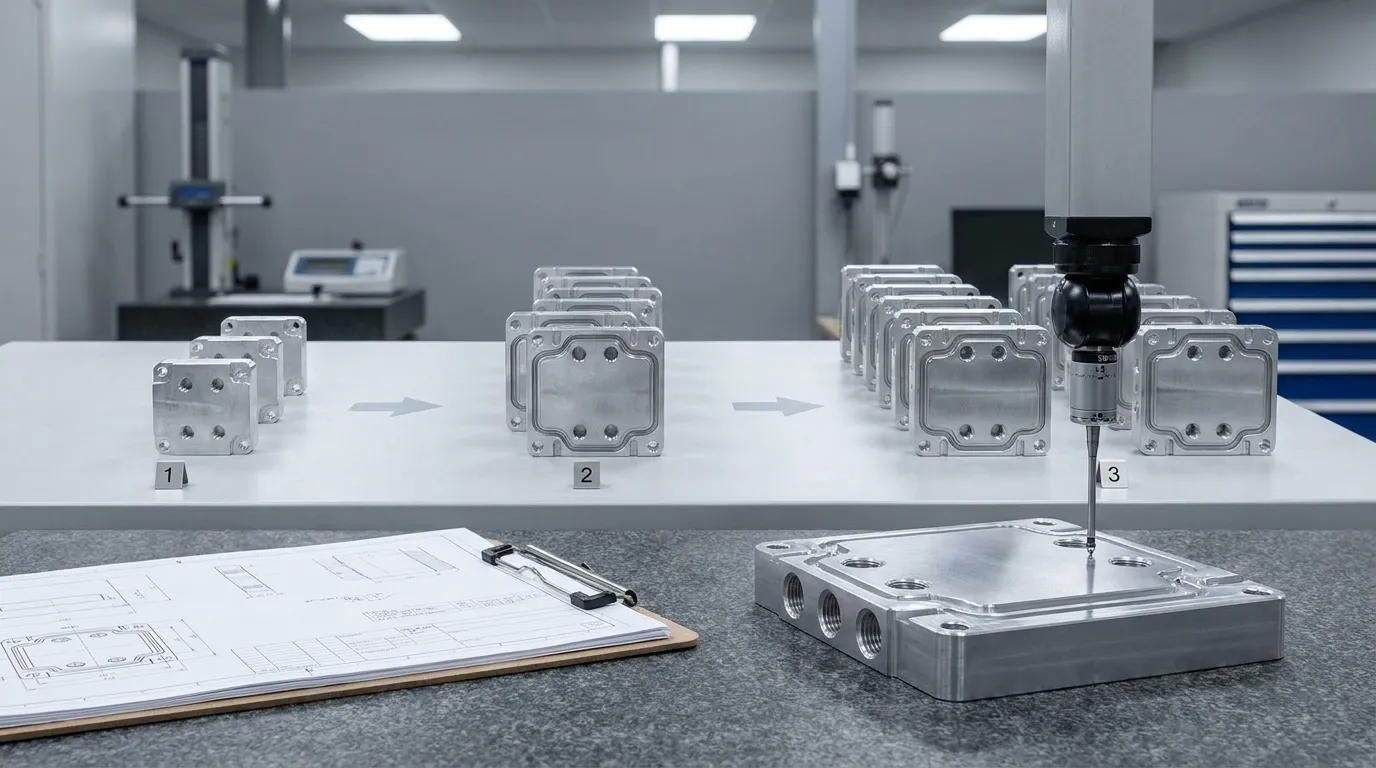
SunOn supports cold plate projects through defined manufacturing stages rather than treating every order as an isolated batch.
| Project Stage | Main Buyer Goal | SunOn Support |
|---|---|---|
| Prototype | Confirm geometry, fit and assembly | No-minimum-order CNC machining and DFM review |
| Revised prototype | Validate design changes | Updated drawing and revision review |
| Pilot batch | Check repeatability and process readiness | Controlled machining, finishing and inspection |
| Production | Maintain approved requirements | Repeat manufacturing based on released documentation |
Project Review and DFM
The process begins with a review of the CAD model, drawing, quantity, material, tolerances, surface treatment, inspection requirements, and requested delivery schedule.
Questions about channel geometry, threads, thin walls, sealing faces, or difficult-to-inspect features can be addressed before machining begins.
Prototype or First Article
The initial part may be used to check:
- Overall fit
- Mounting-hole alignment
- Port position
- Fitting orientation
- Contact-face dimensions
- Sealing interfaces
- Assembly clearance
- Buyer-defined functional requirements
SunOn’s custom CNC machining for prototypes supports early parts without requiring a large production commitment.
Design Revision
When the prototype identifies a necessary change, the updated CAD file and drawing should receive a new revision. Changes to channels, ports, threads, dimensions, material, or finishing should be clearly documented before the next batch.
Pilot or Small-Batch Production
A pilot batch gives the buyer an opportunity to evaluate repeatability, inspection methods, finishing consistency, packaging, assembly, and documentation before production volume increases.
Repeat Production
Once the drawing, revision, material, finish, and inspection requirements are approved, repeat orders can follow the released manufacturing documentation. Any later design change should be reviewed as a controlled revision rather than an informal production adjustment.
Critical Quality Requirements for a Machined Cold Plate
A cold plate drawing should distinguish between general dimensions and features that are critical to assembly, sealing, or contact with the heat-generating component.
Dimensions to Identify on the Drawing
Important requirements may include:
- Overall length, width, and thickness
- Contact-surface flatness
- Sealing-face flatness
- Channel width and depth
- Port location and thread
- Hole pattern and positional tolerance
- O-ring groove dimensions
- Cover or mating-face dimensions
- Surface roughness
- Finished dimensions after treatment
Applying tight tolerances to every feature can increase machining and inspection work without improving the part. Tolerances should focus on dimensions that affect function, sealing, mounting, or assembly.
Dimensional Inspection
Inspection methods are selected according to the feature and drawing requirement. They may include:
- Calipers
- Micrometers
- Height gauges
- Coordinate measuring machines
- Surface-measurement equipment
- Thread gauges
- Buyer-required inspection reports
Critical features should be identified during quotation so that the inspection method, sampling plan, reporting format, and final acceptance criteria can be agreed before production.
Leak, Pressure, and Functional Testing
Leak and pressure requirements must not be assumed from the part name alone. The buyer should specify:
- Test medium
- Test pressure
- Hold time
- Permitted pressure decay
- Maximum acceptable leak rate
- Test temperature
- Number of parts to test
- Required report format
SunOn will review whether the requested test can be performed as part of the quoted manufacturing scope. Helium testing, hydrostatic testing, flow testing, thermal testing, and other specialized validation methods should only be included after equipment, procedure, and acceptance requirements have been confirmed.
Applications for Custom CNC-Machined Cold Plates
SunOn can review liquid cooling cold plate drawings for OEM applications such as:
- Electronic equipment
- Power-conversion systems
- Industrial machinery
- New-energy equipment
- Automotive and EV-related assemblies
- Communication hardware
- Testing equipment
- Custom thermal-management systems
Each project should be assessed from its drawing and specification. Application type alone does not determine the material, channel geometry, joining process, testing method, or achievable cooling performance.
Why OEM Buyers Work With SunOn
SunOn has provided custom manufacturing services since 1997. Its wider capabilities include product development, rapid prototyping, CNC machining, mold manufacturing, die casting, sheet metal work, finishing, assembly, and production support.
For a cold plate project, this wider manufacturing structure can help buyers coordinate several stages through one supplier:
- CAD and drawing review
- CNC prototyping
- Material sourcing
- Precision machining
- Surface treatment
- Dimensional inspection
- Pilot production
- Repeat manufacturing
- Assembly-related review
SunOn also maintains company-level quality systems and supports international OEM projects. Project-specific documentation, inspection reports, material records, certificate requirements, and confidentiality needs should be stated during the RFQ stage.
Most importantly, we keep the manufacturing scope clear. Thermal resistance, heat-removal capacity, pressure drop, leak rate, and operating performance are not presented as fixed values without an approved design and defined test conditions.
Request a Custom Liquid Cooling Cold Plate Quote
Send SunOn your 2D drawing and 3D CAD model for a project-specific manufacturing review.
Include:
- Material or preferred alloy
- Prototype or production quantity
- Channel geometry
- Port and thread details
- Flatness and tolerance requirements
- Sealing or joining method
- Surface treatment
- Inspection criteria
- Leak or pressure test requirements
- Delivery destination
- Required schedule
Frequently Asked Questions
What is a liquid cooling cold plate?
A liquid cooling cold plate is a metal component that transfers heat from a mounted device into a circulating coolant. It usually contains channels, tubes, cavities, or another defined flow path, along with ports, mounting features, and a contact surface.
Can SunOn manufacture a custom cold plate from my CAD file?
Yes. SunOn can review a custom cold plate project from a 3D CAD model and 2D manufacturing drawing. The quotation depends on the material, dimensions, channels, ports, tolerances, surface treatment, quantity, sealing method, and required inspection or testing.
Does SunOn accept one-piece cold plate prototypes?
SunOn supports no-minimum-order CNC machining, including one-piece prototypes where the project is manufacturable. Starting with a prototype allows the buyer to verify fit, mounting, port position, sealing interfaces, and other functional dimensions before ordering a larger batch.
Which materials can SunOn review?
Aluminum is the primary material covered by SunOn’s existing machining capabilities. Copper and other machinable materials may also be reviewed according to the grade, dimensions, geometry, availability, finishing requirements, quantity, and complete manufacturing scope.
Can SunOn machine channels, ports, threads, and sealing grooves?
These features can be reviewed for CNC machining when they are clearly defined in the CAD model and drawing. Feasibility depends on channel depth, tool access, internal radii, wall thickness, thread details, groove geometry, tolerances, and inspection access.
What information is needed for a quotation?
Provide a 3D CAD model, 2D drawing, material, quantity, critical tolerances, channel details, port specifications, surface finish, sealing or joining method, inspection requirements, testing criteria, delivery location, and target schedule.
Can SunOn provide finishing and dimensional inspection?
SunOn can review requirements for anodizing, plating, polishing, painting, deburring, and other applicable finishes. Dimensional inspection may use calipers, micrometers, gauges, CMM equipment, or another agreed method based on the drawing and reporting requirements.
Can SunOn provide leak or pressure testing?
Leak and pressure testing must be reviewed for each project. The buyer should specify the test medium, pressure, hold time, permitted decay or leak rate, sampling quantity, and reporting requirements. Testing should only be considered included after SunOn confirms the available method.
Can SunOn support production after prototype approval?
Yes. After the prototype and drawing revision are approved, SunOn can support pilot batches and repeat production using the released material, dimensions, finishing, inspection criteria, and manufacturing documentation.
Upload your 2D drawing and 3D CAD model today to request a custom liquid cooling cold plate manufacturing quote from SunOn.
