


Types of Metal Fabrication Services Explained
Metal fabrication services encompass a wide range of industrial processes designed to transform raw metal into functional parts. From cutting and bending to complex assembly, these services are the backbone of modern manufacturing. Understanding the different types of fabrication is essential for choosing the right production path for your project’s volume, budget, and technical requirements.
What are the Main Types of Metal Fabrication Services?
Metal fabrication services involve several core processes: cutting, forming, joining, and finishing. Common techniques include laser or waterjet cutting, CNC bending, and various welding methods like TIG and MIG. Each service serves a specific purpose, ranging from creating simple brackets to building complex industrial machinery enclosures.
To truly understand fabrication, you have to look at it as a subtractive and additive puzzle. In my years on the production floor, I’ve seen how these services overlap. You rarely use just one. A single enclosure might require laser cutting for the "blank," CNC bending for the shape, and specialized welding to hold it all together.
| Service Category | Primary Techniques | Common Use Cases |
| Cutting | Laser, Plasma, Waterjet | Base shapes, holes, and profiles. |
| Forming | Bending, Rolling, Punching | Enclosures, brackets, and frames. |
| Joining | Welding, Riveting, Fastening | Permanent or modular assemblies. |
| Finishing | Powder Coating, Plating | Aesthetics and corrosion protection. |
For businesses requiring high-precision components with very tight tolerances, exploring sheet metal fabrication specifically is often the best starting point.
What is Cutting in Metal Fabrication?
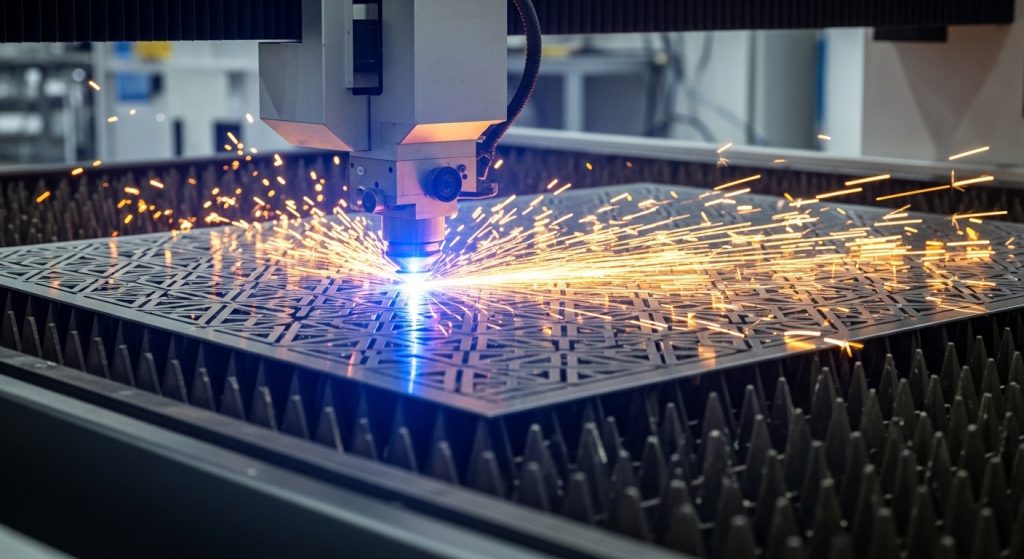
Cutting is the initial stage of fabrication where raw metal sheets or bars are divided into specific shapes. Modern services use high-tech tools like fiber lasers, which offer unmatched speed and accuracy. Other methods include plasma cutting for thicker materials and waterjet cutting for metals sensitive to heat, ensuring clean edges without material distortion.
I remember the days when mechanical shears were the only option. The edges were rough, and the precision was "good enough." Today, fiber lasers are the industry standard. They can slice through stainless steel with the accuracy of a surgeon.
The choice of cutting service depends on:
- Material Thickness: Plasma is great for 1-inch thick steel plates.
- Precision Needs: Lasers are the king of fine detail.
- Heat Sensitivity: Waterjets use cold cutting, which prevents the metal from warping or losing its structural properties due to heat.
How Does Forming Differ from Cutting?
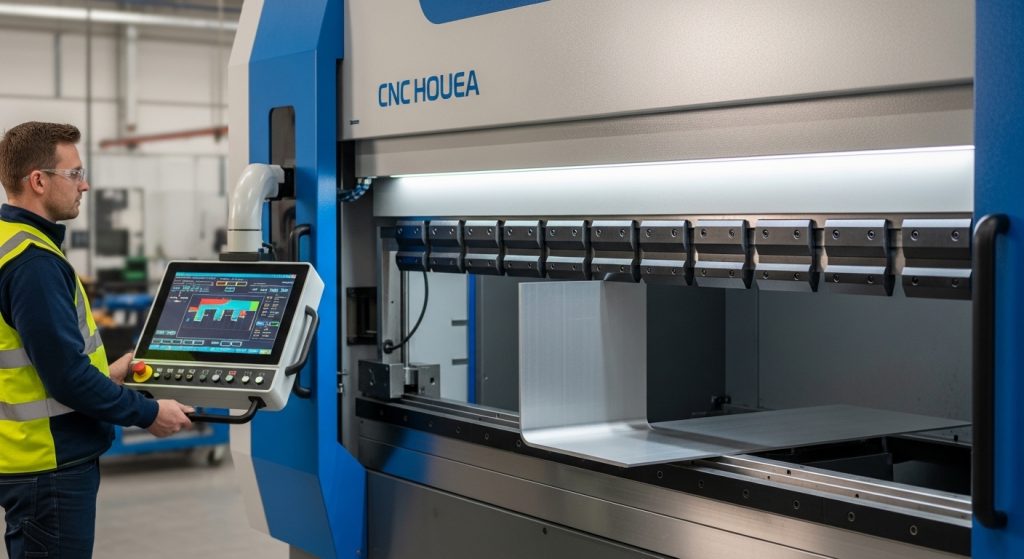
Forming is the process of shaping metal without removing any material, typically through bending or rolling. While cutting removes metal to create a profile, forming uses physical force to deform the metal into a three-dimensional shape. This is usually done with a CNC press brake, which applies high pressure to create precise angles and curves.
Forming is where the "character" of the metal comes into play. You have to account for "springback"—the metal’s tendency to want to return to its original flat state.
Tip: Always check the grain direction of your metal. Bending against the grain can cause cracking, while bending with it ensures a smooth, strong angle.
Most industrial enclosures are products of intense forming processes. If your design is complex, look for a partner with multi-axis press brakes. These machines can perform multiple bends in a single setup, which significantly lowers labor costs.
What Role Does Welding and Joining Play?
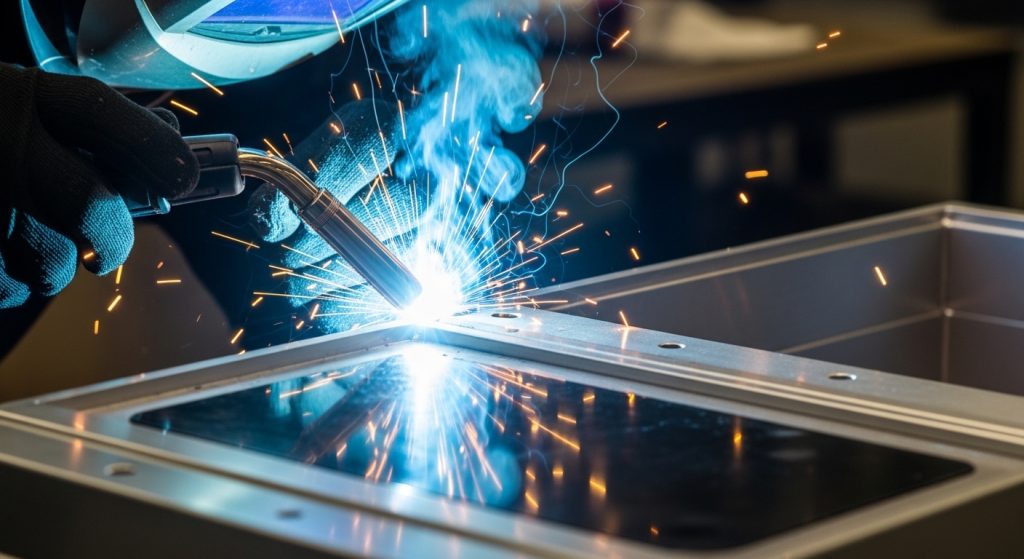
Welding and joining are additive processes that fuse separate metal components into a single unit. Common welding services include TIG (Tungsten Inert Gas) for precision and MIG (Metal Inert Gas) for speed. Beyond welding, joining services also include mechanical fastening with rivets, bolts, or specialized hardware insertion for modular or non-permanent assemblies.
Welding is as much an art as it is a science. A "stack of dimes" weld—where the bead looks perfectly uniform—is the hallmark of a master TIG welder. In high-authority manufacturing, we often use robotic welding for consistency across thousands of parts. This ensures that every joint is identical and leak-proof.
Common joining methods include:
- TIG Welding: Perfect for thin aluminum or stainless steel where aesthetics matter.
- MIG Welding: The workhorse for heavy structural steel frames.
- Spot Welding: Ideal for joining overlapping sheets quickly.
- Hardware Insertion: Press-fitting nuts and studs directly into the metal for easy final assembly.
How Do You Select the Right Metal for Fabrication?
Selecting the right metal involves balancing strength, weight, corrosion resistance, and cost. Common choices include aluminum for its lightweight properties and stainless steel for its durability in harsh environments. The choice of material dictates which fabrication services are applicable, as some metals respond better to laser cutting while others are optimized for high-speed stamping.
Material choice is the most critical decision in the design phase. I've seen engineers specify expensive alloys when a treated carbon steel would have worked just as well.
- Aluminum: Great for heat sinks and aerospace.
- Stainless Steel: Non-negotiable for medical or food-grade applications.
- Copper: The only choice for high-conductivity electrical parts.
To make an informed decision, it helps to understand how to choose metal for stamping and fabrication, as the properties that make a metal good for bending might make it difficult to weld.
What are the Benefits of Precision Metal Stamping Services?
Precision metal stamping services are ideal for high-volume production of identical parts. Unlike custom fabrication, which is better for low volumes, stamping uses custom-made dies to "punch" out parts in seconds. This provides incredible repeatability and the lowest possible per-part cost for industries like automotive and consumer electronics that require millions of components.
If you are looking at a production run of 10,000 units or more, you should pivot from custom fabrication to precision metal stamping services. The initial investment in the tool (the die) is high, but the speed of production is unmatched.
| Feature | Custom Fabrication | Metal Stamping |
| Setup Cost | Low | High (Tooling required) |
| Unit Cost | Medium to High | Very Low |
| Volume | 1 - 5,000 units | 10,000+ units |
| Flexibility | High (Design changes are easy) | Low (Die changes are expensive) |
Why is Surface Finishing Essential?
Surface finishing is the final stage of fabrication that protects the metal from oxidation and enhances its appearance. Services like powder coating provide a durable, colorful shield, while anodizing is used for aluminum to increase surface hardness and corrosion resistance. Finishing ensures that the part not only functions correctly but also survives the environmental stresses of its final application.
Finishing isn't just about "looking pretty." It's about longevity. Without proper finishing, a steel bracket in a humid environment will begin to rust in days.
Common finishes include:
- Powder Coating: A thick, baked-on finish available in any color.
- Anodizing: An electrochemical process that makes the surface of aluminum harder and more resistant to scratches.
- Passivation: A chemical treatment for stainless steel that removes surface contaminants and boosts its natural corrosion resistance.
How Do You Choose a Fabrication Service Provider?
Choosing a provider requires evaluating their technical capacity, quality certifications (like ISO 9001), and the breadth of their services. A one-stop shop that offers both cutting and assembly reduces your logistical headaches. Look for a partner who offers "Design for Manufacturing" (DFM) feedback, which can help you simplify your design and reduce overall costs.
Reputation is built on the shop floor. When vetting a partner, ask to see their quality control lab. A high-authority fabricator will use CMM (Coordinate Measuring Machines) to verify that every part meets the blueprint down to the micron.
Tip: Communication is the most important "service" a fabricator offers. If they don't answer your technical questions during the quoting phase, they won't answer them when your project is behind schedule.
