


How to Choose the Right Metal Material for Stamping Parts: The 2026 Engineering Guide
Choosing the right metal material for stamping parts requires a strategic balance of mechanical properties, environmental resistance, and production cost. At Sunon-Mould, we prioritize materials that match your specific application requirements while ensuring high-volume manufacturability and long-term durability in precision industrial environments.
The Selection Framework: 5 Critical Material Properties
How do you determine which material properties matter most for your stamped components? You must evaluate tensile strength, ductility, conductivity, and corrosion resistance against your part’s final function. Selecting a material with the correct yield point ensures that the metal retains its shape after the stamping press applies tons of pressure.
- Formability & Ductility: This determines how much the metal can stretch or bend without fracturing. High ductility is essential for deep-drawn parts.
- Tensile & Yield Strength: This defines the load-bearing capacity. High-strength alloys prevent deformation under mechanical stress.
- Electrical & Thermal Conductivity: Critical for electronic connectors and EV battery components.
- Corrosion Resistance: Essential for medical, marine, or outdoor automotive applications.
- Hardness: Affects the wear resistance of the part and the lifespan of the stamping die.
| Material Category | Formability | Strength | Conductivity | Best Use Case |
| Aluminum Alloys | High | Medium | High | Aerospace & Consumer Electronics |
| Stainless Steel | Medium | High | Low | Medical & Food Grade Equipment |
| Copper & Brass | Medium | Medium | Excellent | Electrical Stamped Components |
| Cold Rolled Steel | High | Medium | Low | General Industrial Hardware |
Comparing Common Stamping Alloys: Lived Experience from the Shop Floor
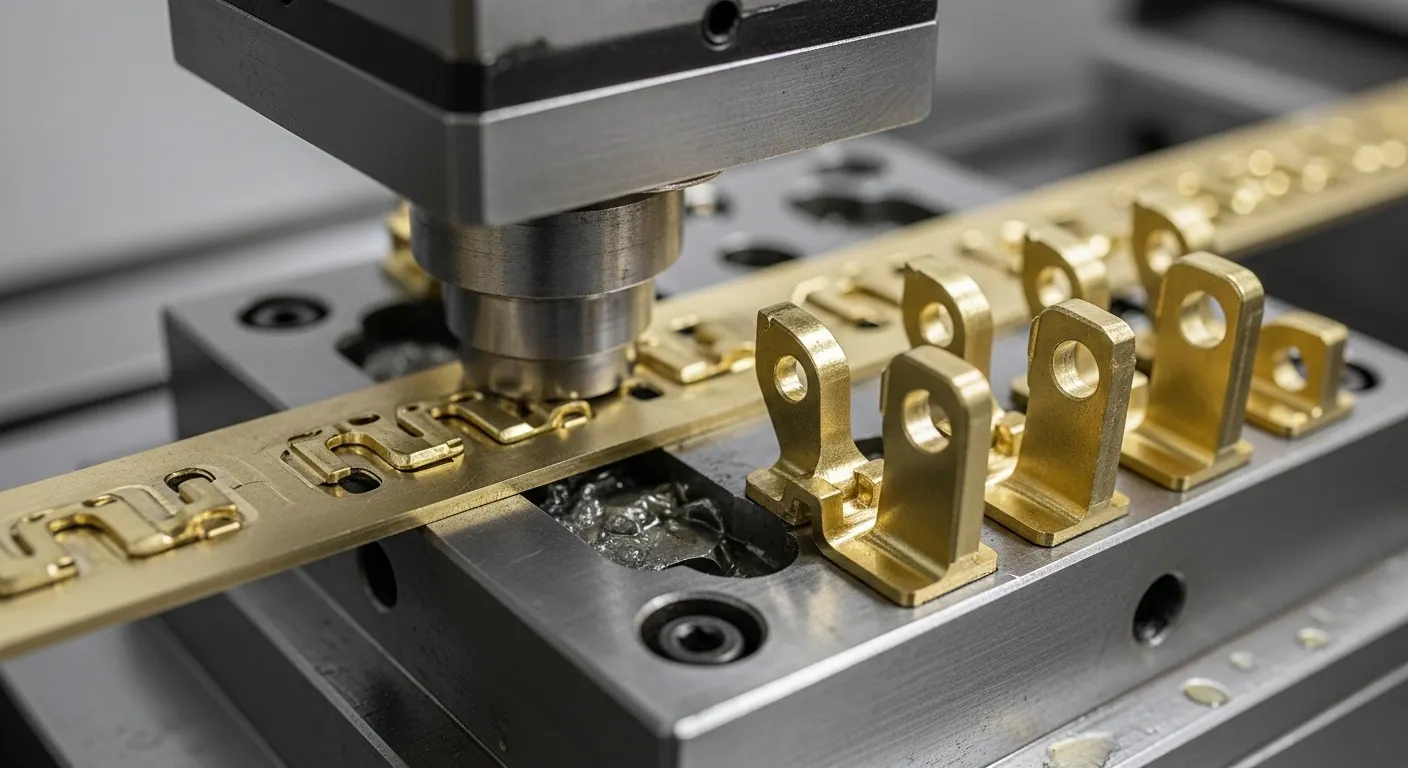
What are the most common alloys used in modern precision stamping? In our experience at Sunon-Mould, Cold Rolled Steel, Stainless Steel, and Aluminum dominate the market due to their predictable behavior during the stamping process. We often recommend specific grades like 304 Stainless for its balance of cost and high-performance oxidation resistance.
Stainless Steel: The Corrosion Champion
We find that Stainless Steel is the premier choice for parts exposed to harsh environments. While 304 is the industry workhorse, we often utilize 316L for medical applications due to its superior pitting resistance. Note that stainless steel has a high work-hardening rate, which requires precise tool design to manage.
Aluminum: Lightweight and Conductive
Aluminum is our go-to for weight-sensitive projects. Alloys like 5052 offer excellent formability for complex shapes, while 6061 provides the structural integrity needed for automotive metal stamping components. It is also naturally resistant to corrosion without additional plating.
Copper and Brass: The Electrical Standard
For high-speed signal transmission and power distribution, copper is unmatched. We specialize in stamping copper and brass for terminals and connectors where electrical conductivity is the primary performance metric.
Cost vs. Performance: The 2026 Sourcing Reality
How can you reduce the cost of your stamped parts without sacrificing quality? You should optimize the material utilization rate during the design phase and select materials that are readily available in the global supply chain. Choosing a standard gauge thickness rather than a custom size can significantly reduce lead times and raw material surcharges.
- Standardize Gauges: Use industry-standard thicknesses to avoid custom mill runs.
- Minimize Scrap: Design parts that nest efficiently on the metal strip.
- Consider Secondary Costs: A cheaper raw material may cost more in the long run if it requires expensive post-process plating.
- Analyze Manufacturability: Sometimes, choosing a slightly more expensive material with better formability reduces the "reject rate" during high-volume production.
In many cases, customers ask us what is the difference between metal stamping and cnc machining regarding cost. For high-volume production, metal stamping is significantly more cost-effective because the per-part material waste is lower and the cycle time is faster.
Prototyping Your Choice: Why Simulation Matters

Why is simulation a mandatory step in the material selection process? We use advanced FEA (Finite Element Analysis) to predict how a specific metal will react to the stresses of the stamping die before we cut any steel. This allows us to identify potential thinning or tearing areas, ensuring the material choice is viable for mass production.
At Sunon-Mould, our engineering team validates every material choice against the part's geometry. If a material shows a high risk of "springback," we adjust the tool design accordingly. This "measure twice, cut once" philosophy is what separates high-authority manufacturers from generic shops.
Frequently Asked Questions
Low-carbon steels and certain aluminum alloys are best for deep drawing because they have high elongation properties. This allows the metal to be pulled into a deep, cup-like shape without thinning or breaking.
Metal has a "grain" created during the rolling process at the mill. Bending a part against the grain is generally stronger, whereas bending parallel to the grain can lead to cracking in high-strength materials like stainless steel.
Yes, but it requires specialized tooling. We often work with pre-galvanized steel or pre-painted aluminum to save on secondary processing costs, provided the bend radii are large enough to prevent the coating from cracking.
Cold Rolled Steel (CRS) is typically the most cost-effective option for high-volume parts that do not require extreme corrosion resistance or high electrical conductivity.
