


Precision Metal Stamping Services for Custom Parts: The Definitive Guide to High-Volume Accuracy
Precision metal stamping services for custom parts are the backbone of modern manufacturing, transforming flat metal sheets into complex, high-tolerance components used in aerospace, medical, and automotive industries. This process utilizes specialized dies and high-speed presses to ensure every part is identical, cost-effective, and structurally sound. Whether you are scaling a prototype or moving into mass production, understanding the nuances of stamping is vital for project success.
What are Precision Metal Stamping Services for Custom Parts?
Precision metal stamping services for custom parts involve a cold-forming manufacturing process that uses dies and stamping presses to transform sheet metal into specific shapes. By applying extreme pressure, the metal is sheared, bent, and formed into intricate components with tolerances often as tight as +/- 0.001 inches, ensuring repeatable quality for high-volume production runs.
At its core, precision stamping is about the marriage of metallurgy and mechanical force. Unlike CNC machining, which removes material, stamping reshapes it. This results in less waste and faster cycle times. In my experience overseeing production lines, the transition from a machined prototype to a stamped production part is where "economies of scale" truly become visible. You aren't just making a part; you are engineering a repeatable result.
Why Should You Choose Precision Stamping for High-Volume Manufacturing?
Precision stamping is the preferred choice for high-volume manufacturing because it offers unmatched speed, consistency, and a lower cost-per-part compared to other methods. Once the initial tooling is created, the process allows for the rapid production of thousands of identical parts with minimal human intervention, significantly reducing labor costs and material waste.
When you are looking at a production run of 50,000 units or more, the ROI on stamping tooling becomes undeniable. While the upfront cost of a progressive die can be significant, the efficiency gains are massive.
Key Benefits of Precision Stamping:
- Speed: Modern presses can operate at hundreds of strokes per minute.
- Durability: Stamping can work with hardened alloys that are difficult to machine.
- Accuracy: Advanced sensors in the die detect microscopic deviations, ensuring every part meets the CAD model.
- Material Efficiency: Specialized nesting software optimizes the layout on the metal coil to minimize scrap.
| Feature | Precision Stamping | CNC Machining | 3D Printing |
| Production Speed | Extremely High | Moderate | Low |
| Unit Cost (High Vol) | Lowest | High | Moderate |
| Initial Tooling Cost | High | Low | None |
| Tolerance | +/- 0.001" | +/- 0.0005" | +/- 0.005" |
What are the Common Materials Used in Metal Stamping Services?
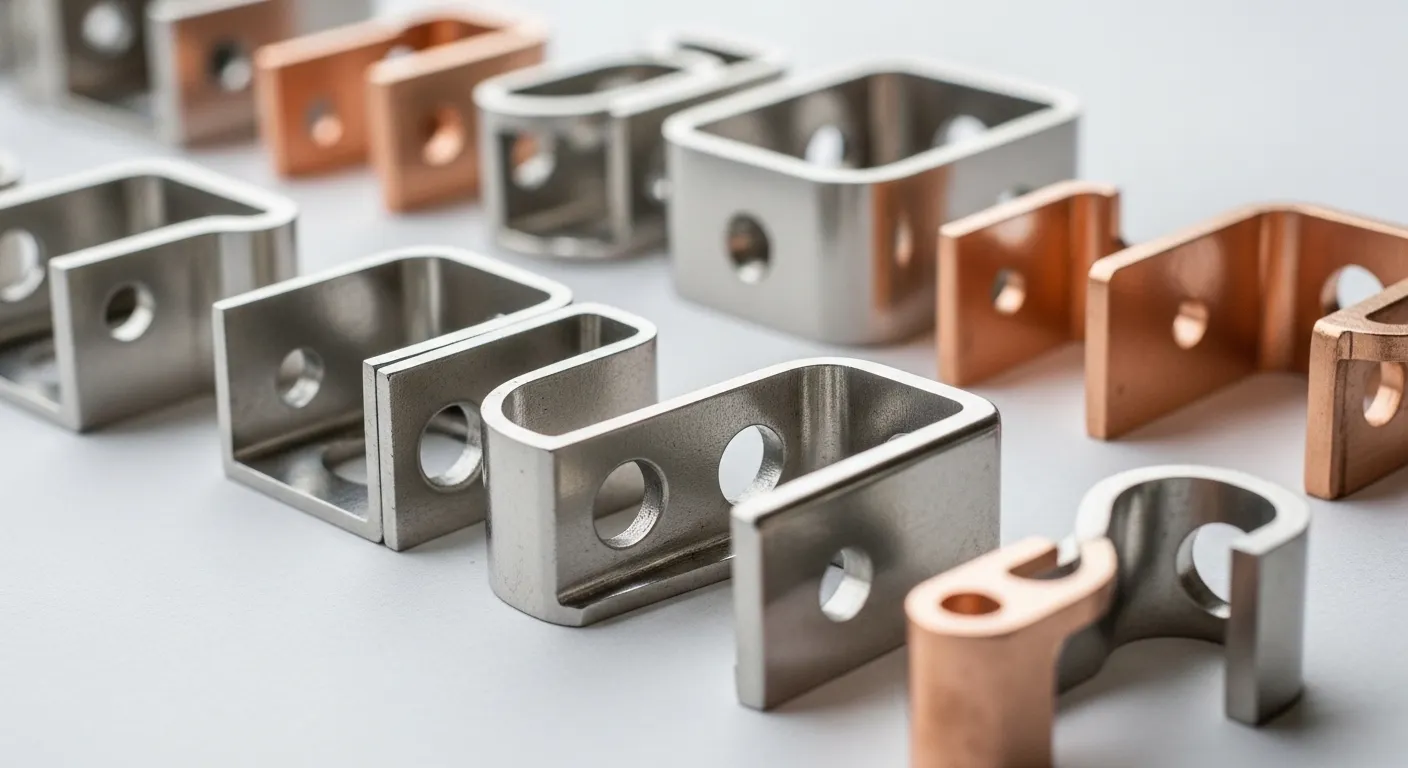
The materials used in precision metal stamping services include stainless steel, aluminum, copper, brass, and specialty alloys like Titanium or Inconel. The choice depends on the part’s environment, required conductivity, and mechanical strength. Each material reacts differently to the die, requiring specific lubrication and pressure settings to prevent cracking or springback.
In the world of custom parts, material selection is where many designers make or break their budget. For instance, while stainless steel offers incredible corrosion resistance, it is harder on the tooling than aluminum. If you are also working on hybrid assemblies, you might need to know how to design parts for silicone rubber molding process to ensure your metal inserts bond correctly with elastomeric coatings.
Top Materials and Their Applications:
- Stainless Steel: Ideal for medical devices due to its biocompatibility.
- Copper: The gold standard for electrical connectors and terminals.
- Aluminum: Chosen for its high strength-to-weight ratio in aerospace.
- Pre-plated Metals: Using pre-galvanized steel can eliminate the need for post-production finishing.
How Does the Progressive Die Stamping Process Work?
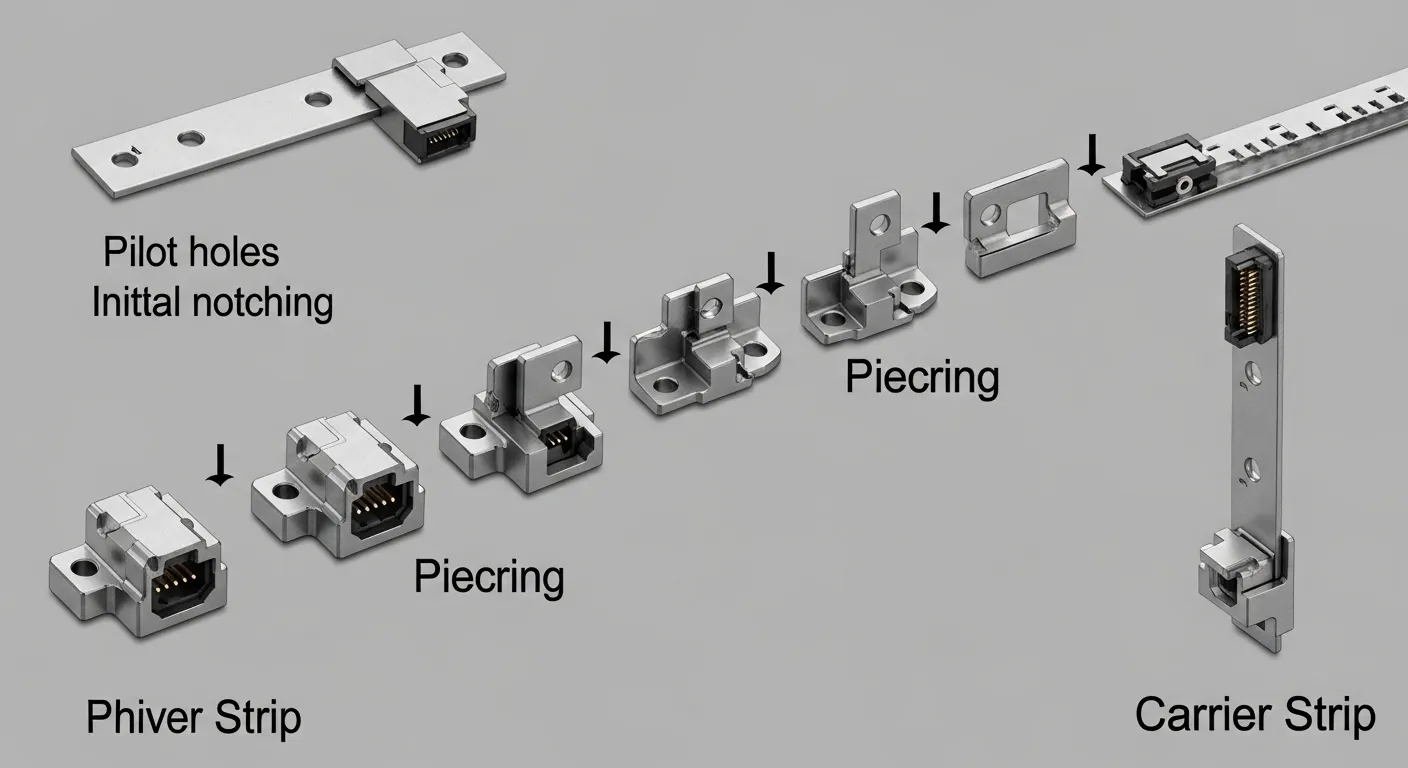
Progressive die stamping works by feeding a metal coil through a series of stations within a single die set. Each station performs a different operation—such as piercing, coining, or bending—until the final part is cut from the carrier strip. This "assembly line" approach inside the press allows for complex geometry in a single stroke.
Imagine a long strip of metal moving through a machine. At station one, a hole is punched. At station two, a flange is bent. At station three, a logo is embossed. By the time the strip reaches the end, a finished part drops out. This is the pinnacle of efficiency.
During my years on the factory floor, I’ve seen that the "strip layout" is the most critical document in the shop. A well-designed strip minimizes "web scrap" (the metal between parts) and ensures the part remains stable as it travels through the die. If stability is lost, the tolerance is lost.
What are the Different Types of Metal Stamping Techniques?
The primary types of metal stamping techniques include progressive die stamping, deep drawing, four-slide stamping, and compound stamping. Deep drawing is used for hollow, cylindrical parts like battery cans, while four-slide (or multi-slide) stamping is ideal for complex wire forms and small connectors that require multiple bends from different angles.
Choosing the right technique is a matter of geometry:
- Deep Drawing: Used when the depth of the part exceeds its diameter. It stretches the metal into a cup shape.
- Four-Slide: Best for clips and brackets. It uses four horizontal slides to "wrap" the metal around a center tool.
- Compound Stamping: Performs multiple cuts or bends in one station. It is slower than progressive stamping but maintains exceptional flatness.
How Do You Ensure Quality Control in Precision Metal Stamping?
Quality control in precision metal stamping is ensured through a combination of in-die sensors, automated vision systems, and rigorous manual inspections. In-die sensors detect "slug pulling" or material thickness variations in real-time, stopping the press immediately to prevent damage to the tool or the production of defective parts.
We don't just check the parts at the end; we check them during the process. We utilize CMM (Coordinate Measuring Machines) to verify the first article against the original blueprint. Furthermore, if your metal part is destined for a medical environment, you must ensure it meets strict regulatory standards. For example, if it will be paired with medical-grade gaskets, you should verify if the silicone rubber is FDA approved for medical devices to maintain the integrity of the entire assembly.
Our Quality Checklist Includes:
- First Article Inspection (FAI): Verifying the first part off the tool.
- SPC (Statistical Process Control): Monitoring dimensions over thousands of cycles to track tool wear.
- Visual Inspection: Checking for burrs, scratches, or oil contamination.
- Material Certification: Ensuring the raw metal coil matches the specified chemical properties.
What Factors Influence the Cost of Custom Metal Stamping?
The cost of custom metal stamping is influenced by material type, part complexity, tooling design, and production volume. While complex parts require more expensive multi-station dies, the cost per unit drops significantly as volume increases because the initial tooling investment is amortized over a larger number of finished components.
Cost Drivers Breakdown:
- Tooling (CapEx): This is your biggest upfront cost. A simple blanking die might cost $5,000, while a complex progressive die can exceed $100,000.
- Material (OpEx): Commodity prices for steel and copper fluctuate. Designing for minimal scrap is the best way to control this.
- Secondary Operations: Does the part need heat treating, plating, or deburring? These add "touches" and cost.
- Tolerances: Asking for +/- 0.0005" when +/- 0.005" is sufficient will triple your cost due to the precision required in the die.
How to Optimize Your Part Design for Metal Stamping?
To optimize part design for metal stamping, you should maintain uniform wall thickness, avoid sharp internal corners, and place holes at least two times the material thickness away from edges. Designing for "producibility" ensures the metal flows correctly within the die, reducing the risk of tearing or excessive tool wear.
Design for Manufacturing (DFM) is the secret sauce. A common mistake I see is designers treating metal like plastic. Metal has "memory." If you bend it, it wants to spring back. If you punch a hole too close to a bend, the hole will deform into an oval.
If your assembly involves extreme heat, you must also consider the thermal limits of surrounding materials. Understanding what temperature silicone rubber parts can withstand is crucial if your metal-stamped bracket is holding a seal in a high-heat engine environment.
What Industries Rely Most on Precision Metal Stamping?
Industries such as automotive, aerospace, medical, electronics, and renewable energy rely heavily on precision metal stamping. These sectors require high-performance parts—like battery terminals, surgical instruments, and structural brackets—that can be produced in massive quantities while maintaining 100% adherence to safety and performance specifications.
- Automotive: Shift toward EVs has spiked demand for high-conductivity copper busbars.
- Medical: Surgical staples and orthopedic implants require the extreme cleanliness and precision of stamping.
- Consumer Electronics: Think of the internal shielding in your smartphone; those are stamped at rates of thousands per hour.
Conclusion: Partnering with the Right Stamping Expert
Precision metal stamping services for custom parts are about more than just hitting a piece of metal with a hammer. It is a high-tech dance of physics, chemistry, and engineering. By choosing a partner who understands the relationship between tool design, material science, and quality control, you ensure your project moves from a concept to a high-market-share reality.
When selecting a vendor, look for a "one-stop shop" that can handle everything from DFM consulting and tool building to mass production and secondary finishing. This reduces your supply chain risk and ensures that the person who built the tool is the one responsible for the quality of the parts it produces.
FAQ: Precision Metal Stamping
Tooling usually takes 4 to 10 weeks depending on complexity. Once the tool is validated, production parts can often be shipped within days.
Usually, we use laser cutting or soft-tooling for prototypes. Hard-tooling for stamping is generally reserved for volumes where the setup cost is justified.
A burr is a small ridge of metal left after cutting. In precision industries, we strictly control burr height (often keeping it under 10% of material thickness) to ensure safety and fit.
Yes, most stamping services include or manage secondary processes like powder coating, anodizing, and heat treatment to provide a "plug-and-play" component.
