


No Minimum Order Plastic Molds: Benefits for Small Businesses
No minimum order plastic molds refer to a production model where manufacturers allow businesses to purchase injection-molded parts in small quantities—often ranging from 50 to 2,000 units—without requiring high-volume commitments. This approach utilizes low-volume injection molding techniques, such as aluminum or "bridge" tooling, to lower the initial financial barrier for startups. By eliminating strict Minimum Order Quantities (MOQs), small businesses can validate their designs, test market demand, and manage cash flow more effectively while still receiving end-use parts that meet industrial quality standards.
Why Choose Low Volume Injection Molding with No MOQ?
Small businesses and hardware startups often face a major roadblock: the gap between 3D printing and mass production. Traditional manufacturers typically demand orders of 10,000 units or more to justify the setup costs. Low volume injection molding with no MOQ solves this by offering a middle ground. This flexibility allows procurement managers to secure high-quality components without tying up capital in excessive inventory that might never sell.
Operating with no MOQ does not mean sacrificing quality. It means the manufacturer has optimized their setup and changeover processes to handle smaller runs efficiently. At SunOn, we provide these services to ensure that even a run of 100 pieces receives the same technical oversight as a run of 100,000. This is particularly vital for companies in the medical or electronics sectors, where the plastic injection mold for medical devices must meet strict tolerances regardless of the total order size.
Furthermore, lower order volumes reduce the "inventory risk" associated with product revisions. If a design engineer identifies a necessary change after the first 500 units, a no-MOQ policy ensures you aren't stuck with thousands of obsolete parts. You simply update the design, modify the tool, and proceed with the next small batch.
How Small Batch Plastic Parts Accelerate Your Market Entry
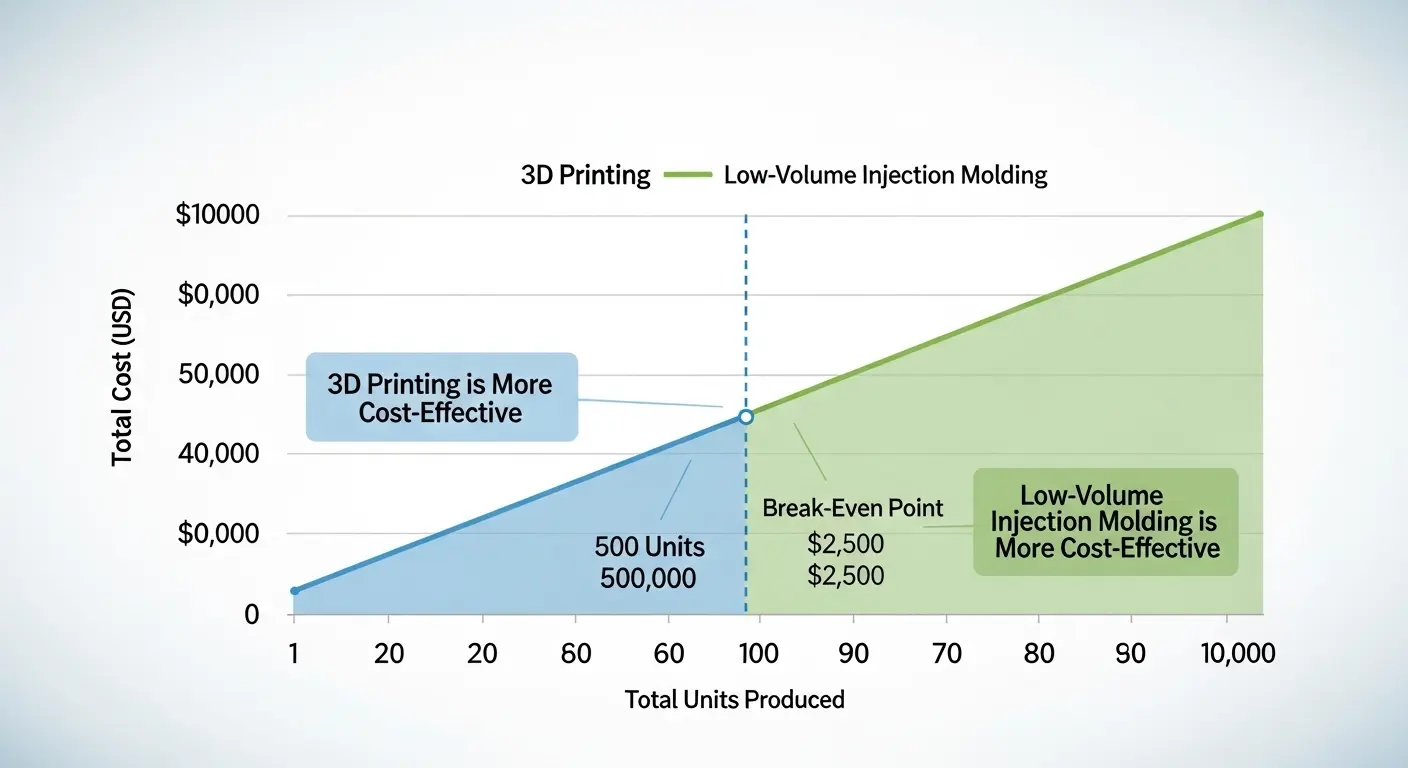
Speed to market is often the deciding factor in the success of a new product. Small batch plastic parts allow brands to launch "Beta" versions or limited editions to gather real-world user data. Instead of waiting months for a high-cavity steel mold to be perfected, companies use short run injection molding services to get functional parts into customers' hands within weeks.
This rapid market entry is supported by the plastic injection molding process being condensed for efficiency. By focusing on single-cavity tools or modular mold bases, manufacturers can significantly cut down on lead times. For a hardware founder, this means the revenue from the first small batch can often fund the subsequent larger production runs.
Moreover, small batches facilitate a "fail fast" or "iterate fast" philosophy. When you aren't bound by a massive purchase order, you can refine the ergonomics, aesthetics, or material properties of your product based on initial feedback. This iterative process ensures that by the time you reach mass production, the product is fully optimized for the end-user.
Balancing Tooling Costs for Affordable Plastic Molds
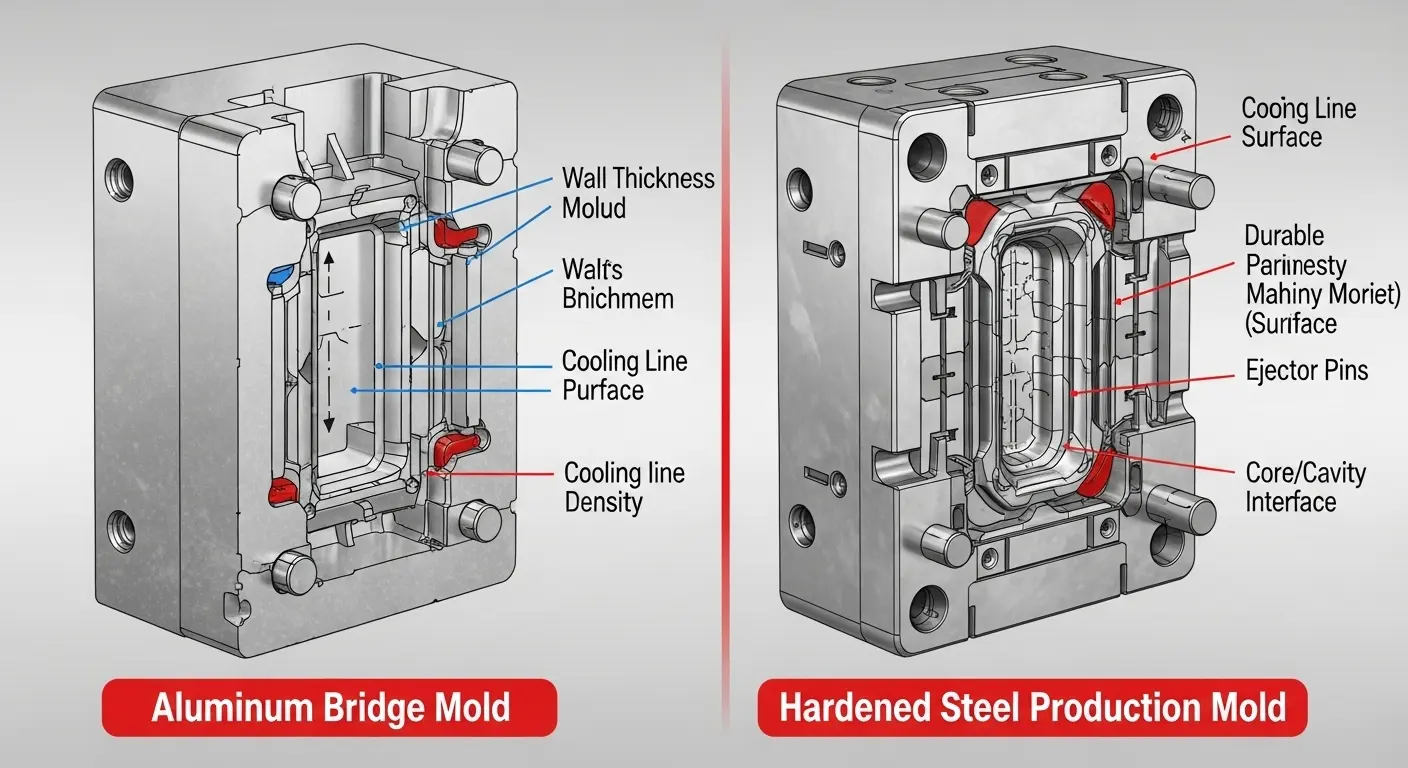
The biggest misconception regarding "no minimum order" services is that the molds themselves are free. In reality, while there is no MOQ on the parts, the mold is still a physical asset that must be engineered and machined. The key to making these molds affordable for startups lies in selecting the right tooling material and construction method.
Utilizing Bridge Tooling for Early Stage Growth
Bridge tooling is a temporary solution that "bridges" the gap between prototyping and long-term production. We often use high-grade aluminum or P20 pre-hardened steel for these molds. Aluminum dissipates heat faster than steel, which can shorten cycle times, and it is much faster to CNC machine. This results in a tool that costs significantly less than a multi-cavity hardened steel mold, making it an ideal choice for runs of 500 to 5,000 parts.
Reducing Financial Risk with Prototype-to-Production Models
A prototype-to-production model allows a business to start with a simplified tool and upgrade it as volume grows. For instance, a small business might start with a manual-insert mold to keep initial costs low. As demand increases, the same manufacturer can transition the project into a more automated system. This prevents the "sticker shock" of high-end tooling costs during the delicate early stages of a business's lifecycle.
| Tooling Feature | Aluminum (Bridge) | P20 Steel (Low Volume) | H13 Steel (High Volume) |
| Typical Cost | $1,500 - $5,000 | $3,000 - $8,000 | $10,000+ |
| Lead Time | 10 - 15 Days | 15 - 25 Days | 35+ Days |
| Tool Life | 1,000 - 5,000 cycles | 10,000 - 50,000 cycles | 500,000+ cycles |
| Best Use Case | Market Testing | Bridge Production | Mass Manufacturing |
The SunOn Process: From RFQ to Your First 100 Units
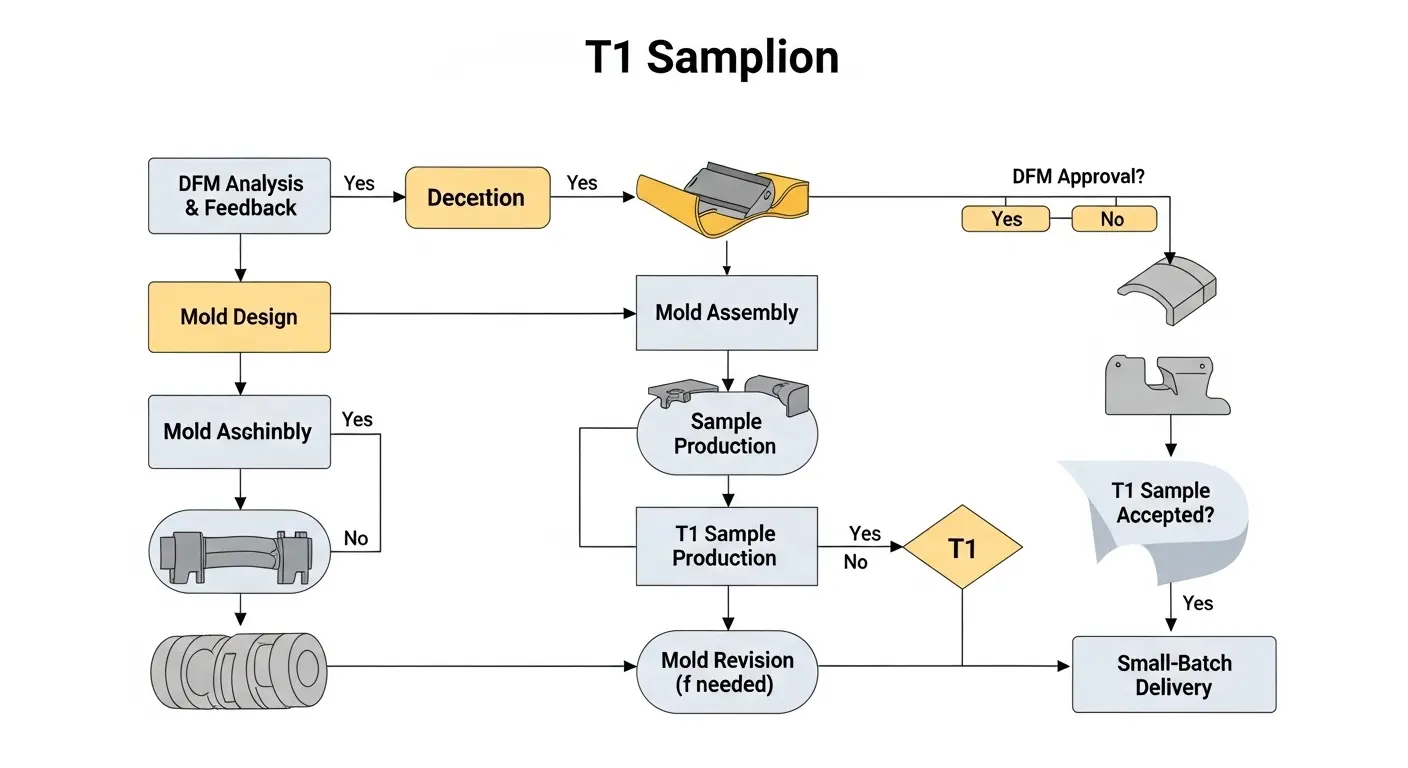
Successfully executing a low-volume project requires a disciplined approach to Design for Manufacturability (DFM). Our process begins with a thorough review of your CAD files to ensure the part can be molded efficiently without expensive secondary operations. This DFM-led quoting process is essential for startups because it identifies potential cost-drivers—like unnecessary undercuts or thick walls—before the tool is even started.
Once the design is finalized, we move to the tooling phase. For small batches, we often recommend simplified mold designs that prioritize function over longevity. After the mold is completed, we conduct a T1 trial to verify dimensions and surface finish. Because we understand the 2K injection molding guide and other complex methods, we can apply advanced technical knowledge even to simple, low-volume projects.
The final step is the production of your first 100 or 500 units. During this phase, we maintain strict quality control, providing inspection reports that confirm the parts meet your specified tolerances. This prototype to production injection molding workflow ensures a seamless transition, allowing you to scale up to larger volumes with the same partner who helped you launch.
Is Low Volume Molding Right for Your Product?
Short run injection molding services are not a universal solution for every product. If your part design is extremely simple and you need only 10 units, 3D printing or CNC machining might still be more cost-effective. However, if your part requires specific mechanical properties, specialized resins, or a high-quality surface finish, injection molding becomes the superior choice once you cross the 50-unit threshold.
Consider your material requirements. Many engineering-grade plastics do not 3D print well. By choosing low-volume molding, you gain access to the full spectrum of industrial thermoplastics. Whether you are following 2K injection molding methods to combine soft and hard plastics or need glass-filled nylon for structural strength, small-batch molding delivers the material integrity you need.
Finally, evaluate your long-term goals. If you anticipate needing 100,000 units in the future, starting with a no-MOQ partner who can also handle mass production is a strategic advantage. It eliminates the need to "re-tool" with a different supplier later, ensuring that your data, mold history, and quality standards remain consistent as your business scales. Using the 2K injection molding process and benefits as a benchmark, SunOn provides the technical depth required to support your journey from the first box of parts to a global rollout.
Frequently Asked Questions (FAQ)
Can I get injection molding with no minimum order?
Yes, you can order injection-molded parts with no minimum quantity, but you must still account for the initial cost of the mold. While you might only order 50 parts, the cost of the tooling is amortized over those units, making the price per part higher than it would be in a high-volume run.
How much does a low-volume plastic mold cost?
A typical low-volume mold using aluminum or pre-hardened steel generally costs between $1,500 and $5,000. The exact price depends on the part's complexity, size, surface finish requirements, and whether the mold needs moving parts like sliders or lifters.
What is the best material for small-batch injection molding?
The best material depends on your application, but low-volume molding supports almost all standard thermoplastics, including ABS, Polycarbonate, Polypropylene, and Nylon. Unlike 3D printing, small-batch molding allows you to use the exact production-grade resin required for your final product.
How long does it take to get 500 plastic parts?
From the moment the design is finalized, you can typically expect finished parts in 2 to 4 weeks. This includes approximately 10 to 15 days for mold fabrication and 2 to 3 days for the actual injection molding and quality inspection.
Is 3D printing cheaper than low-volume injection molding?
3D printing is usually cheaper for very small quantities (under 50 units) because there are no tooling costs. However, once you require 100 units or more, or if you need specific material properties and surface finishes, low-volume injection molding becomes more cost-effective and provides higher-quality results.
Do I own the mold if I order a small batch?
Yes, in most cases, the customer owns the mold even if they only order a small batch of parts. The manufacturer stores and maintains the mold for you, allowing you to come back and order more parts whenever your inventory runs low without paying for the tool again.
Ready to launch your product without the burden of high MOQs? At SunOn Industrial Group, we help small businesses and startups bridge the gap from prototype to mass production with precision and efficiency. Request a low-volume quote and DFM review today to see how our no-minimum-order plastic molds can accelerate your business growth.
