


Optically Clear Silicone Parts for Lighting and Lenses: The Engineer’s Guide
Optically clear silicone parts, specifically those made from optical-grade Liquid Silicone Rubber (LSR), provide high light transmission (up to 95%) and thermal stability for demanding lighting environments. These components are replacing traditional glass and thermoplastics due to their ability to withstand high temperatures without yellowing or cracking.
In this guide, you will:
- Evaluate material performance across LSR, glass, and polycarbonate.
- Identify key applications for automotive and industrial lighting.
- Optimize your part design for high-yield manufacturing.
- Avoid common pitfalls in optical silicone tooling.
Why Choose Optical Liquid Silicone Rubber (LSR)?
Optical LSR is a high-purity, two-component material designed for injection molding complex optical geometries. Unlike standard silicones, optical grades are formulated for maximum clarity and minimal light scattering.
| Feature | Optical LSR | Borosilicate Glass | Polycarbonate (PC) |
| Light Transmission | ~94-95% | ~90-92% | ~89-91% |
| Heat Resistance | Up to 200°C | 500°C+ | ~120°C |
| Weight | Low | High | Low |
| UV Stability | Exceptional | Exceptional | Poor (Yellows) |
| Impact Strength | High (Flexible) | Low (Brittle) | High |
The primary advantage of silicone in 2026 is its resilience. While polycarbonate may deform near high-output LEDs and glass may shatter under mechanical stress, optical LSR maintains its refractive index across a wide temperature range. For projects requiring even higher durability, engineers often integrate these with chemical resistant silicone components for harsh environments to protect internal electronics.
Key Applications in Modern Lighting & Optics
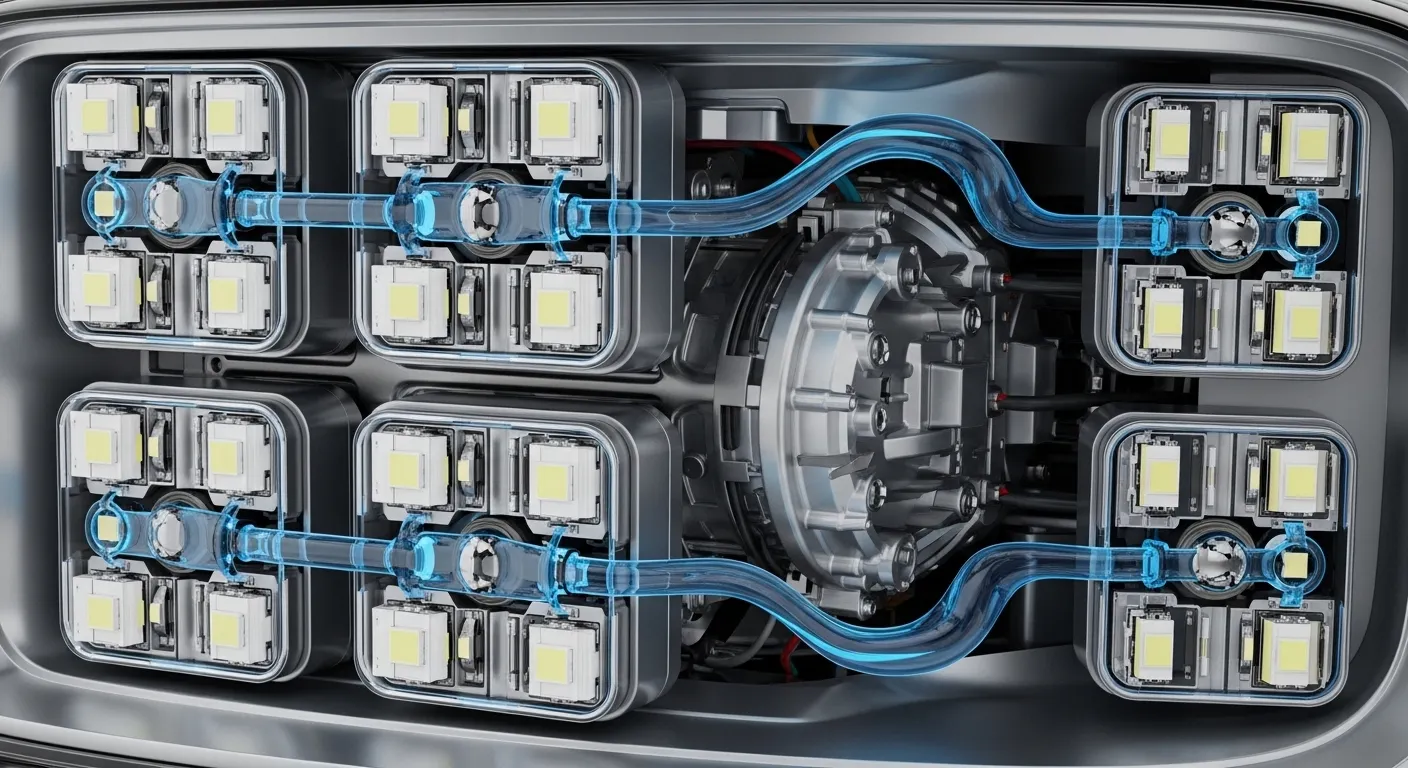
The shift toward smaller, more powerful light sources has made silicone the preferred choice for secondary optics.
Automotive Lighting
Modern Matrix LED and Adaptive Driving Beam (ADB) systems use silicone light guides. Because silicone can be molded into "whiskers" or complex arrays with sharp angles, it allows for precise beam shaping that would be impossible with glass.
Medical and Surgical Lighting
In the operating room, lighting must be shadowless and cool. Silicone lenses allow for high-intensity output without the risk of thermal burns or material degradation during repeated sterilization cycles.
Outdoor and Industrial Illumination
Street lights and high-bay warehouse lights face constant UV exposure and temperature fluctuations. Silicone lenses act as both the optic and the seal, reducing the number of components in the assembly. For systems with moving parts, flexible silicone parts for dynamic applications ensure the housing remains sealed while the optics adjust.
Common Mistakes to Avoid:
- Underestimating Shore Hardness: Using a silicone that is too soft for a large lens can lead to "sagging" under its own weight, distorting the focal point.
- Ignoring Outgassing: Failing to specify low-volatile grades can lead to a "fogging" effect on nearby reflectors.
Design for Manufacturability (DfM) for Silicone Optics
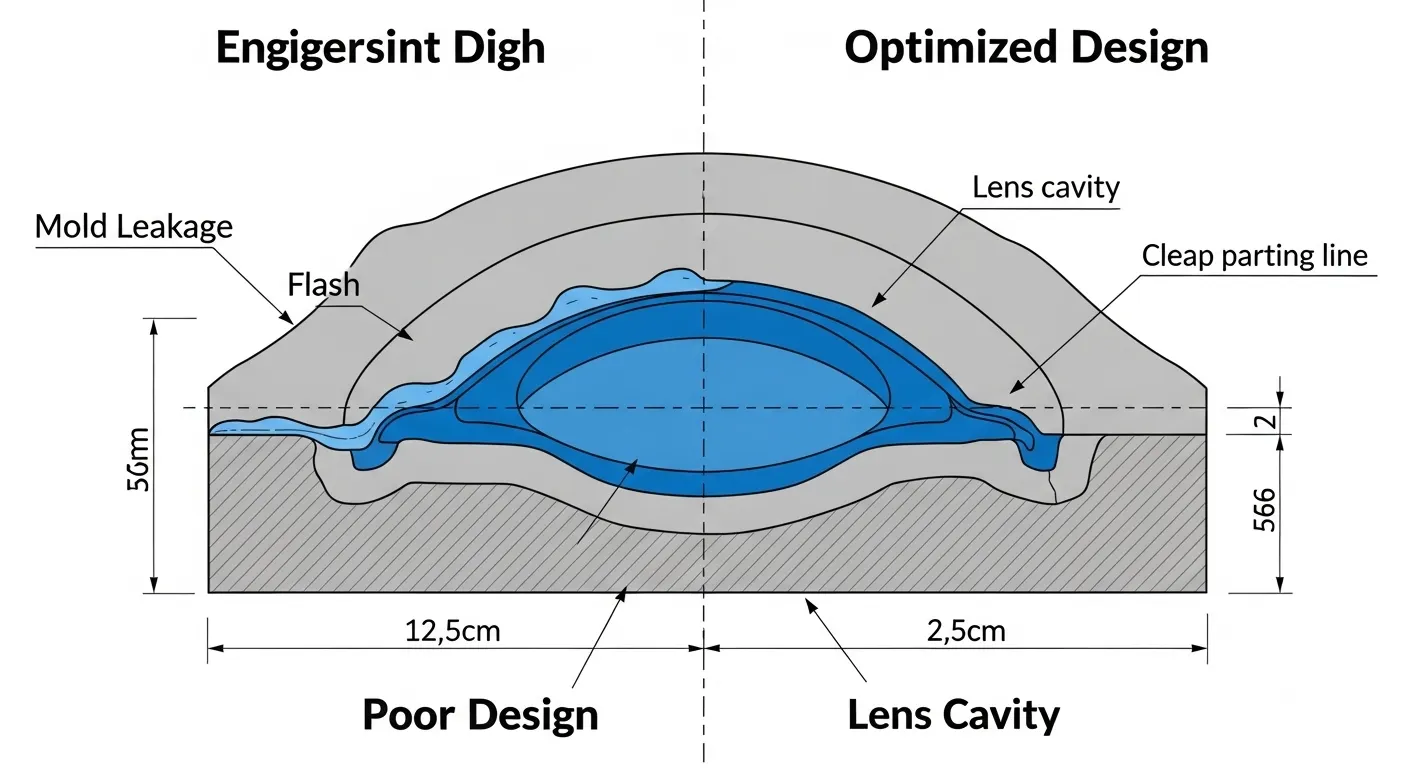
Designing for optical LSR requires a different mindset than designing for thermoplastics. Silicone’s low viscosity allows it to flow into incredibly thin cross-sections, but it also increases the risk of "flash" (excess material) at the parting line.
Critical Design Rules:
- Draft Angles: While silicone is flexible and can often be "stripped" from a mold with zero draft, adding 0.5 to 1 degree of draft helps maintain the SPI-A2 optical finish over long production runs.
- Parting Line Placement: Place parting lines on non-optical surfaces. Even a micron-level mismatch at the tool junction can cause light refraction issues.
- Wall Thickness: Aim for uniformity. While silicone handles thick sections better than plastic (no sink marks), extreme variations can cause "vacuum bubbles" or voids.
Comparative Performance: Silicone vs. Polycarbonate vs. Glass
When evaluating performance, engineers focus on the Yellowness Index (YI) and Delta E (a metric used to quantify the difference between two colors).
- Light Transmission: Optical LSR typically maintains (needs verification: 94%) transmission. In comparison, PC starts lower and degrades over time when exposed to UV.
- Refractive Index: Usually around 1.41 to 1.54 (needs verification). This is lower than glass, which designers must account for when calculating the lens curvature.
- Thermal Expansion: Silicone has a high Coefficient of Thermal Expansion (CTE). If the lens is constrained by a metal housing without room to expand, it can induce stress-birerefringence, affecting the light path.
Common Mistakes to Avoid:
- Miscalculating Shrinkage: Silicone shrinks during the curing process (often 2-4%). Tools must be oversized to compensate, or the lens power will be incorrect.
FAQ: Optically Clear Silicone Parts
No. Unlike polycarbonate or acrylic, optical-grade silicone is inorganic and does not degrade or yellow under intense UV light or high-heat LED exposure.
Most high-grade optical silicones offer between 94% and 95% light transmission, depending on the part thickness and surface finish.
Yes. Through multi-shot injection molding, silicone can be chemically or mechanically bonded to high-temp plastics to create integrated lens and seal assemblies.
An SPI-A2 or A1 diamond polish on the tool is required to achieve high-clarity, "water-clear" finishes on the final molded part.
Significantly better. Because silicone is elastomeric, it can be deformed to clear deep undercuts or negative drafts during ejection without damaging the part.
Typical tolerances are +/- 0.05mm to 0.1mm, though this depends heavily on part geometry and the precision of the mold construction (needs verification).
Conclusion
Optically clear silicone parts represent the future of high-efficiency lighting and precision lenses. By combining the transparency of glass with the design flexibility of injection molding, LSR allows engineers to push the boundaries of what is possible in automotive, medical, and industrial design.
