


Part Cleaning and Finishing: Which Method is Best?
Selecting the best part cleaning and finishing method depends on your material type, the required surface roughness (Ra), and the final application of the component. For industrial manufacturing, effective part cleaning and finishing involves removing contaminants like machining oils or mold release agents through ultrasonic or chemical cleaning, followed by mechanical or chemical finishing to achieve desired aesthetic or functional properties. High-precision industries like medical and automotive typically require integrated "turnkey" workflows to ensure that cleaning protocols do not compromise tight tolerances or material integrity.
Why Part Cleaning and Finishing Dictates Product Success
The final quality of an industrial component is rarely determined by the molding or machining process alone. In professional B2B manufacturing, the post-production phase—specifically part cleaning and finishing—serves as the final gate for quality assurance. If a part is not cleaned correctly, subsequent finishes like painting or plating will likely fail adhesion tests. Conversely, if a finishing method is too aggressive, it can strip away critical dimensions, leading to assembly failures.
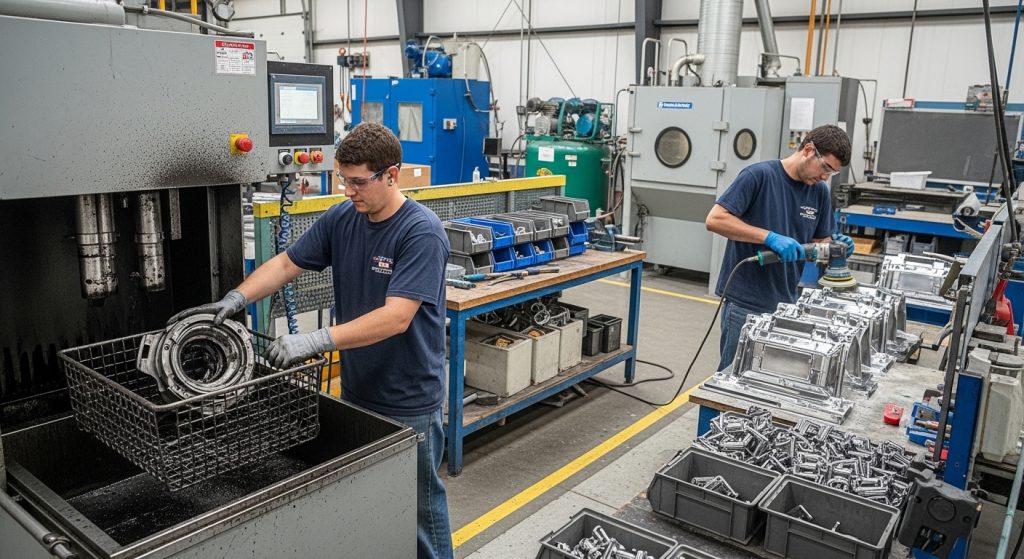
Procurement managers often overlook the logistical complexity of these secondary stages. Moving parts between a molder and a separate cleaning or finishing facility increases lead times and introduces risks of surface oxidation or contamination during transit. By utilizing integrated post-processing services, hardware founders and engineers can maintain a single chain of custody, ensuring that parts remain in a controlled environment from the moment they leave the tool until they are packaged for shipping.
Choosing the Right Industrial Cleaning Methods
Before any aesthetic or protective finish is applied, the substrate must be chemically and physically "clean." Contaminants such as coolants, metal chips, finger oils, and mold release agents can act as barriers, preventing coatings from bonding correctly to the surface.
Ultrasonic Cleaning for High-Precision Components
Ultrasonic cleaning uses high-frequency sound waves to create cavitation bubbles in a liquid solvent. When these bubbles collapse, they release energy that dislodges contaminants from even the most complex internal geometries. This method is the industry standard for medical devices and aerospace components where manual cleaning is impossible.
For parts produced via 2K injection molding, ultrasonic cleaning must be calibrated carefully. The vibration frequency must be high enough to clean the part but low enough to avoid delaminating the bond between the two different materials.
Chemical Degreasing and Solvent Cleaning
Chemical degreasing involves dipping or spraying parts with solvents or aqueous builders that dissolve oils and greases. This is often the primary step for metal die-castings and CNC-machined parts. Manufacturers must balance the cleaning power of the solvent with environmental compliance, ensuring all processes remain RoHS and REACH compliant to satisfy global regulatory requirements.
Mechanical Finishing: Achieving the Perfect Texture
Mechanical finishing uses physical abrasive force to alter the surface of a part. This is usually the first choice for removing burrs, smoothing parting lines, or creating a specific tactile feel.
Bead Blasting and Sandblasting
Bead blasting uses small spherical media (usually glass or ceramic) to create a uniform, matte finish on the part surface. It is highly effective at hiding minor machining marks or flow lines from the molding process. In the context of rapid molding lead time goals, bead blasting is a fast, cost-effective way to achieve a professional "industrial" look without the need for expensive hand-polishing.
Vibratory Finishing and Tumbling
Tumbling involves placing parts in a vibrating bowl filled with abrasive media and compounds. As the parts rub against the media, edges are deburred and surfaces are smoothed. This is a "batch" process, making it highly economical for high-volume production. It is commonly used for zinc and aluminum die-castings to prepare them for subsequent plating or painting.
Chemical and Electrochemical Finishing Solutions
When a part requires more than just a surface texture change—such as increased hardness or corrosion resistance—chemical finishing is necessary.
Anodizing for Aluminum and Titanium
Anodizing is an electrochemical process that converts the metal surface into a durable, corrosion-resistant, anodic oxide finish. Type II anodizing is primarily decorative and can be dyed in various colors, while Type III (Hardcoat) is used for industrial components requiring extreme wear resistance. Engineers must account for the dimensional "growth" that occurs during anodizing, often around 0.01mm to 0.05mm, in their initial 2K injection molding part design or machining files.
Electropolishing for Medical and Food Grade Parts
Electropolishing is essentially "reverse plating." It removes a microscopic layer of material from the surface of a metal part, typically stainless steel, to create a mirror-like finish. This process removes surface inclusions and burrs, leaving a surface that is easy to sterilize. It is the preferred method for surgical tools and food processing equipment.
Strategic Decision Factors for Sourcing Managers
Selecting a cleaning and finishing partner requires looking beyond the price per part. B2B buyers must evaluate the "Total Cost of Ownership," which includes the risk of failure and the cost of delays.
Material Compatibility and DFM Risks
Not every finish works with every material. For instance, certain aggressive solvents used in cleaning can craze or crack specific plastic resins. During a DFM-led quoting process, a senior manufacturer will flag these risks early. They might suggest a material change or a different cleaning protocol to ensure the part doesn't degrade over time.
Tooling Cost vs. Unit Cost Trade-offs
Sometimes, achieving a specific finish through post-processing is cheaper than trying to achieve it through the tool itself. For example, a high-gloss finish on an injection-molded part requires a highly polished (SPI A-1) steel tool, which can add thousands of dollars to the 2K mold maintenance and initial cost. In low-volume production, it may be more economical to use a standard tool finish and apply a high-gloss PU coating afterward.
Quality Assurance and Testing Transparency
A manufacturer's expertise is proven by their testing capabilities. When parts undergo part cleaning and finishing, the QA team should perform standardized tests to verify the result:
- Adhesion Testing: Using the "Cross-Hatch" method to ensure paints and coatings won't peel.
- Salt Spray Testing: For checking the corrosion resistance of plated or anodized metal parts.
- Surface Roughness (Ra) Measurement: Using a profilometer to verify that mechanical finishing met the engineering specifications.
- Cleanliness Verification: Using "water break" tests or solvent extraction to ensure all oils were removed during the cleaning phase.
Integrating Cleaning and Finishing into the RFQ
To ensure the best results, engineers should include finishing requirements in the initial RFQ. This allows the manufacturer to plan the entire production flow, from the choice of mold release agent to the final assembly steps.
- Identify the Environment: Is the part for indoor use, or will it face UV exposure and salt water?
- Define Tolerances: Specify if the dimensions on the drawing apply before or after finishing.
- Specify Standards: Use standard codes like RAL for colors or MT/SPI for textures to avoid ambiguity.
By providing these details, you allow the production team to optimize the vacuum casting process for prototypes or mass production tooling to accommodate the final finish.
Frequently Asked Questions
Which part cleaning method is best for small, complex geometries?
Ultrasonic cleaning is generally the best method for small or complex parts. It uses cavitation bubbles in a liquid medium to reach into tiny crevices and blind holes that manual cleaning or spray washing cannot penetrate, making it ideal for medical or electronic components.
Does bead blasting affect the dimensions of a part?
Bead blasting can affect dimensions, but the impact is usually minimal (typically less than 0.01mm). However, for extremely tight tolerances, manufacturers must protect critical surfaces with masking or adjust the initial machining dimensions to account for the slight material removal.
How do I know if a part is clean enough for painting?
The most common industrial test is the "water break" test. If a part is clean, water will spread in a thin, continuous film across the surface. If oils or contaminants remain, the water will "bead up," indicating that the surface energy is too low for proper paint adhesion.
Is anodizing better than powder coating for aluminum?
The choice depends on the application. Anodizing is an integral part of the substrate that won't peel and maintains tight tolerances, making it better for precision parts. Powder coating is a thicker "overlay" that provides better impact resistance and a wider range of colors, but it can obscure fine details.
How does finishing impact lead times in China-based manufacturing?
Integrated finishing usually adds 3–5 days to the production cycle. However, using a "turnkey" provider like SunOn is faster than shipping parts to a separate finishing house, which can add 10–14 days due to logistics, receiving inspections, and separate production queues.
Can I finish parts made from 2K injection molding?
Yes, you can finish 2K parts, but you must select methods compatible with both materials. For example, a cleaning solvent that is safe for an ABS substrate might damage a TPE overmold. A professional DFM review will identify these material compatibility risks before production begins.
Get an Expert DFM Review for Your Project
Choosing the wrong finishing method can lead to costly scrap and project delays. Request a DFM-led quote from SunOn today to ensure your part cleaning and finishing strategy is optimized for your specific material and application.
