


What is Precision Sheet Metal Fabrication? (Process & Applications)
Precision sheet metal fabrication is the backbone of modern manufacturing. It allows us to create highly accurate components for various industries. From aerospace to medical devices, this process ensures that every part fits perfectly. In this guide, we will dive deep into the methods, materials, and benefits of this specialized craft.
What is the Definition of Precision Sheet Metal Fabrication?
Precision sheet metal fabrication is an advanced manufacturing process that transforms flat metal sheets into complex parts using precise cutting, bending, and assembly techniques. Unlike standard fabrication, precision methods achieve extremely tight tolerances, often within +/- 0.005 inches. It relies on computer-controlled machinery (CNC) to ensure repeatability and accuracy for high-spec industrial applications.
When you think of standard fabrication, you might imagine a local shop welding steel beams for a fence. Precision fabrication is a different world entirely. It is a high-tech environment where fractions of a millimeter determine the success of a satellite launch or the functionality of a life-saving medical instrument. This process isn't just about moving metal; it's about mastering geometry and material science.
In my experience, the "precision" element comes from the synergy between software and hardware. Engineers use CAD (Computer-Aided Design) to create 3D models, which are then converted into machine code. This code guides lasers and punch presses with surgical accuracy. This level of detail is why industries like telecommunications and aerospace rely so heavily on these services. If you are looking for a broader overview of the general industry, you can explore the fundamentals of sheet metal fabrication.
What are the Main Stages of the Precision Fabrication Process?
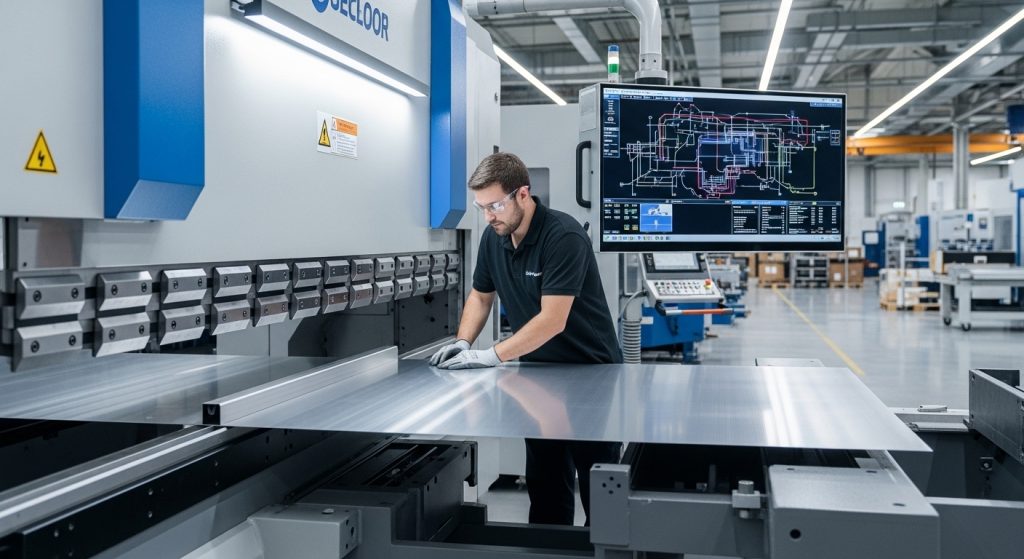
The precision sheet metal fabrication process follows a structured workflow: engineering and design, material selection, cutting, forming, and finishing. First, CAD designs are optimized for manufacturability (DFM). Then, the metal is cut via laser or waterjet, bent using CNC press brakes, and joined through specialized welding. Finally, parts undergo surface treatments like powder coating.
The journey from a flat sheet to a finished product is a fascinating sequence of physical transformations. Here is how it breaks down on the factory floor:
| Stage | Primary Method | Key Goal |
| Design | CAD/CAM Modeling | Eliminate errors before the first cut. |
| Cutting | Fiber Laser or CNC Punching | Create the "blank" with exact dimensions. |
| Bending | CNC Press Brake | Form angles while accounting for material springback. |
| Joining | TIG/MIG Welding or Riveting | Secure components into a final assembly. |
| Finishing | Anodizing/Powder Coating | Protect against corrosion and improve aesthetics. |
I've seen many projects fail during the bending stage because the designer didn't account for "bend allowance"—the physical stretch of the metal during forming. A precision partner will calculate this during the DFM phase, saving hours of rework and thousands in material costs.
Which Technologies Drive Precision in Metal Fabrication?
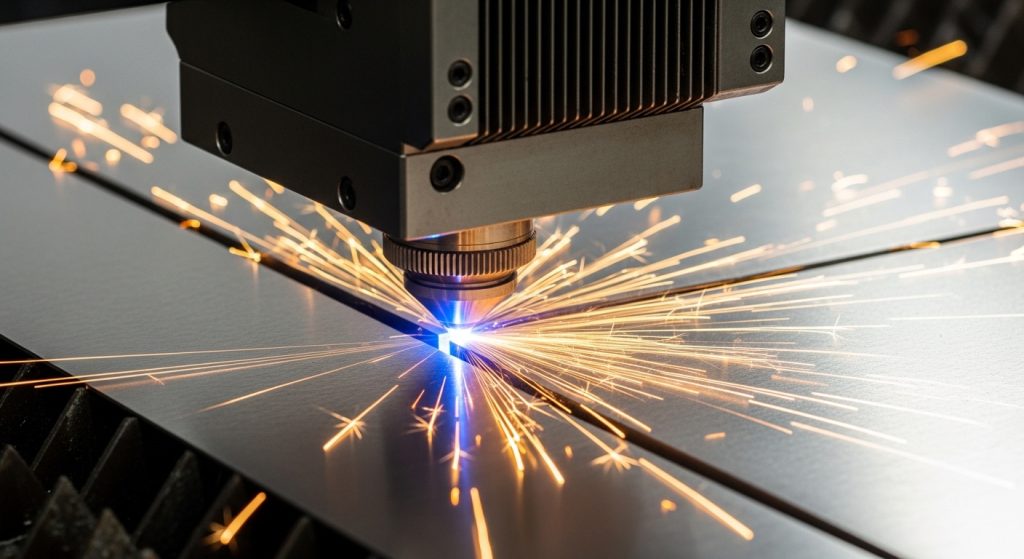
The primary technologies driving precision are Fiber Laser Cutting, CNC Punching, and CNC Bending. Fiber lasers use high-intensity light to cut through metal with minimal heat distortion. CNC Punching allows for high-speed creation of complex holes and louvers. CNC Bending uses computerized back-gauges to ensure that every bend angle is identical across thousands of parts.
Fiber Laser Cutting
Laser technology has revolutionized the industry. Modern fiber lasers can slice through stainless steel or aluminum at incredible speeds while maintaining a kerf (cut width) as thin as a human hair. This reduces material waste and allows for intricate patterns that were once impossible.
CNC Punching
For parts requiring repetitive holes or specialized forms like dimples or countersinks, CNC punching is the fastest method. It strikes the metal with immense force and speed, often completing hundreds of hits per minute.
CNC Bending (Press Brakes)
Even a 1-degree error in a bend can render a part useless. CNC press brakes solve this by using sensors to measure the angle in real-time. This is where the skill of the operator meets the intelligence of the machine. When producing metal stamping parts, consistency is key, and CNC bending provides that foundation for low-to-medium volume runs.
What Materials are Best Suited for Precision Fabrication?
The most common materials used are Aluminum, Stainless Steel, Carbon Steel, and Copper alloys. Aluminum is favored for its strength-to-weight ratio, while Stainless Steel is chosen for corrosion resistance. Copper and Brass are essential for electrical components. Selecting the right grade (e.g., Aluminum 6061 vs. 5052) is critical for achieving the desired precision.
Material selection is often the most overlooked part of the process. I once saw a client insist on a specific high-carbon steel for a part with tight bends, only to have the parts crack during production. The "temper" and "alloy" of the metal dictate how it reacts to stress.
- Aluminum: Lightweight and easy to form. Great for heat sinks.
- Stainless Steel (304/316): Tough, beautiful, and resistant to rust.
- Cold Rolled Steel: Cost-effective with a smooth finish, perfect for indoor enclosures.
- Copper: The gold standard for thermal and electrical conductivity.
Before you start your project, it is wise to learn how to choose metal for stamping and fabrication, as the material's grain direction can impact the final strength of your component.
How Does Precision Fabrication Differ from Metal Stamping?
Precision fabrication is a flexible, tool-less process ideal for low-to-medium volumes and prototyping. Metal stamping, however, uses dedicated "dies" to produce high-volume parts rapidly. Fabrication is better for design changes and complex geometries, while stamping offers the lowest per-part cost for mass production. Fabrication avoids the high upfront cost of custom tooling.
Choosing between these two methods usually comes down to "The Tipping Point"—the volume at which the cost of a custom stamping die pays for itself.
Tip: If you need 500 units, choose precision fabrication. If you need 50,000 units, metal stamping is usually the better investment.
For a deeper technical dive, you can read our comparison of metal stamping vs. CNC machining to see how different subtractive and formative processes stack up against each other.
What are the Typical Applications of Precision Sheet Metal?
Precision sheet metal parts are found in the Aerospace, Medical, Automotive, and Electronics sectors. Common applications include medical imaging equipment housings, aerospace brackets, high-end server racks, and automotive electrical enclosures. These industries require parts that can withstand extreme environments while maintaining perfect fitment within larger, complex mechanical assemblies.
Let's look at some real-world examples I've encountered:
- Medical: We often fabricate enclosures for MRI machines. These must be non-magnetic and have perfect finishes to ensure patient safety and machine longevity.
- Aerospace: Lightweight brackets that hold wiring harnesses in place. Every gram counts in flight, so we use precision thinning and high-strength alloys.
- Data Centers: Server racks require perfect airflow management. Precision punching allows us to create custom perforation patterns for optimal cooling.
What Quality Standards Ensure Precision and Reliability?
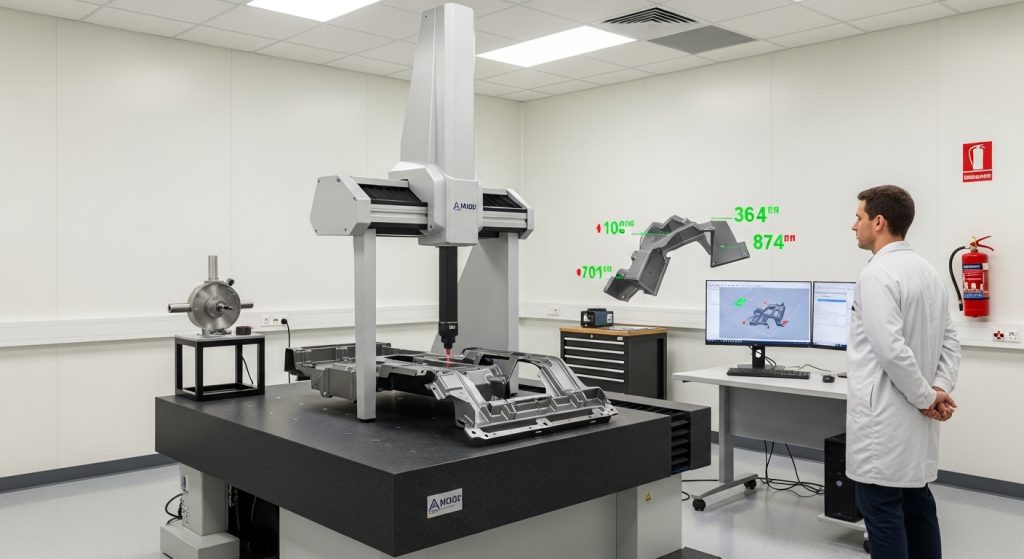
Precision is verified through ISO 9001 certifications and rigorous inspection protocols. Tools like Coordinate Measuring Machines (CMM) and 2D optical scanners compare the finished part to the original CAD model. Any deviation outside the agreed-upon tolerance is flagged. High-authority fabricators also provide material certifications and inspection reports to guarantee that every part meets industrial safety standards.
Tip: Always ask your fabricator for a "First Article Inspection" (FAI). This ensures the first part of a run is perfect before the rest of the batch is produced.
In a high-precision shop, the inspection area is usually the most climate-controlled room in the building. Metal expands and contracts with temperature. To measure a tolerance of +/- 0.002 inches, the part and the measuring tools must be at the same temperature. This is the level of obsession required for true precision.
How Can You Optimize Designs for Precision Fabrication?
To optimize for precision, designers should use consistent bend radii, avoid placing holes too close to bend lines, and simplify geometries where possible. Implementing Design for Manufacturing (DFM) principles reduces lead times and costs. Working with an experienced fabrication partner early in the design phase can help identify potential issues before they become expensive manufacturing hurdles.
Follow these rules of thumb to save money:
- Keep Bends Simple: Every additional bend increases the chance of cumulative error.
- Uniform Thickness: Don't mix different gauges of metal in a single assembly if you can avoid it.
- Standardize Hardware: Use common PEM nuts and standoffs to reduce specialized tooling needs.
Why is Choosing the Right Fabrication Partner Crucial?
The right partner provides more than just a part; they provide engineering expertise and supply chain stability. A partner with a robust quality management system and advanced CNC capabilities ensures that your project stays on schedule and within budget. Look for a manufacturer that offers end-to-end services, from prototyping to final finishing, to reduce logistical complexity.
In my years in this industry, the most successful partnerships are those where the fabricator is treated as an extension of the client's engineering team. When we look at a drawing and say, "If you move this flange by 2mm, we can use a standard tool and save you 15%," that is where the real value is created.
