


Sheet Metal Parts Manufacturing: A Step-by-Step Guide
Sheet metal parts manufacturing is the foundation of modern industrial production across the aerospace, automotive, and electronics sectors. This complex process transforms flat metal sheets into high-performance components using specialized cutting, bending, and forming techniques. By combining engineering precision with advanced machinery, manufacturers create durable parts that meet tight tolerances and specific functional requirements.
What is Sheet Metal Parts Manufacturing?
Sheet metal parts manufacturing is a set of industrial processes that shape flat pieces of metal into functional components. It involves removing material through cutting, deforming it through bending, or shaping it using dies and presses. This versatile method produces everything from tiny brackets to large vehicle panels with exceptional strength-to-weight ratios and cost-efficiency.
In my years on the factory floor, I have seen how this process evolves from a simple CAD drawing to a tangible, high-precision component. It is not just about "hitting metal." It is a calculated science. Whether you are building a prototype or scaling to mass production, understanding the nuances of sheet metal fabrication is the first step toward a successful product launch.
| Feature | Description |
| Material Thickness | Typically ranges from 0.006 to 0.25 inches. |
| Common Metals | Aluminum, Steel, Stainless Steel, Copper, and Brass. |
| Primary Goal | To create lightweight yet structurally sound components. |
| Key Industries | Medical, Telecommunications, Automotive, and Aerospace. |
How Does the Sheet Metal Design Process Work?
The design process for sheet metal parts begins with a digital 3D model that accounts for material thickness and "bend allowance." Engineers use specialized software to create a "flat pattern," which is a 2D representation of the part before it is folded. This stage ensures that the final physical product matches the intended dimensions without material tearing or structural failure.
Tip: Always design your parts with a uniform bend radius. Using the same radius across the entire part reduces tool changes and lowers your manufacturing costs significantly.
When designing, you must account for the K-factor. This is the ratio of the neutral axis to the material thickness. If you ignore this, your holes will not line up once the part is bent. We often see clients submit designs that look great on a screen but fail in the press brake because they didn't account for how the metal stretches.
What Are the Key Steps in the Manufacturing Process?
The manufacturing process follows a logical sequence: cutting, forming, joining, and finishing. First, the raw sheet is cut to the specific flat pattern dimensions. Next, the part undergoes bending or stamping to achieve its 3D shape. Finally, components are joined through welding or fastening before receiving a surface treatment to prevent corrosion.
1. Cutting the Raw Material
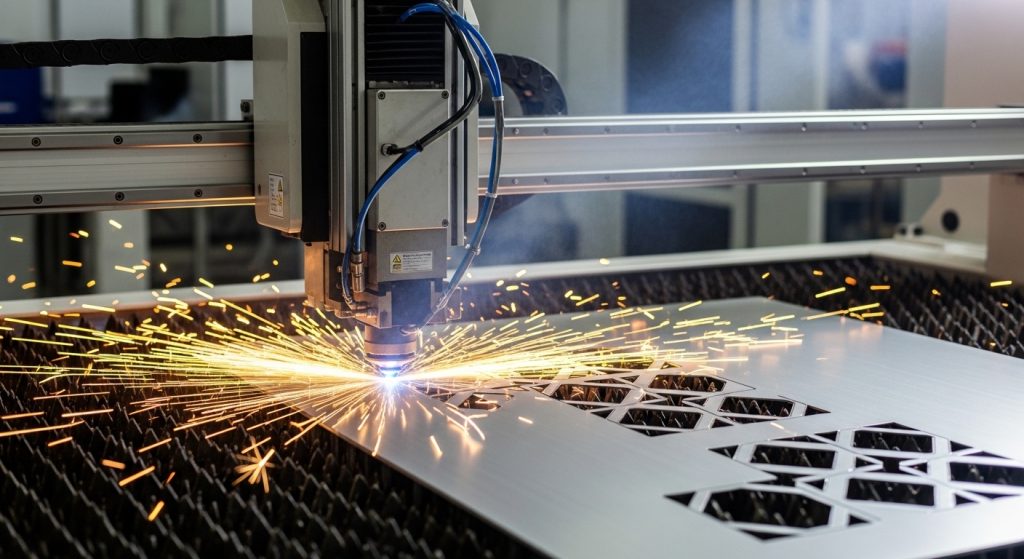
Cutting is the initial stage where the flat pattern is extracted from a large metal sheet. High-power fiber lasers or waterjets are the standard tools here. Laser cutting offers incredible speed and precision for complex geometries, while waterjets are ideal for thicker materials that are sensitive to heat.
2. Bending and Forming
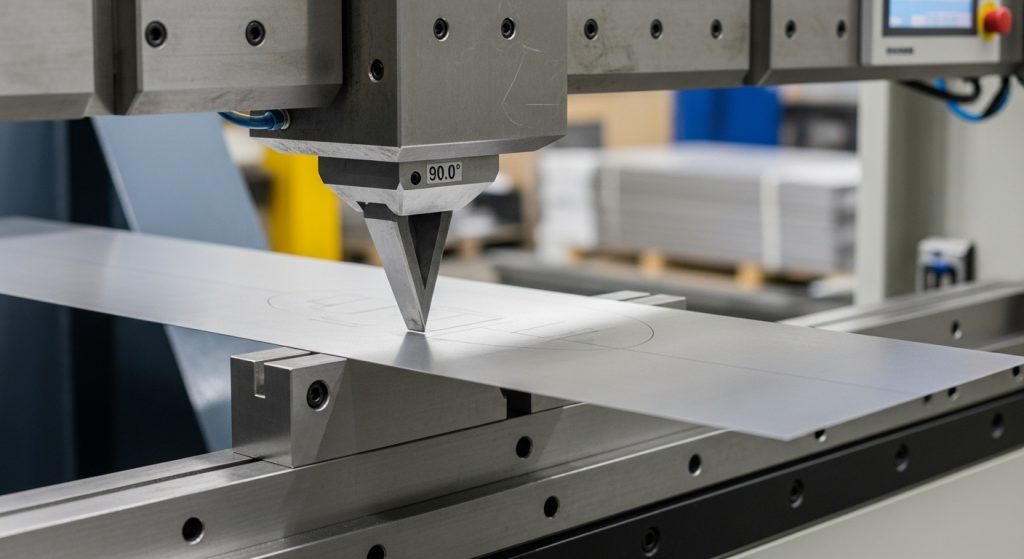
Once the flat shape is ready, it goes to the press brake. Bending requires immense force to deform the metal along a straight line. The operator must precisely calculate the "springback"—the tendency of the metal to return to its original shape—to ensure the angle is perfect.
3. Precision Metal Stamping
For high-volume production, metal stamping parts are the most efficient choice. This process uses a dedicated die and a high-speed press to "stamp" the shape out of the metal in seconds. It is the go-to method for repetitive, high-accuracy parts used in consumer electronics and automotive assemblies.
How Do You Choose the Right Material for Your Parts?
Choosing the right material depends on the part’s environment, required strength, and weight constraints. Aluminum is preferred for its lightweight and corrosion resistance, while stainless steel is chosen for high-strength or hygienic applications. Understanding the mechanical properties of each alloy is vital for ensuring the part performs reliably under stress.
When you choose metal for stamping, you must consider ductility. A metal that is too brittle will crack during the forming process. In our experience, Cold Rolled Steel (CRS) is excellent for parts that need a smooth finish, whereas Galvanized Steel is the workhorse for outdoor brackets due to its protective zinc coating.
| Material | Key Benefits | Common Applications |
| Aluminum 6061 | Lightweight, high corrosion resistance | Aerospace, Marine parts |
| Stainless Steel 304 | Excellent durability, heat resistant | Kitchenware, Medical tools |
| Copper | High electrical conductivity | Electrical terminals, Heat sinks |
| Carbon Steel | Cost-effective, very strong | Structural brackets, Car frames |
What Is the Difference Between Fabrication and Stamping?
The main difference lies in the volume of production and the tooling involved. Sheet metal fabrication is a flexible, lower-volume process using universal tools like lasers and press brakes. In contrast, stamping requires custom-made dies and is designed for massive production runs where the cost of the tooling is offset by a very low price-per-part.
Tip: If you need fewer than 1,000 units, stick with fabrication. If you are projecting 10,000 units or more, investing in stamping dies will save you thousands of dollars in the long run.
What Precision Services Are Available for Complex Parts?
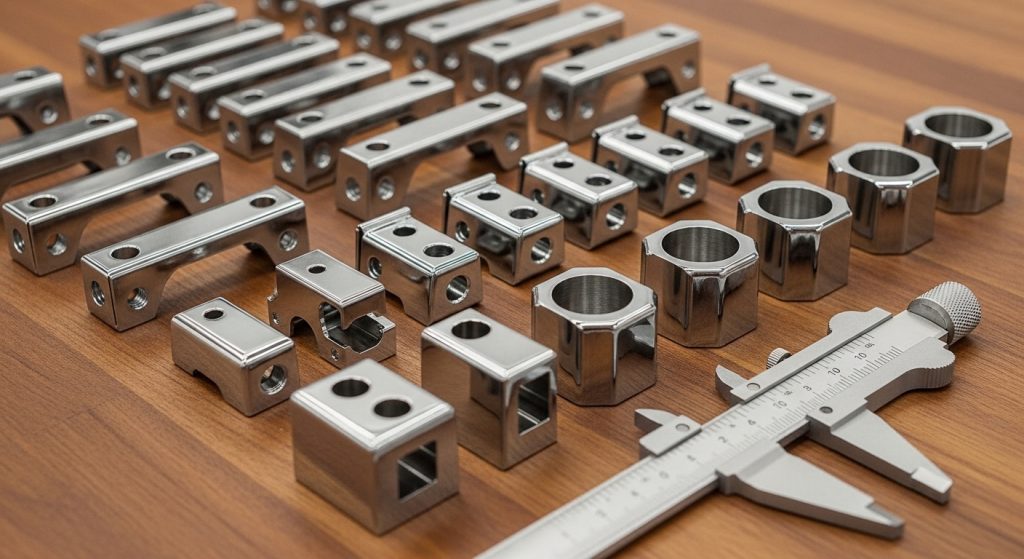
Advanced manufacturers offer precision metal stamping services that include progressive die stamping and deep drawing. These services allow for the creation of intricate shapes with tolerances as tight as +/- 0.001 inches. These high-precision methods are essential for components like battery terminals, sensors, and micro-connectors.
Precision is not just about the machines; it is about the quality control (QC) protocols. A high-authority shop will use Coordinate Measuring Machines (CMM) to verify every dimension. Based on recent industry data, implementing automated optical inspection can reduce defect rates by up to 40% compared to manual checking.
How Do Finishing Touches Enhance the Final Product?
Finishing is the final step where the part receives a surface treatment to improve its appearance or durability. Common finishes include powder coating, anodizing, and plating. These treatments provide a barrier against oxidation and can add aesthetic value through various colors and textures.
- Powder Coating: Provides a thick, durable layer of protection.
- Anodizing: Specifically for aluminum, it increases surface hardness.
- Zinc Plating: Offers sacrificial protection against rust.
- Passivation: Essential for stainless steel to remove surface contaminants.
What Are the Most Common Challenges in Manufacturing?
The most frequent challenges in sheet metal manufacturing include material warping, burr formation, and dimensional inaccuracies. Warping often occurs during welding due to uneven heat distribution. Burrs are sharp edges left behind after cutting or punching, which must be removed through deburring to ensure safety and proper fitment.
To combat these issues, we utilize "Design for Manufacturing" (DFM) reviews. By analyzing the part before a single piece of metal is cut, we identify potential failure points. For instance, placing a hole too close to a bend line will cause the hole to distort. Moving it just a few millimeters saves hours of rework.
Why Should You Partner with an Expert Manufacturer?
Partnering with an expert ensures that your project benefits from technical insight, high-grade materials, and optimized production cycles. A professional manufacturer does more than just follow a drawing; they provide feedback to improve part integrity and reduce waste. This collaboration leads to shorter lead times and a more robust final product.
The global sheet metal market is projected to reach billions in valuation by 2030. Staying competitive means utilizing the latest in automation and material science. When you work with a leader like Sunon Mould, you gain access to decades of expertise in both tooling and production.
