


Water Cooling Plate Manufacturing: CNC-Machined Aluminum Plates from SunOn
SunOn manufactures custom water cooling plates from customer-supplied drawings and project specifications. Our CNC machining team can review the plate geometry, aluminum grade, channel or cavity features, mounting details, tolerances, surface finish, quantity, and inspection requirements before production.
Whether you need an engineering prototype, a small batch, or repeat production, SunOn provides drawing-based manufacturing support for custom CNC-machined aluminum plates.
Send your 2D drawing and 3D CAD model to SunOn for a manufacturability review and quotation.
Custom CNC-Machined Water Cooling Plates from SunOn
A water cooling plate must match the dimensions, mounting arrangement, connection points, and functional requirements of the customer’s equipment. For this reason, SunOn supplies build-to-print parts rather than presenting one standard plate as suitable for every project.
Build-to-Print Manufacturing
SunOn can review water cooling plate designs that include customer-defined features such as:
- Overall plate dimensions and profiles
- Machined pockets and cavities
- Internal channel geometry
- Inlet and outlet positions
- Threaded holes and connection features
- Mounting holes and counterbores
- Sealing grooves or sealing faces
- Component-contact surfaces
- Alignment features
- Multi-face machined details
- Marking and finishing requirements
Manufacturability depends on the complete drawing. Channel depth, internal corner radius, wall thickness, hole location, thread specification, surface requirement, and machining access must all be reviewed before the part is quoted.
Suitable Project Stages
SunOn’s CNC machining service can support different development and purchasing stages, including:
- Engineering prototypes
- Functional samples
- Design-validation parts
- Small-batch production
- Pilot production
- Repeat machined-part orders
Send your material requirement, drawings, quantity, finish, and critical specifications so our team can evaluate the project.
Is a Water Cooling Plate the Same as a Liquid Cooling Cold Plate?
A water cooling plate is generally a subtype of a liquid cooling cold plate. The broader term “liquid cold plate” can describe plates that use water, water-glycol mixtures, or another compatible coolant. The term “water cooling plate” places more emphasis on water or a water-based fluid within the cooling loop.
The plate is only one component within the complete liquid-cooling system. The coolant, pump, tubing, fittings, heat exchanger, and other wetted materials must be considered at the system-design stage.
SunOn’s role on this page is focused on CNC manufacturing the custom aluminum plate according to the customer’s design. Thermal calculations, coolant selection, pressure-drop targets, and full system engineering should be defined by the customer or the responsible thermal-design team.
Water Cooling Plate Features SunOn Can Review for CNC Machining
SunOn can review the following drawing features for manufacturability. Their inclusion does not mean that every geometry can be machined without adjustment. Tool access, cutting depth, setup requirements, wall stability, and inspection access must first be checked.
| Drawing Feature | Manufacturing Consideration | Information the Buyer Should Provide |
|---|---|---|
| Internal channels | Tool diameter, access, depth, corner radius, and remaining wall thickness | Complete channel geometry and critical dimensions |
| Threaded ports | Thread type, depth, orientation, and sealing method | Thread standard and inspection requirement |
| Mounting holes | Position, datum relationship, and assembly fit | Hole tolerance and mating-part details |
| Contact surface | Flatness, roughness, and finishing allowance | Functional requirement and inspection method |
| Sealing groove | Width, depth, corner geometry, and gasket relationship | Seal or gasket specification |
| Thin walls | Deflection and machining stability | Minimum wall requirement and allowable design changes |
| Surface finish | Coating thickness, masking, and dimensional effect | Finish type and finished-dimension requirements |
Early review is especially important for deep or narrow channels, sharp internal corners, long unsupported walls, closely positioned holes, or features requiring machining from several faces.
CNC Manufacturing Process for Custom Water Cooling Plates
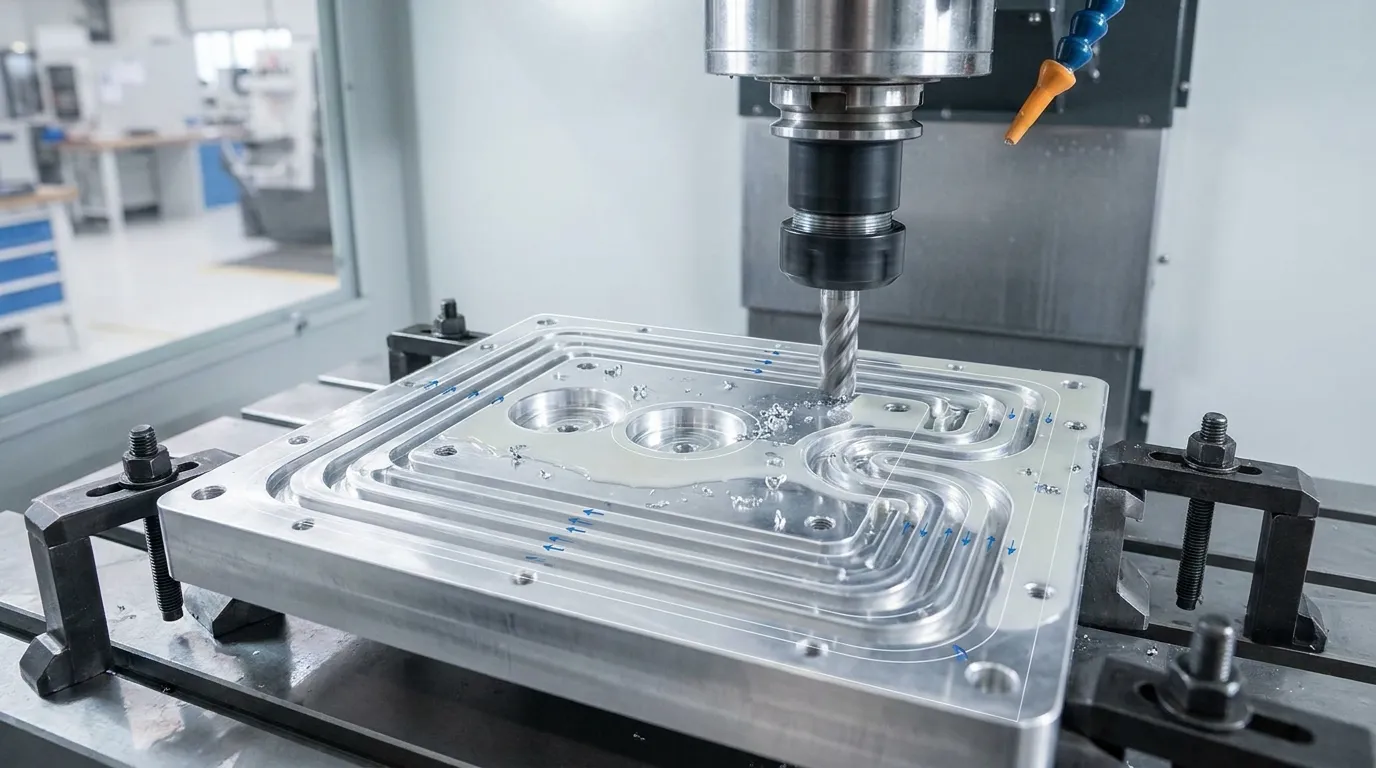
1. RFQ and File Review
A complete quotation normally starts with both a 3D CAD model and a controlled 2D technical drawing.
The 3D model defines the part geometry. The 2D drawing should identify information that may not be clear from the model, including:
- Critical dimensions
- General and feature-specific tolerances
- Datums and GD&T
- Thread specifications
- Flatness
- Surface roughness
- Material grade
- Finish
- Inspection notes
- Drawing revision
SunOn’s precision CNC machining services support projects where specific dimensions, fits, surfaces, or feature relationships require controlled machining and inspection planning.
2. DFM and Machining Review
Before production, the design should be checked for CNC manufacturability. The review may consider:
- Cutting-tool access
- Channel width and depth
- Internal corner radii
- Thin-wall deformation
- Deep pockets
- Hole and thread depth
- Feature alignment
- Number of machining setups
- Finishing allowance
- Inspection access
Not every dimension needs the tightest possible tolerance. Unnecessarily restrictive tolerances can add machining and inspection time without improving the part’s function. Critical features should be identified clearly, while non-critical dimensions can use practical manufacturing tolerances.
3. Material and Process Confirmation
Once the drawing is reviewed, SunOn can discuss the proposed manufacturing route. This may include:
- Aluminum grade
- Raw material form
- CNC milling operations
- Drilling and tapping
- Multi-face or multi-axis machining
- Deburring
- Surface finishing
- Critical feature inspection
SunOn’s aluminum CNC machining services cover custom aluminum components with pockets, slots, holes, threads, mounting features, and assembly-related surfaces.
4. CNC Machining
The machining sequence depends on the plate design. Typical operations may include milling the external profile, creating pockets or channels, drilling mounting holes, tapping threaded features, and machining critical faces.
Parts with features on several sides may require multiple setups or multi-axis machining. The process must maintain the relationship between channels, ports, mounting points, sealing features, and contact surfaces defined on the drawing.
5. Finishing and Inspection
After machining, the plate may require deburring, cleaning, and a customer-specified surface finish.
Finishing requirements should be confirmed before production because coating thickness, masking, and post-machining treatment can affect final dimensions. Buyers should distinguish between:
- Cosmetic surfaces
- Functional contact surfaces
- Sealing surfaces
- Threaded areas
- Masked areas
- Dimensions measured after finishing
Dimensional inspection can be planned around the critical requirements shown on the drawing. Inspection reports or customer-defined functional testing should be discussed during the RFQ stage.
Leak, pressure, flow, or other functional testing must not be assumed. These requirements should be submitted to SunOn for project-specific confirmation.
6. Sample Approval and Production Planning
For a new design, the project may begin with one or more prototype parts. The customer can evaluate assembly, mounting, connections, sealing details, and other functional requirements before approving a larger batch.
A typical path may include:
- Drawing and DFM review
- Prototype machining
- Customer evaluation
- Drawing revision, if required
- Small-batch or pilot production
- Repeat production planning
Aluminum Material and Surface Finish Decisions
Selecting the Aluminum Grade
The correct aluminum grade depends on more than thermal conductivity alone. The decision may also involve:
- Machinability
- Strength
- Corrosion environment
- Surface finish
- Weight
- Dimensional stability
- Coolant compatibility
- Compatibility with other wetted materials
Aluminum 6061 is commonly used for many machined components because it offers a practical balance of machinability, strength, and finishing options. However, it should not automatically be selected for every water cooling plate.
The buyer should specify the required grade or provide enough project information for a material discussion. The coolant and other materials in the cooling loop should also be disclosed so compatibility is not left to assumption.
Surface Finish and Anodizing
A custom aluminum water cooling plate may be supplied as machined or with a specified finish, depending on the project.
Possible finishing considerations include:
- As-machined appearance
- Bead blasting
- Anodizing
- Cosmetic consistency
- Masking requirements
- Thread protection
- Finished dimensions
- Wetted-surface requirements
Anodizing or another coating may affect surface texture and dimensions. The drawing should show whether critical dimensions apply before or after finishing and which areas must remain uncoated.
No finish should be presented as universally suitable for every coolant or operating environment. The final choice must match the complete system requirements.
Specifications to Include in a Water Cooling Plate RFQ
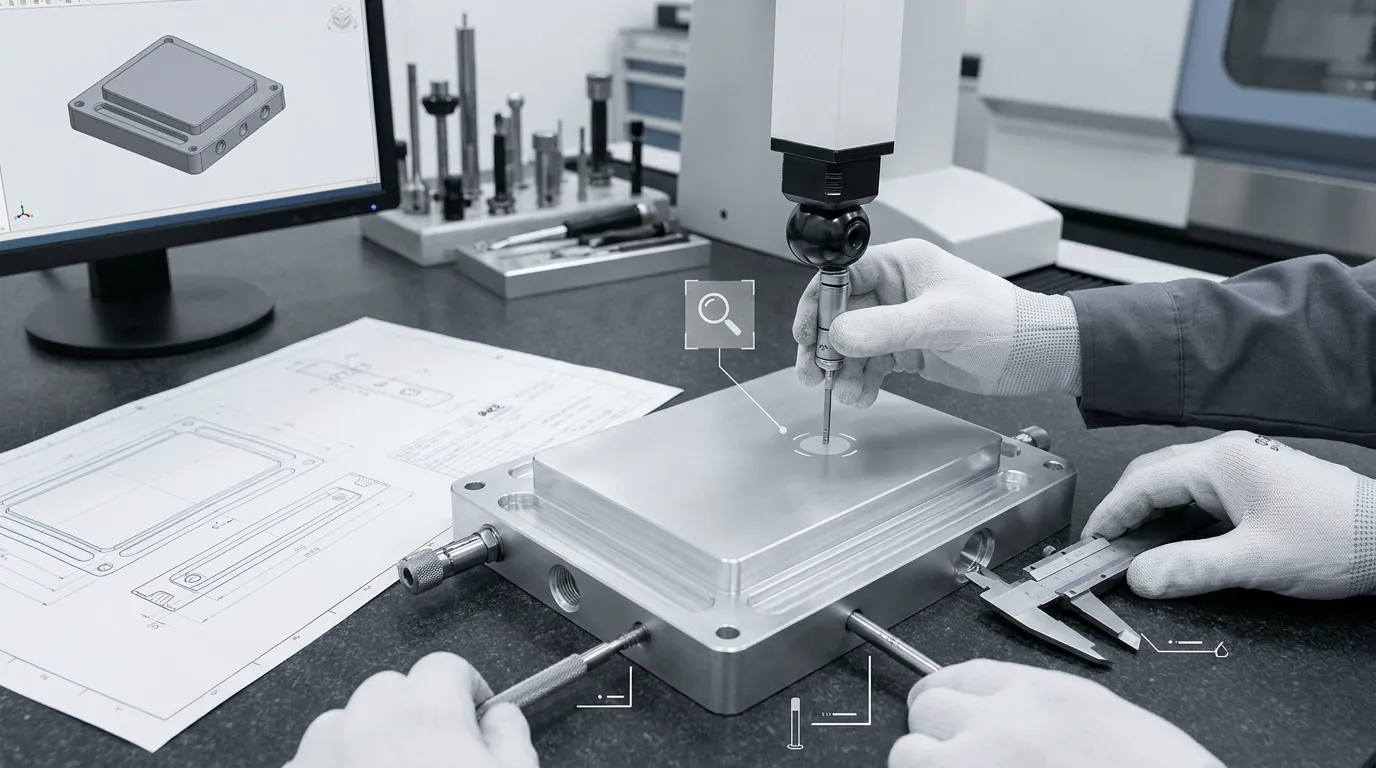
A complete RFQ helps SunOn assess the machining process, inspection needs, and quotation more accurately.
Include the following information where applicable:
- 2D technical drawing
- 3D CAD model
- Drawing revision
- Overall dimensions
- Aluminum grade
- Channel or cavity geometry
- Inlet and outlet positions
- Thread specifications
- Mounting pattern
- Sealing groove details
- Critical datums
- Flatness requirement
- Surface roughness
- General and critical tolerances
- Surface finish
- Masking areas
- Coolant type
- Other wetted-path materials
- Prototype quantity
- Expected production quantity
- Inspection report requirement
- Functional, pressure, flow, or leak-test requirements
- Packaging or cleanliness requirements
| RFQ Item | Why SunOn Needs It | Risk if Missing |
|---|---|---|
| 2D drawing | Defines tolerances, threads, datums, and inspection notes | Critical requirements may be interpreted incorrectly |
| 3D model | Defines the full part geometry | Quotation or programming may be delayed |
| Material grade | Affects machining and finishing | The wrong material may be quoted |
| Critical dimensions | Directs machining and inspection attention | Cost may increase or functional features may be missed |
| Coolant information | Supports compatibility discussions | Wetted-path assumptions may be unsuitable |
| Finish | Affects dimensions and masking | Finished parts may not meet assembly needs |
| Quantity | Supports process and quotation planning | The wrong production assumptions may be used |
| Testing requirement | Defines acceptance expectations | Buyer and supplier may expect different deliverables |
Prototype, Small-Batch, and Production Support
CNC machining allows buyers to produce functional plates without investing in dedicated production tooling at the prototype stage.
A prototype can be used to review:
- Plate dimensions
- Mounting alignment
- Port positions
- Thread engagement
- Assembly fit
- Sealing details
- Contact surfaces
- Drawing revisions
SunOn’s custom CNC machining for prototyping supports early samples, design validation, and low-volume requirements.
As the project moves toward repeat production, drawing revision control, inspection standards, finishing consistency, and expected annual quantity become more important. Buyers should communicate future volume early so SunOn can evaluate the most practical manufacturing approach.
Why Choose SunOn for Water Cooling Plate Manufacturing?
SunOn supports custom manufacturing projects from drawing review through machining, finishing coordination, inspection planning, and production discussion.
Relevant capabilities include:
- Drawing-based CNC manufacturing
- Aluminum machining experience
- CNC milling, drilling, and tapping
- Multi-face and multi-axis machining support
- DFM review before production
- Review of critical dimensions and tolerances
- Prototype and small-batch support
- Finishing coordination
- Inspection-requirement discussion
- OEM and ODM manufacturing support
The final capability assessment depends on the actual plate design. SunOn does not need to rely on broad claims about “maximum cooling” or “superior thermal performance.” The more useful proof is whether the part can be manufactured consistently according to the drawing and agreed acceptance requirements.
For supplier evaluation, buyers may request relevant machining photos, inspection examples, available equipment information, or project-specific production details.
Example Application Categories
Custom CNC-machined water cooling plates may be developed for drawing-based projects in areas such as:
- Electronics and electrical equipment
- Automotive and EV-related components
- Industrial machinery
- Equipment prototypes
- Custom OEM or ODM assemblies
- Other thermal-management components
Application suitability must be confirmed from the actual operating conditions, design, coolant, material, and testing requirements.
Frequently Asked Questions
What is a water cooling plate?
A water cooling plate is a thermally conductive plate designed to transfer heat from a component into water or a water-based coolant flowing through internal passages. It belongs to the broader liquid cold plate category.
Is a water cooling plate different from a liquid cold plate?
A water cooling plate is normally a water-specific subtype or naming variation of a liquid cold plate. “Liquid cold plate” is broader because the working fluid may be water, a water-glycol mixture, or another compatible coolant.
Can SunOn CNC-machine a custom aluminum water cooling plate?
SunOn can review customer drawings for custom aluminum CNC machining. Final manufacturability depends on the geometry, material, tolerances, channels, ports, finish, quantity, inspection requirements, and any required functional testing.
What files should I send for a quote?
Send a 3D CAD model and a controlled 2D technical drawing. Include the material, quantity, finish, critical dimensions, threads, flatness, roughness, coolant information, and inspection or testing requirements.
Which specifications should be included on the drawing?
The drawing should identify critical dimensions, tolerances, datums, threads, channel geometry, mounting features, sealing details, surface requirements, material grade, finish, and inspection notes.
Can SunOn produce prototypes and small batches?
Yes. SunOn’s CNC machining services support prototypes, design-validation parts, small batches, and production planning. Exact quantity, timing, and project requirements must be confirmed through quotation.
Which aluminum grade should I specify?
The grade should be selected according to strength, machinability, corrosion environment, finish, coolant compatibility, and system requirements. If the grade is not finalized, provide the operating and assembly information for review.
Does SunOn provide leak or pressure testing?
Leak, pressure, flow, or other functional testing must be included in the RFQ for engineering confirmation. The available procedure, acceptance criteria, equipment, and documentation should be agreed before production.
Request a Quote for a Custom Water Cooling Plate
Need a CNC-machined aluminum water cooling plate built to your drawing? Send SunOn your 2D drawing, 3D CAD model, material grade, quantity, finish, critical dimensions, coolant information, and inspection or testing requirements.
Our team will review the part for manufacturability and prepare a project-specific quotation.
Upload your drawings and request a custom water cooling plate quote from SunOn.
