


CNC Machining for Complex Parts
Complex CNC parts often include deep pockets, thin walls, angled holes, multiple machined faces, tight datum relationships, small internal radii, threads, inserts, undercuts, or curved surfaces. Before quoting, buyers should confirm the material, quantity, 2D drawing, 3D CAD model, tolerance requirements, surface finish, inspection needs, and production stage.
SunOn supports CNC milling, CNC turning, 5-axis CNC machining, CNC prototype machining, small-batch machining, custom metal parts machining, custom plastic parts machining, post-processing, surface finishing, assembly, and OEM/ODM manufacturing support. The goal is not only to machine the part, but also to help buyers reduce manufacturing risk before cutting material.
When CNC Machining for Complex Parts Is Needed
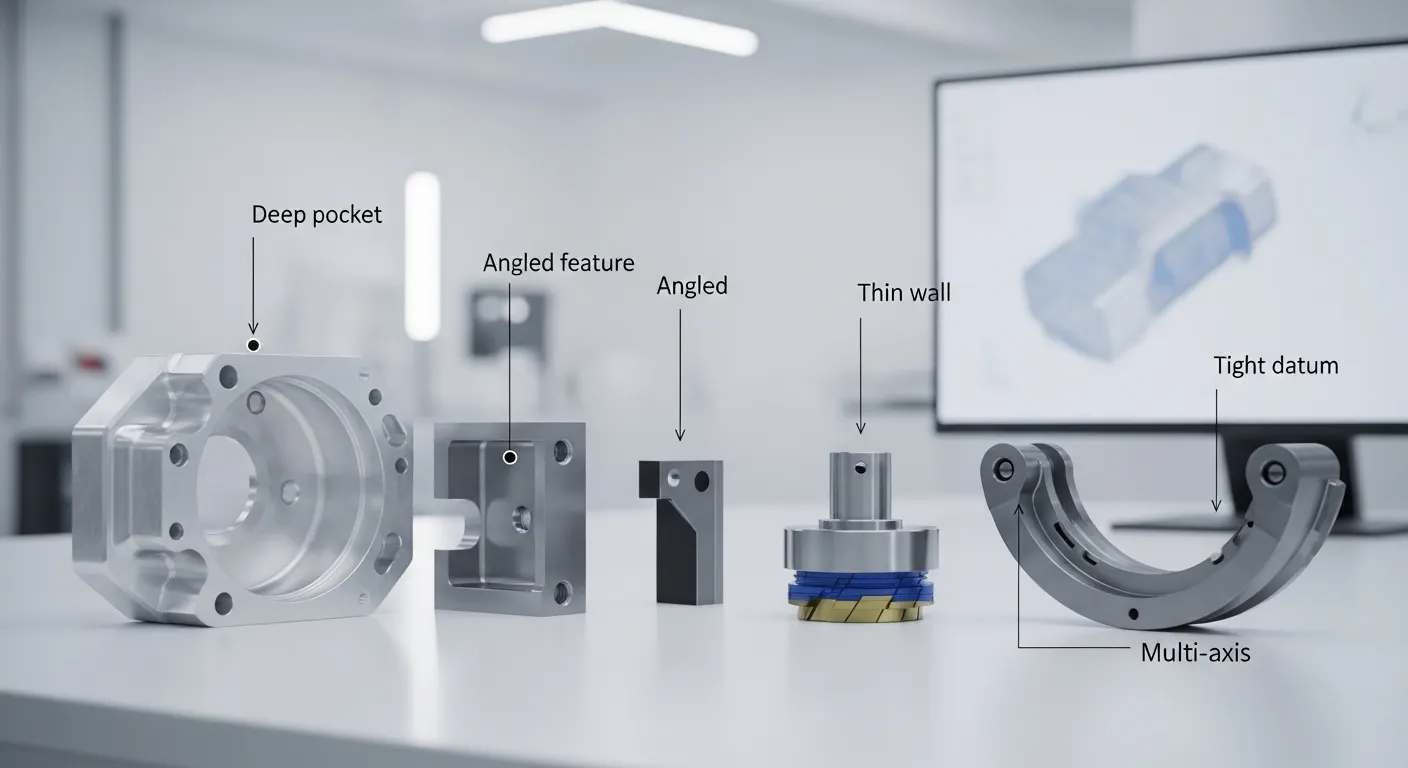
A part becomes complex when its geometry affects tool access, setup stability, tolerance control, or inspection planning. It may look simple in CAD, but machining becomes harder when the part requires features on several sides, narrow tools, long cutting depths, or tight alignment between different datums.
Buyers often request complex CNC machining for:
- Housings with deep pockets or internal walls
- Brackets with angled holes or multi-face features
- Manifolds with intersecting channels
- Automation and robotics components
- Electronics enclosures, heat sinks, and connector parts
- Industrial equipment parts with tight assembly points
- Prototype parts that must later move into small-batch or production use
- Custom metal or plastic parts with critical mating surfaces
For related electronics applications, buyers can also review SunOn’s CNC support for electronics components: CNC machining for electronics.
What Makes a CNC Part Difficult to Machine?
Complexity is not only about shape. It also depends on how the part must function after machining. A part with normal dimensions but strict flatness, perpendicularity, thread alignment, or cosmetic finish may require more planning than a larger part with loose requirements.
Common complexity factors include:
- Deep pockets: Longer tools may be required, which can affect rigidity, vibration, and surface quality.
- Thin walls: Material can flex during machining, especially when pockets or large cutouts are involved.
- Angled features: Holes, slots, and faces at non-standard angles may need 3+2 or 5-axis access.
- Tight datum relationships: Critical features may need careful setup planning and drawing review.
- Small internal radii: Tool diameter limits may make sharp internal corners difficult or costly.
- Undercuts and hidden features: Some features may require special tooling, EDM, or design adjustment.
- Threads and inserts: Thread depth, location, material strength, and assembly requirements must be confirmed.
- Surface finish zones: Cosmetic or sealing areas should be clearly marked on the drawing.
A good RFQ should show which features are functional, cosmetic, or non-critical. This helps the machining team focus accuracy where it matters most.
Choosing 3-Axis, 4-Axis, 3+2, or 5-Axis Machining
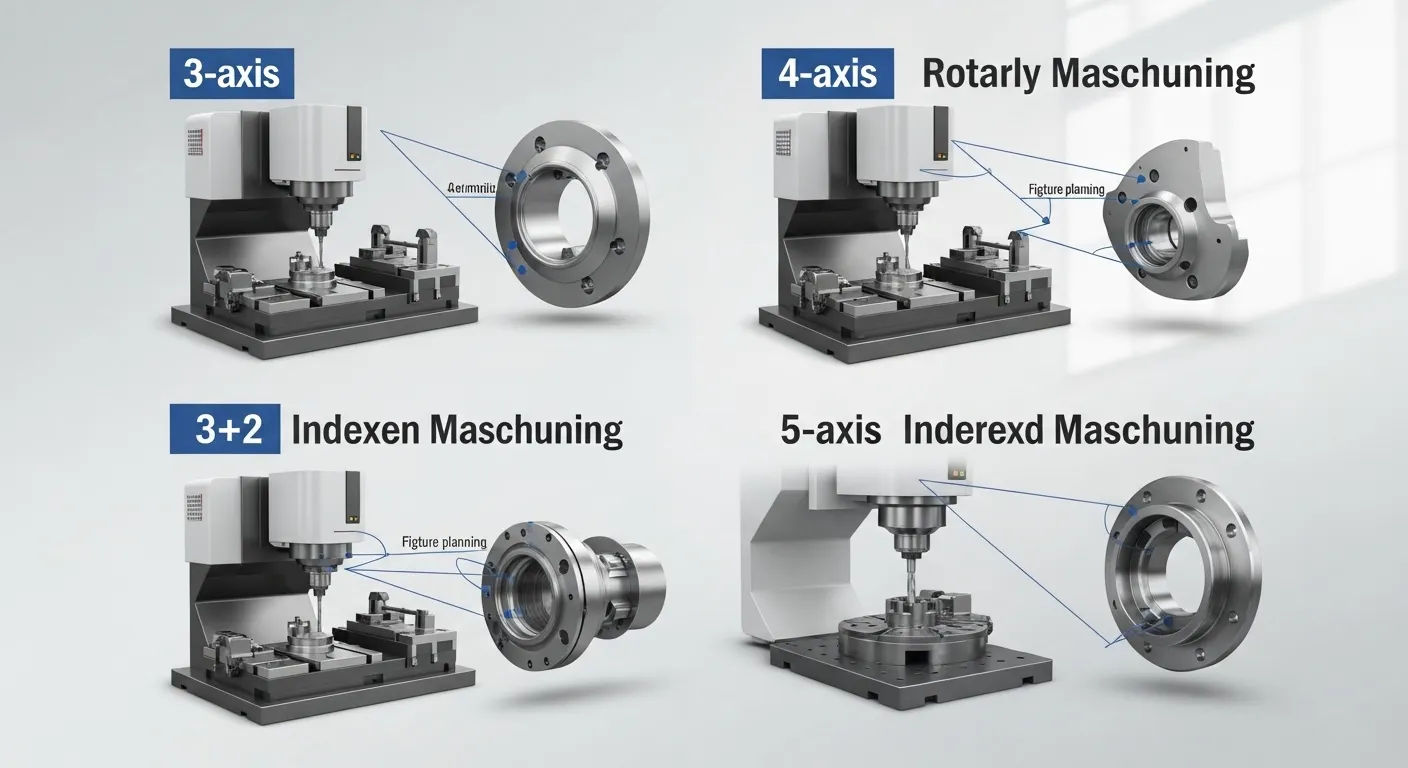
Not every complex part needs 5-axis machining. The correct process depends on geometry, tolerance, quantity, and setup risk. Some parts can be made efficiently with 3-axis milling and good fixture planning. Others may need 4-axis, 3+2, or 5-axis machining to reduce setups and improve access to angled or multi-face features.
| Complex feature or buyer need | Machining concern | Possible CNC approach | What buyers should confirm |
|---|---|---|---|
| Deep pockets | Tool reach, vibration, corner radius | CNC milling, possible 5-axis access | Pocket depth, internal radius, surface finish |
| Thin walls | Deformation during cutting | CNC milling with careful sequencing | Wall thickness, material, functional areas |
| Angled holes or faces | Tool access and setup angle | 3+2 or 5-axis machining | Hole angle, depth, thread requirement |
| Multi-face geometry | Multiple setups may affect alignment | 4-axis, 3+2, or 5-axis machining | Datum scheme and critical relationships |
| Curved surfaces | Toolpath strategy and finish control | 5-axis machining where suitable | Surface finish and cosmetic expectations |
| Threads and inserts | Strength, depth, assembly fit | Milling, drilling, tapping, inserts | Thread standard, insert type, mating part |
| Tight datum relationships | Inspection and repeatability risk | Process planning and fixture review | 2D drawing, GD&T, critical dimensions |
| Undercuts or hidden areas | Standard tools may not reach | Special tooling, EDM, or design change | Feature purpose and acceptable adjustment |
This table should be used as a planning guide, not a fixed rule. SunOn reviews the actual CAD model, drawing, material, tolerance, and quantity before recommending the machining route.
DFM Review Before Machining Complex Geometry
DFM review is especially important for complex CNC parts. A small design change can reduce machining difficulty, improve consistency, or lower unnecessary cost. For example, increasing an internal corner radius, changing a deep pocket detail, or separating a non-critical cosmetic requirement from a functional tolerance can make the part easier to manufacture.
During review, the machining team should check:
- Whether cutting tools can access all required features
- Whether wall thickness is practical for the selected material
- Whether internal corners match realistic tool diameters
- Whether deep holes, threads, and pockets are clearly defined
- Whether critical datums are shown on the 2D drawing
- Whether tolerances are applied only where needed
- Whether finishing requirements affect final dimensions
- Whether inspection requirements are practical for the part geometry
For complex metal components, buyers can also compare related support on SunOn’s custom metal CNC machining page: CNC machining services for custom metal parts.
Material Selection for Complex CNC Parts
Material choice affects tool wear, machining stability, surface finish, deformation risk, and final part performance. Buyers should confirm the material grade where possible, especially when the part has tight tolerance, cosmetic finish, heat exposure, wear resistance, or assembly requirements.
Common CNC material categories include:
- Aluminum: Often selected for lightweight housings, brackets, heat sinks, fixtures, and prototype parts.
- Stainless steel: Suitable where strength, corrosion resistance, or durability is important.
- Steel: Used for stronger mechanical components, tooling-related parts, and industrial applications.
- Brass and copper: Used for electrical, thermal, connector, and precision component applications.
- Titanium: Considered for lightweight strength or corrosion resistance where the application requires it.
- ABS, PC, PMMA, nylon, POM/Delrin, PTFE, and PEEK: Used for plastic machined parts, functional prototypes, insulators, guides, housings, and wear-related components.
For complex plastic parts, the RFQ should also mention whether the part is a prototype, test part, production-intent component, or a candidate for future injection molding. SunOn can support CNC machining as well as plastic injection mold manufacturing and injection molding when the project moves toward production.
Tolerance, Finish, and Inspection Planning
Complex CNC parts need clear tolerance planning. Tight tolerances should be assigned to functional features, not every surface. Over-tolerancing can increase machining effort, inspection time, and cost without improving the final product.
Buyers should clearly mark:
- Critical mating surfaces
- Hole positions and thread requirements
- Flatness, perpendicularity, concentricity, or alignment needs
- Datum features and GD&T callouts
- Cosmetic surfaces
- Sealing surfaces
- Areas affected by plating, anodizing, coating, polishing, or other finishing
- Dimensions that need inspection reports
Surface finishing should also be discussed before machining. Anodizing, plating, powder coating, polishing, bead blasting, painting, and other post-processing steps can affect appearance, dimensions, masking needs, and assembly fit.
If quality-system expectations are important for the project, buyers can review SunOn’s related CNC quality-focused page: CNC machining services with ISO 9001 certification.
Prototype, Small-Batch, and Production Considerations
Complex CNC parts often start as prototypes. The first version helps validate fit, assembly, material behavior, surface finish, and functional performance. After testing, buyers may adjust tolerances, wall thickness, thread details, or finish requirements before ordering small-batch or production quantities.
For small-batch projects, repeatability becomes more important. Fixture planning, datum control, toolpath consistency, and inspection requirements should be discussed early. For production-intent parts, buyers should also consider whether CNC machining remains the best long-term process or whether injection molding, die casting, or another manufacturing route may become more suitable at higher volume.
For machinery, automation, and equipment applications, buyers can also review SunOn’s industrial CNC machining support: CNC machining services for industrial equipment.
What Buyers Should Send for a CNC Machining Quote

A complete RFQ helps SunOn review the part faster and respond with fewer back-and-forth questions. For complex CNC machined parts, the CAD model alone is often not enough. The 2D drawing is still important because it shows tolerances, datums, threads, finishes, and inspection requirements.
Before requesting a quote, prepare:
- Product or part name
- Application or industry
- Prototype, small-batch, or production stage
- Required quantity
- 3D CAD model
- 2D technical drawing
- Material requirement and grade if known
- Critical tolerance requirements
- Surface finish, color, coating, plating, anodizing, or polishing needs
- Threading, holes, slots, inserts, undercuts, or assembly details
- Cosmetic surface requirements
- Inspection report or dimensional report needs
- Functional testing requirements if relevant
- Delivery destination
- Target schedule if relevant
- NDA, BOM, or project specification if required
- Existing mold, tooling, or previous sample information if available
If some details are not finalized, buyers can still send the available files and ask for DFM feedback. Early review is useful when the design has deep pockets, thin walls, tight datums, or features that may need multi-axis machining.
Why Work With SunOn for Complex CNC Parts?
SunOn Mould supports buyers who need more than a simple machined component. Many projects require CNC machining, finishing, assembly, prototype validation, mold making, injection molding, die casting, or OEM/ODM manufacturing support in the same development path.
For complex parts, SunOn can help buyers discuss:
- Which CNC machining route fits the geometry
- Whether 5-axis machining is useful or unnecessary
- How material choice affects manufacturability
- Which tolerances should be treated as critical
- Which finish requirements should be confirmed before machining
- How prototype feedback may affect future production
- Whether the part should remain CNC machined or move to another process later
This makes the page especially relevant for engineers, product teams, and procurement managers who need a supplier that can review the technical details before production starts.
Frequently Asked Questions
Can SunOn machine complex CNC parts with deep pockets or angled features?
SunOn can review complex part geometry, including deep pockets, angled holes, thin walls, multi-face features, and tight datum relationships. The final machining approach depends on the CAD model, drawing, material, tolerance, finish, and quantity.
When does a part need 5-axis CNC machining?
A part may need 5-axis machining when features sit on several angled faces, tool access is limited, or fewer setups may improve machining stability. SunOn reviews the design before recommending 3-axis, 4-axis, 3+2, or 5-axis machining.
What files are needed for a complex CNC quote?
Send a 3D CAD model and a 2D drawing. The drawing should show material, quantity, tolerances, threads, datums, surface finish, inspection needs, and any special assembly or cosmetic requirements.
Do tight tolerances increase CNC machining difficulty?
Yes. Tight tolerances can require more careful setup, slower machining, added inspection, and closer process control. Buyers should apply tight tolerances to functional features rather than every dimension.
Which materials are used for complex CNC parts?
Common options include aluminum, stainless steel, steel, brass, copper, titanium, ABS, PC, PMMA, nylon, POM/Delrin, PTFE, and PEEK. The best choice depends on strength, weight, wear, temperature, finish, and application needs.
Can complex CNC parts move from prototype to production?
Yes. CNC machining is often used for prototypes, small batches, and production-intent parts. SunOn can review design changes, material choices, finishing needs, and inspection requirements as the project moves forward.
Request a CNC Machining Quote for Complex Parts
If your part includes deep pockets, thin walls, angled holes, multi-face geometry, tight datum relationships, threads, inserts, undercuts, or critical surface finish requirements, share your project files with SunOn for review.
Send your 3D CAD model, 2D drawing, material requirement, quantity, tolerance details, surface finish needs, inspection requirements, application, delivery destination, and target schedule. SunOn can review your files, discuss DFM concerns, recommend a suitable CNC machining approach, and support your project from prototype to small batch, production planning, finishing, assembly, or OEM/ODM manufacturing.
