


CNC Plastic Machining Services
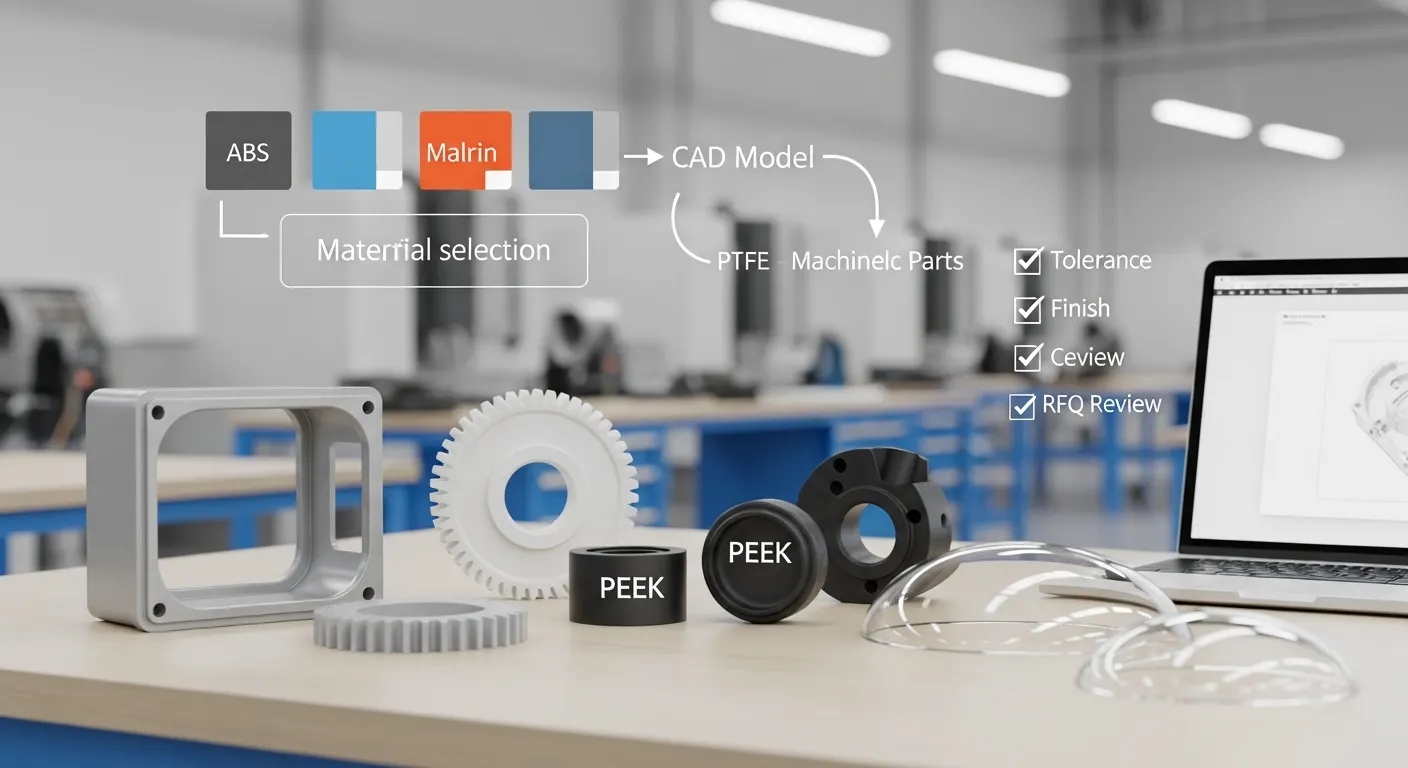
Plastic materials do not behave like metals during machining. ABS, Delrin, PTFE, PEEK, nylon, and PC each respond differently to cutting heat, wall thickness, moisture, friction, and dimensional stress. A good RFQ should not only ask whether a supplier can machine the part. It should also show how the part will be used, which dimensions are critical, and whether the project is for prototype testing, small-batch production, or future injection molding.
SunOn supports custom CNC machining, prototyping, finishing, mold making, injection molding, assembly, and OEM/ODM manufacturing support for buyers who need a practical path from design review to production planning.
CNC Plastic Machining for Prototypes and Low-Volume Parts
CNC plastic machining is often the right choice when buyers need real engineering plastic parts without waiting for mold tooling. It is useful for functional prototypes, test parts, jigs, fixtures, enclosures, covers, spacers, bushings, gears, brackets, and small-batch components.
For early product development, CNC machining can help teams test fit, strength, assembly, and material behavior before committing to injection mold manufacturing. It is also useful when the quantity is too low for tooling, when the design may change, or when the part needs features that are easier to machine from plastic stock.
SunOn can review plastic CNC projects based on:
- Part geometry and feature complexity
- Material selection and material grade requirements
- Prototype, small-batch, or production stage
- CNC milling, CNC turning, or multi-axis machining needs
- Tolerance and critical dimension requirements
- Surface finish and cosmetic expectations
- Threading, inserts, holes, slots, and assembly features
- Inspection or dimensional report requirements
This helps buyers avoid selecting a material or process that looks suitable on paper but becomes difficult during machining, assembly, or end use.
Which Plastic Materials Can Be CNC Machined?
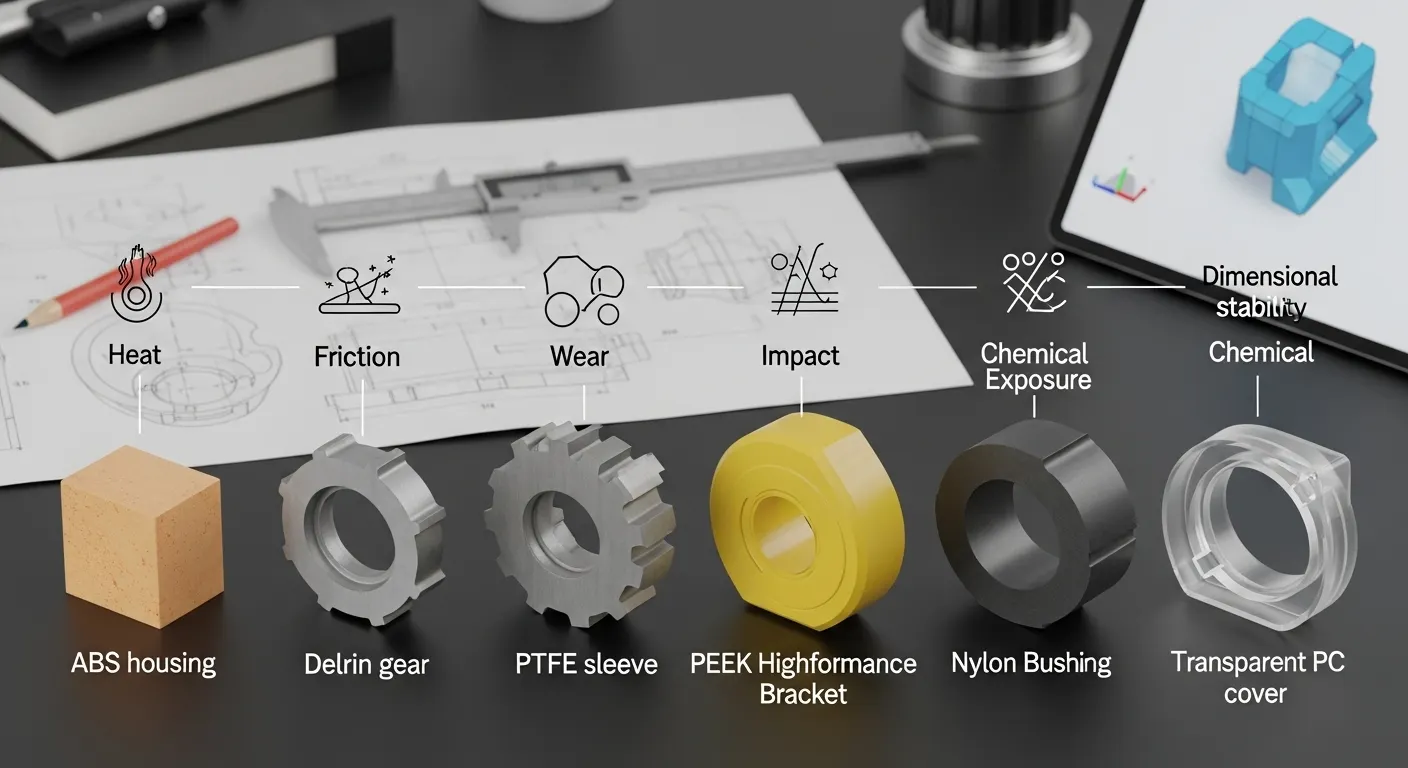
Material selection is the most important decision in CNC plastic machining. The right plastic depends on load, friction, heat, chemical exposure, dimensional stability, transparency, impact resistance, and cost expectations.
| Plastic material | Common reason to choose it | Typical part examples | Machining and tolerance notes |
|---|---|---|---|
| ABS | General-purpose plastic for prototypes and housings | Enclosures, covers, brackets, fit-check parts | Good for functional prototypes, but final use conditions should be confirmed |
| Delrin / POM | Low friction, wear resistance, dimensional stability | Gears, bushings, rollers, spacers, sliding parts | Good for precision plastic parts, but thin or uneven sections need review |
| PTFE | Very low friction and chemical resistance | Seals, sliding parts, chemical-contact parts, insulators | Softer material; tolerance and deformation risk should be reviewed |
| PEEK | High-performance plastic for heat, wear, and demanding use | High-temperature parts, wear parts, precision components | Suitable for demanding applications, but cost and machining requirements should be discussed |
| Nylon | Strength, wear resistance, and mechanical performance | Gears, bushings, bearings, structural plastic parts | Can absorb moisture, so dimensional stability should be considered |
| PC / Polycarbonate | Impact resistance and transparency | Covers, guards, lenses, protective parts, housings | Cosmetic and transparent surface expectations should be confirmed early |
For buyers comparing engineering plastics, SunOn’s Delrin CNC machining page can support low-friction and wear-resistant part decisions. For high-performance plastic components, the PEEK machined parts page is useful when heat, wear, chemical exposure, or demanding functional conditions matter.
How Plastic Materials Affect Tolerance and Stability
Plastic parts can move, flex, swell, or deform more easily than metal parts. This does not mean plastic cannot be machined accurately. It means the tolerance plan must match the material, geometry, and application.
Several factors affect plastic CNC tolerance:
- Thermal expansion during machining or end use
- Moisture absorption, especially for materials such as nylon
- Softness or creep in materials such as PTFE
- Internal stress in plastic stock
- Thin walls, deep pockets, and uneven material removal
- Large flat surfaces that may warp
- Tight holes, threads, press-fit features, or inserts
- Temperature and load during final use
Buyers should mark critical dimensions clearly on the 2D drawing. Non-critical dimensions should not be over-toleranced, because unnecessary tight tolerance can increase machining difficulty and cost.
If your part has demanding tolerance requirements, SunOn can review the drawing, material, and geometry before quoting. For related guidance, see SunOn’s page on tight tolerance CNC machining services.
CNC Milling, Turning, and Complex Plastic Features
Different plastic part designs need different CNC processes. CNC milling is often used for flat surfaces, pockets, slots, holes, profiles, enclosure features, and complex multi-side geometry. CNC turning is useful for round components such as bushings, sleeves, rollers, spacers, shafts, and threaded cylindrical parts.
Some plastic parts may need multi-axis machining when features appear on several faces or when the design has complex surfaces. The best process depends on the CAD model, drawing, tolerance, material, and required finish.
Before production, buyers should confirm whether the part includes:
- Deep pockets or narrow slots
- Thin walls or long unsupported features
- Sharp internal corners
- Small holes or tapped holes
- Threads, inserts, or press-fit areas
- Undercuts or multi-side machining
- Transparent or cosmetic surfaces
- Assembly interfaces with metal or molded parts
These details affect tooling strategy, machining sequence, workholding, inspection, and final part stability.
Surface Finish Expectations for CNC Machined Plastic Parts
Most CNC machined plastic parts are supplied with an as-machined surface unless another finish is requested. The final appearance depends on the plastic material, cutting strategy, tool marks, part geometry, and cosmetic requirement.
For functional prototypes, an as-machined finish may be enough. For visible parts, covers, guards, or customer-facing components, buyers should define the acceptable appearance before quoting.
Common finish-related points include:
- Whether tool marks are acceptable
- Whether the part needs deburring
- Whether polishing is required or possible
- Whether transparent PC or acrylic-like parts need special cosmetic review
- Whether color depends on stock material
- Whether the surface is functional, cosmetic, or both
- Whether the part will later be assembled, bonded, or fitted with inserts
Plastic finishing should be discussed early. Some materials polish or deburr better than others, and some features may be difficult to finish after machining.
When Should Buyers Choose CNC Plastic Machining Instead of Molding?
CNC plastic machining is often better when the buyer needs real plastic parts quickly, in lower quantity, or before the design is frozen. It avoids mold tooling and allows design changes between batches.
Injection molding is usually more suitable when the design is stable and the buyer needs repeat production at higher volume. Mold making requires more upfront planning, but it can support consistent molded plastic parts after the tool is approved.
Vacuum casting may fit small batches of prototype-like plastic parts when buyers need molded-style appearance without production tooling. 3D printing may be better for early concept models, fast geometry checks, or designs that do not need production-grade plastic stock.
A practical process choice depends on:
- Quantity
- Target material
- Functional load
- Surface appearance
- Tolerance
- Design maturity
- Tooling budget
- Future production plan
SunOn can support CNC machining, rapid prototyping, injection mold manufacturing, plastic injection molding, vacuum casting, finishing, assembly, and OEM/ODM production planning. This helps buyers choose a process based on the project stage rather than only the part shape.
Common Applications for CNC Plastic Machined Parts
CNC plastic machining is useful across product development and industrial manufacturing. Buyers often request plastic machined parts for applications where weight, insulation, friction, chemical resistance, or non-metallic performance matters.
Common examples include:
- Plastic enclosures and covers
- Electrical insulation parts
- Spacers, washers, sleeves, and bushings
- Gears, rollers, and low-friction wear parts
- Jigs, fixtures, and assembly aids
- Transparent guards or protective covers
- Chemical-contact or fluid-handling parts
- Test parts before injection molding
- Industrial equipment components
- Electronics, automation, machinery, and new energy product parts
For regulated or demanding industries, buyers should provide clear application requirements, inspection needs, and any project-specific standards. SunOn should review these requirements before confirming the manufacturing route.
What to Send for a CNC Plastic Machining Quote
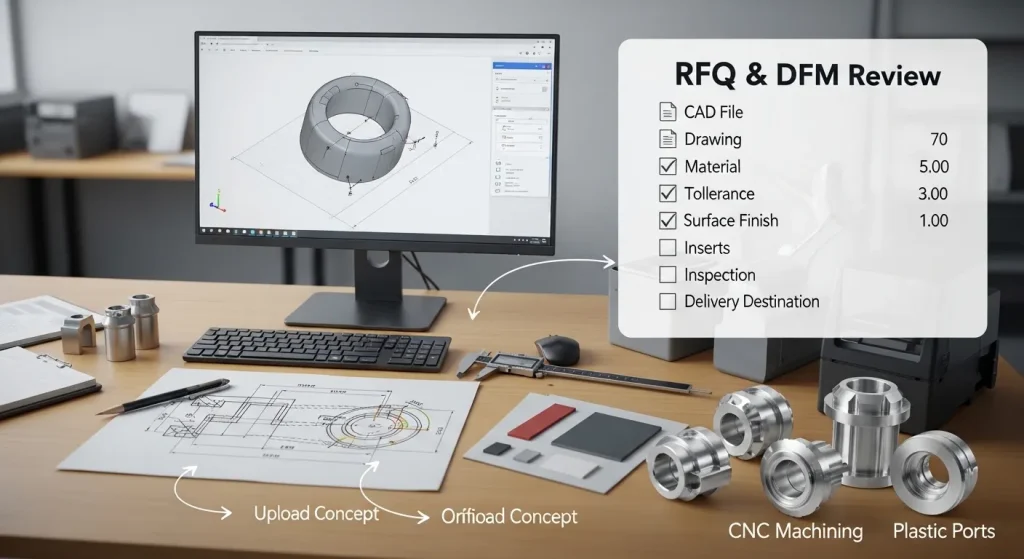
A clear RFQ helps SunOn review manufacturability, material suitability, tolerance risk, surface finish needs, and production planning. It also reduces back-and-forth between engineering and procurement teams.
Before requesting a quote, prepare:
- Product or part name
- Quantity required
- Prototype, small-batch, or production stage
- Application or industry
- 3D CAD model
- 2D drawing with critical dimensions
- Plastic material requirement
- Material grade if already specified
- Tolerance requirements
- Surface finish or cosmetic expectations
- Color requirement if relevant
- Threading, inserts, holes, slots, or undercuts
- Assembly requirements
- Inspection report requirements
- Functional testing needs if relevant
- Delivery destination
- Target schedule if relevant
- NDA, BOM, or project specification if needed
If the material is not finalized, share the application conditions instead. Load, temperature, friction, chemical exposure, moisture, transparency, and assembly method can help the engineering team suggest a better direction.
Why Work With SunOn for Custom Plastic CNC Machining?
SunOn Mould supports buyers who need more than a machined part supplier. Many projects require material review, DFM feedback, prototype support, finishing, assembly, and a path toward future production.
For plastic CNC projects, SunOn can help buyers discuss:
- Whether CNC machining is suitable for the part
- Which plastic material may fit the application
- Whether the design has warping or tolerance risks
- Whether CNC milling, turning, or multi-axis machining is needed
- Whether injection molding should be considered for later production
- What files and drawings are needed for quotation
- Which surface finish and inspection details should be defined
This approach is useful for OEM/ODM buyers, engineers, and procurement teams that need practical manufacturing communication before placing an order.
Frequently Asked Questions
Can SunOn machine ABS, Delrin, PTFE, PEEK, nylon, and PC?
SunOn can review CNC plastic machining projects using common engineering plastics such as ABS, Delrin/POM, PTFE, PEEK, nylon, and PC. Buyers should confirm the material grade, application, tolerance, and quantity during RFQ.
Is CNC plastic machining good for low-volume parts?
Yes. CNC plastic machining is often suitable for prototypes, functional parts, and low-volume production because it does not require injection mold tooling. It is useful when the design may still change.
Which plastic is best for low-friction parts?
Delrin/POM and PTFE are common choices for low-friction plastic parts. The better option depends on load, wear, temperature, chemical exposure, and tolerance requirements.
Why do plastic parts need tolerance review?
Plastic materials can expand, absorb moisture, deform, or move under stress more than metals. Material type, wall thickness, geometry, and temperature can all affect dimensional stability.
Should I choose CNC machining or injection molding?
Choose CNC machining for prototypes, small batches, and design changes without tooling. Consider injection molding when the design is stable and the project requires repeat production at higher volume.
What files are needed for a quote?
Send a 3D CAD model, 2D drawing, material requirement, quantity, tolerance, surface finish, application details, and inspection needs. Add notes about threads, inserts, holes, or assembly features if relevant.
Request a CNC Plastic Machining Quote
Share your plastic part drawings with SunOn for CNC machining review, material discussion, DFM feedback, and quotation. To help our team respond clearly, send the part type, quantity, prototype or production stage, application, 3D CAD model, 2D drawing, material requirement, tolerance, surface finish, color or cosmetic needs, threading or insert details, inspection requirements, delivery destination, and target schedule if available.
