


Delrin CNC Machining
For buyers sourcing gears, bushings, rollers, guides, fixtures, spacers, housings, or sliding parts, the key question is not only whether Delrin can be machined. The bigger question is whether the part design, tolerance, wall thickness, surface finish, inspection needs, and quantity are suitable for CNC machining.
SunOn helps buyers review Delrin part requirements before production. You can send 2D drawings, 3D CAD files, material requirements, tolerance notes, quantity, finish expectations, and application details for quotation and manufacturability review.
Delrin CNC Machining for Functional Plastic Parts
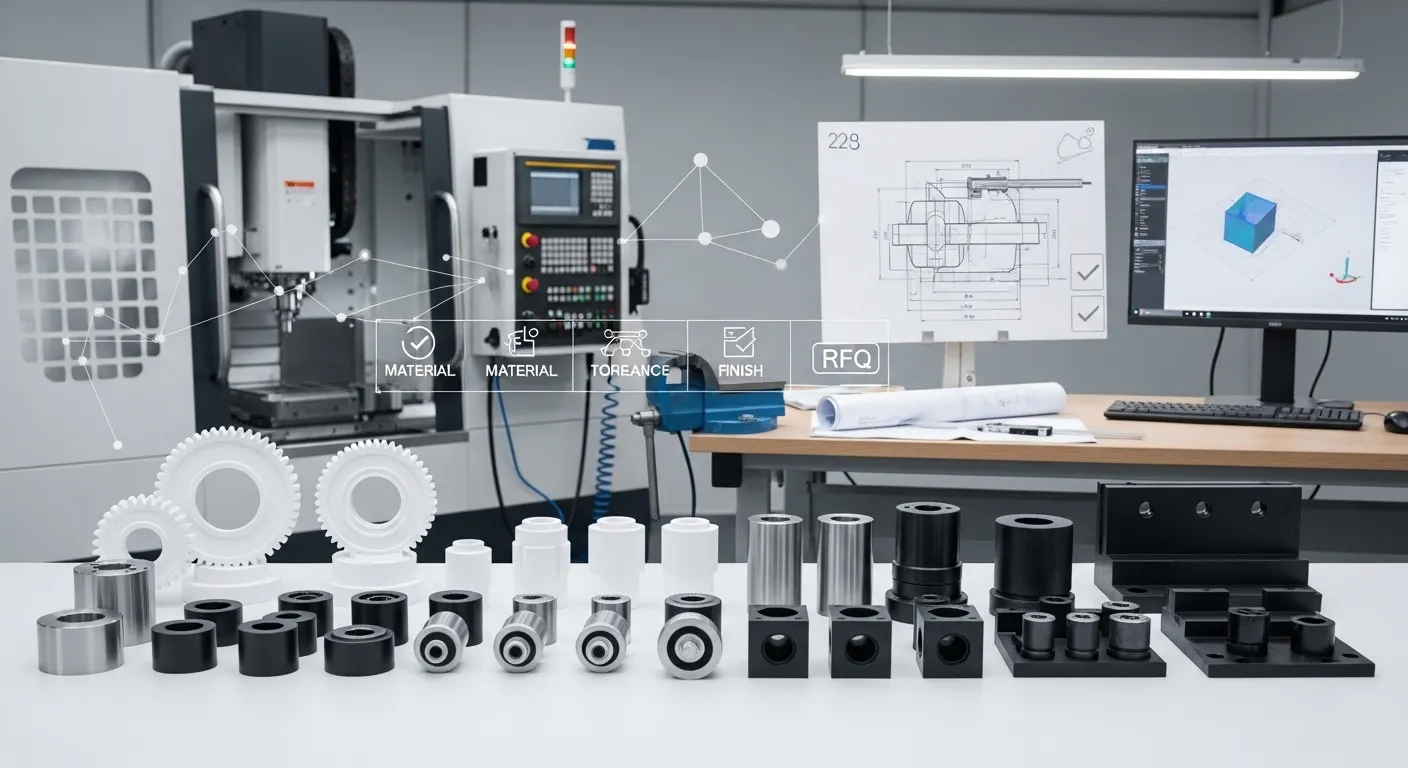
Delrin is a strong engineering plastic used when buyers need a balance of stiffness, smooth sliding performance, and machinability. Compared with many softer plastics, it can hold shape well under normal mechanical use. Compared with metal, it is lighter and often better for low-friction movement.
Delrin CNC machining is commonly used for:
- Gears and gear wheels
- Bushings and bearing parts
- Rollers and guide wheels
- Sliding blocks and wear pads
- Jigs, fixtures, and checking tools
- Spacers, washers, and sleeves
- Pump and valve components
- Electrical insulation parts
- Housings, brackets, and custom plastic components
This makes Delrin useful for automation equipment, electronics, machinery, consumer products, automotive-related product development, and medical device product teams that need machined plastic components. For regulated or highly controlled industries, buyers should share all quality, inspection, and documentation requirements before quotation.
Why Buyers Choose Delrin/POM for CNC Parts
Delrin is popular because it machines cleanly and supports functional part testing. It is often chosen when a plastic part must move against another surface, resist wear, or maintain a controlled shape after machining.
Common reasons to choose Delrin include:
- Low friction for sliding or rotating parts
- Good wear resistance for moving components
- High stiffness compared with many common plastics
- Good dimensional stability for precision plastic parts
- Low moisture absorption compared with nylon
- Good machinability for gears, bushings, rollers, and fixtures
- Smooth as-machined surface for many functional parts
However, Delrin is still a plastic. Thin walls, tight tolerances, deep pockets, sharp internal corners, heat buildup, and aggressive clamping can affect the final result. Buyers should define critical dimensions clearly instead of applying tight tolerances to every feature.
What Delrin Parts Can SunOn Support?
SunOn supports custom plastic CNC machining for buyers who need machined parts from CAD drawings or technical files. For Delrin parts, the manufacturing approach depends on the part geometry, function, tolerance, and order stage.
For example, a roller or bushing may be suitable for CNC turning. A flat guide plate, fixture block, or housing may need CNC milling. A complex part with multiple sides, pockets, and mounting holes may require more detailed process planning.
Common Delrin part requirements include:
- Roundness and concentricity for rollers, sleeves, and bushings
- Smooth sliding surfaces for guides and wear blocks
- Tooth profile control for gears
- Edge break or chamfer control for assembled parts
- Hole position control for mounting features
- Thread or insert planning for repeated assembly
- Flatness and stability for fixtures and plates
If the part has critical fit, moving contact, sealing, press-fit, or assembly requirements, mark those areas in the 2D drawing. This helps the CNC team review which features need tighter control.
CNC Milling, Turning, and Feature Control
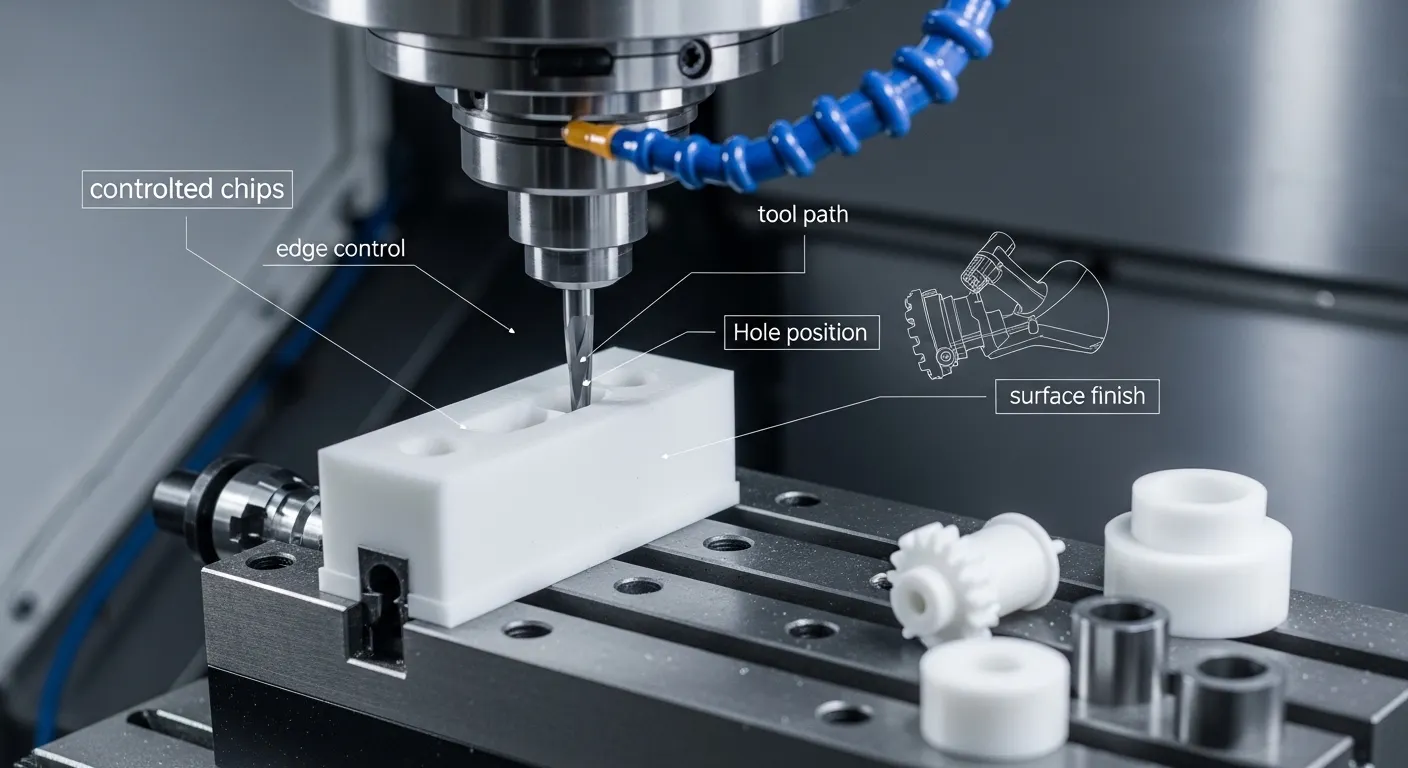
Delrin can be machined using CNC milling and CNC turning. The right process depends on the shape of the part.
CNC milling is suitable for plates, blocks, housings, brackets, pockets, slots, holes, and complex flat or multi-sided features. CNC turning is suitable for round parts such as rollers, bushings, sleeves, spacers, shafts, and ring-shaped components.
For more complex geometries, buyers should share the full 3D model and 2D drawing. This allows the manufacturing team to review workholding, tool access, internal radii, hole depth, and whether the part may need multiple setups.
Key design points include:
- Avoid very thin unsupported walls when possible
- Add internal radii instead of sharp internal corners
- Confirm whether external sharp edges are functional or can be broken
- Review deep holes, deep pockets, and narrow slots early
- Use clear thread specifications if the part needs assembly
- Consider inserts if the part will be assembled and disassembled often
- Mark critical dimensions separately from general dimensions
These details help reduce rework, cost changes, and unclear expectations during quoting.
Tolerance, Surface Finish, and Inspection Considerations
Delrin can be used for precision plastic parts, but tolerance should be reviewed based on geometry and function. Plastic parts react differently from metal parts during machining. Heat, internal stress, wall thickness, and clamping pressure can affect final dimensions.
Before requesting a quote, buyers should confirm:
| RFQ detail | Why it matters | What to send or specify |
|---|---|---|
| Material | Delrin/POM grades may behave differently | Required material or acceptable alternatives |
| Quantity | Affects process planning and cost review | Prototype, small batch, or production quantity |
| Critical dimensions | Prevents over-tolerancing the whole part | 2D drawing with tolerance callouts |
| Surface finish | Affects sliding, fit, and appearance | As-machined, deburred, edge break, or other finish needs |
| Holes and threads | Affects tool access and assembly life | Thread type, depth, insert needs, and mating parts |
| Application | Helps review material and feature risks | Load, movement, temperature, environment, or assembly use |
| Inspection needs | Affects quote and quality planning | Dimensional report or critical feature checks |
| Delivery details | Needed for commercial quotation | Destination, target schedule, and packaging needs |
Surface finish for Delrin is often functional rather than decorative. Many parts use an as-machined surface with deburring or controlled edge break. If a part needs polishing, tumbling, painting, or other treatment, it should be reviewed based on geometry and material behavior.
Delrin vs Other CNC Materials
Delrin is not always the right choice. It works well for low-friction movement, wear parts, and stable machined plastic components. But some projects may need another material.
Nylon may be considered for toughness, but moisture absorption can matter for dimensional control. PTFE offers very low friction, but it is softer and may not suit parts that need higher stiffness. PEEK may be selected for higher performance requirements, but cost and application need careful review.
Metal may be better when the part needs higher strength, heat resistance, conductivity, or load capacity. For mechanical metal alternatives, buyers can review brass CNC machining or stainless steel 304 machining. For conductive parts where Delrin is not suitable, copper CNC machining may be more relevant.
The best choice depends on load, friction, environment, assembly method, tolerance, cost target, and production quantity.
Prototype, Small-Batch, and Production Planning
CNC machining is a practical choice for Delrin prototypes and low-volume parts because it does not require production tooling. Buyers can test fit, movement, wear behavior, assembly, and geometry before committing to a larger production method.
Delrin CNC machining may fit:
- Functional prototypes
- Engineering samples
- Jigs and fixtures
- Small-batch mechanical parts
- Bridge production before tooling
- Custom replacement or low-volume components
If the final quantity becomes high, SunOn can also help review whether mold manufacturing and plastic injection molding are more suitable. This prototype-to-production path is useful for OEM/ODM buyers who want to validate the part first, then plan a more scalable manufacturing process.
What Should Buyers Send for a Delrin CNC Machining Quote?
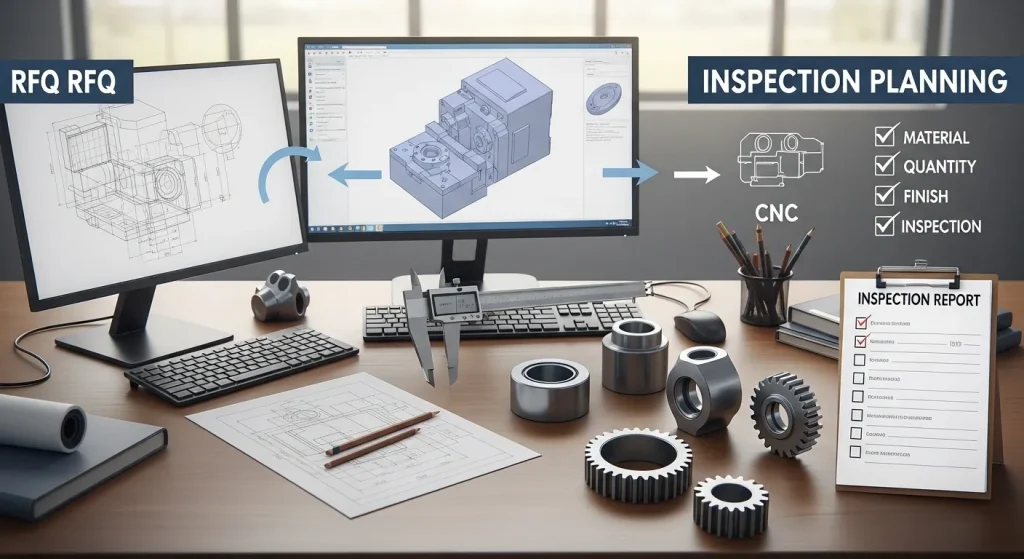
A clear RFQ helps SunOn review the part faster and reduce back-and-forth questions. Delrin parts often depend on small design details, so the quote request should include both commercial and technical information.
Please prepare:
- Product or part name
- Application or industry
- Prototype, small-batch, or production stage
- Quantity required
- 3D CAD model
- 2D drawing with critical dimensions
- Delrin/POM material requirement
- Material grade if already selected
- Color requirement if relevant
- Tolerance requirements
- Surface finish or edge break requirements
- Holes, slots, threads, inserts, or undercuts
- Assembly or mating part information
- Inspection report requirements
- Functional testing needs if relevant
- Delivery destination
- Target schedule if relevant
- NDA, BOM, or project specification if needed
For medical device product teams or similar controlled projects, buyers should define the part use, documentation needs, and inspection expectations clearly. Related project teams can also review SunOn’s page on CNC machining for medical devices for broader manufacturing planning.
Why Work With SunOn for Delrin Parts?
SunOn supports buyers who need more than a machined plastic part. Many projects require process selection, manufacturability review, material comparison, surface finishing, assembly planning, and later production support.
Our team can help review whether Delrin is suitable for the part function, whether CNC machining fits the quantity, and which details should be clarified before manufacturing. If the design is still changing, CNC machining can support prototype and testing stages. If the design is moving toward larger production, SunOn can discuss mold making, injection molding, finishing, assembly, and OEM/ODM support.
This makes SunOn a practical partner for buyers who want one manufacturing team to support development, sampling, and production planning.
Frequently Asked Questions
Is Delrin good for CNC machining?
Yes. Delrin machines well and is often used for low-friction, wear-resistant, dimensionally stable plastic parts. The final result depends on geometry, wall thickness, tolerance requirements, clamping, and inspection planning.
What Delrin parts are commonly CNC machined?
Common parts include gears, bushings, rollers, sleeves, guides, fixtures, spacers, washers, housings, pump parts, valve parts, and electrical insulation components.
Can Delrin parts have threads or inserts?
Yes. Threads can be machined into Delrin, but inserts may be better for repeated assembly or higher load. Share the mating part and assembly requirement during RFQ review.
Is CNC machining or injection molding better for Delrin parts?
CNC machining is better for prototypes, engineering samples, low-volume parts, and bridge production. Injection molding may be better for higher-volume production after the design is validated.
What tolerance should I request for Delrin parts?
Only apply tight tolerances to critical features. Delrin tolerance depends on part size, geometry, wall thickness, temperature, and inspection method. Send a 2D drawing with clear tolerance callouts.
What files are needed for quotation?
Send a 3D CAD model, 2D drawing, material requirement, quantity, tolerance notes, finish requirements, application details, inspection needs, and delivery destination.
Request a Delrin CNC Machining Quote
Send SunOn your Delrin/POM part files for quotation and DFM review. Include the part type, quantity, application, prototype or production stage, 2D drawing, 3D CAD model, material grade if known, tolerance requirements, surface finish needs, holes, threads, inserts, inspection requirements, delivery destination, and target schedule.
SunOn can review your design for custom CNC machining, prototype support, small-batch production, finishing, assembly, and wider OEM/ODM manufacturing planning.
