


Copper CNC Machining
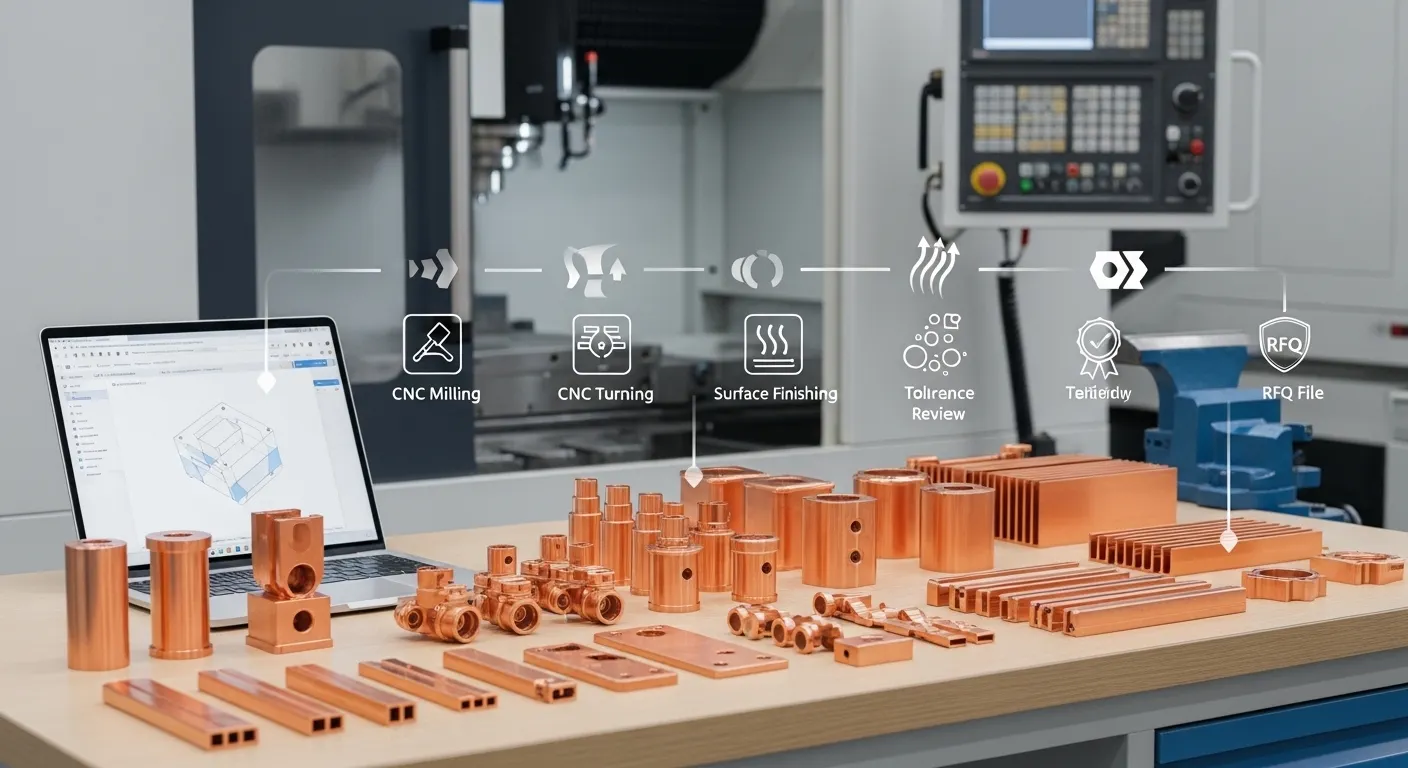
For copper parts, the quote is not only about part size and quantity. Buyers should confirm the copper grade, CNC process, tolerance requirements, surface finish, plating needs, burr control expectations, inspection requirements, and whether the project is for prototype, small-batch, or production use.
SunOn supports custom CNC machining, CNC milling, CNC turning, 5-axis machining when needed, surface finishing, assembly, and OEM/ODM manufacturing support. If you already have 2D drawings, 3D CAD files, or early product specifications, our team can review the part for manufacturability before quotation.
Copper CNC Machining for Electrical and Thermal Parts
Copper is different from many common CNC metals. It is selected mainly for performance, not only for strength or appearance. Many buyers choose copper because the part must carry current, transfer heat, resist corrosion, support soldering, or work inside an electrical or thermal assembly.
Typical copper CNC machined parts include:
- Electrical terminals and contact parts
- Busbars and conductive plates
- Connector bodies and pins
- Heat sinks and thermal blocks
- Cooling plates and heat-transfer components
- Shielding parts and conductive housings
- Custom brackets, bushings, and fittings
- Precision components for electronics and industrial equipment
SunOn can review copper part drawings for CNC machining feasibility, process selection, finish requirements, and production planning. For broader CNC machining support, buyers can also review SunOn’s CNC machining parts manufacturer page.
When Should Buyers Choose Copper?
Copper is suitable when conductivity or heat transfer is a key requirement. If the part only needs moderate strength, easier machining, or lower cost, another metal may be more suitable. This is why material selection should be part of the RFQ review.
Copper is often a good choice when the part needs:
- High electrical conductivity
- High thermal conductivity
- Good corrosion resistance
- Reliable contact performance
- Heat dissipation
- Solderability or plating compatibility
- Functional use in electronics, power, EV, battery, or thermal systems
However, copper can be more challenging to machine than brass or aluminum. It is softer, can form burrs more easily, and may require careful tooling and cutting control. Buyers should avoid selecting copper only because it “looks premium.” The material should match the function of the part.
Copper Grades and Machining Considerations
Many copper CNC projects involve grades such as C101, C110, or other copper alloys. C101 is often considered when high purity and conductivity are important. C110 is widely used for electrical applications and can be a practical choice for many machined components. Some copper alloys are chosen when machinability is more important than maximum conductivity.
SunOn should confirm the final material grade during RFQ review based on:
- Electrical conductivity requirement
- Thermal performance requirement
- Machinability
- Part geometry
- Cost target
- Surface finish or plating requirement
- Application environment
- Quantity and production stage
If your drawing already specifies a copper grade, send it with the RFQ. If the grade is not fixed yet, explain the part function so the team can help review suitable options.
Copper vs Brass CNC Machining
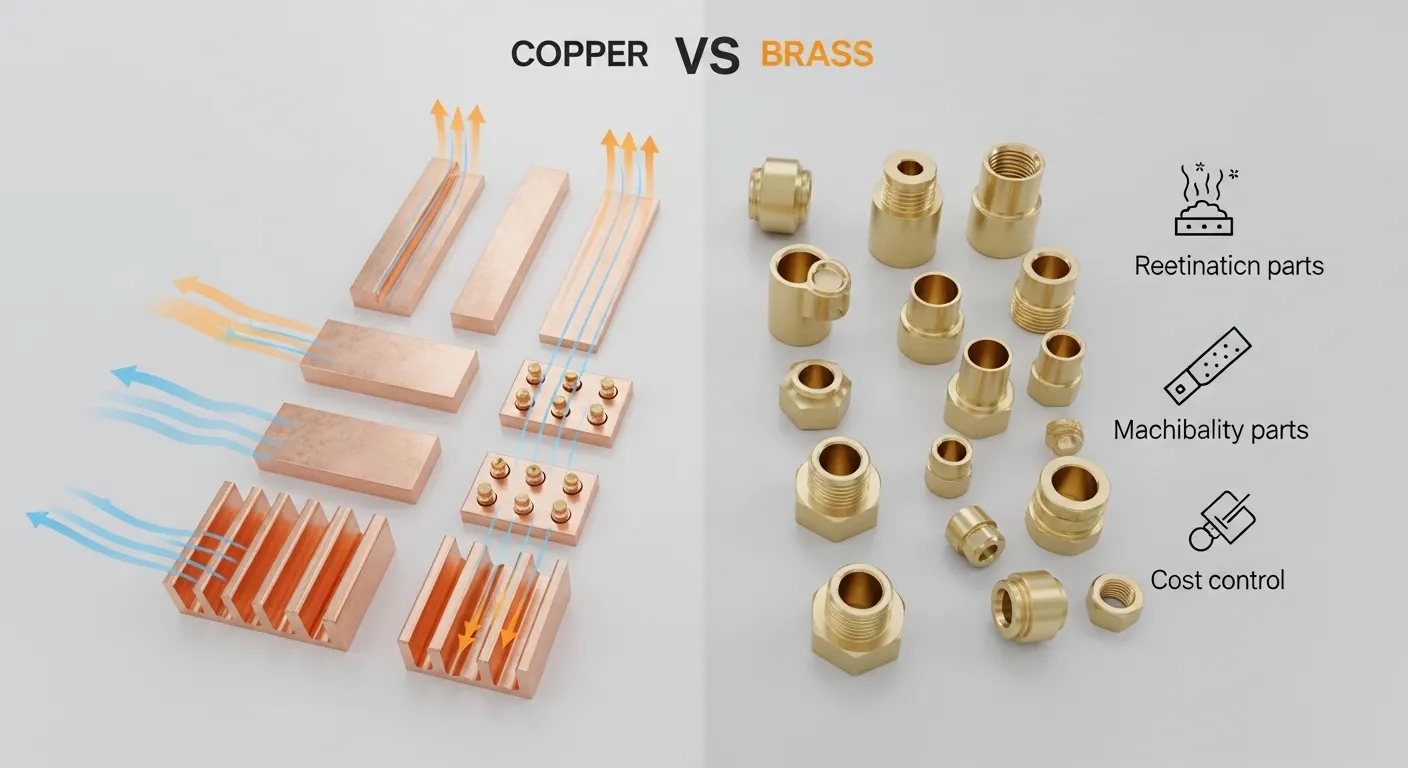
Copper and brass are often compared because both are used for conductive, decorative, mechanical, and industrial parts. But they do not behave the same during machining.
| Buyer decision factor | Copper | Brass | Practical RFQ guidance |
|---|---|---|---|
| Electrical conductivity | Usually stronger choice | Lower than copper | Choose copper when current flow is critical |
| Thermal conductivity | Strong heat-transfer performance | Lower thermal performance | Choose copper for heat sinks, cooling plates, and thermal blocks |
| Machinability | Softer and more burr-prone | Usually easier to machine | Brass may reduce machining difficulty for non-critical conductive parts |
| Burr control | Needs careful review | Often cleaner cutting | Mark burr-free edges on drawings |
| Cost sensitivity | Often higher material and machining concern | Often more cost-friendly | Ask for material/process suggestions if budget is tight |
| Typical parts | Busbars, terminals, heat sinks, contacts | Fittings, connectors, decorative and mechanical parts | Match material to function, not only appearance |
| Finish and plating | Often used for conductivity or corrosion needs | Often used for appearance and corrosion resistance | Confirm whether plating affects function |
If your project may work with brass instead of copper, SunOn can help compare manufacturability and application fit. For more details, visit the related brass CNC machining page.
CNC Milling, Turning, and 5-Axis Options for Copper Parts
The best CNC process depends on geometry, critical features, and production stage.
CNC milling is suitable for copper plates, blocks, slots, pockets, cooling features, heat sinks, busbars, and flat or multi-face parts. Milling is also useful when the part needs holes, counterbores, pockets, grooves, or precise mounting features.
CNC turning is suitable for round copper parts such as pins, bushings, terminals, sleeves, threaded components, and cylindrical connector parts. Turning may also be combined with milling for parts that need both round and flat features.
5-axis machining may be useful when copper parts have complex multi-side features, angled surfaces, or geometry that benefits from fewer setups. It should be selected when the design needs it, not only as a premium label.
For each process, buyers should confirm which dimensions are critical, which features are functional, and which surfaces need controlled finish or plating allowance.
What Makes Copper Challenging to Machine?
Copper can be soft and gummy during cutting. This may increase the risk of burrs, tool wear, smearing, poor chip control, and dimensional variation. These issues become more important when the part has thin walls, small holes, deep pockets, tight slots, sharp edges, or close-fitting assembly features.
During DFM review, SunOn can check for:
- Burr-prone edges
- Deep pockets and narrow slots
- Thin walls or fragile features
- Small drilled holes
- Threading and tapping requirements
- Sharp internal corners
- Heat-sensitive features
- Plating allowance
- Critical inspection dimensions
Buyers should clearly mark functional surfaces and critical tolerances on the 2D drawing. Not every dimension needs a tight tolerance. Over-specifying tolerances can increase cost and machining difficulty without improving function.
Tolerance, Surface Finish, and Plating Requirements
Copper CNC parts often need both dimensional accuracy and functional surface performance. The right tolerance depends on part size, geometry, copper grade, wall thickness, machining process, and inspection method. Instead of assuming a standard tolerance is enough, buyers should identify the dimensions that affect assembly, sealing, conductivity, contact pressure, or heat transfer.
Surface finish and plating should also be selected based on function. Common finish-related requirements may include:
- As-machined surfaces for general functional parts
- Polishing for smoother surfaces or visual needs
- Deburring for safe handling and assembly
- Electropolishing when suitable for surface improvement
- Nickel plating for corrosion protection or wear-related needs
- Tin plating for solderability or electrical contact needs
- Silver or gold plating when low contact resistance is required
Finish availability and suitability should be confirmed during quote review. Plating can affect dimensions, conductivity, solderability, and assembly fit, so it should be included in the drawing or RFQ notes.
Applications for Custom Copper CNC Parts
Copper parts are widely used in products where current, heat, or signal performance matters. SunOn supports buyers from product development, engineering, and procurement teams who need custom metal parts for prototype validation or production planning.
Common application areas include:
- Electronics: connectors, terminals, shielding parts, heat spreaders, conductive housings
- Power and energy: busbars, contact plates, battery-related conductive parts, switchgear components
- Thermal management: heat sinks, cooling plates, thermal blocks, heat-transfer components
- Industrial equipment: bushings, fittings, conductive machine parts, custom brackets
- Automotive and EV-related products: conductive parts, thermal components, connector-related parts
- Medical device product development: copper or conductive components where drawings, application requirements, and quality expectations must be reviewed carefully
For regulated or high-risk applications, buyers should share all quality, inspection, material, and documentation needs before quotation. SunOn does not assume special certification requirements unless they are confirmed in the project scope. For related application context, buyers may also review SunOn’s CNC machining for medical devices page.
What Should Buyers Send for a Copper CNC Machining Quote?
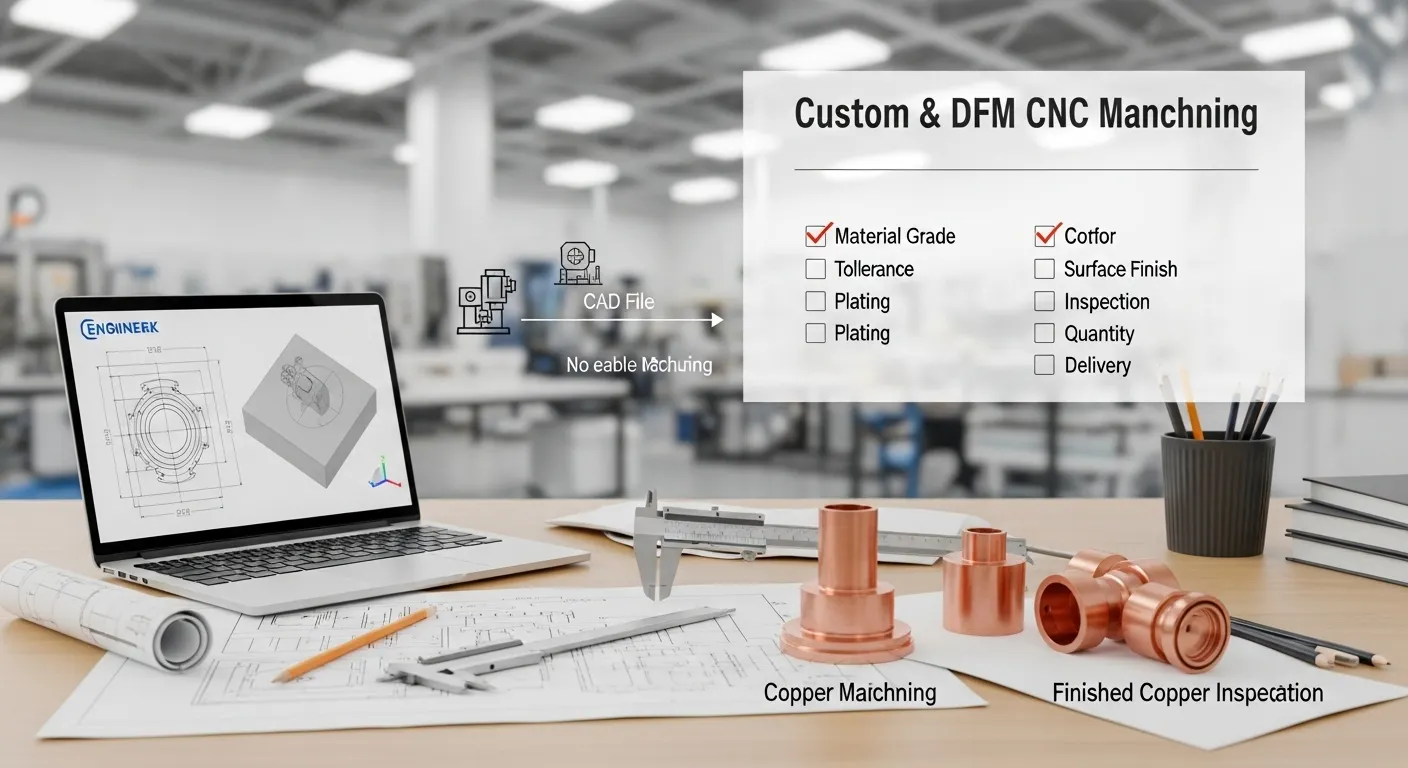
A clear RFQ helps the engineering team review manufacturability, quote more accurately, and reduce back-and-forth communication. For copper parts, this is especially important because material grade, finish, plating, burr control, and tolerance can strongly affect production.
Please prepare:
- Product or part name
- Application or industry
- Prototype, small-batch, or production stage
- Quantity needed
- 3D CAD model
- 2D drawing with tolerances
- Copper grade, if already selected
- Conductivity or heat-transfer requirement
- Critical dimensions and functional surfaces
- Surface finish requirement
- Plating or coating requirement
- Burr-free edge requirements
- Threading, holes, slots, inserts, or assembly details
- Inspection report or quality documentation needs
- Functional testing requirement, if relevant
- Delivery destination
- Target schedule
- NDA, BOM, or project specification, if needed
If you are not sure which grade, finish, or process is best, send the drawing and explain the part function. SunOn can review the design and suggest practical manufacturing points before final quotation.
Prototype, Small-Batch, and Production Support
Copper CNC machining is often used at different project stages. A hardware startup may need prototypes to test conductivity or heat transfer. An OEM buyer may need low-volume parts for pilot assembly. A production team may need stable machining, finishing, inspection, and assembly planning.
At the prototype stage, the focus is usually design validation, fit, function, and material behavior. At the small-batch stage, buyers often need repeatability, finish control, and assembly checks. At the production stage, the focus shifts to stable quality, cost control, packaging, and supplier communication.
SunOn’s wider manufacturing support also includes rapid prototyping, surface finishing, mechanical assembly, injection molding, die casting, mold making, and OEM/ODM production support. If your copper CNC part is one component in a larger product, our team can review how it fits the full manufacturing plan.
Why Work With SunOn for Copper CNC Parts?
Copper parts need more than basic machining. The supplier should understand material behavior, functional requirements, and RFQ details before production starts. SunOn helps buyers review the practical details that affect cost, lead planning, quality, and manufacturability.
Buyers can work with SunOn when they need:
- Custom copper machined parts from drawings
- CNC milling or turning support
- DFM review before quotation
- Prototype-to-production manufacturing support
- Surface finishing or plating discussion
- Assembly-related manufacturing support
- OEM/ODM project communication
- Help comparing copper with brass, stainless steel, or other materials
If your project also requires stainless steel comparison for strength, corrosion resistance, or structural use, SunOn’s stainless steel 304 machining page may help with material planning.
Frequently Asked Questions
Is C101 or C110 better for CNC machined copper parts?
C101 is often used when high purity and conductivity matter. C110 is common for electrical parts and can be practical for many applications. The best choice depends on part function, geometry, cost target, and finish requirements.
Why is copper harder to machine than brass?
Copper is softer and can be gummy during cutting. It may create more burrs, tool wear, and surface control challenges. Brass usually machines cleaner, so buyers should choose copper mainly when conductivity or heat transfer is required.
Can copper CNC parts be plated?
Yes, copper parts can often be finished or plated depending on function. Buyers should specify whether the part needs corrosion protection, solderability, low contact resistance, appearance, or wear resistance. Plating thickness and functional surfaces should be confirmed.
What tolerances should I specify for copper parts?
Specify tight tolerances only on functional dimensions. Copper tolerance depends on grade, geometry, wall thickness, feature size, and inspection needs. Send a 2D drawing so SunOn can review which dimensions are critical.
What files are needed for a copper CNC quote?
Send a 3D CAD model and a 2D drawing with material, quantity, tolerance, finish, plating, and inspection requirements. Also include application details, delivery destination, and any assembly or functional requirements.
Can SunOn support copper prototypes and production parts?
Yes, SunOn can review copper CNC parts for prototype, small-batch, and production projects. Share your project stage, quantity, drawings, material needs, and target schedule so the team can review the manufacturing approach.
Request a Copper CNC Machining Quote
Send SunOn your copper part drawings for DFM review and quotation. Include the part type, application, quantity, project stage, 2D drawing, 3D CAD file, copper grade if known, tolerance requirements, surface finish, plating needs, burr-control notes, inspection requirements, delivery destination, and target schedule.
Our team can review your copper CNC machining project, confirm key manufacturability points, and help you plan the right process for prototype, small-batch, or production manufacturing.
