


PEEK Machined Parts
For PEEK CNC machining projects, buyers should confirm the part application, PEEK grade, tolerance requirements, surface finish, quantity, drawing files, inspection needs, and production stage before requesting a quote. SunOn supports CNC milling, CNC turning, prototype machining, small-batch CNC machining, finishing, assembly, and broader OEM/ODM manufacturing support.
This page helps you decide when PEEK is worth the cost, what makes it more difficult to machine, and what details your team should send for a manufacturability review and quotation.
When Should Buyers Choose PEEK Machined Parts?
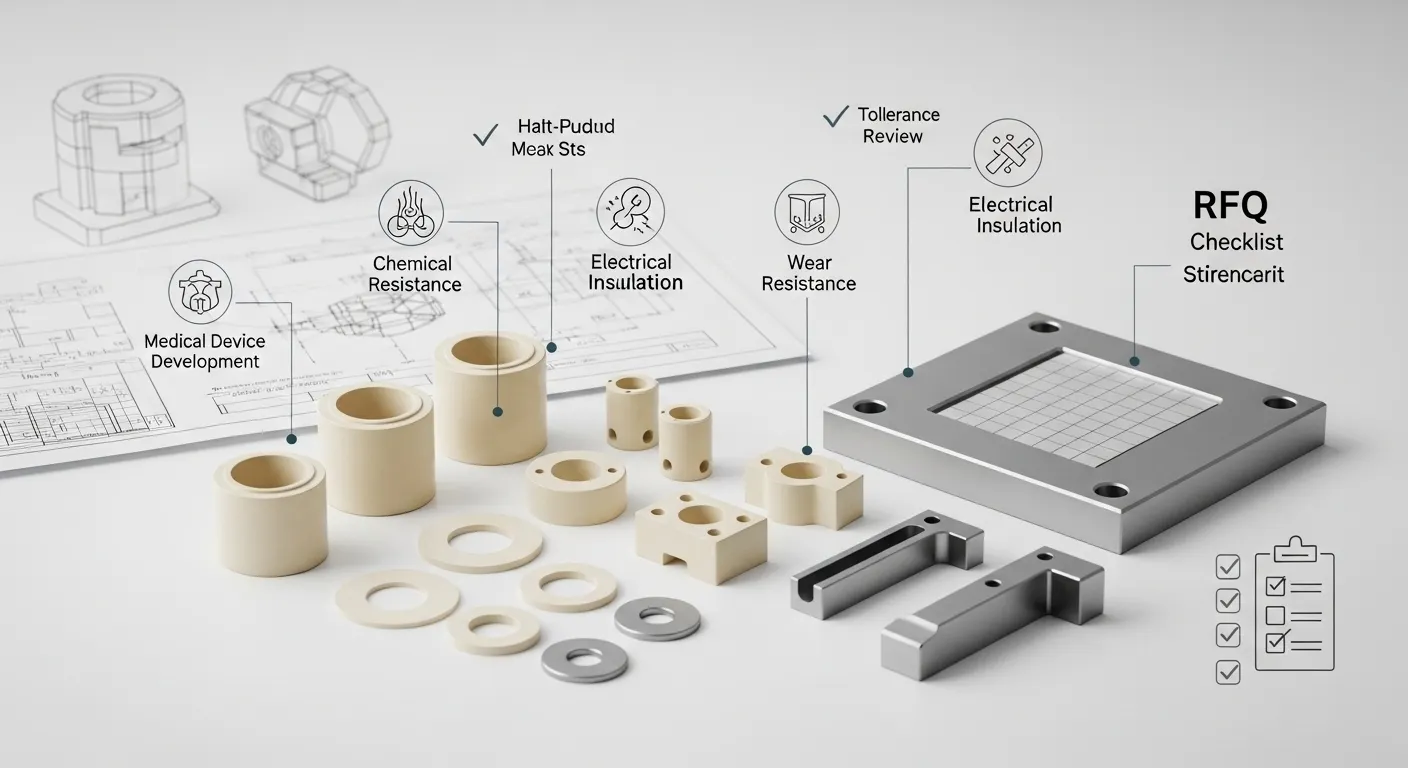
PEEK is a high-performance engineering plastic used when common plastics cannot meet the working conditions of the part. It is often considered for components exposed to heat, chemicals, friction, repeated movement, electrical insulation needs, or tight dimensional requirements.
Buyers often choose PEEK machined parts for:
- High-temperature plastic components
- Chemical-resistant machine parts
- Wear-resistant bushings, bearings, and spacers
- Electrical insulation parts
- Lightweight alternatives to some metal components
- Prototype parts before tooling investment
- Low-volume precision plastic components
- Functional parts for testing, validation, and production planning
PEEK is not always the lowest-cost option. If the part only needs general strength, stiffness, or dimensional stability, a lower-cost engineering plastic may be enough. For example, buyers comparing precision plastic materials can also review SunOn’s Delrin CNC machining service when the application does not require PEEK-level heat or chemical resistance.
PEEK CNC Machining Capabilities at SunOn
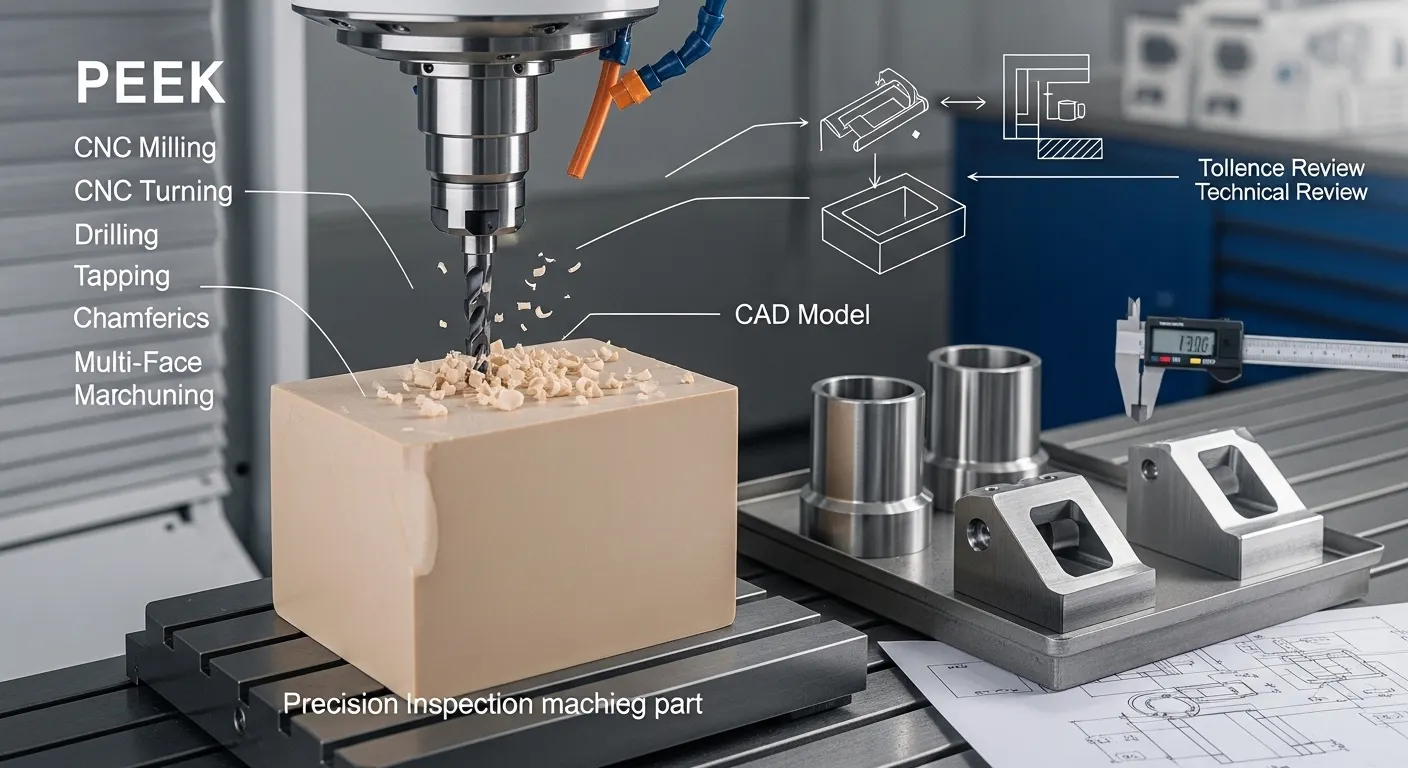
SunOn supports custom plastic CNC machining for PEEK components used in prototype, small-batch, and production-related projects. Depending on the part geometry, our CNC machining support may involve milling, turning, drilling, tapping, slotting, pocketing, chamfering, deburring, and multi-face machining.
CNC milling is usually suitable for flat, prismatic, or complex plastic parts such as plates, brackets, housings, fixtures, manifolds, insulators, and components with pockets or slots.
CNC turning is often used for round PEEK parts such as bushings, sleeves, spacers, washers, rings, shafts, and cylindrical components.
For more complex geometry, buyers may also need 5-axis machining or multiple setups. This can help reduce repositioning issues and improve access to difficult features. However, the best machining method depends on the 3D CAD model, 2D drawing, tolerance callouts, and feature layout.
PEEK can be more challenging than standard plastics. Therefore, the drawing should clearly show critical dimensions, functional surfaces, thread requirements, edge conditions, and inspection expectations.
What Makes PEEK More Difficult to Machine?
PEEK is strong and stable, but its performance also makes machining more demanding. It can respond differently from easier plastics such as ABS, nylon, or Delrin.
Important machining concerns include:
- Heat buildup during cutting
- Internal material stress
- Tool wear, especially with filled grades
- Burrs around holes, slots, and edges
- Thin-wall deformation
- Surface tool marks
- Flatness and parallelism control
- Risk of over-specifying tolerances
For tight or functional parts, the machining plan should consider tool selection, cutting strategy, workholding, deburring, and inspection. Some PEEK projects may also need discussion around stress relief or material preparation, depending on the blank, geometry, tolerance, and application.
This is why SunOn recommends sending both 2D drawings and 3D CAD files. The model shows geometry, while the drawing confirms tolerances, surface finish, threads, materials, and inspection requirements.
Which PEEK Grade Should You Specify?
Not every PEEK part uses the same material grade. Buyers should confirm the grade based on performance requirements, supplier availability, application environment, and project documentation.
Common PEEK material categories include:
- Unfilled PEEK for balanced strength, heat resistance, chemical resistance, and machinability.
- Glass-filled PEEK when added stiffness and dimensional stability are needed.
- Carbon-filled PEEK when strength, wear behavior, or stiffness is a priority.
- Bearing or wear-grade PEEK for sliding, friction, or moving parts.
- Conductive or antistatic PEEK for selected electronics or static-control applications.
- Application-specific PEEK grades when the buyer has medical, food, electronics, or regulated-use requirements.
SunOn should review the selected grade before machining. Filled grades may improve performance, but they can also increase tool wear and affect surface finish. If the grade is already specified by your engineering team, include it in the RFQ.
PEEK Machined Parts Application Examples
PEEK machined parts are often used in industries where ordinary plastics may fail under temperature, chemical, friction, or stability requirements.
Typical application examples include:
- Bushings, bearings, washers, and spacers
- Electrical insulators and connector parts
- Pump, valve, and fluid-handling components
- Test fixtures, jigs, and positioning parts
- Semiconductor and electronics support components
- Automation equipment parts
- Lightweight aerospace-related components
- Medical device development parts
- Automotive and new energy equipment components
- Industrial machine components
For medical, aerospace-related, automotive, or other high-requirement applications, buyers should provide clear drawings and project specifications. SunOn can review machining feasibility and quality requirements, but certifications or regulated production claims should be confirmed through official project documentation.
PEEK Machining Decision Checklist
| Buyer requirement | Why PEEK may fit | Machining point to confirm | RFQ detail to send |
|---|---|---|---|
| High heat exposure | PEEK performs better than many standard plastics | Check geometry stability and tolerance needs | Working temperature and application |
| Chemical resistance | Useful for fluid, pump, valve, and industrial parts | Confirm chemical environment and contact surfaces | Chemical exposure details |
| Wear or friction | Suitable for bushings, bearings, and sliding parts | Grade and surface finish affect performance | Wear surface and mating material |
| Electrical insulation | Useful for electronics and connector components | Confirm holes, slots, and thin features | Insulation function and drawing |
| Tight dimensions | PEEK can support precision parts when designed properly | Tolerance depends on geometry and wall thickness | 2D drawing with critical dimensions |
| Prototype testing | CNC avoids tooling cost for early validation | Design can be adjusted after test results | Quantity and prototype stage |
| Low-volume production | CNC can support small batches without mold investment | Repeatability and inspection should be defined | Batch quantity and inspection needs |
Tolerance, Surface Finish, and Inspection Considerations
PEEK machined parts can require careful tolerance review. The achievable result depends on the part size, geometry, material grade, wall thickness, feature depth, machining setup, and drawing requirements.
Buyers should avoid applying tight tolerances to every dimension. Instead, mark only functional and assembly-critical dimensions. This helps reduce unnecessary cost and machining risk.
Surface finish should also be discussed early. CNC machined PEEK may show tool marks, especially on complex surfaces or filled grades. If the part needs a specific appearance, sealing surface, sliding surface, or assembly interface, state that requirement clearly.
For precision components, buyers may request dimensional inspection, critical dimension checks, thread checks, or inspection reports. If the project needs stricter tolerance planning, SunOn’s tight tolerance CNC machining services page can help buyers understand the type of details that should be confirmed before production.
CNC Machining vs Injection Molding for PEEK Parts
CNC machining is often the best starting point for PEEK parts when the buyer needs prototypes, engineering samples, low-volume production, or functional validation. It avoids mold investment and allows design changes after testing.
Injection molding may become more suitable when the part design is stable and production quantity justifies tooling. For some projects, buyers may also consider molded blanks with final machining, but this depends on geometry, volume, material, and cost targets.
SunOn’s broader manufacturing support can help buyers compare CNC machining, mold making, injection molding, finishing, assembly, and OEM/ODM production planning. This is useful when a product may start with machined prototypes and later move toward tooling or higher-volume manufacturing.
What Should Buyers Send for a PEEK Machining Quote?
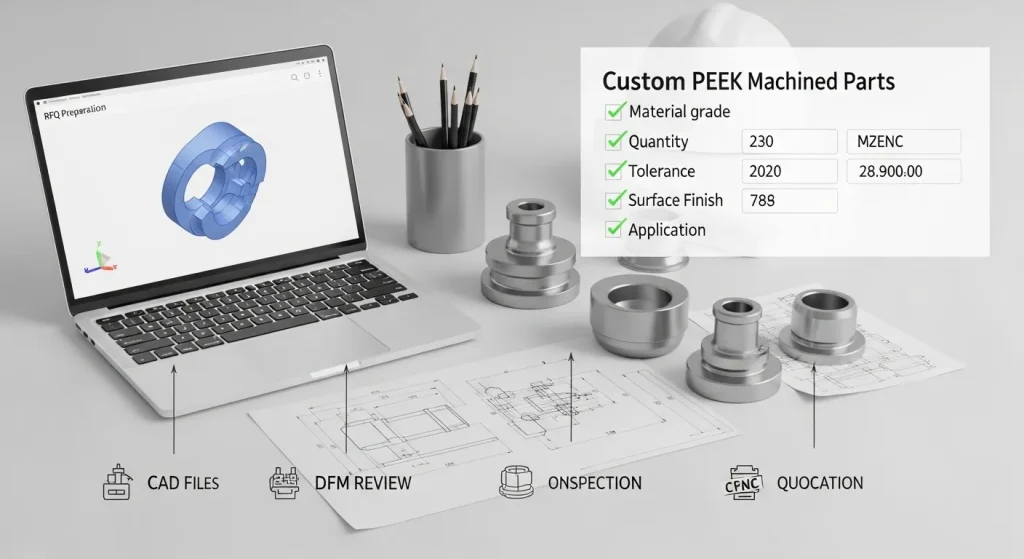
A clear RFQ helps SunOn review manufacturability, pricing factors, machining risk, and production planning more accurately. The more complete the technical package is, the easier it is to avoid delays and unclear assumptions.
Please prepare:
- Product or part type
- Prototype, small-batch, or production stage
- Required quantity
- Application or industry
- 2D technical drawing
- 3D CAD model
- PEEK grade or material requirement
- Critical tolerance requirements
- Surface finish requirements
- Threads, inserts, holes, slots, undercuts, or assembly details
- Functional surfaces or sealing surfaces
- Inspection report requirements
- Functional testing requirements, if relevant
- Delivery destination
- Target schedule, if relevant
- NDA, BOM, or project specification, if needed
If you are unsure whether PEEK is the right material, share the operating conditions with SunOn. Our team can review the project context and discuss whether PEEK, another plastic, CNC machining, or another manufacturing route may be more suitable.
Why Work With SunOn for Custom PEEK Components?
SunOn Mould supports global buyers who need more than a simple part quote. Many PEEK projects require material review, DFM feedback, machining planning, tolerance discussion, finishing review, and production-stage planning.
Our team can support buyers from early prototype parts to small-batch machining and broader OEM/ODM manufacturing projects. This is useful for product developers, engineering teams, and procurement managers who need one manufacturing partner for CNC machining, prototyping, mold making, injection molding, die casting, surface finishing, assembly, and production support.
For projects where PEEK may replace metal, buyers can also compare performance needs against metal machining options such as stainless steel 304 machining. The right choice depends on strength, temperature, weight, insulation, corrosion, friction, and cost requirements.
Frequently Asked Questions
Can PEEK be machined to tight tolerances?
Yes, but tolerance depends on part geometry, wall thickness, PEEK grade, setup, and drawing requirements. Buyers should mark only critical dimensions and discuss inspection needs before quotation.
Is PEEK worth the higher cost?
PEEK is worth considering when heat, chemicals, wear, electrical insulation, or dimensional stability matter more than material cost. For less demanding parts, another engineering plastic may be more cost-effective.
Which PEEK grade should I choose?
It depends on the application. Unfilled PEEK offers balanced performance. Glass-filled or carbon-filled grades may improve stiffness or wear behavior. Buyers should send operating conditions and grade requirements for review.
Should PEEK parts be CNC machined or molded?
CNC machining fits prototypes, low-volume parts, and design validation. Injection molding may fit higher-volume production when the design is stable and tooling investment is justified.
What files are needed for a PEEK quote?
Send a 3D CAD model, 2D drawing, quantity, material grade, tolerance requirements, surface finish, application details, and inspection requirements. This helps SunOn review manufacturability and quotation details.
Can SunOn support prototype PEEK parts?
Yes. SunOn supports CNC prototype machining and small-batch plastic machining. Share your CAD files, drawings, quantity, and project stage so the team can review the best production route.
Request a Quote for Custom PEEK Machined Parts
If your project needs custom PEEK machined parts, send SunOn your 2D drawing, 3D CAD model, quantity, PEEK grade, tolerance requirements, surface finish needs, application details, and inspection expectations. Our team can review the design for manufacturability, discuss CNC milling or turning options, and support your prototype, small-batch, or production planning requirements.
