


Custom Liquid Cooling Manifolds: CNC Machining Services from SunOn
SunOn manufactures custom liquid cooling manifold components from customer drawings and 3D CAD models. Each manifold can be machined to match your required dimensions, internal coolant passages, port locations, thread specifications, sealing features, mounting points, material, surface finish, and inspection requirements.
We support one-off prototypes, engineering samples, small batches, and repeat production without a fixed minimum order quantity. Send your design files to receive a manufacturability review and project-specific quotation.
Custom CNC-Machined Liquid Cooling Manifolds
A liquid cooling manifold distributes coolant between multiple lines, cooling plates, or other parts of a liquid cooling system. Unlike a standard catalog product, a custom manifold is designed around the available installation space, connection layout, flow requirements, and assembly method of a specific system.
SunOn provides drawing-based manifold machining rather than a fixed range of stocked designs. Our precision CNC machining services can support custom manifold blocks with project-specific external geometry and fluid-routing features.
Depending on your drawing, customizable features may include:
- Overall length, width, and height
- Port quantity, position, and orientation
- Inlet and outlet arrangement
- Thread type and thread size
- Internal coolant channels
- Intersecting drilled passages
- Sealing faces
- O-ring grooves
- Mounting holes and alignment features
- Datum surfaces
- Identification or part markings
- Material grade
- Surface finish
- Critical tolerance and inspection requirements
Final manufacturability depends on the geometry, material, tolerance, passage depth, tooling access, and inspection requirements. Our engineering team reviews these factors before production.
Send your manifold drawing to SunOn for a manufacturability and quotation review.
What to Specify for Your Manifold Project
A clear drawing package helps us quote the correct material, machining process, finishing work, and inspection scope. It also reduces the risk of thread mismatches, incorrect port positions, inaccessible passages, or unnecessary manufacturing cost.
Geometry and Connection Requirements
Your 2D drawing and 3D CAD model should define the component’s external shape and connection layout. Important details include:
- Number and position of inlet and outlet ports
- Thread standards, sizes, and depths
- Internal passage dimensions
- Cross-drilled channel intersections
- O-ring groove dimensions
- Sealing-face requirements
- Mounting-hole patterns
- Alignment and datum features
- Assembly clearances
- Critical wall thicknesses
Thread specifications should be stated clearly rather than shown only through the CAD geometry. Sealing faces, mounting datums, and port orientation should also be identified on the controlled drawing.
Operating and Fluid Requirements
Manufacturing decisions may depend on how the manifold will be used. Where relevant, provide:
- Coolant or working-fluid type
- Operating pressure
- Operating temperature
- Target flow requirement
- Pressure-drop requirement
- Corrosion or environmental exposure
- Required leak or pressure testing
These details help identify possible material, wall-thickness, sealing, finish, and verification concerns. SunOn manufactures the component according to the approved design and specifications. Complete liquid cooling system design should remain under the responsibility of the customer’s engineering team unless separate engineering support is agreed upon.
Manufacturing and Quality Requirements
The quotation request should also identify:
- Required material and grade
- Critical dimensions
- General and feature-specific tolerances
- GD&T requirements
- Surface roughness
- Surface treatment
- Cleaning requirements
- Inspection method
- Required reports or certificates
- Prototype or production quantity
- Current design stage
- Expected future order volume
| Buyer Input | Information to Provide | Why It Is Needed |
|---|---|---|
| CAD and drawing files | STEP file, 2D drawing, revision number | Defines geometry and controlled dimensions |
| Connections | Port size, position, orientation, and thread | Determines tooling and assembly compatibility |
| Internal passages | Channel size, depth, and intersections | Affects tool access and process planning |
| Material | Exact grade or performance requirement | Affects machining, finishing, and quotation |
| Operating conditions | Coolant, pressure, temperature, and flow | Helps identify functional manufacturing risks |
| Tolerances | Critical dimensions, GD&T, and roughness | Determines machining and inspection scope |
| Surface finish | Anodizing, plating, passivation, or other treatment | Affects post-processing and finished dimensions |
| Quantity | Prototype, small batch, or repeat production | Affects setup and production planning |
| Verification | Inspection report, leak test, or other requirement | Must be included in the process and quotation |
SunOn’s CNC Manifold Manufacturing Process
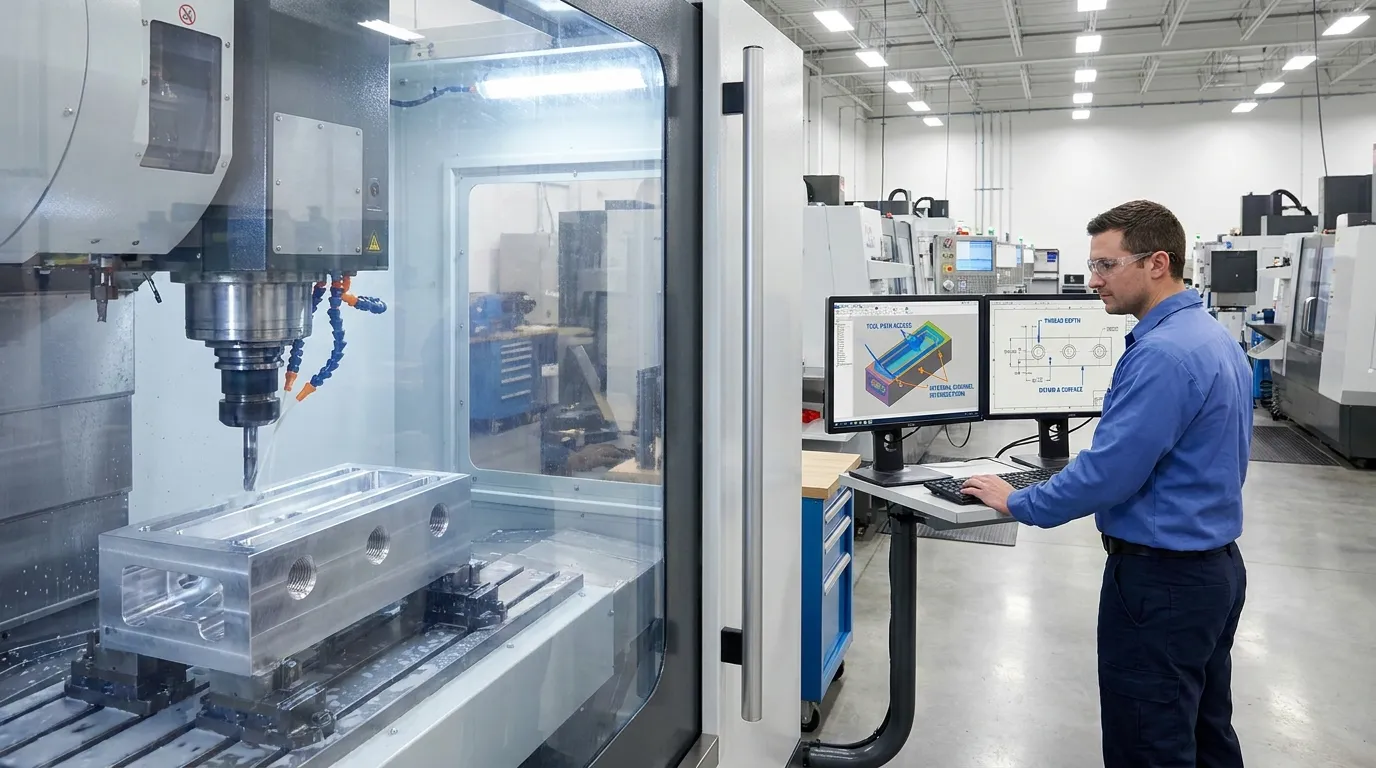
Drawing and DFM Review
The process begins with a review of the supplied CAD model, drawing, quantity, material, and functional requirements.
During design for manufacturability review, our engineers may check:
- Tool access to internal and external features
- Hole diameter and depth
- Channel intersections
- Thread depth and accessibility
- Thin walls around passages
- Sealing-face geometry
- O-ring groove dimensions
- Critical tolerance locations
- Datum selection
- Surface-finish allowances
- Inspection accessibility
When a feature creates an avoidable machining or inspection risk, we can provide feedback before production. Any proposed design change remains subject to customer approval.
Process Planning and CNC Machining
The machining route is selected according to the manifold geometry, material, quantity, and tolerance requirements.
Possible operations include:
- CNC milling
- Drilling
- Boring
- Reaming
- Tapping
- Thread milling
- Multi-face machining
- Multi-axis CNC machining where required
A simple manifold block may be produced through several indexed setups. More complex port angles or difficult-to-reach features may require multi-axis machining. The final process is confirmed after drawing review.
Deburring, Finishing, and Cleaning
Ports and intersecting passages can retain burrs or machining debris if post-machining requirements are not properly defined. Accessible edges and machined features are deburred according to the drawing and agreed quality requirements.
Depending on the project, post-processing may also include:
- Cleaning of ports and accessible passages
- Protection of threads and sealing faces
- Bead blasting
- Anodizing
- Plating
- Passivation
- Polishing
- Customer-specified finishing
Finish thickness should be considered when defining threaded features, sealing areas, and tightly controlled dimensions.
Inspection and Delivery
Inspection is planned around the controlled drawing and approved requirements. Checks may include:
- Overall dimensions
- Port position and orientation
- Thread verification
- Mounting-hole location
- Sealing-face flatness
- O-ring groove dimensions
- Surface roughness
- Critical wall thickness
- Material and finish confirmation
Dimensional reports or project-specific functional tests can be discussed during quotation. Testing requirements should be confirmed before production because they may affect fixtures, process planning, cost, and delivery.
| Stage | SunOn Activity | Buyer Input |
|---|---|---|
| RFQ review | Reviews files, material, quantity, and requirements | Supplies the latest drawing revision |
| DFM review | Identifies machining and inspection risks | Reviews and approves proposed changes |
| Process planning | Selects equipment, setups, tools, and inspection methods | Confirms critical requirements |
| Machining | Produces ports, passages, threads, and external features | Maintains drawing-change control |
| Finishing | Applies the approved post-processing | Confirms finish specifications |
| Inspection | Verifies agreed dimensions and features | Defines report and testing needs |
| Delivery | Packages and ships the completed components | Confirms packaging and delivery requirements |
Prototype and Any-Quantity Manufacturing
SunOn accepts custom manifold projects without a fixed minimum order quantity. This allows customers to order according to the actual stage of development rather than committing to a large batch before the design has been validated.
Our custom CNC machining for prototyping can support:
- One-off development components
- Functional prototypes
- Design-validation samples
- Small engineering batches
- Pilot production
- Repeat orders
- Higher quantities after design approval
Prototype production also allows engineers to verify installation, connection alignment, sealing interfaces, and assembly access before moving to a larger order.
Pricing and delivery depend on the selected material, component size, number of setups, passage complexity, tolerance requirements, finishing, inspection, testing, and quantity. Sending complete design information helps us prepare a more accurate quotation.
Materials and Surface Finishes
Material selection should reflect the coolant, temperature, pressure, corrosion exposure, weight requirement, mechanical strength, and finishing process of the application.
| Material Category | Main Buyer Considerations |
|---|---|
| Aluminum | Low weight, machinability, surface treatment, and coolant compatibility |
| Stainless steel | Corrosion resistance, strength, weight, and machining time |
| Copper or copper alloy | Conductivity, weight, corrosion behavior, and machining cost |
| Engineering plastic | Chemical resistance, temperature, dimensional stability, and pressure |
| Customer-specified material | Application requirements, availability, and manufacturability |
Aluminum is commonly considered for lightweight machined fluid components, but it is not automatically the correct choice for every coolant or operating environment. Stainless steel, copper alloys, and engineering plastics may be suitable for particular projects after technical review.
Available finishing options depend on the selected material and design. They may include as-machined surfaces, deburring, bead blasting, anodizing, plating, passivation, polishing, or another specified treatment.
For related heat-transfer components, SunOn also provides CNC-machined liquid cooling plates and custom water cooling plates. A cooling plate absorbs heat from a component, while a manifold distributes coolant between different parts of the system.
Quality Priorities for Machined Cooling Manifolds
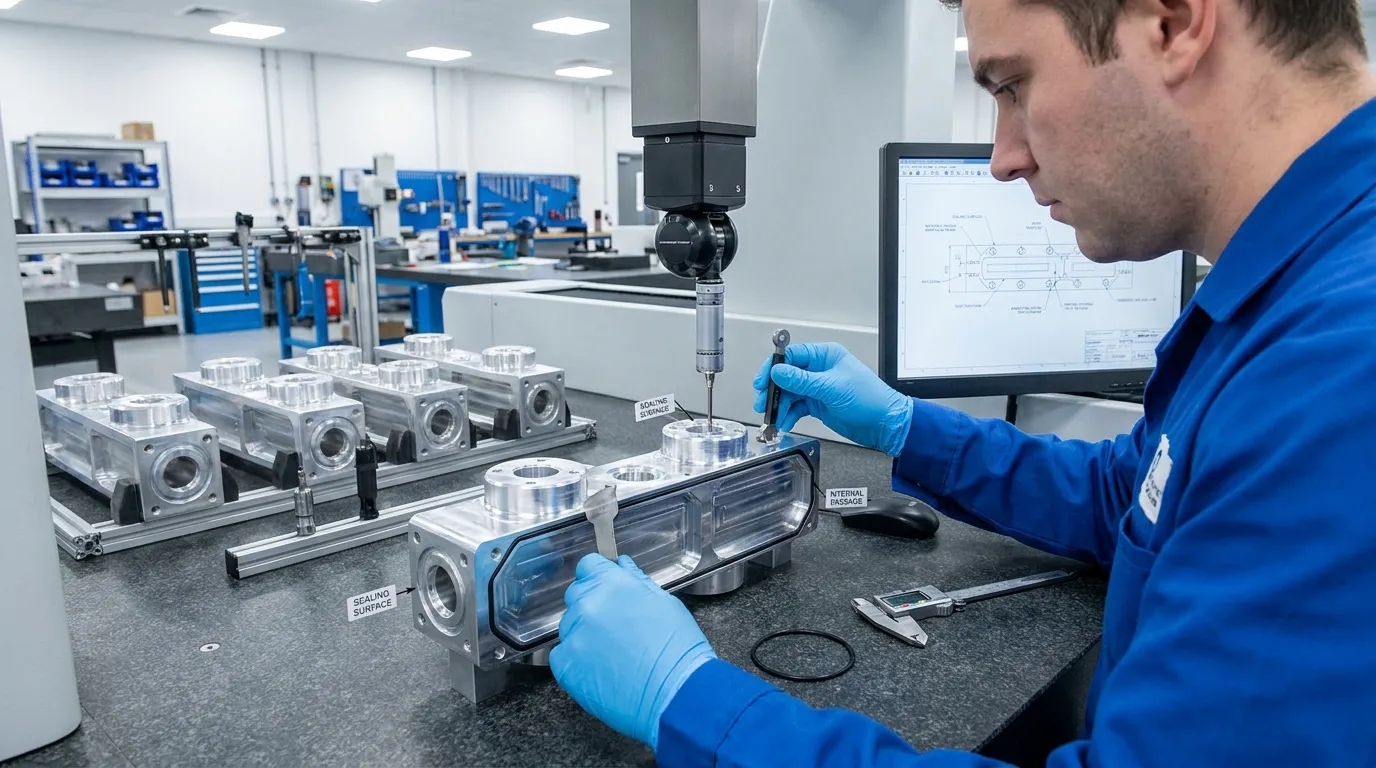
Manifold quality depends on more than the external dimensions. Fluid connections, sealing areas, and internal passages must match the approved design.
Important control points may include:
- Port position and angular orientation
- Thread type, size, depth, and gauge result
- Flatness of mounting and sealing faces
- O-ring groove dimensions
- Alignment of intersecting channels
- Wall thickness around drilled passages
- Burr removal
- Internal cleanliness
- Material confirmation
- Surface-finish conformity
- Drawing revision control
- Functional test requirements
Overly tight tolerances can increase machining and inspection cost without improving component performance. At the same time, insufficient control of ports, datums, sealing faces, or mounting features can create assembly problems.
SunOn reviews the requested tolerances and inspection scope during the quotation process. Dimensional reports and functional verification requirements should be stated in the RFQ.
Why Source Custom Manifolds from SunOn?
SunOn combines drawing-based manufacturing with prototype and production support. Customers can use one supplier for machining, finishing, inspection, and related OEM manufacturing requirements.
Our relevant capabilities include:
- Custom CNC machining from 2D and 3D files
- DFM and engineering review
- Prototype and small-batch support
- No fixed minimum order quantity
- CNC milling and multi-axis machining capability
- Metal and engineering-plastic machining
- Surface-finishing coordination
- Dimensional inspection
- Repeat production support
- Broader OEM and ODM manufacturing services
Every manifold project is evaluated according to its actual geometry and technical requirements. We do not rely on a single standard design or assume that one material, tolerance, or manufacturing route will fit every cooling system.
Request a Quote for Your Liquid Cooling Manifold
To request a quotation, send:
- 3D CAD model
- 2D technical drawing
- Current drawing revision
- Material and grade
- Prototype or production quantity
- Port and thread specifications
- Coolant information
- Operating pressure and temperature
- Flow or pressure-drop requirements, where applicable
- Critical dimensions and GD&T
- Surface roughness
- Surface finish
- Cleaning requirements
- Inspection-report requirements
- Functional or leak-test requirements
- Packaging requirements
- Target delivery schedule
Our team will review the files, identify manufacturability questions, and prepare a project-specific quotation.
Frequently Asked Questions
What is a liquid cooling manifold?
A liquid cooling manifold is a component that routes or distributes coolant between multiple lines, cooling plates, or system branches. Its ports, channels, mounting features, and connections can be customized for a specific assembly.
Can SunOn machine a manifold from my existing drawing?
Yes. SunOn manufactures custom manifold components from customer-supplied 2D drawings and 3D CAD models. The files are reviewed for material, geometry, tolerances, tool access, finishing, and inspection requirements before production.
Can I order only one prototype?
Yes. SunOn accepts prototype and one-off CNC machining projects. There is no fixed minimum order quantity, although cost and delivery depend on the component’s complexity and requirements.
Which materials are available?
Possible materials include aluminum, stainless steel, copper alloys, engineering plastics, and other customer-specified materials. The final choice should consider coolant compatibility, pressure, temperature, weight, corrosion exposure, and finishing requirements.
Can SunOn machine custom ports and internal channels?
Yes, subject to design review. CNC operations can produce custom ports, threaded connections, drilled passages, channel intersections, sealing features, and mounting geometry when the design provides suitable tool access and wall thickness.
What files are required for quotation?
Send a 3D CAD model and a controlled 2D drawing. The drawing should identify material, quantity, threads, tolerances, surface finish, critical dimensions, and inspection or testing requirements.
Can I request surface finishing and inspection reports?
Yes. Surface finishing and dimensional reporting can be included according to the project requirements. State the exact finish, inspection scope, and documentation needs when submitting the RFQ.
Can testing requirements be included?
Project-specific leak, pressure, or other functional testing requirements can be reviewed during quotation. The required method, pressure, acceptance criteria, and documentation must be defined before production.
Can SunOn support repeat or larger-volume orders?
Yes. SunOn can begin with prototypes or small batches and support repeat production after the design and manufacturing process have been approved.
Upload your 2D drawing and 3D CAD model to request a custom liquid cooling manifold quotation from SunOn. Include your material, quantity, port specifications, operating conditions, finish, and inspection requirements so our engineering team can review the project accurately.
