


Low to Mid-Volume Assembly: When to Outsource vs In-House
Determining whether to keep production in-house or utilize low-to-mid-volume mechanical assembly services depends on your total cost of ownership (TCO), internal capacity, and technical complexity. Generally, outsourcing becomes the more viable economic choice when production volumes range between 100 and 10,000 units, as this "bridge" phase requires specialized assembly fixtures and labor-intensive processes that carry high internal capital expenditure (CAPEX) risks.
Defining Low-to-Mid-Volume: When Does Outsourcing Make Sense?
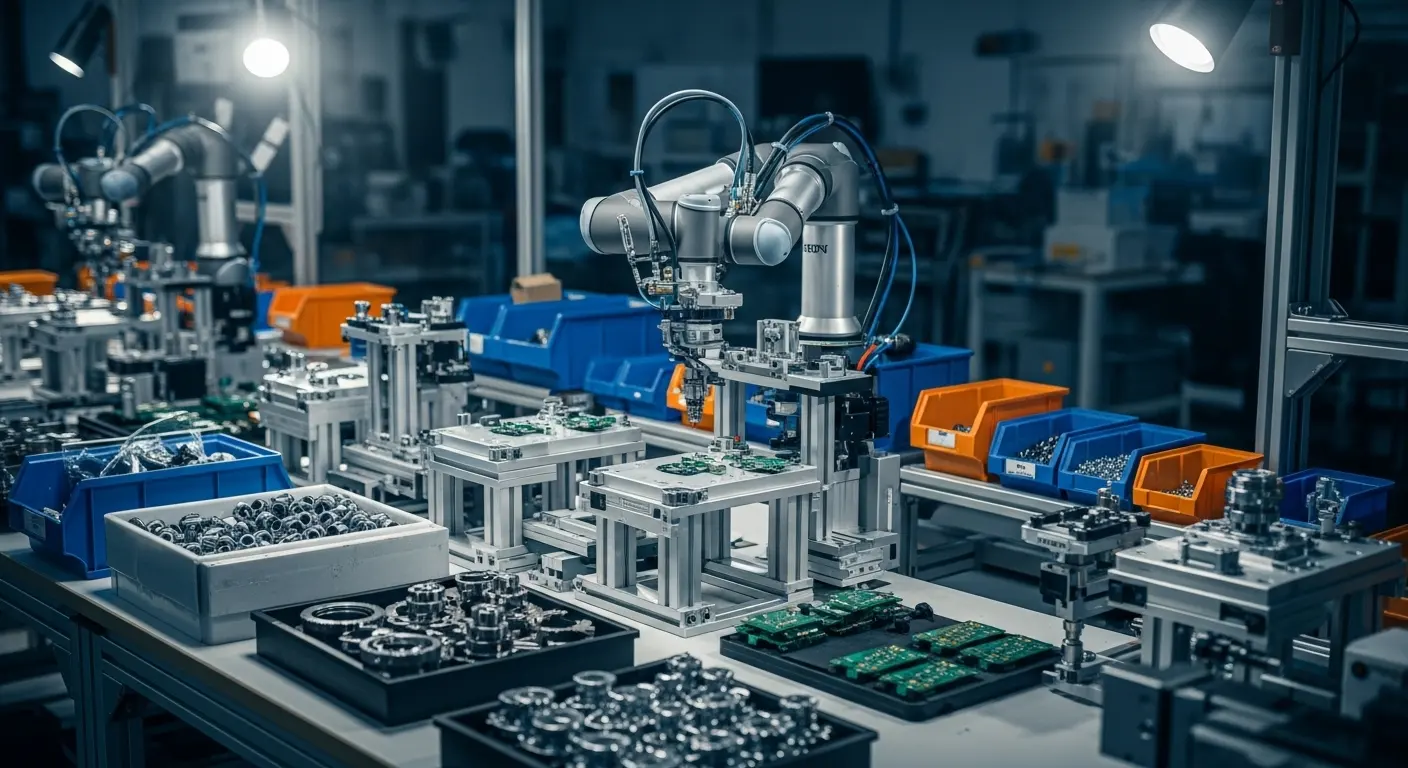
In the manufacturing world, "low-to-mid-volume" occupies the critical space between rapid prototyping and full-scale mass production. For most hardware brands and industrial equipment manufacturers, this typically means runs of 100 to 5,000 units per month. At this stage, the manual processes used for prototypes are no longer efficient, yet the volume does not justify the massive investment in fully automated robotic assembly lines.
Choosing between internal production and low volume contract manufacturing requires an honest assessment of your floor space and personnel. In-house assembly often seems cheaper on paper because it uses existing staff. However, as orders scale, those staff members are pulled away from core competencies like R&D or business development. Outsourcing allows your team to remain lean while a specialized partner manages the granular details of component sourcing, fitment testing, and repetitive manual tasks.
SunOn Industrial Group specializes in this "high-mix, low-volume" environment. By leveraging turnkey mechanical assembly strategies, we help clients navigate the transition from a proven design to a market-ready product without the burden of expanding their own physical footprint.
The Economics of Outsourcing Mechanical Assembly
The primary driver for outsourcing is the conversion of fixed costs into variable costs. When you manage assembly in-house, you pay for the square footage, the utilities, the insurance, and the specialized workstations regardless of whether you are producing 10 units or 1,000.
Reducing Capital Expenditure (CAPEX) on Assembly Fixtures
Every mechanical product requires specific jigs, cradles, and alignment tools to ensure repeatable quality. These assembly fixtures represent a significant upfront cost. When you partner with a contract manufacturer, these costs are often amortized across the production run or handled by the supplier’s existing infrastructure.
For complex projects involving low-to-mid-volume mechanical assembly, the cost of designing and CNC-machining these fixtures can reach thousands of dollars. An experienced partner like SunOn integrates the cost of fixture development into the overall project quote, ensuring you don't face unexpected hardware bills before the first unit is even boxed.
Overhead vs. Scalability: Managing Seasonal Demand
In-house assembly lines are notoriously difficult to scale down. If market demand dips, your assembly staff and equipment become expensive idle assets. Conversely, if demand spikes, you face the "bottleneck" crisis—hiring and training new workers takes weeks, during which your lead times skyrocket.
Outsourcing shifts this burden to the supplier. A robust partner manages multiple projects simultaneously, allowing them to reallocate labor dynamically. This flexibility ensures that your precision component assembly remains on schedule, regardless of internal personnel shifts or seasonal market volatility.
Critical Technical Factors in Outsourced Box Build Services
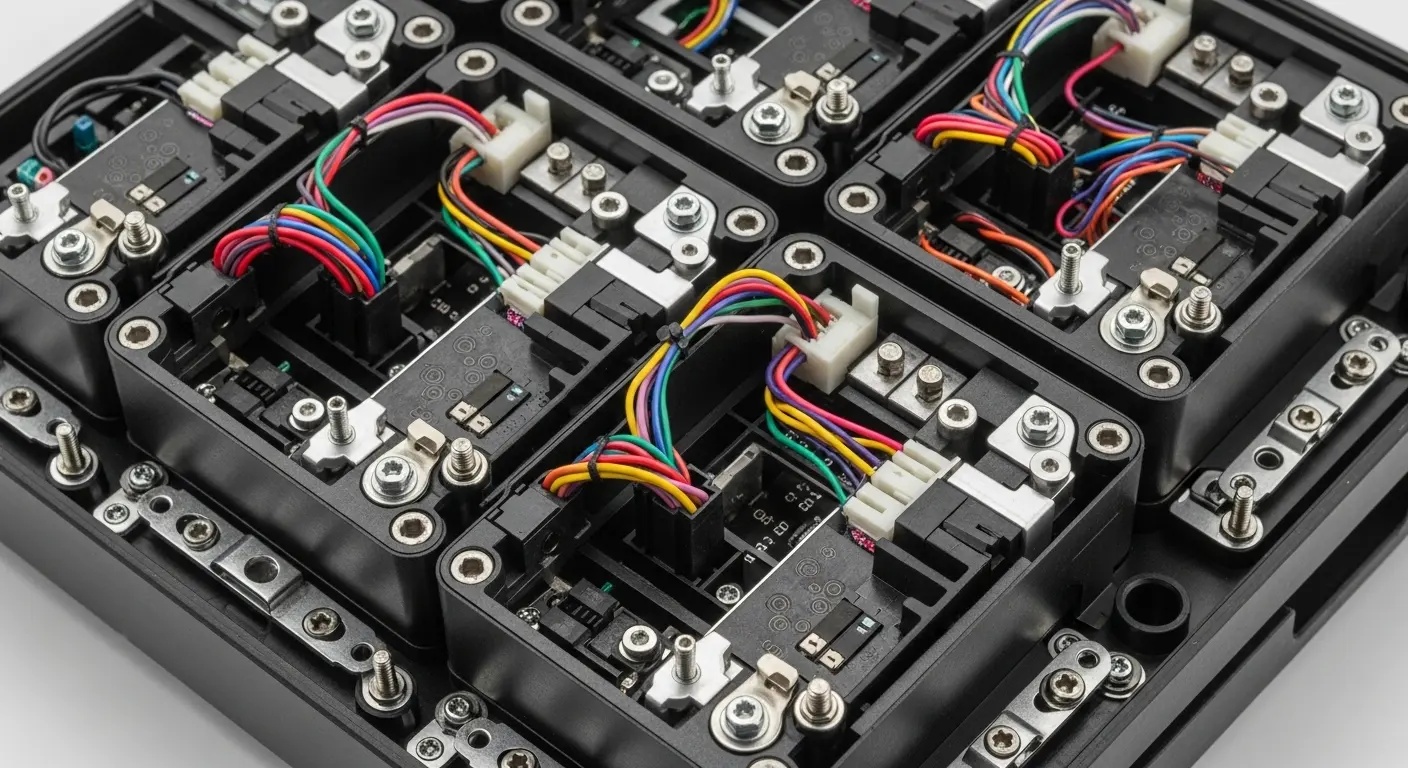
A "Box Build" goes beyond simple part-to-part joining; it involves the full integration of electronics, sub-assemblies, cabling, and the final outer housing. When evaluating box build assembly services, technical competence in material science and tolerance stacking is non-negotiable.
Integration of Plastic Injection Molding and Post-Processing
One of the greatest advantages of working with a vertically integrated supplier is the seamless transition from part fabrication to assembly. If your product requires custom enclosures, having the same team handle the injection molding and the subsequent assembly eliminates "fitment friction."
When the molding team and the assembly team work under one roof, they can quickly iterate on gate placements or cooling times to prevent warping that might interfere with the final snap-fits. Furthermore, integrating post-processing services like EMI shielding, painting, or ultrasonic welding into the assembly flow reduces the risk of cosmetic damage that often occurs during transit between different vendors.
Quality Control Standards: ISO, Tolerances, and Testing
Quality assurance in a low-volume environment requires a different mindset than mass production. In high-volume runs, you might use statistical sampling. In mid-volume mechanical assembly, the expectation is often 100% inspection for critical dimensions.
SunOn maintains strict adherence to ISO standards, ensuring that every screw torque, cable routing path, and structural bond meets the engineering print. We provide comprehensive documentation, including material certifications and final inspection reports (FAI), giving procurement managers the "paper trail" necessary for compliance in regulated industries like medical devices or automotive electronics.
How DFM Reduces Costs in Mid-Volume Assembly
Design for Manufacturing (DFM) is often discussed in terms of molding, but DFM for assembly (DFA) is where the most significant labor savings are found. During the quoting phase, our engineers analyze your 3D files to identify "assembly killers"—design choices that make the product difficult or impossible to put together efficiently.
Common DFA improvements include:
- Part Consolidation: Can two plastic components be redesigned into one to eliminate a fastening step?
- Self-Aligning Features: Adding chamfers or guide pins to parts so they "find" their location without complex fixtures.
- Fastener Standardization: Reducing the variety of screw types so a single tool can complete the entire assembly.
- Z-Axis Assembly: Designing the product so parts are stacked from the bottom up, reducing the need to flip or rotate the unit during production.
By addressing these factors early, we often reduce the total labor time per unit by 15-30%, directly lowering your unit cost and improving the reliability of the manual vs automated assembly balance.
Manual vs. Automated Assembly for Mid-Volume Runs
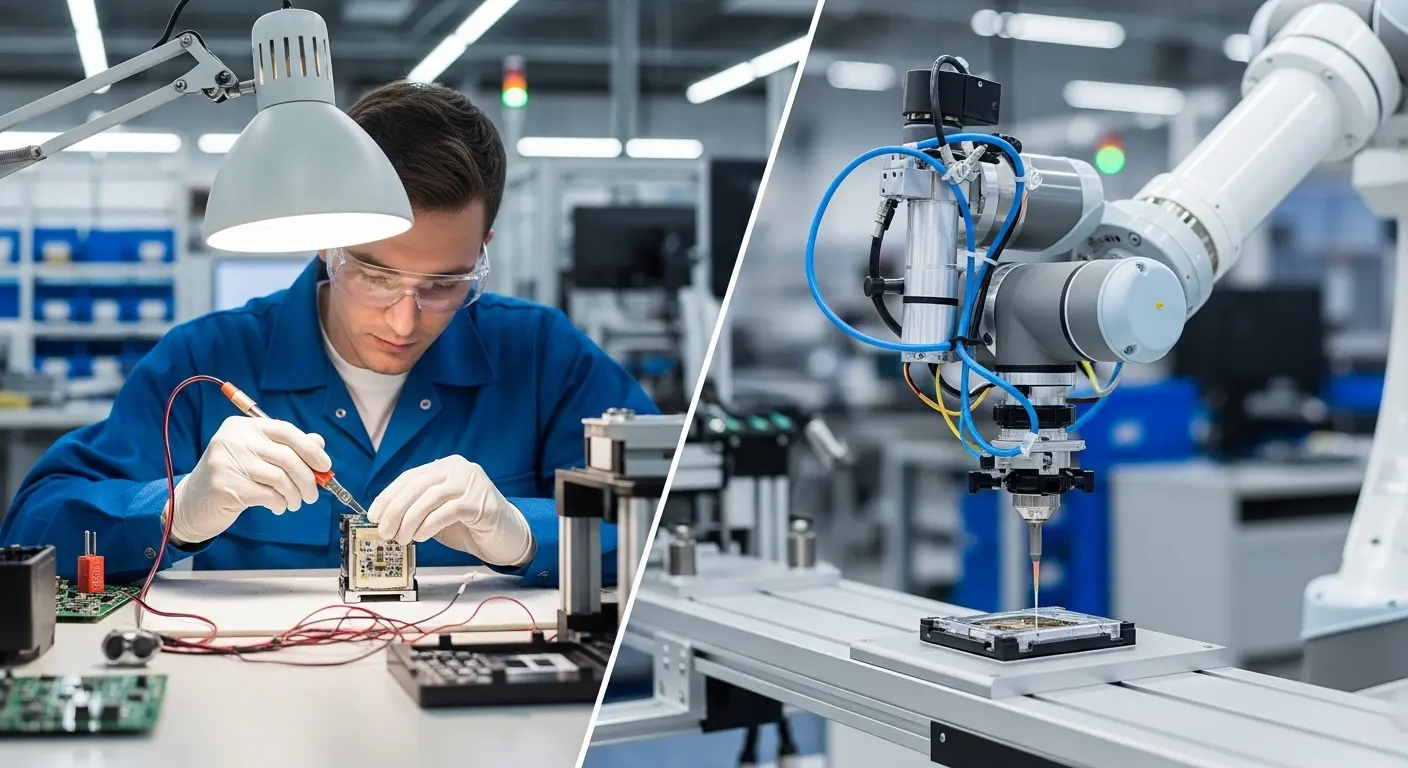
A common misconception is that all assembly in China is purely manual labor. In reality, modern low-to-mid-volume mechanical assembly utilizes a "hybrid" approach. We use semi-automated stations for tasks that require extreme precision—such as dispensing adhesives or pressing bearings—while utilizing skilled technicians for complex cable routing or final aesthetic checks.
This hybrid model is ideal for the 500 to 5,000-unit range. It provides the repeatability of automation without the six-figure setup costs of a fully robotic line. It also allows for much faster design changes. If you need to update a component in version 2.0, we can adjust a manual workstation in hours, whereas a robotic line might require weeks of reprogramming and new end-of-arm tooling.
Why SunOn is the Strategic Choice for Your Assembly Needs
Choosing a partner for mechanical assembly is a matter of trust. You are not just buying a service; you are extending your factory floor to Dongguan. SunOn Industrial Group provides the technical depth of a Tier-1 supplier with the agility required for mid-volume innovators.
We offer a "prototype-to-production" pathway. This means the same engineering team that helps you with your initial 3D-printed prototypes will oversee your 2,000-unit assembly run. This continuity of knowledge prevents the "lost in translation" errors that occur when moving a project from a design house to a separate manufacturer. Our DFM-led approach ensures that your quote is not just a price, but a roadmap for manufacturability.
Frequently Asked Questions (FAQ)
What is the typical lead time for a mid-volume assembly project?
Lead times generally range from 2 to 4 weeks once all components are staged, depending on complexity. Initial setup, including fixture fabrication and DFM review, usually adds another 1 to 2 weeks to the first production run.
Can SunOn source third-party components like PCBs or fasteners?
Yes, we provide full turnkey sourcing for non-molded components. Our procurement team manages a verified network of local suppliers for electronic components, specialized hardware, and packaging materials to streamline your supply chain.
How do you handle intellectual property (IP) protection during assembly?
We implement strict internal protocols, including non-disclosure agreements (NDAs) and restricted access to project-specific assembly areas. As a long-term partner to global hardware brands, protecting client IP is fundamental to our business model.
Do you offer functional testing as part of the assembly process?
Yes, we can perform basic electrical continuity tests, pressure testing for sealed enclosures, and custom functional "go/no-go" testing based on your specific testing jigs and protocols.
What is the minimum order quantity (MOQ) for assembly services?
While we specialize in mid-volume runs of 500 to 5,000 units, our MOQs are flexible. We often support early-stage runs as low as 50 to 100 units for market validation or pilot launches.
How does shipping work for a full box build?
We can ship fully assembled products directly to your warehouse or fulfillment center. We offer various packaging options, from bulk industrial packing to individual retail-ready boxes, and handle all export documentation from China.
