


Micro Channel Cold Plates: 5-Axis CNC Precision Manufacturing at SunOn
A micro channel cold plate combines narrow coolant channels, thin internal walls, sealing features, ports, and precision contact surfaces in one compact component. Manufacturing these features reliably requires more than basic CNC milling. Tool access, channel depth, datum relationships, burr control, finishing allowances, and inspection methods must all be reviewed before production begins.
SunOn provides drawing-based CNC manufacturing support for custom microchannel cold plate projects. Our team reviews your 3D model, technical drawing, material, tolerances, sealing requirements, and order quantity to determine whether conventional milling, 5-axis CNC machining, or another manufacturing approach is appropriate.
Send your CAD files and specifications to receive a manufacturability review and quotation.
Custom Micro Channel Cold Plate Manufacturing at SunOn
SunOn manufactures custom precision components based on customer drawings, CAD models, samples, and project specifications. For a CNC-machined microchannel cold plate, the work can include:
- 3D CAD and 2D drawing review
- Design for manufacturability assessment
- CNC process and setup planning
- Prototype machining
- Low-volume production
- Material and finishing review
- Critical-tolerance planning
- Port, thread, groove, and mounting-feature machining
- Dimensional inspection planning
- Assembly and wider OEM/ODM manufacturing support
Each project is reviewed individually. A simple plate with straight, open channels may not need the same equipment or setup strategy as a design containing angled ports, multi-level manifolds, or features located across several faces.
This process-led approach helps prevent unnecessary machining complexity while maintaining control over the dimensions that affect sealing, assembly, flow paths, and thermal contact.
For an accurate quotation, send your 3D model, 2D drawing, selected material, quantity, critical channel dimensions, surface finish, and inspection requirements.
When a Micro Channel Cold Plate Benefits From 5-Axis CNC Machining
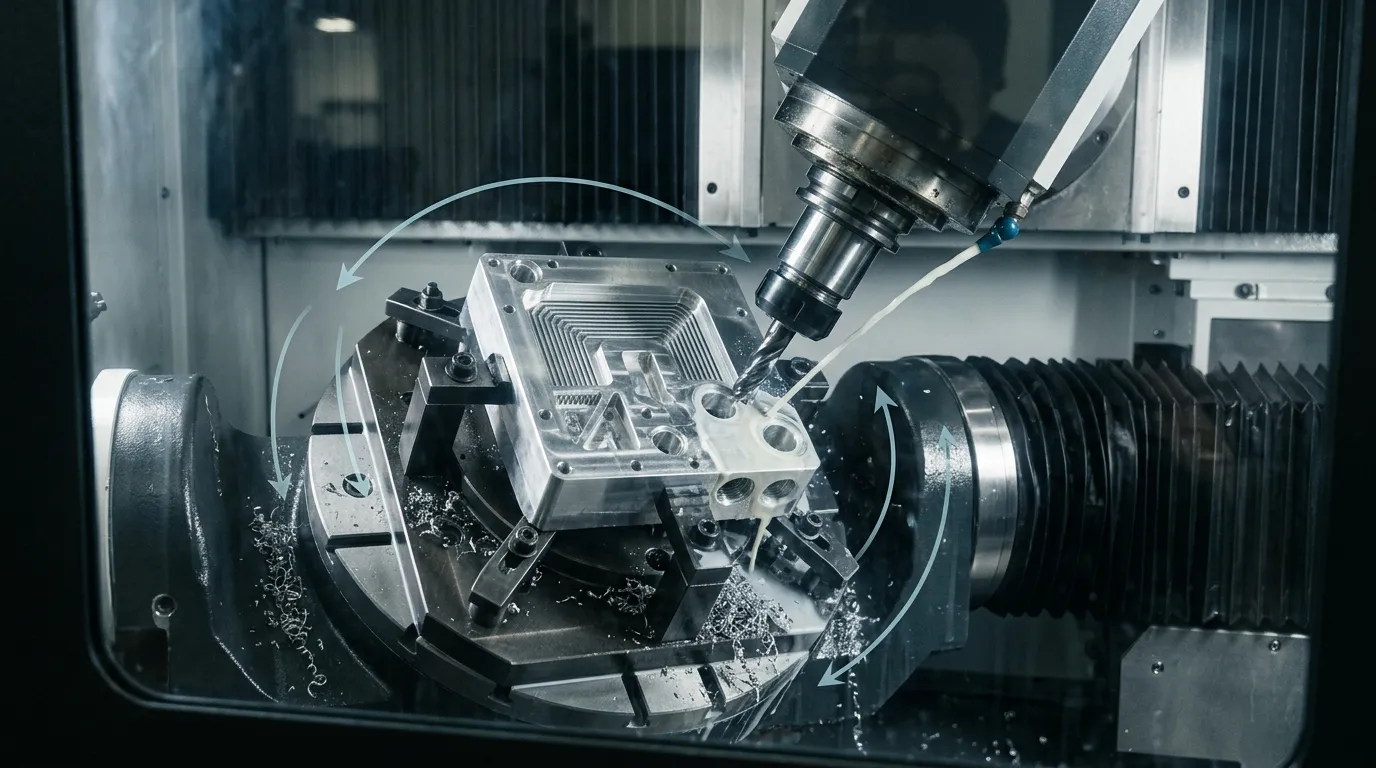
Not every microchannel cold plate requires 5-axis machining. The appropriate process depends on the geometry, tool approach, feature relationships, and tolerance requirements.
SunOn uses 5-axis CNC machining services when multi-directional access or reduced re-clamping can make the manufacturing process more practical.
Geometry That May Justify 5-Axis Machining
A microchannel design may benefit from 5-axis CNC machining when it includes:
- Angled inlet or outlet ports
- Manifolds extending across multiple faces
- Non-planar channels or cavities
- Features requiring several tool-approach directions
- Closely related mounting, sealing, and fluid features
- Deep areas that are difficult to reach vertically
- Critical features that could lose alignment during repeated re-clamping
Machining several sides in fewer setups can help maintain the relationship between channel arrays, ports, sealing grooves, mounting holes, and datum surfaces. It may also reduce the number of dedicated fixtures required for complex components.
When 3-Axis Machining May Be Sufficient
A simpler process may be suitable when the plate has:
- Straight planar channels
- Accessible top-down geometry
- Open channel arrays
- Standard vertical holes
- Simple external ports
- No difficult multi-face relationships
The final decision should follow a DFM review rather than the product name alone.
| Design Condition | 3-Axis May Be Suitable | 5-Axis May Add Value | Information Needed |
|---|---|---|---|
| Straight planar channels | Yes | Usually limited | Width, depth, pitch |
| Angled ports | Sometimes, with extra setups | Often | Port angle, position, thread |
| Multi-face manifold | Less efficient | Often | Complete CAD model and flow layout |
| Closely related features on several faces | Possible with re-clamping | May reduce datum-transfer risk | Critical datums and tolerances |
| Deep, difficult-access cavities | Tool reach may be limited | Improved tool approach may help | Depth, opening size, corner radius |
Microchannel Features SunOn Reviews Before Machining
A workable cold plate design depends on how the channel geometry interacts with the surrounding walls, manifolds, ports, sealing areas, and external mounting features.
Channel Geometry
The drawing should clearly define:
- Channel width
- Channel depth
- Channel pitch
- Fin or wall thickness
- Channel length
- Internal corner radius
- Entry and exit transitions
- Minimum distance between channels and external surfaces
- Local changes in channel direction or cross-section
Very narrow channels combined with excessive depth can create cutter-reach, vibration, chip-removal, and tool-breakage risks. Thin walls may also deform under cutting or clamping forces.
Sharp internal corners should be avoided unless they are functionally necessary and supported by a suitable manufacturing method. CNC-milled internal corners normally require a radius based on the selected cutter.
Manifold and Port Geometry
The inlet and outlet regions influence both manufacturability and final assembly. SunOn reviews:
- Manifold depth and shape
- Port location and orientation
- Thread type and depth
- Fitting clearance
- Transitions between ports and channel arrays
- Wall thickness around threaded features
- Relationships between ports, channels, and sealing surfaces
Angled ports or manifolds spread across several faces are among the features that may justify a multi-axis setup.
Functional External Features
The cold plate drawing should also define:
- Mounting holes
- Contact surfaces
- Cover interfaces
- O-ring grooves
- Gasket faces
- Datum surfaces
- Alignment features
- Assembly clearances
| Feature | Buyer Should Specify | Manufacturing Concern | Verification Requirement |
|---|---|---|---|
| Channel width | Nominal size and tolerance | Cutter selection and repeatability | Agreed measurement method |
| Channel depth | Nominal size and tolerance | Tool reach and vibration | Depth inspection |
| Wall thickness | Minimum allowable thickness | Deformation and breakage | Sampling or full inspection |
| O-ring groove | Width, depth, radius, finish | Leakage and seal compression | Profile measurement |
| Contact surface | Flatness and surface finish | Thermal-interface contact | Flatness inspection |
| Ports | Thread, position, angle | Fitting alignment and sealing | Thread gauge and position check |
Tight-Tolerance Planning for Cold Plate Performance and Assembly
A microchannel cold plate should not receive the same tight tolerance on every dimension. Tolerances should be assigned according to function.
SunOn’s tight-tolerance CNC machining process focuses on identifying which features are genuinely critical to performance or assembly.
These may include:
- Channel width
- Channel depth
- Minimum wall thickness
- O-ring groove geometry
- Port location
- Thread dimensions
- Sealing-surface flatness
- Contact-face flatness
- Mounting-hole position
- Cover alignment
- Surface roughness
- Relationships between datum features
Why Setup Reduction Matters
Every time a part is removed, repositioned, and clamped again, a new setup relationship is introduced. For cold plates containing connected features across several faces, excessive re-clamping may make it harder to maintain alignment between the ports, manifolds, channels, sealing grooves, and mounting points.
Where the geometry supports it, 5-axis machining may reduce these setup changes and help preserve feature relationships from a consistent datum strategy.
Avoid Unnecessary Over-Tolerancing
Applying very tight tolerances to non-critical dimensions can increase:
- Machining time
- Tooling requirements
- Inspection work
- Rejection risk
- Overall production cost
The drawing should distinguish critical-to-function dimensions from general dimensions. It should also account for dimensional changes caused by anodizing, plating, joining, heat input, or other secondary operations.
Material Options for CNC-Machined Micro Channel Cold Plates
Material selection affects thermal behavior, weight, corrosion resistance, machining stability, finishing, and cost. SunOn reviews the exact material grade rather than treating all aluminum or copper alloys as equivalent.
Aluminum
Aluminum is commonly selected for machined cold plates because it offers:
- Relatively low weight
- Good machinability
- Practical prototype and production processing
- Compatibility with several finishing options
The engineering review should still consider thin-wall distortion, final flatness, thread strength, coating thickness, and coolant compatibility.
Copper
Copper may be selected where thermal spreading is a major priority. From a manufacturing perspective, the project must account for:
- Higher material density
- Different cutting behavior
- Burr formation
- Thin-feature deformation
- Tool and process control
- Surface-treatment requirements
The exact copper grade should be identified in the RFQ.
Other Materials
Stainless steel, brass, and other engineering alloys may be considered for projects with specific mechanical, corrosion, or fluid-compatibility requirements. Their suitability depends on the application and geometry.
| Material | Common Buyer Priority | Machining Consideration | RFQ Details Needed |
|---|---|---|---|
| Aluminum | Weight and machinability | Thin-wall distortion and finishing allowance | Exact alloy and finish |
| Copper | Thermal spreading | Burrs, cutting stability, density | Exact grade and coating |
| Stainless steel | Strength and corrosion resistance | Tool wear and longer machining time | Grade and coolant environment |
Sealing, Joining, and Post-Machining Requirements
Many microchannel cold plates require a cover or another method of closing the machined flow paths. The intended sealing or joining method must be defined before the machining plan is finalized.
Project requirements may include:
- O-ring sealing
- Gasket sealing
- Mechanical cover fastening
- Brazing
- Welding
- Bonding
- Thread sealing
- Coated sealing surfaces
The buyer should specify the intended closure method, operating pressure, coolant, allowable leakage, and assembly conditions.
These details can affect:
- Groove geometry
- Surface finish
- Cover alignment
- Wall thickness
- Material choice
- Finishing allowance
- Inspection sequence
- Final flatness
Do not leave joining and testing requirements until after the channels have been machined. A secondary process may change dimensions or distort critical contact and sealing surfaces.
SunOn will review the supplied requirements and confirm the appropriate manufacturing scope during quotation.
Deburring, Cleaning, and Inspection of Fine Cooling Channels
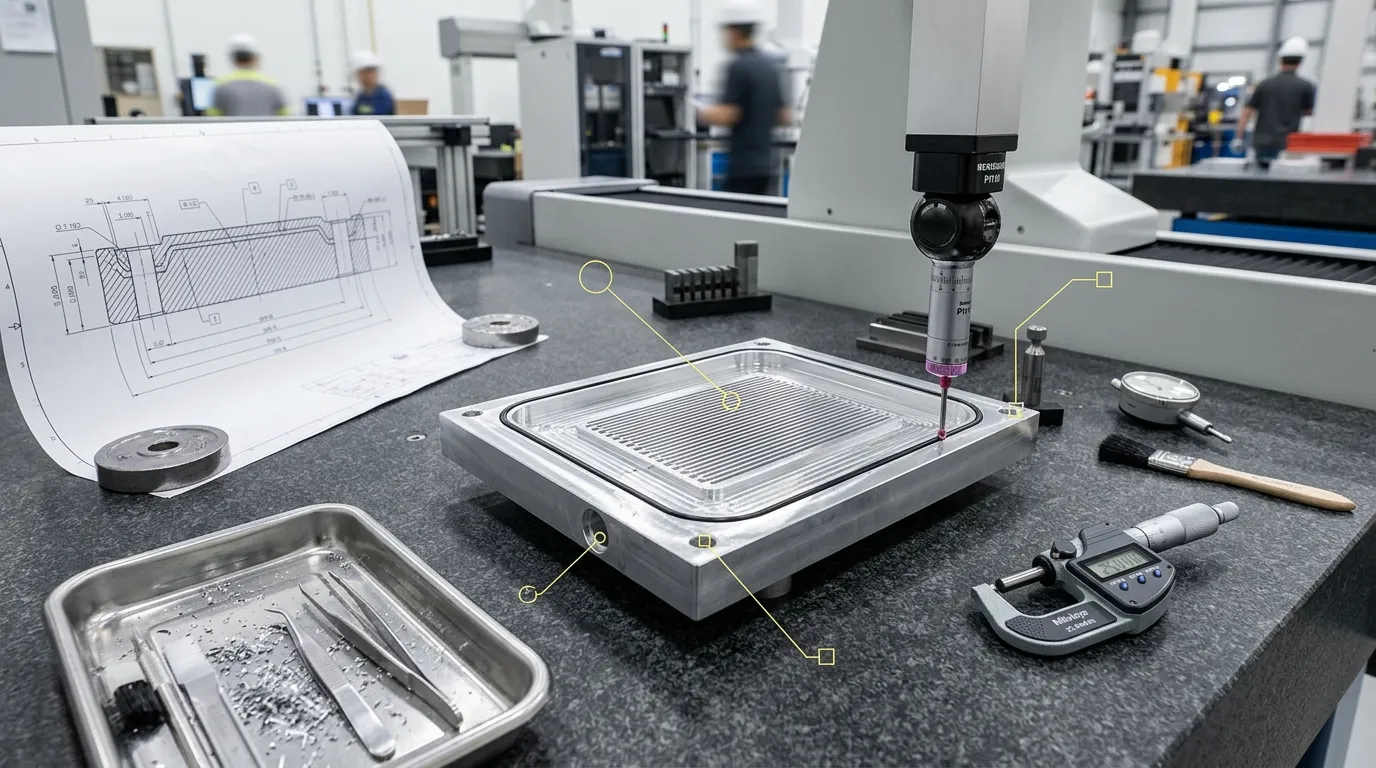
Machining the channels is only one part of producing a functional cold plate. Narrow flow paths must also be free from burrs, loose chips, and retained contamination.
Deburring and Contamination Control
Post-machining planning should address:
- Burrs around channel edges
- Chips trapped in deep features
- Residue from cutting fluids
- Debris retained after finishing
- Blocked or restricted coolant paths
- Protection against contamination during packaging
The selected cleaning and deburring method must suit the channel geometry and material without damaging thin walls or changing critical dimensions.
Dimensional Inspection
Inspection requirements may include:
- Channel width and depth
- Wall thickness
- O-ring groove profile
- Port threads
- Port and hole position
- Contact-surface flatness
- Surface roughness
- Cover alignment
- Critical datum relationships
SunOn will review the drawing and identify which dimensions require standard measurement, profile inspection, gauges, or more detailed reporting.
Testing Requirements
Where pressure or leak testing is required, the RFQ should define:
- Test method
- Test medium
- Test pressure
- Hold time
- Allowable leakage
- Reporting requirements
These conditions should be agreed before production so that the test procedure matches the intended operating environment.
Prototype, Validation, and Low-Volume Production
CNC machining is well suited to early microchannel cold plate development because it allows engineers to evaluate a physical part without committing immediately to production tooling.
A typical project may progress through:
- Drawing and DFM review
- Prototype machining
- Dimensional inspection
- Fit and assembly validation
- Pressure or leak validation where specified
- Drawing revision
- Pilot batch
- Low-volume or repeat production
Prototype parts can be used to evaluate assembly, port alignment, contact surfaces, sealing features, and manufacturing feasibility.
For repeat orders, SunOn can review fixture requirements, revision control, inspection sampling, and other measures needed to improve consistency. Our broader precision CNC machining services also support custom parts from prototype development through production planning.
Common Micro Channel Cold Plate Manufacturing Risks
Common risks that should be addressed during DFM include:
- Channels that are too narrow for the specified depth
- Excessive channel depth-to-width relationships
- Thin fins or walls that deform during machining
- Sharp internal corners that cannot be milled as drawn
- Insufficient cutter reach
- Tool vibration in deep channels
- Burrs obstructing coolant paths
- Chips or residue remaining after machining
- Port and channel misalignment
- Undefined datum structures
- Tight tolerances applied to non-critical features
- Finishing changing groove, port, or channel dimensions
- Joining processes distorting contact surfaces
- Undefined sealing requirements
- Missing pressure- or leak-test specifications
- Material and coolant incompatibility
- No agreed inspection method for internal features
A DFM review before production helps identify these issues while the design can still be adjusted.
What to Send SunOn for a Micro Channel Cold Plate Quote
Provide as much of the following information as possible:
- 3D CAD model
- 2D technical drawing
- Drawing revision
- Part application
- Material and grade
- Overall dimensions
- Channel width, depth, and pitch
- Minimum wall or fin thickness
- Internal corner requirements
- Port size, position, angle, and thread
- O-ring or gasket details
- Contact-surface flatness
- Surface-roughness requirements
- General and critical tolerances
- GD&T and datum structure
- Surface finish or coating
- Cover or joining method
- Coolant type
- Operating pressure
- Pressure-test or leak-test requirements
- Inspection-report requirements
- Prototype or production quantity
- Target delivery date
- Assembly requirements
- BOM or related project specifications
Complete information allows SunOn to review tool access, process selection, tolerance feasibility, inspection requirements, and quotation conditions more accurately.
Why Work With SunOn for Micro Channel Cold Plate Manufacturing?
SunOn combines product-specific DFM review with established CNC and broader manufacturing capabilities.
Customers can access:
- 3-axis and 5-axis CNC process review
- Tight-tolerance machining support
- Drawing and CAD analysis
- Prototype and small-batch production
- Material and surface-finishing review
- Inspection planning
- Assembly and wider OEM/ODM support
- One supplier for related custom manufacturing requirements
We do not assume that one process is correct for every cold plate. Our engineers review the geometry, critical features, material, quantity, and inspection requirements before recommending a manufacturing route.
This helps buyers avoid paying for unnecessary complexity while still applying advanced machining where the part genuinely requires it.
Frequently Asked Questions
Does Every Micro Channel Cold Plate Require 5-Axis CNC Machining?
No. Straight, open, planar channels may be suitable for 3-axis machining. Five-axis CNC is more relevant when the part contains angled ports, complex manifolds, difficult tool access, multi-face features, or critical relationships that benefit from fewer setups.
Can SunOn Manufacture a Custom Micro Channel Cold Plate From My Drawing?
SunOn reviews custom parts from 3D CAD models and 2D technical drawings. Send the geometry, material, quantity, tolerances, finish, sealing, and inspection requirements for a manufacturability review and quotation.
What Files Are Required for a Quote?
A STEP or other usable 3D CAD file should be supplied with a 2D drawing showing dimensions, tolerances, materials, surface finishes, threads, datums, inspection requirements, and drawing revision.
Can SunOn Machine Aluminum and Copper Cold Plates?
SunOn can review aluminum and copper CNC machining projects. The exact alloy or grade must be provided because material properties affect cutting strategy, burr control, finishing, dimensional stability, and quotation.
How Should Microchannel Tolerances Be Specified?
Identify the features that directly affect flow paths, sealing, thermal contact, mounting, and assembly. Avoid applying the tightest tolerance to every dimension. SunOn can review critical dimensions during DFM.
Can SunOn Review Narrow Channels and Thin Walls Before Production?
Yes. The review can assess channel width, depth, pitch, wall thickness, internal radii, tool reach, deformation risk, datum relationships, and inspection feasibility before machining begins.
Can SunOn Support Prototypes and Low-Volume Orders?
SunOn’s CNC services support prototypes, engineering samples, pilot batches, and low-volume production. Quantity, revision status, and inspection requirements should be included in the RFQ.
Should Pressure and Leak-Test Requirements Be Included in the Drawing?
Yes. Specify the test method, pressure, medium, hold time, allowable leakage, and reporting requirement before production. These conditions can affect the sealing design, joining process, inspection sequence, and quotation.
Request a Micro Channel Cold Plate Manufacturing Review
Send SunOn your 3D CAD model, 2D technical drawing, material, quantity, channel dimensions, critical tolerances, sealing details, surface finish, inspection requirements, and pressure or leak-test specifications.
