


Rapid CNC Machining Services
For the fastest review, buyers should send a complete RFQ package, including a 3D CAD model, 2D drawing, material requirement, quantity, tolerance notes, surface finish expectations, inspection needs, delivery destination, and target schedule. Standard materials, practical tolerances, and simpler finishes usually support a faster CNC workflow than complex geometries, hard-to-machine materials, tight tolerance stacks, or multi-step finishing requirements.
What Can Be Made Quickly With Rapid CNC Machining?
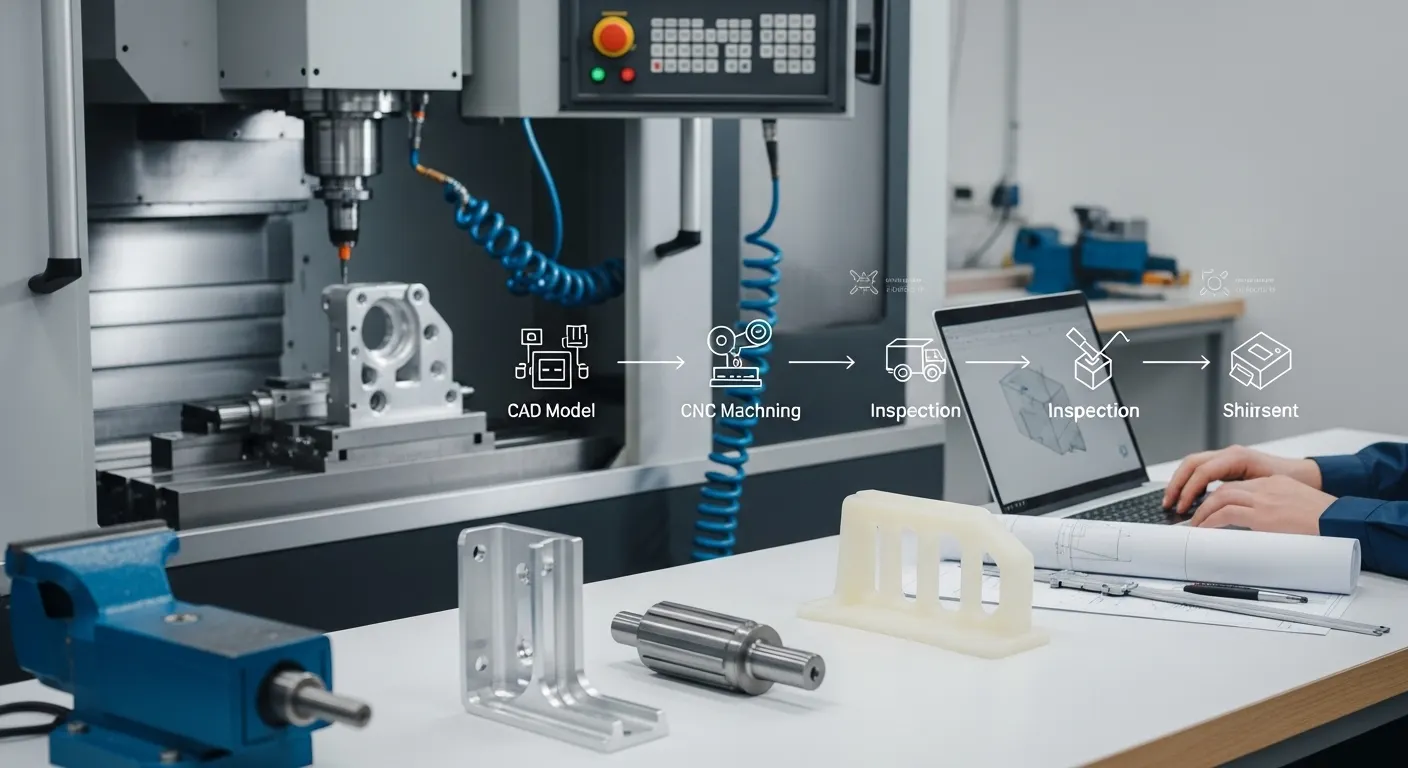
Rapid CNC machining is often used when buyers need real functional parts faster than tooling-based production can support. It is especially useful for prototypes, test parts, pilot builds, urgent replacement parts, and bridge-production quantities before injection molding, die casting, or other mass-production tooling is ready.
Common rapid CNC part examples include:
- Aluminum brackets, plates, covers, and housings
- Prototype enclosures and product shells
- Fixtures, jigs, test parts, and assembly aids
- Shafts, bushings, pins, spacers, and turned parts
- Heatsinks, mounting blocks, and mechanical supports
- Plastic functional prototypes and engineering samples
- Low-volume CNC parts for pilot production or bridge supply
Rapid CNC is most effective when the part design is clear, the material is available, the tolerance requirements are realistic, and the surface finish does not require unnecessary extra processing.
Buyer Need vs Fastest CNC Planning Route
| Buyer Situation | Recommended CNC Route | Fastest Planning Choice | Possible Delay Factor | RFQ Note |
|---|---|---|---|---|
| Functional aluminum prototype | CNC milling | Use a practical aluminum grade and as-machined or simple finish | Tight cosmetic finish or unclear tolerance notes | Send 3D model and 2D drawing for critical dimensions |
| Round shaft, pin, or bushing | CNC turning | Confirm diameter, length, thread, and fit requirements | Unclear thread, groove, or surface finish details | Mark mating surfaces and critical diameters |
| Complex multi-face part | 3-axis, 4-axis, or 5-axis CNC review | Let SunOn review the most efficient setup | Deep pockets, undercuts, thin walls, or complex datum control | Send complete CAD and drawing package |
| Cosmetic prototype housing | CNC milling plus finishing review | Separate functional surfaces from cosmetic surfaces | Anodizing, plating, polishing, painting, or color matching | Confirm finish priority before quoting |
| Bridge-production batch | Small-batch CNC machining | Use stable material, repeatable tolerance, and clear inspection plan | Changing design after quote approval | Confirm quantity range and target schedule |
What Slows Down a Rapid CNC Quote?
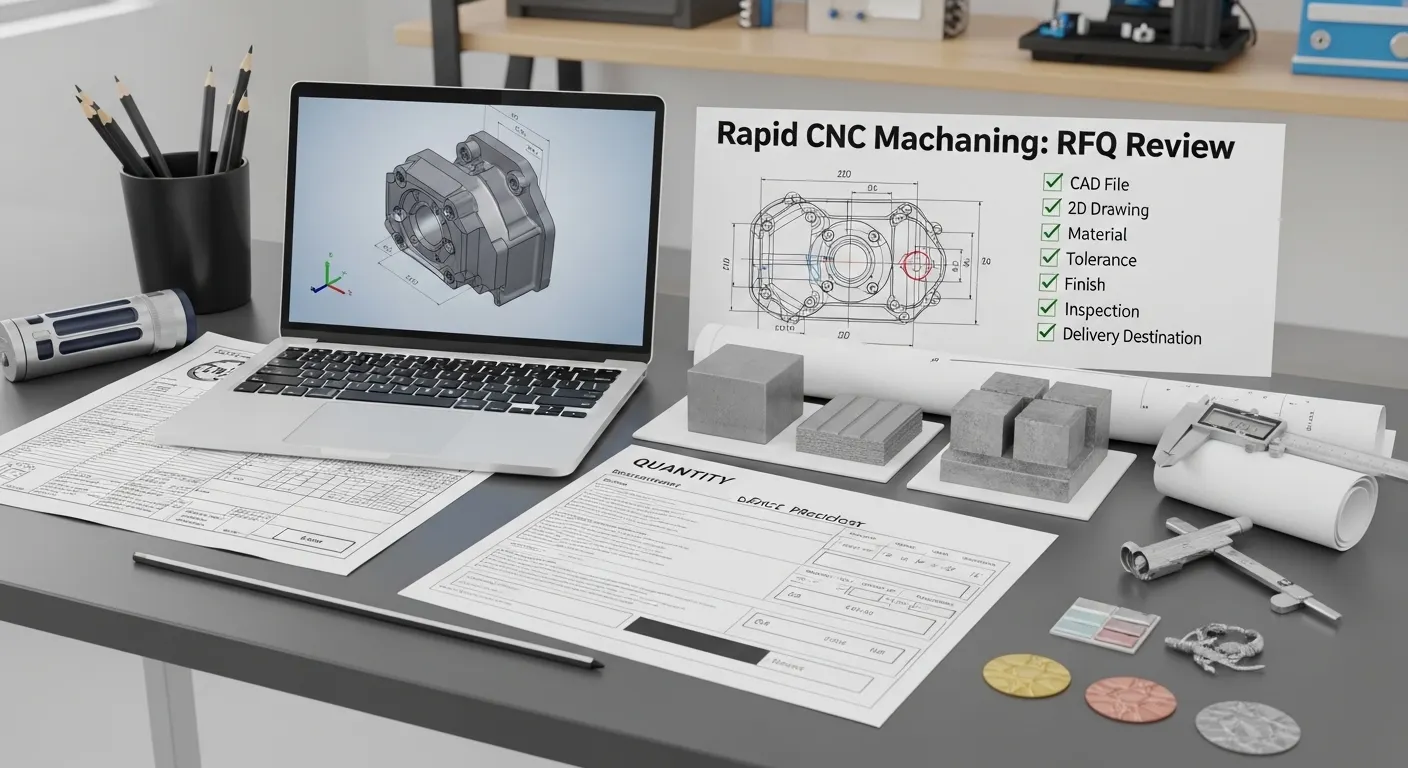
Many rapid CNC delays happen before machining starts. A quote may take longer when the buyer sends incomplete files, unclear tolerance requirements, or finish instructions that need extra confirmation.
Common quote and production delay factors include:
- Missing 2D drawings for critical dimensions
- No confirmed material grade
- No quantity or unclear production stage
- Unclear tolerance requirements
- Unclear cosmetic or surface finish expectations
- Thin walls, deep pockets, small holes, or undercuts
- Tight threads, inserts, slots, and multi-side features
- Difficult-to-machine materials
- Special inspection or reporting requirements
- No delivery destination or target schedule
To reduce back-and-forth, buyers should prepare drawings and specifications before requesting a quote. A complete RFQ helps SunOn review manufacturability, process choice, material, tolerance, finish, and inspection needs more efficiently.
For quote preparation details, buyers can review SunOn’s CNC machining quote checklist.
Which CNC Process Is Best for Urgent Parts?
The fastest CNC process depends on the geometry, material, tolerance, and quantity. Buyers do not always need to choose the exact process before contacting SunOn, but understanding the basic process fit can reduce confusion during RFQ review.
CNC Milling
CNC milling is commonly used for plates, brackets, housings, slots, pockets, mounting surfaces, and multi-face components. It is suitable for many prototype and low-volume metal or plastic parts.
CNC Turning
CNC turning is suitable for round or cylindrical parts such as shafts, pins, bushings, spacers, sleeves, and threaded components. If a part is mainly rotational, CNC turning may be more efficient than milling.
5-Axis CNC Machining
5-axis CNC machining can be useful for complex parts with angled surfaces, multi-side features, or geometry that would otherwise require several setups. However, simple parts do not always need 5-axis machining. For urgent jobs, SunOn should review whether 3-axis, 4-axis, 5-axis, turning, or a combined process is the most practical route.
How Material Choice Affects CNC Speed
Material choice has a direct impact on machining time, tool planning, finish options, and quote review. Some materials are commonly selected for quick prototypes, while others need more engineering review because they are harder to machine or require tighter process control.
Aluminum is often practical for rapid prototypes, enclosures, brackets, fixtures, and lightweight mechanical parts. Stainless steel can be suitable for stronger or more durable parts, but machining time and tool planning may require closer review. Brass and copper are useful for conductive or decorative parts, but burr control, finish, and dimensional requirements should be discussed early.
Titanium is strong and lightweight, but it is more difficult to machine than many common metals. Buyers with titanium projects should confirm geometry, tolerance, surface finish, and inspection needs carefully. For titanium-specific projects, SunOn can connect the discussion with its titanium CNC machining services.
Plastic CNC machining materials may include ABS, POM/Delrin, nylon, PC, PMMA, PEEK, PTFE, and other engineering plastics depending on the application. Plastic parts may need special attention to wall thickness, deformation risk, surface finish, and tolerance expectations.
Tolerance and Surface Finish Trade-Offs for Faster Turnaround
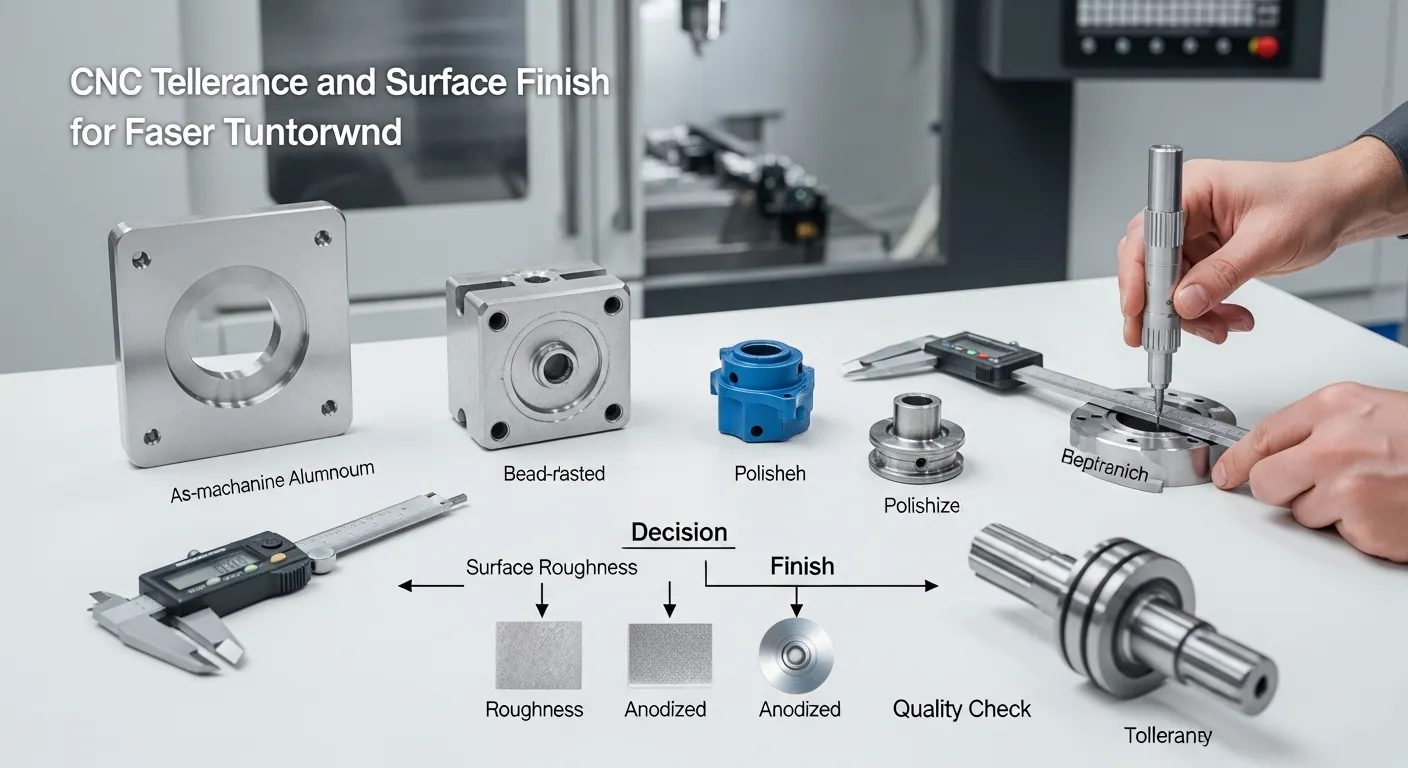
Rapid CNC machining does not mean every dimension should be specified as a tight tolerance. Over-tolerancing can slow quote review, increase machining complexity, and create unnecessary inspection requirements.
Buyers should separate critical dimensions from non-critical dimensions. Critical features may include bearing seats, mating surfaces, sealing areas, threaded holes, press-fit areas, and assembly interfaces. Non-critical dimensions can often follow a more practical tolerance approach if the function allows it.
Surface finish also affects turnaround. An as-machined finish is usually simpler than multi-step cosmetic finishing. Finishes such as anodizing, plating, polishing, bead blasting, powder coating, brushing, painting, or color matching should be confirmed during RFQ review because they may add process steps.
| Requirement | Faster Option | More Review-Heavy Option | Buyer Note |
|---|---|---|---|
| General dimensions | Use practical standard tolerance where possible | Tight tolerance on all dimensions | Mark only critical dimensions clearly |
| Prototype appearance | As-machined or simple finish | Polishing, plating, anodizing, coating, or color matching | Confirm whether function or appearance is the priority |
| Complex geometry | Simplify non-critical features | Deep pockets, thin walls, undercuts, and small holes | Request DFM review before production |
| Inspection | Basic dimensional check for key features | Detailed report for many dimensions | State inspection needs during RFQ |
Rapid CNC for Prototype, Small Batch, and Bridge Production
Rapid CNC machining can support more than one-off prototypes. It can help buyers move through product development, functional testing, pilot production, and temporary supply before tooling or mass production is ready.
For product development teams, CNC prototypes can verify form, fit, and function before committing to tooling. For procurement teams, small-batch CNC machining can support pilot builds, customer samples, assembly testing, and urgent low-volume orders. For OEM/ODM projects, rapid CNC can also act as bridge production while mold manufacturing, injection molding, die casting, finishing, or assembly planning continues.
When a project moves beyond prototypes, SunOn can support broader production planning through OEM CNC machining services and related manufacturing support.
What to Send for a Fast CNC Machining Quote
A complete RFQ package helps SunOn understand the part, review manufacturability, choose the right CNC process, and identify any risks before production. Buyers should include both technical and commercial details.
| RFQ Item | Why It Affects Speed | What Buyer Should Send |
|---|---|---|
| Part type and application | Helps evaluate function and manufacturing risk | Product use, assembly role, or industry application |
| Quantity | Changes process planning and production approach | Prototype, small-batch, bridge-production, or production quantity |
| 3D CAD model | Needed for geometry review and machining planning | Complete 3D model file |
| 2D drawing | Clarifies tolerances and critical dimensions | PDF or drawing file with key dimensions and notes |
| Material | Affects machining, sourcing, finish, and cost | Material name and grade if known |
| Tolerance | Controls machining and inspection requirements | Critical dimensions, fits, threads, and mating surfaces |
| Surface finish | May add extra process steps | As-machined, anodizing, plating, polishing, coating, or other finish requirement |
| Special features | Can affect tooling and setup | Threads, inserts, holes, slots, undercuts, or assembly details |
| Inspection needs | Affects quality review and documentation | Dimensional report, functional check, or other inspection requirement if needed |
| Delivery details | Needed for schedule and shipping planning | Delivery destination and target schedule |
Quality Review Before Shipment
Rapid CNC machining should still include clear quality expectations. Buyers should define inspection needs before production begins, especially for parts with tight fits, assembly interfaces, threads, sealing surfaces, or cosmetic requirements.
Quality review may include dimensional checks, critical feature verification, thread and hole checks, surface finish review, and inspection reporting if required. Any special documentation, functional testing, or material requirement should be discussed during RFQ review instead of after production has started.
Request a Rapid CNC Machining Quote From SunOn
To request a rapid CNC machining quote, send SunOn your CAD files, 2D drawings, material requirement, quantity, tolerance notes, finish requirements, inspection needs, application details, delivery destination, and target schedule. SunOn can review the part for CNC machining, DFM risks, prototype needs, small-batch planning, bridge production, or OEM/ODM manufacturing support.
For urgent projects, the most useful first step is to explain what the part must do, what dimensions are critical, and which requirements are flexible. This helps SunOn recommend a practical CNC process, material, tolerance approach, and finish plan for your project.
FAQ
How fast can SunOn review a rapid CNC machining request?
Review speed depends on how complete the RFQ information is. A 3D CAD model, 2D drawing, material, quantity, tolerance notes, surface finish, inspection requirements, delivery destination, and target schedule can help reduce back-and-forth.
What files are needed for a fast CNC quote?
Buyers should send a 3D CAD model and a 2D drawing for critical tolerances, dimensions, threads, fits, and surface requirements. Material, quantity, finish, inspection needs, and application details should also be included.
What slows down rapid CNC machining?
Common delays include incomplete drawings, unclear materials, tight tolerances on non-critical dimensions, complex geometry, thin walls, deep pockets, small holes, difficult materials, special finishes, and unclear inspection requirements.
Which materials are best for rapid CNC prototypes?
Aluminum and common engineering plastics are often practical for rapid prototypes. Stainless steel, titanium, copper, PEEK, PTFE, and other difficult or specialty materials may need more review depending on geometry, tolerance, and finish requirements.
Is 5-axis CNC machining faster for urgent parts?
5-axis CNC machining can reduce setups for complex multi-face parts, angled features, or complex contours. However, simple plates, brackets, and round parts may be faster with 3-axis milling or CNC turning.
Can I reduce lead time by changing tolerance or surface finish?
In many cases, yes. Mark only critical tolerances, allow practical tolerance for non-critical features, and choose simpler finishes when schedule is more important than cosmetic appearance.
Can SunOn support bridge production after prototypes?
Yes, rapid CNC machining can support prototype validation, small-batch production, and bridge production before tooling or mass production is ready. SunOn can also support related OEM/ODM manufacturing planning depending on the project.
What inspection details should be included in the RFQ?
Include critical dimensions, mating surfaces, thread requirements, hole tolerances, cosmetic surfaces, functional testing needs, and any inspection report requirements. These details help clarify quality expectations before production.
