


CNC Machining Instant Quote
A simple part with complete files can usually be reviewed faster than a complex part with missing specifications. If the design includes tight tolerances, thin walls, deep pockets, special threads, cosmetic finishing, inserts, or assembly requirements, SunOn’s engineering team may need to confirm manufacturability before final quotation.
This page helps you understand what to upload, what details affect quote accuracy, and when manual engineering review is needed before CNC machining starts.
Upload CAD Files for a Faster CNC Machining Quote
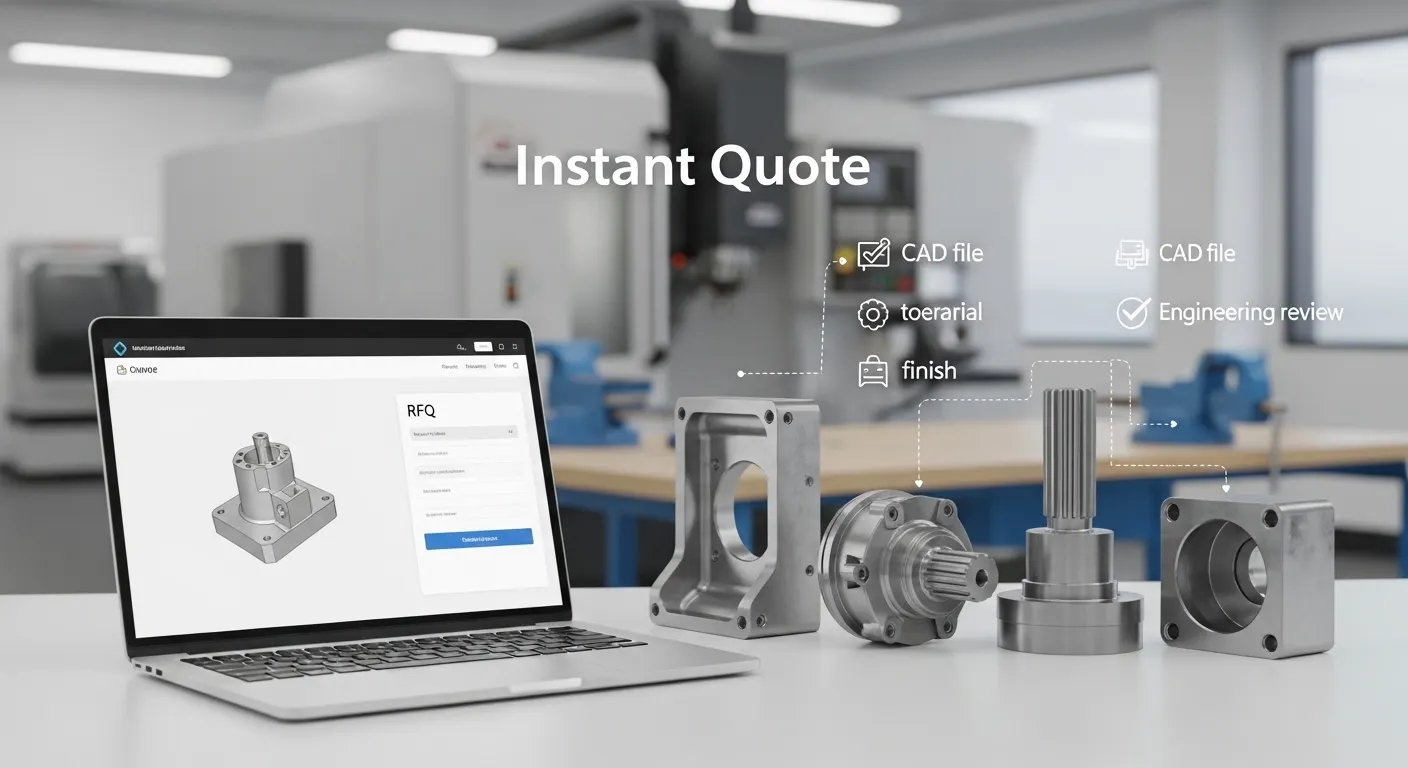
A clear file package is the fastest way to reduce quote delays. For most CNC machined parts, a 3D CAD model shows the full part geometry, while a 2D drawing confirms the manufacturing details that cannot always be understood from the model alone.
For quote review, buyers should prepare:
- 3D CAD model for part geometry
- 2D drawing for tolerances, notes, threads, and critical dimensions
- Material name and grade if already selected
- Quantity for prototype, small-batch, or production stage
- Surface finish or post-processing requirement
- Inspection or documentation requirements
- Assembly, insert, or functional requirements if relevant
Common 3D file formats may include STEP, STP, IGES, X_T, SLDPRT, or similar CAD formats. For 2D drawings, PDF, DWG, or DXF files can help confirm tolerances, surface roughness, hole notes, thread callouts, and other production details.
If you only have a 3D model, SunOn can still review the part. However, tolerance assumptions may need confirmation before the quote is finalized.
What Affects CNC Machining Quote Accuracy?
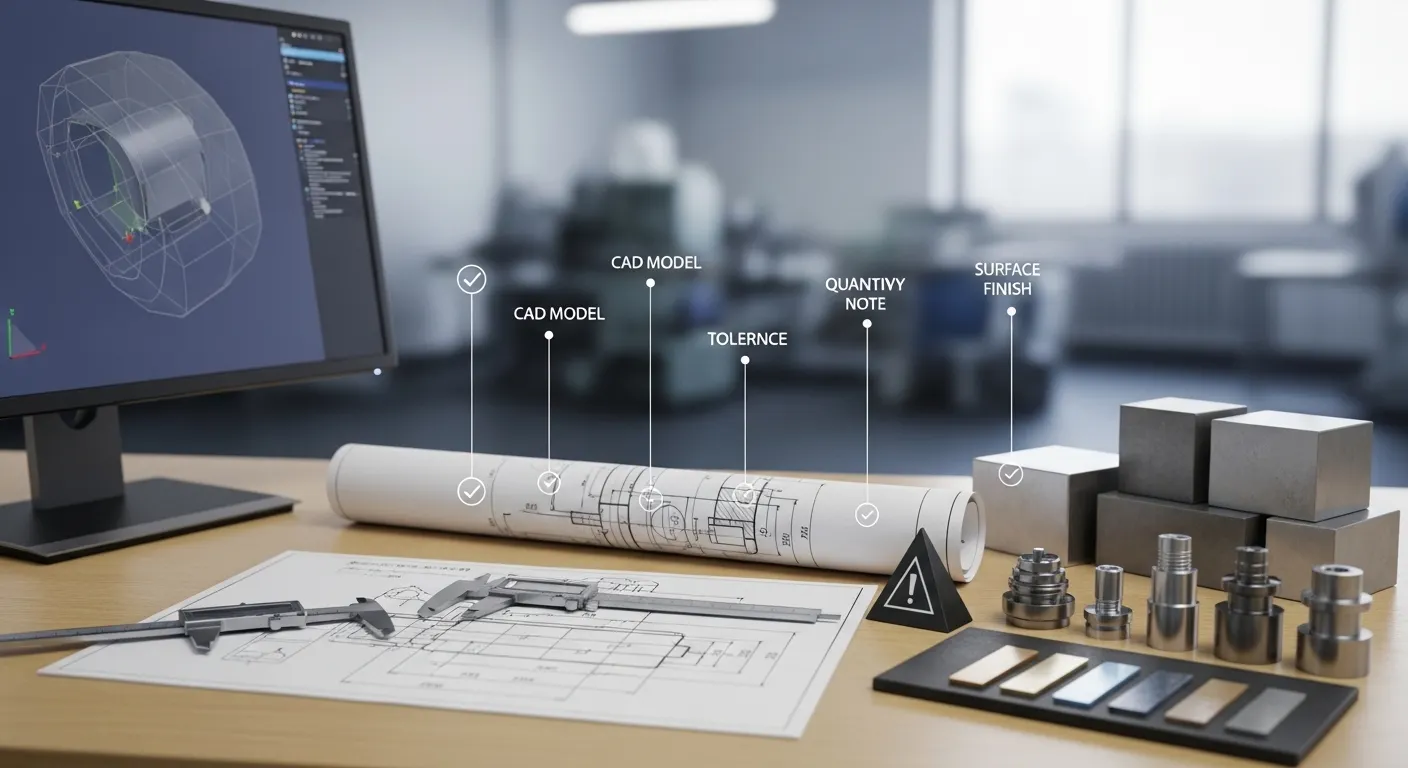
A CNC quote is not based on part shape alone. Price, manufacturability, production risk, and inspection planning can all change when the buyer updates material, quantity, tolerance, finish, or drawing notes.
The most important quote factors include:
| RFQ detail | Why it matters | What buyers should send |
|---|---|---|
| 3D CAD model | Defines part geometry, size, and machining features | STEP, STP, IGES, X_T, SLDPRT, or similar file |
| 2D drawing | Confirms tolerances, threads, surface notes, and critical dimensions | PDF, DWG, or DXF drawing |
| Material | Affects machinability, cost, finish, and application suitability | Material type and grade if known |
| Quantity | Changes setup planning, unit cost, and production method | Prototype, small batch, or production quantity |
| Tolerance | Tight tolerances may require extra review and inspection | General tolerance and critical dimensions |
| Surface finish | Finishing can affect appearance, function, and cost | As-machined, anodizing, plating, polishing, coating, or other finish |
| Part features | Deep holes, thin walls, undercuts, threads, and inserts affect machining strategy | Feature notes and functional requirements |
| Inspection needs | Defines quality checks before shipment | Dimensional report, critical dimension check, or other requirements |
| Delivery destination | Helps plan packaging and export discussion | Country or region for delivery planning |
Complete RFQ details help the engineering team review the part more accurately. They also reduce back-and-forth questions after the first quote request.
When Does an “Instant Quote” Need Engineering Review?
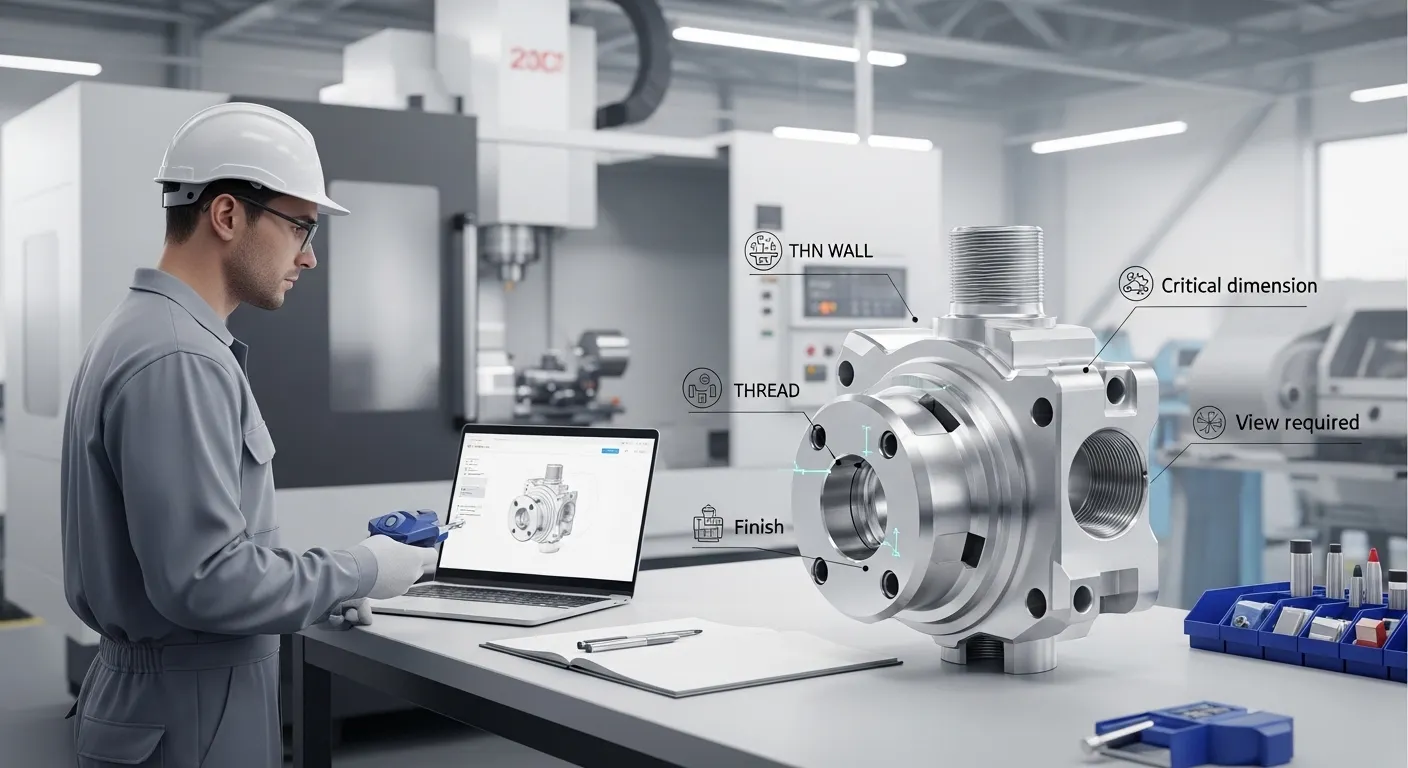
Some CNC projects should not be priced only by a fast online form. A quick quote may be useful for simple parts, but complex parts often need human review before final confirmation.
Engineering review is important when the part includes:
- Tight tolerance or GD&T requirements
- Thin walls or narrow slots
- Deep pockets or deep holes
- Small internal radii
- Threads, tapped holes, or inserts
- Undercuts or difficult tool access
- Cosmetic surface finish requirements
- Special coating, plating, polishing, or anodizing needs
- Assembly or functional testing requirements
- 5-axis geometry or multi-face machining
- Production quantities that require repeatability planning
Manual review protects both the buyer and the manufacturer. It helps confirm whether the part can be machined as designed, whether the material is suitable, and whether the tolerance or finish requirements are practical for the intended use.
Choose the Right CNC Process Before Quoting
Different part geometries require different CNC machining processes. If you already know the required process, include it in your RFQ. If not, SunOn can review the design and help suggest a suitable machining direction.
CNC Milling
CNC milling is commonly used for housings, plates, brackets, covers, fixtures, heat sinks, enclosures, and parts with pockets, slots, holes, flat surfaces, or complex profiles. For parts with prismatic geometry, buyers can review SunOn’s custom CNC milling services for related capability context.
CNC Turning
CNC turning is suitable for round or cylindrical components such as shafts, pins, bushings, spacers, sleeves, threaded parts, and rotating components. If the main shape is round, SunOn’s CNC turning services may be the most relevant reference.
CNC Turning and Milling
Some parts need both turning and milling. Examples include round parts with flats, cross holes, grooves, slots, side features, or milled surfaces. For these designs, SunOn’s CNC turning and milling services can help buyers understand the combined process.
5-Axis CNC Machining
5-axis CNC machining may be considered for complex geometry, angled features, multi-side machining, or parts that require fewer setups. It can be useful when the part is difficult to machine with standard 3-axis setups. The final process choice depends on part geometry, tolerance, material, and quantity.
Material and Finish Details to Confirm
Material selection affects machining strategy, surface quality, strength, cost, and application performance. Buyers should specify the required material and grade whenever possible.
Common CNC material categories include:
- Aluminum for lightweight structural parts, housings, brackets, and prototypes
- Stainless steel for corrosion-resistant or stronger mechanical parts
- Steel for durable industrial components
- Brass and copper for electrical, thermal, or decorative applications
- Titanium for high-performance applications where strength-to-weight ratio matters
- ABS, POM/Delrin, nylon, PC, PMMA, PEEK, PTFE, and other plastics for functional machined parts
Do not rely only on a broad material name if the part has strict performance needs. “Aluminum,” “stainless steel,” or “plastic” may not be enough. If you know the exact grade, include it in the quote request.
Surface finishing should also be confirmed early. CNC parts may need as-machined finish, bead blasting, anodizing, plating, polishing, powder coating, painting, or other post-processing. Finish requirements can affect appearance, corrosion resistance, assembly fit, and quote accuracy.
Prototype, Small-Batch, or Production CNC Quote?
The project stage changes how the quote should be reviewed.
For a prototype, the buyer may care most about function, fast design validation, and DFM feedback. The part may change after testing, so the RFQ should mention whether the design is still under development.
For a small batch, repeatability becomes more important. The buyer may need consistent dimensions, finish, and inspection across multiple parts.
For production planning, the RFQ should include more complete drawings, quantity expectations, packaging needs, inspection requirements, and any assembly or finishing details. If the part may later move to injection molding, die casting, or other production methods, tell SunOn early so the team can consider manufacturability beyond the first CNC batch.
Tolerance, Finish, and Inspection Details Buyers Should Confirm
Tolerance is one of the most important details in a CNC machining quote. Overly tight tolerances can increase cost and inspection requirements. Missing tolerance notes can create confusion during production.
Before requesting a quote, confirm:
- Which dimensions are critical
- Whether general tolerances are acceptable
- Whether GD&T is required
- Which surfaces need specific roughness
- Whether holes, threads, or mating features need special control
- Whether the part must fit with another component
- Whether inspection reports are required
For surface finish, explain whether the part is functional, cosmetic, or both. A hidden internal bracket may not need the same finish as a visible electronics housing or consumer product part.
For inspection, state any critical dimensions, fit requirements, assembly checks, or reporting needs. This helps SunOn review the quote with the correct quality expectations from the beginning.
Common Quote Delays Buyers Can Avoid
Many CNC quote delays happen because the RFQ is incomplete. Buyers can reduce delays by checking the file package before submission.
Common issues include:
- 3D model without drawing notes
- Missing material grade
- Quantity not confirmed
- Tight tolerance shown without explaining critical function
- Surface finish not specified
- Threads or inserts not clearly marked
- No application or assembly context
- No delivery destination
- Conflicting information between the CAD model and 2D drawing
If the project is confidential, buyers can also prepare an NDA or limited project specification before sharing full details. This is especially useful for OEM/ODM projects, new product development, and custom mechanical assemblies.
How SunOn Supports CNC Quote Review
SunOn Mould supports custom CNC machining as part of a broader manufacturing service scope that includes prototyping, CNC milling, CNC turning, 5-axis machining, surface finishing, mold making, injection molding, die casting, sheet metal fabrication, assembly, and OEM/ODM production support.
For buyers, this means the quote discussion can go beyond one machined part. If your product may need prototypes first and production later, SunOn can review the project direction and help discuss suitable manufacturing options.
For example, CNC machining may be suitable for prototypes, low-volume parts, fixtures, and precision metal or plastic components. Injection molding may become more suitable for higher-volume plastic production after design validation. Die casting may be considered for certain metal production parts. The right path depends on design, material, quantity, tolerance, budget, and project stage.
For a broader quote preparation workflow, buyers can also review SunOn’s CNC machining quote page.
CNC Machining Quote Request Checklist
Before contacting SunOn, prepare as many of these details as possible:
- Product or part name
- Application or industry
- Prototype, small-batch, or production stage
- Quantity
- 3D CAD model
- 2D drawing
- Material requirement
- Material grade if known
- Tolerance requirements
- Surface finish requirements
- Color, coating, plating, anodizing, or polishing needs
- Threading, inserts, holes, slots, or undercuts
- Assembly or mating part requirements
- Inspection report or quality documentation needs
- Functional testing requirements if relevant
- Delivery destination
- Target schedule if relevant
- NDA, BOM, or project specification if available
- Existing tooling or mold status if relevant
You do not need to have every answer before starting a discussion. However, the more complete your RFQ is, the faster and more accurate the quote review can be.
Frequently Asked Questions
Can I get a CNC machining instant quote from SunOn?
You can request a fast CNC machining quote by sending CAD files and project details. For complex parts, tight tolerances, special finishes, or production orders, SunOn may need engineering review before final quote confirmation.
What files are needed for a CNC quote?
A 3D CAD model is needed for part geometry. A 2D drawing is recommended for tolerances, threads, critical dimensions, surface roughness, material notes, and inspection requirements.
Is a 3D CAD model enough?
A 3D model may be enough for an initial review. However, a 2D drawing is important when the part has tight tolerances, GD&T, special holes, threads, surface finish requirements, or inspection notes.
What details affect CNC quote accuracy?
Material, quantity, tolerance, surface finish, part complexity, wall thickness, holes, threads, inserts, inspection needs, and delivery destination can all affect quote accuracy.
Can SunOn quote prototypes and production parts?
Yes, SunOn supports CNC machining discussions for prototypes, small batches, and production planning. Buyers should clearly state the project stage so the quote review matches the manufacturing goal.
Can finishing be included in the CNC quote?
Yes. Buyers should specify finishing needs such as as-machined surface, anodizing, plating, polishing, coating, painting, or other post-processing requirements if they are relevant to the part.
Request a CNC Machining Quote from SunOn
Send SunOn your 3D CAD model, 2D drawing, material requirement, quantity, tolerance needs, surface finish, application details, inspection requirements, and delivery destination for CNC quote review. If your part includes complex geometry, tight tolerance, special finishing, inserts, threads, assembly, or prototype-to-production planning, ask for engineering feedback before confirming the order.
Contact SunOn Mould to request a CNC machining quote, upload drawings for DFM review, or discuss custom CNC machining, prototyping, finishing, assembly, and OEM/ODM manufacturing support for your next project.
