


CNC Turning and Milling Services
For many parts, mill-turn machining can reduce setups, improve datum control, and shorten the production route. However, not every part needs a combined process. Some designs are better made by separate CNC turning and CNC milling, especially when the geometry, tolerance, quantity, or cost target makes separate operations more practical.
SunOn helps buyers review drawings, 3D CAD files, materials, tolerances, finishes, quantities, and inspection needs before quotation. Our goal is to help you choose the right CNC process before production starts.
CNC Turning and Milling Services for Mixed-Geometry Parts
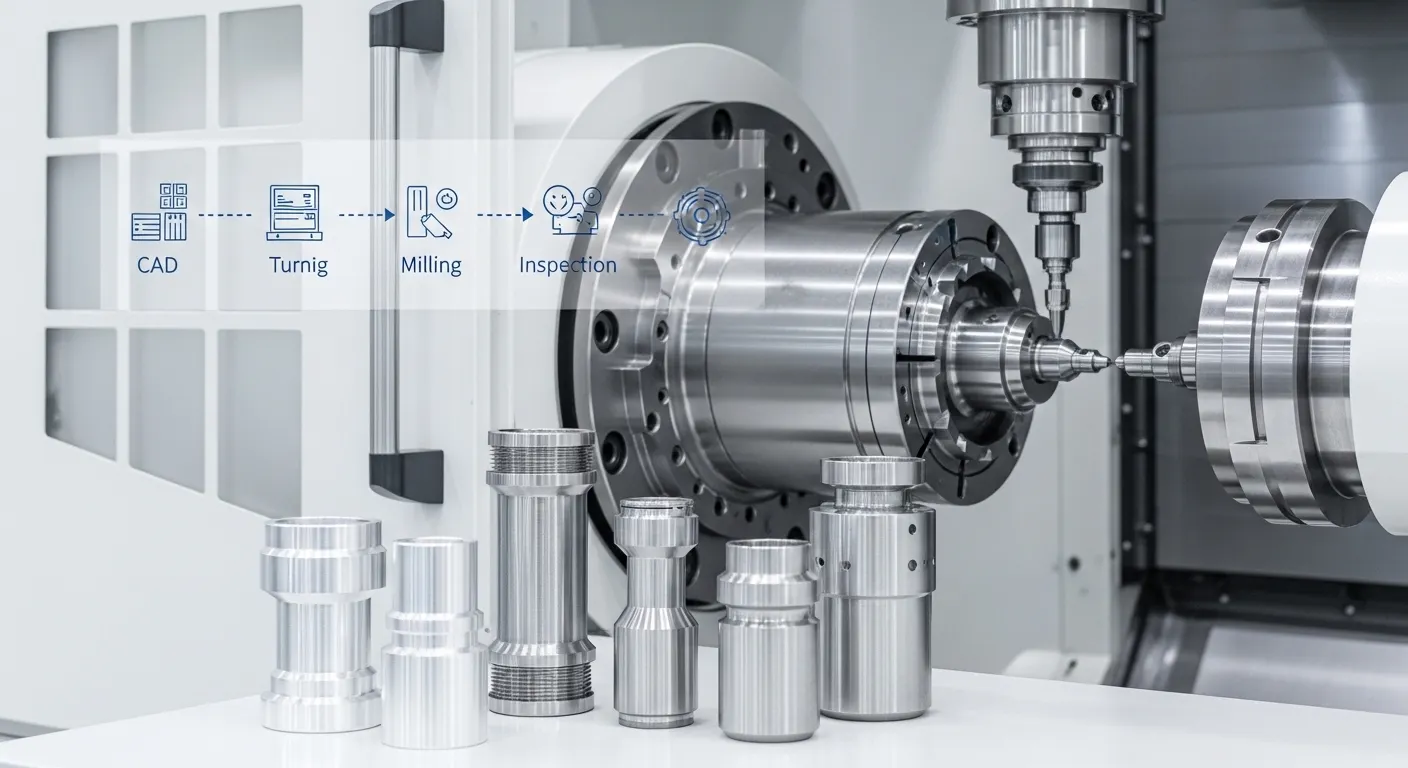
CNC turning is typically used for round or rotational features. CNC milling is used for flats, slots, holes, pockets, and non-round surfaces. Many custom parts need both.
A part may need turning and milling when it includes:
- Outer diameters and inner bores
- Grooves, shoulders, tapers, or threaded areas
- Milled flats or wrench flats
- Cross holes or side holes
- Slots, pockets, or keyways
- Tapped holes on the side face
- Round bosses on a milled housing
- Datum-sensitive features that must stay aligned
For simple round parts, CNC turning services may be enough. For block-shaped parts with pockets, ribs, slots, and multi-face details, custom CNC milling services may be more suitable. For parts that combine both feature types, SunOn can review whether a mill-turn route or a separate operation route fits the project.
When Should Buyers Choose Mill-Turn Machining?
Mill-turn machining is useful when a part has turned features and milled features that need a close relationship to the same datum. By reducing re-clamping and fixture transfers, the process can help control alignment between diameters, holes, slots, and milled surfaces.
Buyers often consider mill-turn machining for:
- Shaft parts with flats, holes, or threads
- Cylindrical connectors with side features
- Bushings with cross holes
- Spacers or standoffs with milled details
- Fittings with round and angled features
- Precision parts where datum transfer is a concern
The main value is not only speed. It is also the ability to control how features relate to each other. If a turned diameter, hole position, and milled slot must align, process planning becomes important.
For projects that need tighter process control, buyers can also review SunOn’s broader precision CNC machining services.
Mill-Turn vs Separate CNC Turning and Milling
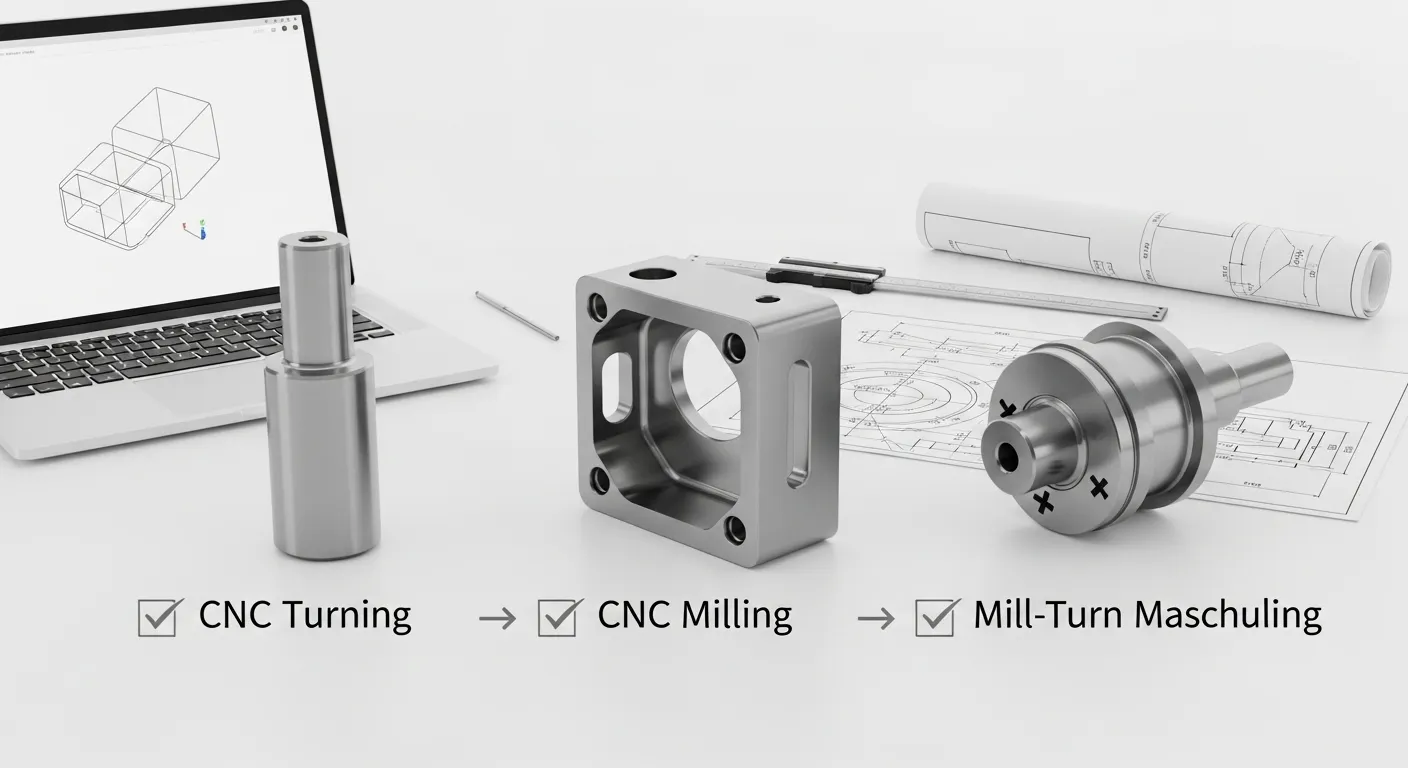
Mill-turn machining is powerful, but it is not always the best choice. A clear process review helps avoid unnecessary cost, complex setups, or over-engineered production.
| Buyer requirement | Possible process route | Why it fits | RFQ detail to confirm |
|---|---|---|---|
| Simple round shaft, pin, spacer, or sleeve | CNC turning | Efficient for rotational parts | Diameter, length, thread, material |
| Round part with flats, cross holes, or slots | Mill-turn or turning plus milling | Controls round and milled features | Datum, hole position, feature relationship |
| Block-shaped bracket or housing | CNC milling | Better for prismatic geometry | 3D CAD, pocket depth, wall thickness |
| Complex multi-face part | CNC milling or 5-axis CNC machining | Helps reach angled or multi-side features | Feature access, tolerance, setup surfaces |
| Turned part with loose secondary feature | Separate turning and milling | May be more practical for cost or quantity | Quantity, tolerance, finish, inspection |
A buyer should not request mill-turn machining only because the term sounds advanced. The right route depends on part geometry, functional surfaces, tolerance relationship, quantity, and finishing needs.
CNC Features SunOn Reviews Before Quotation
Before machining, SunOn reviews the features that affect manufacturing risk, setup planning, and inspection. This helps the buyer avoid unclear drawings or missing RFQ details.
Important features include:
- Turned OD and ID dimensions
- Bores, counterbores, and shoulders
- Grooves, threads, and undercuts
- Milled flats, pockets, and slots
- Radial holes and cross-drilled holes
- Tapped holes and thread standards
- Thin walls or long slender sections
- Burr-sensitive edges
- Cosmetic and functional surfaces
- Datum references and GD&T notes
A 3D CAD model helps the manufacturing team understand geometry. A 2D drawing is still important when the part has critical tolerances, threads, surface finish requirements, or inspection notes.
Materials for CNC Turned and Milled Parts
Material choice affects machining behavior, surface finish, cost, burr control, tolerance stability, and final application performance. Buyers should confirm the material grade when it is already specified by the design team.
Common material categories for turned and milled CNC parts include:
- Aluminum for lightweight housings, brackets, spacers, and prototypes
- Stainless steel for corrosion-resistant mechanical parts
- Steel for strength-focused industrial components
- Brass and copper for fittings, electrical, and thermal applications
- Titanium for lightweight and strength-critical applications where suitable
- ABS, nylon, PC, PMMA, POM/Delrin, PEEK, and PTFE for plastic machined parts
Plastic and metal parts need different design reviews. Plastics may require attention to wall thickness, clamping, heat, and dimensional stability. Metals may require attention to burrs, threads, surface finish, plating, anodizing, or corrosion resistance.
If the material is not final, send the application, load condition, operating environment, and finish requirement. SunOn can review the project and discuss practical CNC manufacturing options.
Tolerance, Datum, Finish, and Inspection Planning
Turning and milling projects often fail because the RFQ does not show which dimensions are truly critical. Applying tight tolerance to every feature can increase cost and inspection effort without improving function.
Buyers should clearly identify:
- Critical dimensions
- Datum surfaces
- Concentricity or runout requirements
- Hole position requirements
- Thread type and thread depth
- Surface roughness or cosmetic finish needs
- Areas that must remain burr-free
- Assembly interfaces
- Inspection report requirements
Surface finishing should also be discussed before quotation. Depending on material and application, buyers may request as-machined finish, anodizing, plating, polishing, bead blasting, powder coating, painting, or other post-processing. The selected finish can affect dimensions, appearance, corrosion resistance, and assembly fit.
Do not rely only on the 3D model when tolerance matters. Send a 2D drawing with clear notes.
Prototype, Small-Batch, and Production Support
CNC turning and milling can support different stages of a product lifecycle. A prototype may focus on fit, function, and design validation. A small-batch run may focus on test builds, market launch, or bridge production. Production parts may require more attention to repeatability, inspection planning, and finishing consistency.
SunOn supports custom manufacturing projects where CNC machining may connect with rapid prototyping, mold making, injection molding, die casting, surface finishing, assembly, or OEM/ODM production support.
For example, a buyer may start with CNC prototype parts to validate a design. Later, the project may move to low-volume CNC machining, injection molding, die casting, or another production process. Early DFM review helps reduce redesign risk before larger production decisions.
Applications for CNC Turning and Milling
CNC turning and milling services are commonly used for functional parts across industrial, electronics, automotive-related, medical device product development, automation, machinery, consumer product, and new energy projects.
Example part types include:
- Shafts, pins, rollers, and spacers
- Bushings, sleeves, and couplings
- Threaded connectors and fittings
- Valve or sensor-related components
- Motor, pump, and mechanical interface parts
- Brackets with round bosses or locating holes
- Electronics housings and enclosure-related parts
- Automation equipment components
- EV, battery, and new energy mechanical parts
For enclosure-style CNC projects, buyers can also review SunOn’s CNC electrical enclosure manufacturing content when the part includes housing, cover, mounting, or electronics protection requirements.
What Buyers Should Send for an Accurate RFQ

A complete RFQ helps SunOn review the process route, material, finish, tolerance, and inspection needs faster. It also reduces back-and-forth communication before quotation.
Please prepare:
- Product or part name
- Prototype, small-batch, or production stage
- Quantity
- Application or industry
- 3D CAD model
- 2D drawing with tolerance notes
- Material and grade if known
- Surface finish requirement
- Color, coating, plating, anodizing, or polishing needs
- Threading, inserts, holes, slots, or undercut details
- Critical dimensions and datum references
- Inspection report requirement
- Functional testing requirement if relevant
- Assembly or mating part information
- Delivery destination
- Target schedule if relevant
- NDA, BOM, or project specification if needed
If you are unsure whether the part should be made by CNC turning, CNC milling, mill-turn machining, 5-axis machining, or another process, send the files first. SunOn can review the geometry and discuss a practical manufacturing route.
Why Work With SunOn for CNC Turning and Milling Projects?
SunOn Mould is a custom manufacturing service provider for global buyers that need engineering communication, CNC machining support, prototyping, finishing, and production planning. Our team works with buyers who need more than a machined part price. They need process review, drawing understanding, manufacturability feedback, and support from prototype to production.
SunOn is suitable for projects where buyers need:
- Custom CNC machined metal or plastic parts
- CNC turning and CNC milling process review
- Prototype and small-batch machining support
- Surface finishing and post-processing coordination
- OEM/ODM manufacturing communication
- DFM review before production
- Help comparing CNC machining with molding, die casting, or other processes
The best results come when buyers share complete files and clear technical expectations before production. This allows SunOn to review the part as a manufacturing project, not just a price request.
Frequently Asked Questions
When should I choose CNC turning and milling services?
Choose this service when your part has round features plus milled details, such as flats, slots, cross holes, pockets, or side threads. It is especially useful when those features must align to the same datum.
Is mill-turn machining always better?
No. Mill-turn machining is useful for mixed-geometry and datum-sensitive parts. Separate CNC turning and milling may be better for simple parts, oversized parts, loose-tolerance features, or cost-sensitive production.
What files are needed for a quote?
Send a 3D CAD model and a 2D drawing. The drawing should show material, quantity, tolerances, threads, surface finish, datum references, inspection needs, and any special notes.
What materials can SunOn review?
SunOn can review CNC machining projects involving common metals and plastics, including aluminum, stainless steel, steel, brass, copper, titanium, ABS, nylon, POM/Delrin, PC, PMMA, PEEK, and PTFE.
How do tolerances affect the CNC quote?
Tight tolerances may require more setup control, slower machining, and additional inspection. Mark only the critical dimensions tightly, and use standard tolerances where possible to support cost-effective manufacturing.
Can CNC turning and milling support prototypes and production?
Yes. CNC turning and milling can support functional prototypes, low-volume parts, and production planning. The best process route depends on part geometry, material, quantity, tolerance, finish, and inspection requirements.
Request a CNC Turning and Milling Quote
Send SunOn your 2D drawing, 3D CAD model, material requirement, quantity, tolerance notes, surface finish, inspection needs, and application details for review. Our team can help evaluate whether your part should use mill-turn machining, separate CNC turning and milling, CNC milling, 5-axis machining, or another custom manufacturing route.
Contact SunOn Mould to request a CNC turning and milling quote, DFM review, prototype support, or OEM/ODM manufacturing consultation for your next custom part project.
