


Liquid Cooling Heat Sink Mold Manufacturing | Custom Tooling by SunOn
SunOn provides custom liquid cooling heat sink mold manufacturing for OEM projects that require production-ready tooling, validated samples, and scalable component manufacturing. Our support can cover design review, DFM analysis, mold engineering, toolmaking, mold trials, T1 inspection, secondary CNC machining, and production planning based on your component design.
Liquid-cooled heat sink projects require more than a standard mold layout. Internal flow paths, sealing interfaces, inlet and outlet ports, thin walls, fins, mounting features, and flat thermal-contact surfaces must all be considered before tooling begins. SunOn reviews these requirements from your 2D drawings, 3D CAD files, target alloy, production volume, and functional testing specifications.
- Custom tooling developed from customer drawings
- DFM and mold-flow review
- Mold manufacturing and trial production
- T1 sample inspection and mold adjustment
- Optional die casting, CNC machining, finishing, and assembly
Send your CAD files to SunOn for a tooling feasibility review and custom quotation.
Custom Liquid Cooling Heat Sink Mold Services from SunOn
SunOn supports manufacturers that need custom tooling for liquid-cooled heat sinks and related thermal-management components. The service is suitable for new product development, design conversion, tooling replacement, or projects moving from low-volume machining to repeat production.
Depending on the approved project scope, SunOn can support:
- Drawing and technical requirement review
- Design for manufacturability analysis
- Mold-flow evaluation
- Mold structure and component design
- CNC milling, turning, and EDM for tool components
- Mold assembly and trial
- T1 sample production
- Dimensional inspection
- Mold tuning after sample review
- Die-cast component production
- Secondary machining and surface finishing
- Mechanical assembly and project-specific testing
For broader background on casting thermal components, see SunOn’s die-cast heat sink manufacturing capabilities.
What Is Included in the Tooling Package?
The exact tooling package should be defined before mold design begins. Some customers require a completed mold for use in their own facility. Others prefer SunOn to manage tooling, casting, machining, finishing, and recurring production under one manufacturing workflow.
| Deliverable | Mold-Only Project | Turnkey Production Project |
|---|---|---|
| Drawing and requirement review | Included | Included |
| DFM analysis | Project-based | Project-based |
| Mold-flow review | When required | When required |
| Mold design | Included | Included |
| Mold manufacturing | Included | Included |
| Mold assembly and trial | Included | Included |
| T1 samples | Defined in quotation | Defined in quotation |
| Dimensional report | Available by project | Available by project |
| Mold adjustment | Based on approval terms | Based on approval terms |
| Recurring die-cast production | Not included | Available |
| Secondary CNC machining | Optional | Optional |
| Finishing and assembly | Optional | Optional |
| Pressure or leakage testing | Subject to project review | Subject to project review |
Tool ownership, sample quantity, revision rounds, inspection documents, mold location, and production responsibilities should be confirmed in the quotation.
Liquid-Cooled Heat Sink Designs This Tooling Can Support
A custom liquid cooling component may combine cast geometry with machined or assembled features. Final feasibility depends on the part structure, internal flow-path design, target alloy, pressure requirements, tolerances, sealing method, and expected production quantity.
Potential project types include:
- Die-cast heat sink bodies with liquid-cooling interfaces
- Thermal housings with integrated fins, ribs, bosses, or mounting points
- Cast bases or covers used in liquid-cooled assemblies
- Components requiring post-casting ports, grooves, threads, or channels
- Thermal-management parts combining die casting and precision machining
- High-volume components converted from fully machined designs
Not every internal channel can be produced directly during casting. Some designs may require separate covers, inserts, tubes, removable cores, secondary machining, or another joining method. SunOn evaluates the proposed structure during DFM review before confirming the tooling route.
Critical DFM Factors for Liquid Cooling Heat Sink Molds
Casting Geometry and Mold Filling
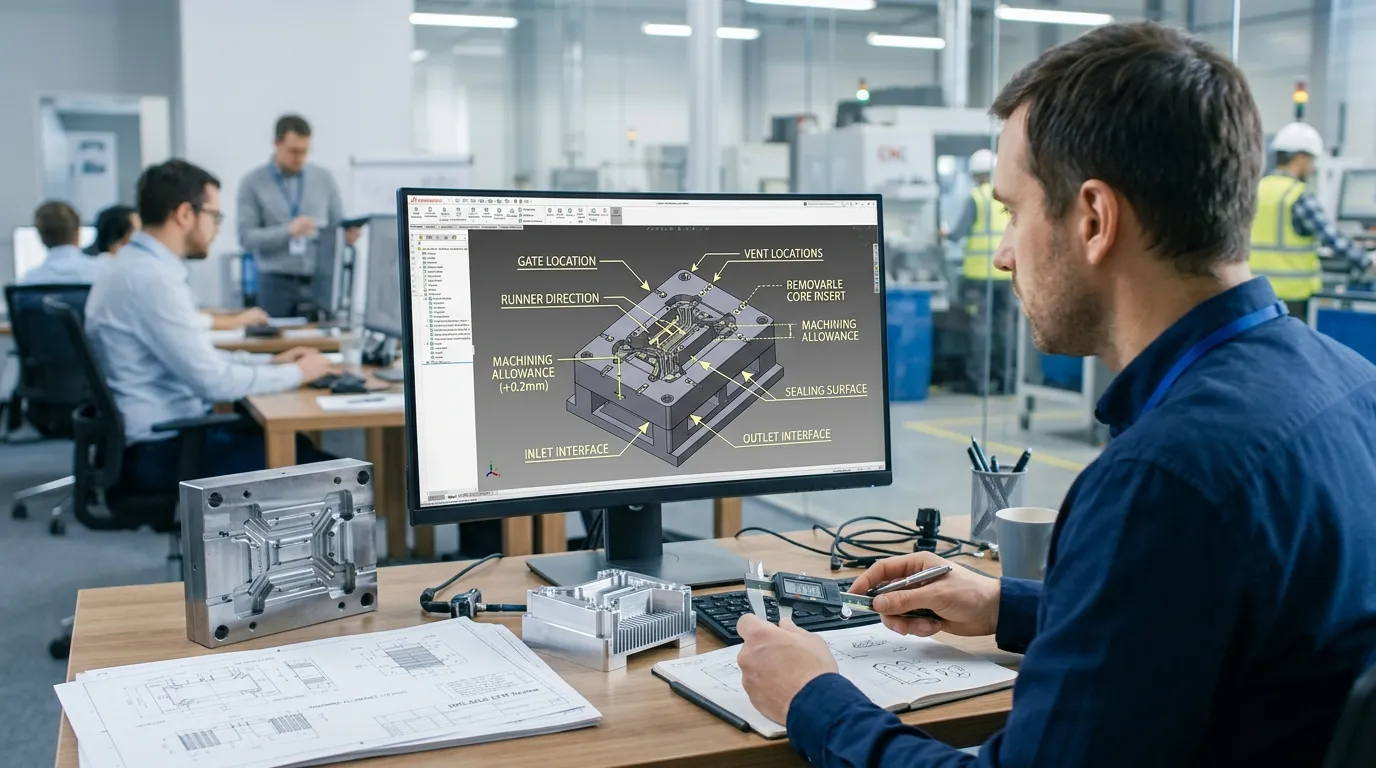
A liquid-cooled heat sink mold must produce consistent geometry while allowing reliable filling, solidification, release, and ejection. SunOn reviews features that may affect tooling complexity or casting stability, including:
- Wall-thickness consistency
- Fin thickness and spacing
- Deep ribs or narrow cavities
- Draft angles
- Parting-line position
- Mounting bosses
- Gate and runner placement
- Vent and overflow locations
- Shrinkage and warpage
- Ejection areas
- Material reserved for secondary machining
Thin fins and complex thermal features can be difficult to fill consistently. Mold-flow analysis may be used to evaluate filling balance, air entrapment, incomplete sections, and other potential casting risks before tool steel is cut.
For a conventional tooling comparison, visit SunOn’s zinc-alloy heat sink die-casting mold page.
Internal Flow-Path and Core Strategy
The internal coolant path is one of the most important design considerations. The correct manufacturing approach depends on channel accessibility, shape, depth, sealing method, and whether the internal geometry can be released from the mold.
During project review, SunOn evaluates:
- Whether a channel can be formed during casting
- Whether removable cores or inserts are practical
- Whether a separate cover is required
- Whether channels should be machined after casting
- Whether tubes or inserts must be incorporated
- How the structure affects mold maintenance
- Whether the proposed geometry supports stable repeat production
The selected method must balance functional requirements with manufacturability. A channel design that performs well in simulation may still require modification if it creates trapped tooling features, weak cast sections, difficult core removal, or unreliable sealing areas.
Sealing Surfaces, Ports, and Interfaces
Liquid-cooled components often contain features that require tighter control than the surrounding cast geometry. These may include:
- O-ring grooves
- Gasket interfaces
- Threaded inlet and outlet ports
- Cover alignment features
- Flat mounting bases
- Datums
- Connector positions
- Bolt holes
- Machined sealing faces
Critical surfaces are commonly produced with planned machining allowance. After casting, CNC machining can finish these areas to the specified dimensions, flatness, thread, and surface condition.
Porosity and Leakage Risk
Porosity is a serious concern when a cast component must contain coolant or operate under pressure. Mold design, gating, venting, overflow placement, material flow, and process control can all affect the result.
Before tooling begins, the buyer should define:
- Coolant type
- Normal operating pressure
- Proof-test pressure
- Leakage acceptance criteria
- Required inspection method
- Relevant functional or industry standards
These requirements influence the mold design, component structure, machining plan, and validation process. Pressure, leakage, porosity, flow, or thermal testing should only be included when agreed within the project scope.
SunOn’s Mold Development Process
1. RFQ and Drawing Review
The process begins with a review of the component design and commercial requirements. For a more accurate assessment, provide:
- 3D CAD model
- Fully dimensioned 2D drawing
- Material or alloy requirement
- Estimated annual quantity
- Critical tolerances
- Surface-finish requirement
- Coolant type
- Operating and test pressure
- Sealing method
- Inspection requirements
- Target production schedule
SunOn also needs to know whether you require tooling only or a complete production service.
2. DFM and Mold-Flow Analysis
The engineering team reviews the design for potential manufacturing risks. Feedback may cover wall thickness, fins, draft, release direction, parting surfaces, gates, runners, vents, overflows, ejection, core feasibility, machining stock, sealing interfaces, and critical dimensions.
Recommended design changes are discussed before mold manufacturing starts. This helps reduce avoidable tool modifications after the first trial.
3. Mold Design
After the design and manufacturing route are approved, SunOn develops the mold structure. The design may include:
- Cavity and core layout
- Parting surface
- Gate and runner system
- Venting and overflow
- Ejection system
- Mold cooling
- Inserts or removable components
- Tool-access and maintenance features
Cavity count and mold configuration are selected according to component size, projected production volume, machine requirements, and project economics.
4. Mold Component Manufacturing
Tool components are manufactured using processes such as CNC milling, turning, grinding, and EDM where appropriate. Tool-steel selection, heat treatment, insert material, and surface treatment are determined by the approved tooling specification.
5. Mold Assembly and Trial
The completed mold components are assembled, aligned, and prepared for the first trial. T1 samples allow the engineering team and customer to evaluate whether the tooling produces the intended geometry.
6. T1 Review and Mold Tuning
T1 review may include:
- Overall dimensions
- Critical datums
- Fin and wall completion
- Flatness
- Port position
- Sealing areas
- Surface condition
- Machining allowance
- Visible casting defects
If adjustments are required, the mold is tuned according to the agreed correction and approval process. Revised samples can then be produced for further evaluation.
7. Mold Delivery or Production Launch
After approval, the mold can follow the sourcing arrangement defined in the contract. It may be prepared for transfer to the customer, or it may remain at SunOn for recurring component production.
Tool Steel, Casting Alloy, and Production Configuration
Tooling decisions must reflect expected volume, component geometry, program duration, alloy behavior, and maintenance requirements.
| Decision | Why It Matters | Information Needed |
|---|---|---|
| Casting alloy | Affects flow, weight, thermal performance, strength, and processing | Required grade or functional target |
| Tool steel | Affects wear, thermal fatigue, maintenance, and service life | Annual quantity and expected program duration |
| Cavity count | Affects output and tooling investment | Production forecast |
| Core or insert design | Affects complex-feature feasibility | Final channel and component geometry |
| Machining allowance | Protects critical dimensions and sealing areas | Tolerances and finish callouts |
| Surface treatment | Affects corrosion protection and appearance | Operating environment |
| Inspection plan | Defines approval and production controls | Critical-to-quality features |
| Functional testing | Influences fixtures and workflow | Pressure and leakage requirements |
Material recommendations should be based on the actual project rather than selected from a general list.
Quality Validation for Liquid-Cooled Heat Sink Tooling
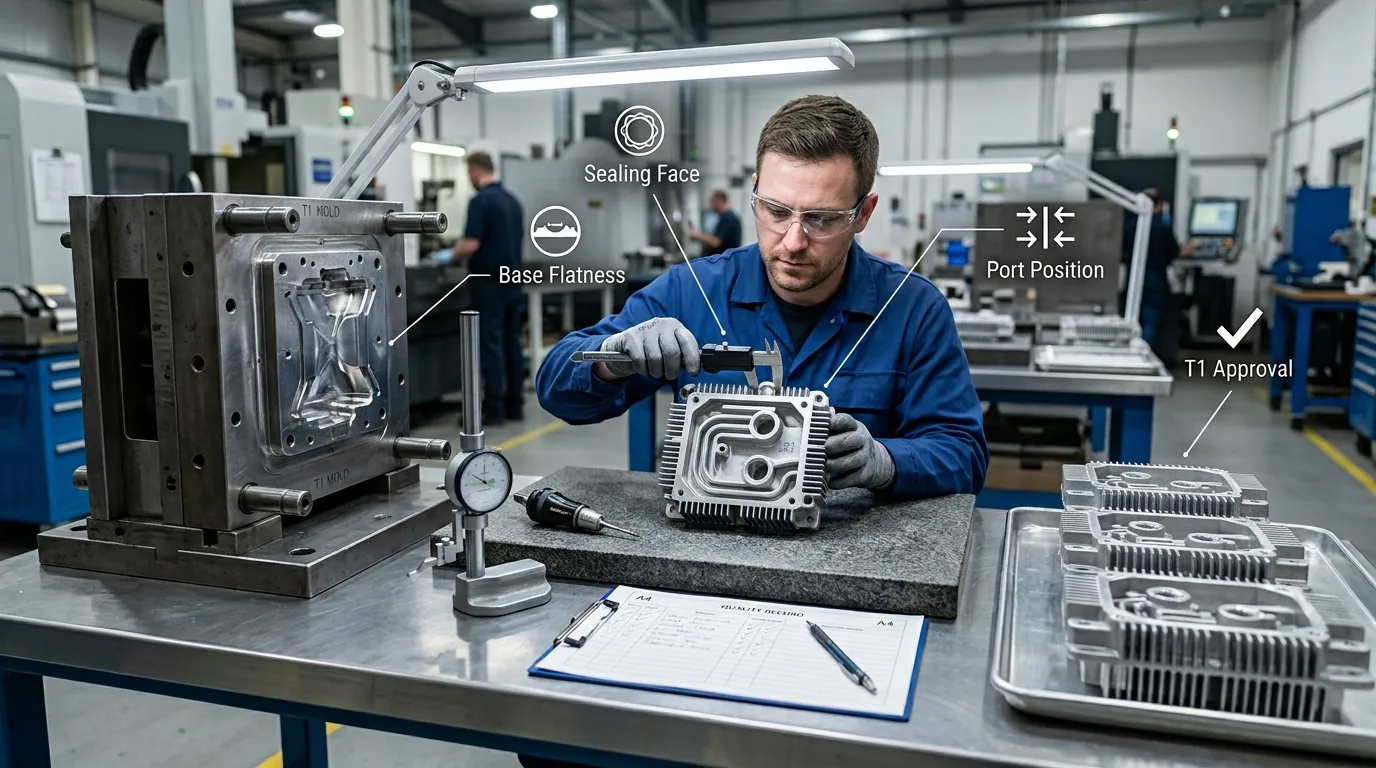
SunOn can define inspection activities according to the agreed drawing and acceptance criteria.
Tool validation may include:
- Mold-component dimensional checks
- Cavity and core alignment
- Ejection operation
- Insert fit
- Mold opening and closing
- Trial stability
T1 component validation may include:
- Overall dimensions
- Critical tolerances
- Flatness
- Fin and wall formation
- Port locations
- Sealing surfaces
- Machining stock
- Visible defects
Where included in the project, liquid-specific validation may involve pressure testing, leakage testing, porosity inspection, flow testing, or other functional checks. The required test method and acceptance limit should be supplied before tooling approval.
Mold-Only Supply vs Complete Production at SunOn
| Requirement | Mold-Only Supply | Turnkey Mold and Production |
|---|---|---|
| Buyer has its own die-casting facility | Suitable | Usually unnecessary |
| Buyer wants direct control of production | Suitable | More limited |
| Buyer needs an integrated supplier | Less suitable | Suitable |
| Casting process development | Managed by buyer after transfer | Managed within agreed SunOn scope |
| CNC machining and finishing | Arranged separately unless added | Can be integrated |
| Assembly and testing | Managed by buyer | Can be included by project |
| Supplier coordination | Buyer manages multiple operations | Reduced through one supplier |
| Best fit | Tool transfer or in-house casting | Ongoing outsourced production |
For low-volume projects or designs still undergoing frequent changes, a fully machined route may sometimes be more practical than immediate production tooling. SunOn can review the design against precision-machined cooling plate manufacturing considerations before recommending a final route.
Why Work with SunOn?
SunOn combines mold engineering with downstream manufacturing capabilities. This allows customers to discuss tooling, casting, machining, finishing, assembly, and inspection within one project workflow.
Relevant support includes:
- Custom mold design and manufacturing
- DFM and mold-flow analysis
- CNC and EDM toolmaking
- Die-cast production
- Secondary precision machining
- T1 sample validation
- Inspection reporting
- Surface finishing and assembly
- International OEM project support
For a broader overview of thermal-component production methods, see heat sink manufacturing methods.
What to Send for a Liquid Cooling Heat Sink Mold Quote
To evaluate your project, send the following information where available:
- 3D CAD model
- 2D engineering drawing
- Current drawing revision
- Component dimensions
- Casting alloy
- Annual and lifetime volume
- Prototype or production status
- Critical dimensions and GD&T
- Required base flatness
- Surface-finish requirements
- Coolant type
- Normal operating pressure
- Proof or leakage-test requirement
- Inlet and outlet specifications
- Sealing method
- Insert and thread requirements
- Joining or cover method
- Inspection-document requirements
- Mold-only or complete-production preference
- Delivery destination
- Target schedule
- NDA requirement
Clear technical inputs help SunOn review mold feasibility, identify secondary operations, define T1 acceptance criteria, and prepare a more accurate quotation.
Upload your drawings for a tooling feasibility review.
Frequently Asked Questions
What is a liquid cooling heat sink mold?
It is production tooling used to manufacture a cast body or related component for a liquid-cooled heat sink. The mold may form external thermal features, structural geometry, mounting points, and selected coolant-related interfaces.
Can SunOn supply the mold without producing the parts?
A mold-only arrangement may be available when the customer plans to transfer the approved tool to its own die-casting facility. Ownership, trial requirements, transfer conditions, and acceptance criteria should be defined in the quotation.
Can SunOn manufacture the mold and run die-cast production?
SunOn can evaluate projects that require both tooling development and recurring component production. Secondary machining, finishing, assembly, and inspection can also be discussed according to the design.
Can internal coolant channels be created directly during casting?
It depends on channel geometry, tool access, release direction, core strategy, sealing method, and process reliability. Some designs require removable cores, inserts, separate covers, tubes, or post-casting machining.
Which surfaces normally require CNC machining?
Critical sealing faces, O-ring grooves, threaded ports, mounting holes, flat thermal-contact surfaces, and tight-tolerance datums may require secondary CNC machining after casting.
What happens during T1 mold validation?
T1 samples are inspected against agreed drawing requirements. The review may check dimensions, flatness, wall and fin completion, port positions, sealing areas, machining stock, and visible casting defects before mold approval.
What pressure or leakage testing is available?
Testing depends on the component design and agreed project scope. Provide the coolant, operating pressure, test pressure, acceptance limit, and required test method during the quotation stage.
What files are needed for a quotation?
Provide a 3D CAD model, dimensioned 2D drawing, target alloy, quantity forecast, critical tolerances, coolant and pressure information, testing requirements, surface finish, and preferred tooling or production arrangement.
Request a Quote for Custom Liquid Cooling Heat Sink Tooling
Send SunOn your 3D CAD model, 2D drawing, alloy requirement, production quantity, pressure conditions, critical tolerances, and testing requirements. Our team will review the design, identify tooling and secondary-process needs, and prepare a quotation for mold-only supply or turnkey manufacturing.
Contact SunOn to request a DFM review and custom liquid cooling heat sink mold quotation.
