


Precision Aerospace CNC Components
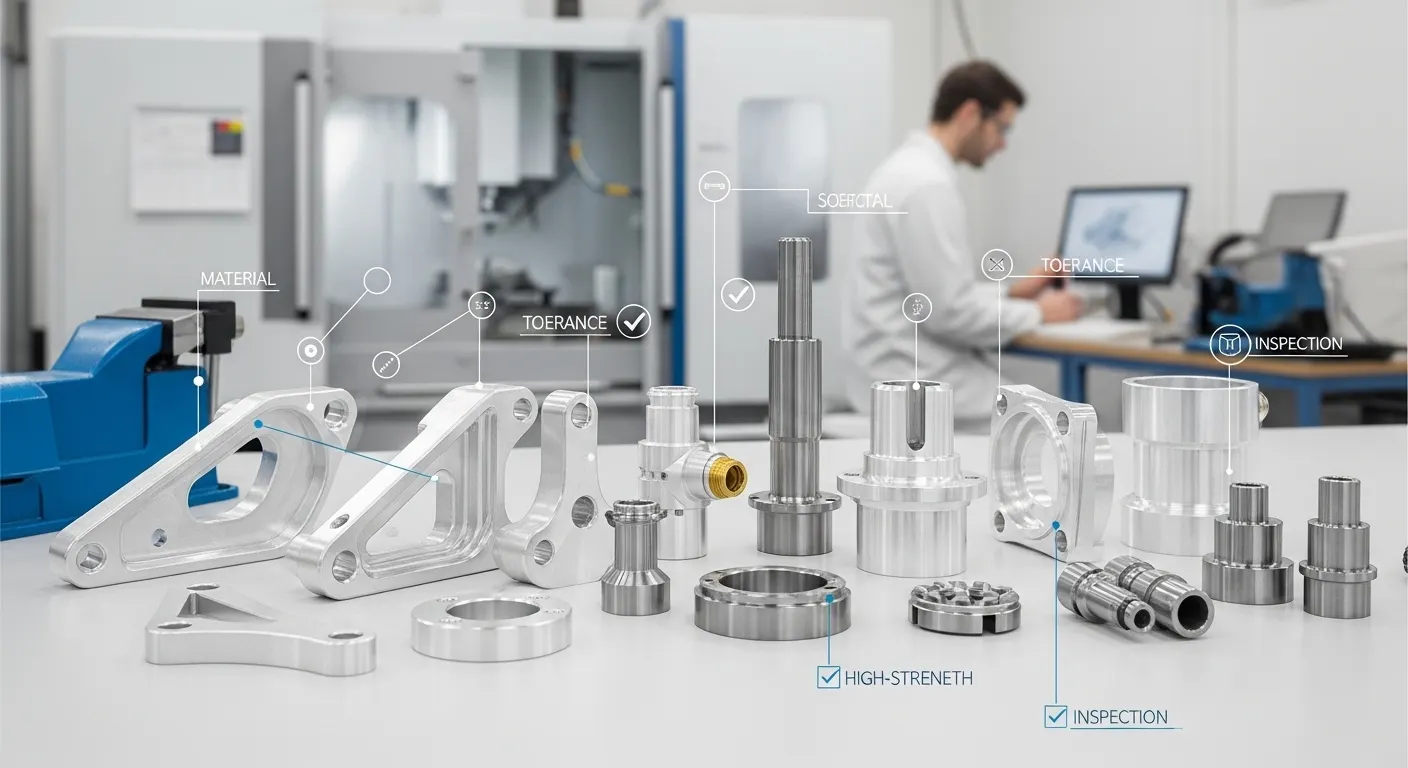
For aerospace-related parts, the RFQ should not be based on a simple part name alone. Buyers should confirm the material grade, quantity, 2D drawing, 3D CAD model, tolerance requirements, surface finish, threaded features, inspection report needs, traceability expectations, and application environment before quotation. SunOn helps review these details so the machining route, finishing method, and manufacturing plan match the part’s function and procurement requirements.
Precision Aerospace CNC Components SunOn Can Support
Aerospace-related CNC components often combine lightweight design, strong materials, complex geometry, and tight mating features. These parts may be used in product development, equipment assemblies, test fixtures, structural hardware, housings, or non-flight production support where dimensional stability and repeatable machining matter.
SunOn can review custom CNC machining requirements for parts such as:
- Mounting brackets and structural supports
- Aluminum or stainless steel housings
- Fittings, sleeves, bushings, and connectors
- Shafts, pins, spacers, and cylindrical parts
- Lightweight frames, plates, and covers
- Instrument or equipment housings
- Prototype aerospace-related mechanical parts
- CNC machined parts for test equipment and assembly fixtures
Each component should be reviewed according to its function. A simple bracket may need flatness, hole position, and anodizing. A housing may need pocket depth, wall thickness, sealing surfaces, and threaded inserts. A fitting may need concentricity, thread accuracy, and surface finish control.
Aerospace Component and CNC Spec Matrix
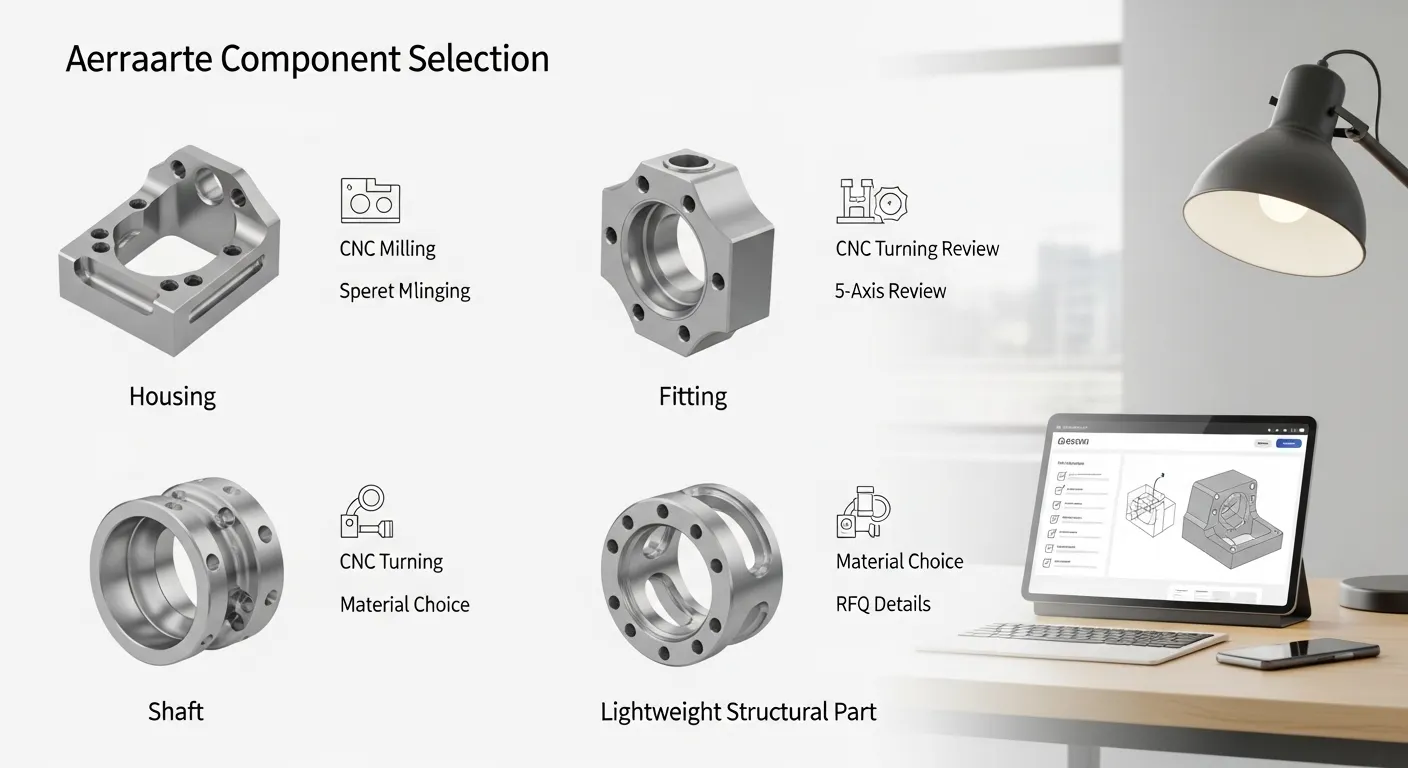
The table below helps buyers connect common aerospace-related components with CNC process choices and RFQ details.
| Component type | Typical CNC process | Material direction | Critical features to review | RFQ details to send |
|---|---|---|---|---|
| Brackets and mounts | CNC milling, 5-axis review for angled faces | Aluminum, stainless steel | Hole position, flatness, slots, pockets, edge breaks | 2D drawing, CAD file, tolerance, finish, quantity |
| Housings and covers | CNC milling, multi-face machining | Aluminum, stainless steel, engineering plastics | Wall thickness, internal pockets, sealing faces, threaded holes | 3D model, critical surfaces, finish, inspection needs |
| Fittings and sleeves | CNC turning, turning plus milling | Stainless steel, aluminum, brass/copper if required | Threads, concentricity, bore size, surface finish | Thread spec, material grade, drawing notes |
| Shafts and pins | CNC turning | Stainless steel, aluminum, steel alloys if specified | Diameter tolerance, runout, grooves, surface condition | Drawing, tolerance class, quantity, finish |
| Lightweight structural parts | CNC milling, 5-axis review | Aluminum or other specified metals | Thin walls, ribs, pockets, datum control | CAD model, application load notes, finish, inspection |
| Prototype test parts | CNC prototype machining | Project-specific metal or plastic | Fit, assembly clearance, function validation | Prototype stage, revision level, target use |
Which CNC Process Fits Your Aerospace Component?
CNC milling is often suitable for brackets, housings, plates, frames, pockets, slots, and multi-surface parts. It is useful when a component has mounting faces, hole patterns, internal cavities, or flat datum surfaces.
CNC turning is better for round parts such as shafts, sleeves, bushings, pins, spacers, and fittings. If the part also needs flats, cross holes, slots, or side features, the drawing should make those features clear so the machining route can be reviewed.
5-axis CNC machining may be useful when the part has complex angles, multi-face features, difficult setups, or geometry that would otherwise require several operations. Buyers with complex geometry can also review SunOn’s related guidance on CNC machining for complex parts.
For early-stage development, CNC prototype machining can help validate fit, assembly, and function before committing to a larger batch. For stable designs, small-batch or production machining can be planned with clearer inspection and finishing requirements.
Material Choices for Lightweight and High-Strength Parts
Material choice affects strength, weight, machinability, finish, cost, and inspection risk. Aerospace-related buyers should avoid selecting material only by habit. The application environment and functional load should guide the decision.
Common material directions include:
- Aluminum: Often used for lightweight brackets, housings, covers, frames, and prototype structural parts. Buyers should confirm the required grade, finish, and corrosion-resistance needs.
- Stainless steel: Useful where strength, wear resistance, or corrosion resistance matters. It may require more careful machining and tolerance planning than aluminum.
- Brass or copper: Relevant for some fittings, conductive parts, or special functional components. Confirm conductivity, surface finish, and thread requirements.
- Engineering plastics: Useful for lightweight non-structural components, insulators, covers, or prototype parts when metal is not required.
- Titanium or special materials: These should be discussed carefully during RFQ because machinability, tooling, finishing, and inspection requirements can affect feasibility.
For related metal part manufacturing support, buyers can review SunOn’s page on CNC machining services for custom metal parts.
Tolerance, Finish, and Inspection Details That Matter

Aerospace-related parts often have critical features that affect assembly, alignment, sealing, or motion. The most important tolerances should be shown clearly on the 2D drawing. Do not rely only on a 3D model if the part has critical dimensions.
Buyers should define:
- Critical hole positions and datum references
- Flatness, perpendicularity, concentricity, or runout needs
- Thread type, thread depth, and tapped-hole requirements
- Mating surfaces and sealing surfaces
- Surface roughness requirements
- Edge break, deburring, and sharp-edge restrictions
- Any inspection report or dimensional report requirement
- Material traceability or documentation expectations
Surface finishing should also be discussed early. Depending on the material and part function, buyers may request anodizing, plating, passivation, polishing, bead blasting, powder coating, or other post-processing. The required finish can affect tolerance, masking, color, corrosion resistance, and final inspection.
For buyers reviewing quality-focused CNC support, SunOn also provides related information on CNC machining services with ISO 9001 certification.
Prototype, Small-Batch, and Production Planning
Not every aerospace-related component starts as a production order. Many projects begin with prototype machining to test fit, assembly, weight, and function. At this stage, DFM feedback can help identify thin walls, deep pockets, difficult threads, sharp internal corners, or tolerance notes that may increase risk.
For small-batch production, buyers should confirm whether the design is frozen, whether all drawings are approved, and whether inspection requirements are stable. If the part may move toward production, it is better to discuss finish, packaging, documentation, and repeatability before the first batch.
SunOn’s broader custom manufacturing support can help buyers connect CNC machining with finishing, assembly, prototyping, mold making, injection molding, die casting, and OEM/ODM production planning when a project involves more than one process.
What Buyers Should Send for an Accurate RFQ
A strong RFQ helps SunOn review manufacturability, cost drivers, machining route, finish, and inspection requirements. For aerospace-related CNC components, buyers should prepare more than a simple part description.
Send the following when available:
- Product or part type
- Prototype, small-batch, or production stage
- Quantity required
- 3D CAD model
- 2D technical drawing with tolerances
- Material and material grade if known
- Surface finish, coating, plating, anodizing, or polishing requirement
- Threading, inserts, holes, slots, undercuts, or assembly requirements
- Critical dimensions and inspection points
- Inspection report or material traceability requirement
- Application or operating environment
- Delivery destination
- Target schedule if relevant
- NDA, BOM, or project specification if required
If some details are not finalized, buyers can still send the available files for review. SunOn can discuss process selection, material options, manufacturability risks, and quote requirements before production planning.
How to Compare Aerospace CNC Machining Suppliers
A suitable supplier should understand both engineering and procurement requirements. For aerospace-related projects, price alone should not be the only comparison point.
Before choosing a CNC machining partner, buyers should ask:
- Can the supplier review both 2D drawings and 3D CAD files?
- Can they explain the best CNC process for the geometry?
- Can they support prototype and small-batch requirements?
- Can they discuss material, tolerance, and surface finish risks?
- Can they coordinate post-processing and assembly if needed?
- Can they review inspection report or traceability requirements before quotation?
- Can they communicate clearly when a tolerance or feature may increase risk?
For buyers sourcing machined parts used in equipment assemblies, SunOn’s related page on CNC machining services for industrial equipment may also be useful.
Frequently Asked Questions
Can SunOn machine aerospace brackets and housings?
Yes. SunOn can review CNC machining requirements for brackets, housings, covers, mounts, and similar aerospace-related mechanical parts. Buyers should provide drawings, CAD files, material, tolerance, finish, and inspection requirements for quotation review.
Do aerospace CNC components always need 5-axis machining?
No. Many brackets, housings, shafts, and fittings can use CNC milling or CNC turning. 5-axis machining is more useful for complex angles, multi-face features, reduced setups, or difficult geometry.
What materials are common for lightweight aerospace CNC parts?
Aluminum is often selected for lightweight brackets, housings, and structural parts. Stainless steel, brass, copper, engineering plastics, or other specified materials may be used depending on strength, corrosion, conductivity, weight, and application needs.
What files are needed for a CNC machining quote?
Send a 3D CAD model, 2D drawing, material requirement, quantity, tolerance notes, surface finish, inspection needs, and application details. The 2D drawing is especially important for critical dimensions and GD&T.
Can SunOn support prototype and small-batch aerospace-related parts?
Yes. SunOn supports CNC prototype machining, small-batch CNC machining, finishing, and production planning. Prototype orders can help validate fit, assembly, material choice, and tolerance requirements before larger production.
Can buyers request inspection reports or traceability?
Buyers should state inspection report, dimensional report, or material traceability requirements during RFQ. These requirements should be discussed before quotation so the manufacturing and documentation plan can be reviewed properly.
Send Your Aerospace CNC Component RFQ to SunOn
If you need precision CNC machined brackets, housings, fittings, shafts, lightweight parts, or high-strength components for an aerospace-related project, share your drawings with SunOn Mould for review.
Send your 2D drawing, 3D CAD model, material requirement, quantity, tolerance notes, surface finish requirement, inspection needs, application details, delivery destination, and target schedule. SunOn can review the part for CNC machining, DFM feedback, prototype support, finishing, assembly, and OEM/ODM manufacturing planning before quotation.
