


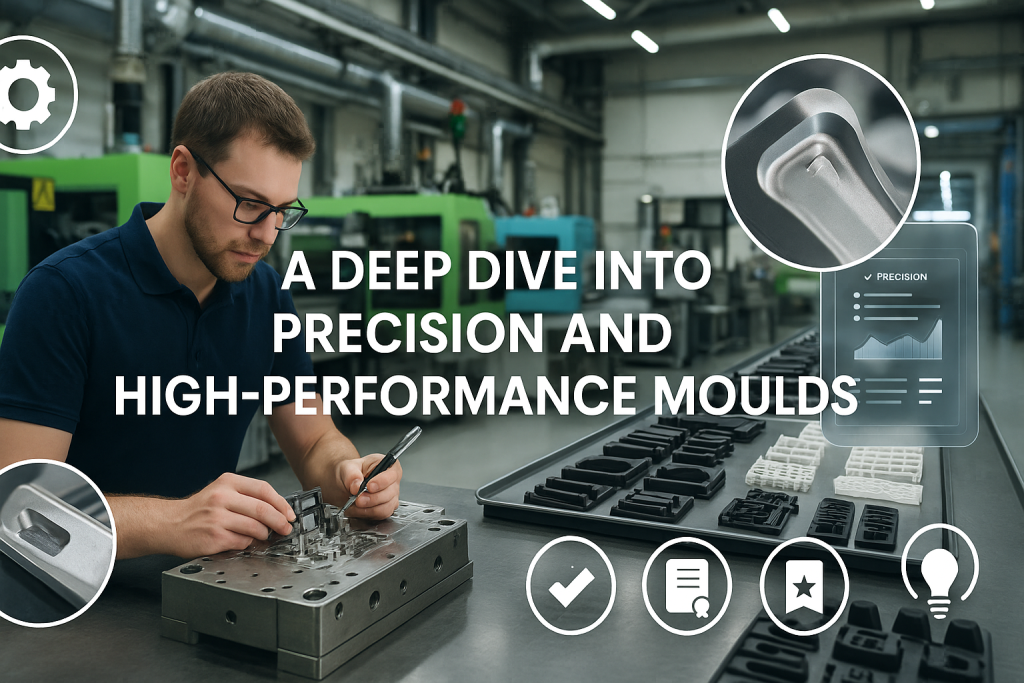
A Deep Dive into Precision and High-Performance Moulds
Precision and high-performance moulds are the pinnacle of tooling technology. They are highly engineered instruments designed for the most demanding manufacturing applications. Unlike standard moulds, these tools are built for extreme accuracy, speed, and longevity. The process of injection moulding relies on the quality of the mould to produce consistent parts. High-performance tooling elevates this capability to a world-class level. This expertise is not found everywhere. It is concentrated in global centers of excellence where generations of skill are combined with cutting-edge technology. This guide will explore the defining characteristics, technologies, and applications of these advanced moulds.
The Foundations of a Precision Mould
A precision mould is defined by its ability to produce parts with extremely tight tolerances, repeatedly and reliably. This level of accuracy is not achieved by accident. It is the result of a deliberate and meticulous approach to every aspect of the mould's design and construction. It starts with a foundation of the best materials and an unwavering commitment to quality.
Defining Precision: Tolerances and Repeatability
Precision in injection moulding is measured in microns. A micron is one-thousandth of a millimeter. A precision mould must be able to produce parts where critical dimensions vary by only a few microns from shot to shot. This is known as repeatability. The mould must also be accurate, meaning the parts it produces match the original design specifications. Achieving both accuracy and repeatability is the core challenge of precision mould making.
The Critical Role of High-Grade Tool Steels
The foundation of any great mould is the steel it is made from. For precision moulds, only high-grade tool steels are used. These are specialized alloys that are extremely clean and homogenous. Materials like H-13, S-7, and stainless steels are common. These steels are heat-treated to a specific hardness. This gives them the strength to withstand the pressures of injection and the durability to last for millions of cycles without wear.
The Importance of Mould Base and Component Quality
A precision mould is an assembly of many different components. The mould base provides the foundation for the entire tool. The quality of this base is critical for alignment and stability. Other components, such as leader pins, bushings, and ejector pins, must also be of the highest quality. Every component in the assembly contributes to the overall precision of the mould.
How Regional Expertise Drives Precision
This level of expertise is often concentrated in specific industrial hubs around the world. These regions have a long history of fine mechanics and toolmaking. For example, the makers of precision moulds in Italy, Milan, are known for their skill in producing tooling for complex, high-aesthetic parts. Similarly, the industrial heartland of the US is home to specialists in high-precision moulds in Chicago, who serve the demanding medical and automotive sectors.
Design Principles for High Performance
A high-performance mould is one that is designed for maximum efficiency and reliability. The goal is to produce the highest quality parts in the shortest possible cycle time. This requires a deep understanding of thermodynamics, fluid dynamics, and mechanical engineering. Every aspect of the mould's design is optimized for performance.
Advanced Cooling Channel Design
The cooling phase is often the longest part of the injection moulding cycle. A high-performance mould is designed to cool the part as quickly and as evenly as possible. This is achieved through optimized cooling channel design. The most advanced technique is conformal cooling. This involves creating cooling channels that follow the exact contours of the part. This provides much more effective cooling than traditional drilled channels.
Optimized Gating and Runner Systems
The gate is where the plastic enters the part cavity. The runner is the channel that delivers the plastic to the gate. The design of these elements is critical for part quality and cycle time. A well-designed runner system will be balanced, ensuring all cavities fill at the same rate. The gate will be located in a position that results in the best cosmetic appearance and part strength.
The Science of Venting in High-Speed Moulds
When molten plastic enters the mould, it displaces the air that is already in the cavity. This air must be able to escape. If it becomes trapped, it can cause defects in the part. In high-speed, high-performance moulds, venting is critical. Vents are very small channels that are machined into the mould. They are large enough to let air out but small enough to prevent the plastic from escaping.
Robust Mechanical Design for Longevity
A high-performance mould must be able to run for millions of cycles without failure. This requires a robust mechanical design. All moving components, like slides and lifters, must be designed for extreme durability. The mould must be able to withstand the high clamping forces of the moulding machine. This focus on robust design ensures a long and productive life for the tool.
Key Technologies in Advanced Mould Making
The creation of a precision, high-performance mould is only possible with the use of advanced technology. The world's best mould makers invest heavily in state-of-the-art equipment and software. This technology enables their skilled craftspeople to achieve levels of accuracy and complexity that were once unimaginable.
5-Axis CNC and High-Speed Machining
Five-axis CNC milling is a core technology. It allows for the creation of complex, three-dimensional shapes in hardened steel. High-speed machining techniques are used to achieve very fine surface finishes and tight tolerances. This technology is the foundation of modern, high-precision toolmaking. It is what allows for the creation of the intricate cores and cavities that define modern products.
Wire and Sinker EDM for Intricate Features
Electrical Discharge Machining (EDM) is used to create features that cannot be machined with traditional cutting tools. Wire EDM uses a thin, electrified wire to cut through steel with incredible accuracy. Sinker EDM uses a custom-shaped electrode to "burn" a shape into the steel. These processes are essential for creating sharp corners, fine ribs, and other intricate details.
Advanced Surface Treatments and Coatings
The surface of the mould is critical. For many applications, it must be polished to a mirror-like finish. For others, it may require a specific texture. After machining, various surface treatments and coatings can be applied. These can increase the hardness and wear resistance of the mould. They can also provide a lower coefficient of friction, which helps the part to release more easily.
The Role of Simulation in a Digital Twin
Modern mould making is a digital process. Engineers create a complete 3D "digital twin" of the mould before any physical work begins. They use advanced simulation software to analyze every aspect of its performance. Mould flow analysis simulates the plastic injection process. Finite Element Analysis (FEA) is used to simulate the mechanical stresses on the mould. This digital process helps to ensure the mould will work correctly the first time.
Types of High-Performance Moulds and Their Applications
The term "high-performance" can refer to many different types of specialized tooling. Different industries and applications require different types of high-performance solutions. A top-tier mould maker will have expertise in a wide range of these advanced tooling categories.
High-Cavitation and Multi-Cavity Moulds
For high-volume production of small parts, high-cavitation moulds are used. These moulds can have 32, 64, 128, or even more cavities. This allows for the production of a huge number of parts in a single cycle. Building these moulds requires extreme precision to ensure that all the cavities are identical. This is a specialty of hubs that serve the packaging and medical markets, such as the makers of multi-cavity moulds in Montreal.
Hot Runner Systems for Efficiency and Quality
A hot runner system is a heated manifold that delivers plastic directly to the part cavities. This eliminates the need for a traditional "cold runner," which is the solidified plastic that is ejected with the parts. Hot runner moulds are more efficient. They reduce material waste and can enable faster cycle times. Expertise in this area is critical, with specialists like the makers of a hot-runner mould in the Netherlands leading the way.
Large Moulds for Big Components
Some applications require very large parts. This includes components for the automotive industry, large appliances, and industrial containers. Building the tooling for these parts is a highly specialized skill. It requires large-scale machining equipment and expertise in managing the unique challenges of large part moulding. This is a key capability for industrial centers like the makers of large moulds in Adelaide.
Two-Shot and Multi-Material Moulds
Two-shot moulding allows for the creation of a single part from two different materials or colors. This is a highly advanced process that requires a very complex mould. These moulds often have a rotating section that moves the first shot into position for the second injection. This technology is used to create parts with soft-touch grips or integrated seals.
Unscrewing Moulds for Threaded Parts
Many parts, such as caps and closures, have internal or external threads. To release these parts from the mould, a special unscrewing mechanism is needed. The mould has a mechanism that rotates the core to unscrew it from the part before ejection. These are complex mechanical devices that require a high level of design and manufacturing skill.
Industries that Demand Precision and Performance
The demand for precision and high-performance moulds is driven by industries that produce sophisticated, high-stakes products. For these industries, the quality and reliability of their plastic components are non-negotiable. They are willing to invest in superior tooling to ensure the success of their products.
Medical and Pharmaceutical Devices
The medical industry is one of the biggest users of precision moulds. Components for surgical instruments, drug delivery devices, and diagnostic equipment must be made to exact specifications. Patient safety depends on it. These moulds are often run in certified cleanroom environments. They must be built to the highest standards of cleanliness and precision.
Electronics and Telecommunications
The trend of miniaturization in the electronics industry has created a huge demand for precision moulding. Components like connectors, switches, and mobile phone casings have incredibly fine details and thin walls. The moulds used to produce these parts are marvels of micro-machining.
Automotive Lighting and Powertrains
The automotive industry is another major driver. The lighting systems on a modern car require optical-quality lenses and light pipes made in ultra-precision moulds. The components in the powertrain, both for traditional and electric vehicles, must also be made to tight tolerances to ensure reliability and performance.
Aerospace and Defense Components
The aerospace and defense sectors use injection moulding for a variety of high-performance components. These parts are often made from advanced, lightweight composite materials. They must meet the most stringent quality and safety standards. The tooling for these applications must be extremely robust and precise.
High-Volume Packaging and Closures
The packaging industry is driven by the need for speed and efficiency. High-performance, multi-cavity moulds are essential for the mass production of items like bottle caps and thin-wall containers. These moulds must be able to run at incredibly fast cycle times, 24 hours a day.
Quality Assurance and Validation for Advanced Tooling
Building a precision mould is only half the battle. You must be able to prove that it is capable of producing parts that meet all specifications. This requires a rigorous quality assurance and validation process. This is a key service provided by any top-tier mould maker.
The Role of Climate-Controlled Environments
To build and measure a mould with micron-level accuracy, you must control the environment. Temperature fluctuations can cause the steel to expand and contract, which can affect measurements. For this reason, the most advanced tool shops have climate-controlled environments for both their machining and quality control areas.
Advanced Metrology
Advanced metrology tools are essential for validation. A Coordinate Measuring Machine (CMM) is used to perform highly accurate dimensional inspections of both the mould components and the final plastic parts. 3D laser scanners are also used to create a complete digital map of a part's surface. This data is compared to the original CAD model to verify its accuracy.
Scientific Moulding and Process Validation
Once the mould is complete, it is put through a rigorous validation process. Scientific moulding techniques are used to develop a stable and repeatable moulding process. This process is then formally validated. For medical devices, this is a formal IQ/OQ/PQ (Installation, Operational, and Performance Qualification) process. This proves that the mould and process are ready for production.
The Production Part Approval Process (PPAP)
In the automotive industry, a similar process called PPAP is used. This is a comprehensive submission of documents and sample parts. It demonstrates to the customer that the supplier's process is capable of consistently producing conforming parts. A successful PPAP is required before any mass production can begin.
Selecting a Partner for Your Project
Choosing a partner for a precision or high-performance mould project is a critical decision. You are not just buying a tool; you are buying the expertise and experience of the company that builds it. A careful and thorough selection process is essential.
Assessing a Maker’s Technical Capabilities and Portfolio
The first step is to assess a potential partner's technical capabilities. Review their equipment list. Look at their portfolio of past work. Do they have experience building moulds of similar size, complexity, and precision to yours? A strong portfolio is the best evidence of their abilities.
The Importance of In-House Engineering and Program Management
A great mould maker will have a strong in-house engineering team. These are the experts who will design your mould and provide DFM feedback. They should also have a professional program management team. These are the people who will manage your project and ensure it stays on schedule.
Evaluating a Maker's Commitment to Technology and R&D
The technology in this field is constantly evolving. Look for a partner who demonstrates a strong commitment to investing in new technology and research and development. This shows that they are a forward-thinking company that is dedicated to staying at the forefront of the industry.
Key Specifications for a High-Performance Mould RFQ
When you request a quote for a high-performance mould, it is important to provide a detailed set of specifications. This will ensure that you receive an accurate and comprehensive proposal.
- Provide a complete 3D CAD model and 2D drawings of the part.
- Specify the exact type and grade of plastic material to be used.
- Define the critical dimensions and their required tolerances.
- State the required production volume and the expected life of the mould.
- Specify any special requirements, such as surface finish or validation protocols.
Conclusion
Precision and high-performance moulds are a strategic investment in quality, efficiency, and competitiveness. They are complex instruments that are the result of deep engineering expertise and advanced manufacturing technology. By partnering with a true specialist in this field, a company can ensure the success of its most critical products. The value delivered by a superior mould, in terms of part quality and production efficiency, will pay dividends for many years to come.
