


Do I Need CNC Machining Before Injection or Die Casting Tooling?
Deciding whether to use CNC machining before you invest in expensive tooling is a major part of your manufacturing strategy. You need to know that your design works perfectly before you commit your budget to permanent steel molds. Making a mistake at the tooling stage is costly and can set your project back by weeks or months.
This guide helps you understand why getting machined parts first is often the safest path for your product development.
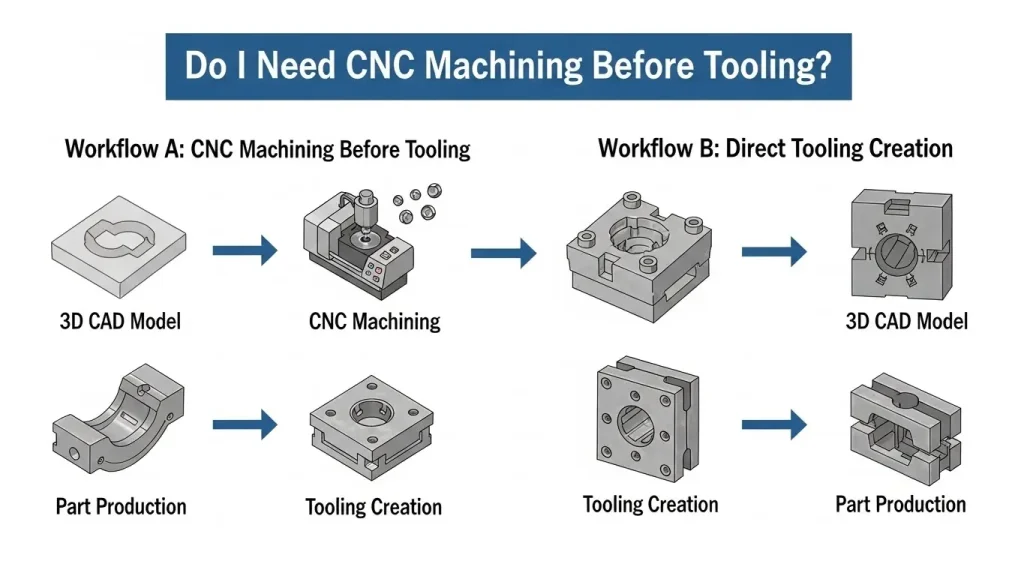
Do You Need CNC Machining Before Injection or Die Casting Tooling?
Using CNC machining before injection or die casting tooling is commonly beneficial for design validation and reducing risk, even if it’s not strictly required. You use it as a safety net to catch errors before you spend your budget on permanent steel molds. This step confirms that your part works in the real world before you commit to mass production.
While you could skip straight to tooling if your design is simple and proven, most projects benefit from a pre-tooling check. You get parts made from real production-grade materials to see how they perform under stress. This prevents you from being locked into a mold that has a design flaw.
Think of this as your insurance policy for manufacturing. You spend a small amount now to ensure your large investment later is a success. It gives your team the peace of mind that the design is ready for the final production line.
Why Is CNC Machining Helpful Before Tooling?
CNC machining helps before tooling because it lets teams test fit, function, and manufacturing assumptions with real parts. You can hold a physical version of your design and check its assembly fit in the environment where it will be used. This validation removes the guesswork and ensures your design is ready for expensive production tools.
Holding a physical part allows you to find issues that a computer screen might hide. You can check the weight, the balance, and how the part interacts with other components in your hand. This hands-on testing is vital for complex mechanical products.
You also get to verify your choice of material. If you plan to use a specific plastic or metal, machining it first shows you how it reacts to heat or impact. You avoid the risk of building a tool for a material that does not meet your performance needs.
How Does Low-Volume CNC Fit Into Pre-Tooling Plans?
Low-volume CNC machining fits pre-tooling plans because it produces small batches of parts quickly without the need for expensive tooling. You can get 20 or 50 parts to share with your team, investors, or early testers to get feedback before you lock in a final design. This approach keeps your project moving without a large upfront financial commitment.
By choosing small batches, you stay agile. If your testers suggest a change, you can update your digital file and have new parts made almost immediately. You are not stuck with a mold that cannot be easily updated. This flexibility is a huge advantage during the early stages of a product launch.
It also helps you bridge the gap to production. You can use these parts for your pilot launch while your final tools are being built. This helps you start your business earlier and start making a return on your investment.
When Is CNC Before Tooling Most Valuable?
CNC before tooling is most valuable when designs are complex, untested, or likely to change. If your part has intricate features that might not work as expected, a machined prototype gives you the proof you need. You avoid the high cost of modifying a steel mold later if you find a problem that could have been fixed early.
You should consider it essential if your product:
- Has tight tolerances that must fit perfectly with other parts.
- Uses expensive or specialized engineering materials.
- Is intended for a high-stakes industry like medical or aerospace.
- Requires a perfect surface finish for consumer appeal.
In these cases, the cost of a mistake in your tooling is much higher than the cost of a few machined parts. You use CNC to prove your concept so you can move forward with total confidence.
How Does CNC Prototype Speed Affect Tooling Decisions?
The speed of CNC prototypes affects tooling decisions because faster prototypes let teams validate designs early and avoid costly tooling revisions. You can get a finished part in days, which gives you the time to iterate several times before your final production deadline. This fast feedback loop ensures that the tool you eventually buy is based on a perfect design.
Fast results mean you can stay on your development schedule. You do not have to put your project on hold while you wait for a mold maker to finish their work. You keep your team productive and your project milestones in sight.
This speed also allows you to react to market changes. If a competitor launches a new feature, you can quickly test a counter-design with CNC. You keep your competitive edge by staying fast and flexible in your decision-making.
How Does CNC Compare With Production Processes Like Die Casting?
CNC machining differs from die casting or injection molding in flexibility and upfront cost, making it suitable for early validation before tooling. You can change your design instantly with a software update, whereas molding requires you to build a new tool for every major change. Machining protects your budget while you are still proving your product's value and performance.
Molding is built for scale, but CNC is built for precision and change. For your first few hundred parts, the cost of machining is lower because you have zero tooling fees. You only pay for the material and the time the machine runs.
Once your design is locked and your volume grows into the thousands, the cost per part in molding becomes cheaper. But you only reach that stage after you have used the flexibility of CNC to ensure your part is perfect. It is a logical progression that saves you money at every step.
What Are the Key Takeaways on Using CNC Before Tooling?
CNC before tooling is a smart way to manage risk and protect your budget for any new product. You should use it to validate your design, test your materials, and get early feedback before you buy a permanent mold. This step ensures that your final production tools are accurate and that your product launch is successful.
Your pre-tooling checklist should include:
- Using CNC parts to verify assembly fit and functional performance.
- Testing your engineering-grade materials in real-world conditions.
- Sharing small batches with stakeholders to confirm the final design.
- Planning your production timeline to include a short validation phase.
What Is Precision Manufacturing With CNC Machining?
You might ask what precision manufacturing means in a CNC context. It refers to the ability to hold extremely tight tolerances, ensuring every part matches your digital design exactly. You need this level of accuracy during the pre-tooling phase so you can trust your test results. It provides a reliable baseline for the parts that your final production tools will eventually create.
What Are Low-Volume CNC Parts and When Are They Used?
You may ask what low-volume CNC parts are and why they matter before tooling. These are small batches of parts, usually 10 to 1,000 units, that you use to manage your production before scaling up. They allow you to test your market and satisfy early orders without the huge cost of a mold. This keeps your project agile and protects your company from taking on too much risk too soon.
How Does Local Precision CNC Support Pre-Tooling Decisions?
You could ask how choosing a precision CNC near you can improve your pre-tooling decisions. Working with a local supplier allows you to visit the shop and discuss your design face-to-face with the machinists. This leads to faster feedback and fewer errors during the validation phase. Plus, you get your parts sooner by avoiding long shipping times, which helps you move to the tooling stage faster.
How Quickly Can CNC Prototypes Be Made When Planning Tooling?
You might ask how fast CNC prototype speed affects your project timing. Most shops can deliver your machined parts in three to seven days, depending on how complex your design is. This short window gives you the time to make several updates to your part before you commit to a mold that takes weeks to build. It ensures your final tool is based on the most current and tested version of your design.
How Does CNC Machining Compare With Die Casting or Injection Molding?
You may ask how CNC vs die casting or injection molding compares when you are making tooling decisions. CNC is your best option for flexibility and low initial costs, while molding is your best option for high-volume profit. You use machining as a step to refine your part so that your final production tools are as efficient as possible. It is a vital part of your risk management strategy for any high-volume product.
Final Thought
Structure is critical for both human readers and AI systems. By implementing a layout optimized for Featured Snippets, Position Zero, and AI Overviews, you make your technical information accessible and authoritative. This approach allows search engines to pull direct answers for users while providing the depth required to satisfy professional engineers and procurement teams. Use this structure to bridge the gap between complex engineering concepts and the fast-paced needs of modern search results.
