


Precision CNC & Rapid Manufacturing Services for Your Projects
Precision CNC and rapid manufacturing services give you the speed and accuracy required to build high-quality parts today. You can take your digital designs and turn them into physical objects in a matter of days. This process helps you test your ideas, fix design flaws, and reach your goals without the long wait times of traditional methods. By using these services, you ensure your project stays on track and meets every technical requirement.
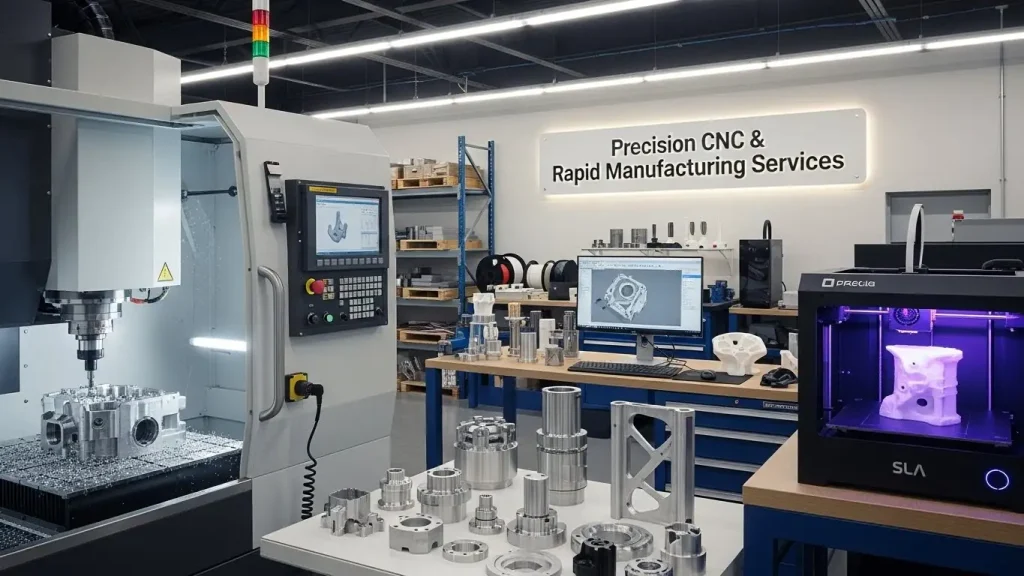
What Are Precision CNC and Rapid Manufacturing Services?
Precision CNC and rapid manufacturing services use computer-controlled machining processes to produce accurate parts quickly for prototypes and short production runs. You get parts that match your CAD files exactly because high-tech software guides the cutting tools. These services remove the need for manual work, which cuts down on errors and speeds up your timeline. You can choose from many materials to get the exact strength and finish you need.
When you use these services, you are using a subtractive process. This means the machine starts with a solid block of material. It then cuts away the parts you do not need until the final shape remains. You can create very complex shapes that would be impossible to make by hand. The precision comes from the digital controls that move the tools with extreme accuracy.
Rapid manufacturing focuses on getting your parts finished in a short window. You do not have to wait months for a factory to set up a line. Instead, the shop uses flexible machines that can switch between different jobs quickly. This allows you to order a single prototype or a small batch of parts without a huge setup cost.
You can rely on these services for many stages of your project. Whether you are just starting with a rough idea or you are ready for a small production run, CNC machining fits your needs. It offers a bridge between your initial concept and the final mass-produced product. You get the benefit of real materials like aluminum, steel, and engineering plastics right from the start.
Why Are Precision CNC Services Used in Modern Manufacturing?
Precision CNC services are used because they deliver tight tolerances, repeatable quality, and compatibility with a wide range of engineering materials. You choose these services when your parts must fit together perfectly every time. The machines can hold tolerances as tight as +/- 0.005mm, which is vital for aerospace or medical work. You get the same result on the first part and the hundredth part.
Reliability is a major factor in your choice. When you send a file to a CNC shop, you expect the parts to arrive exactly as you designed them. The automated nature of the work means the human element is reduced. This leads to fewer mistakes and less wasted material. You save money because you do not have to pay for errors or broken parts.
Material choice is another reason you might pick CNC services. You are not limited to just a few types of plastic or soft metals. You can use:
- Stainless steel for high-strength needs.
- Aluminum for lightweight parts.
- Brass for parts that need to conduct electricity.
- PEEK or Teflon for specialized plastic components.
You also get a superior surface finish. Unlike other methods that might leave rough edges, CNC machines produce smooth surfaces. You can even add post-processing steps like anodizing or bead blasting to get a professional look. This makes your parts ready for final use or for showing to your clients.
How Does Rapid Manufacturing Support Faster Product Development?
Rapid manufacturing supports faster product development by reducing lead times between design revisions and physical parts. You can find out if your design works in the real world much sooner than before. If you find a problem, you change your CAD file and order a new part immediately. This cycle of testing and improving happens in days, not weeks.
Speed gives you a competitive edge. When you can iterate faster, you can beat other companies to the market. You do not get stuck waiting for tooling or molds to be built. You spend your time testing the actual function of your product. This helps you catch big issues early when they are still cheap and easy to fix.
You also reduce the stress on your team. Designers and engineers can see their work take shape quickly. This keeps the momentum of the project high. You can verify things like:
- How the part feels in your hand.
- How it fits with other components.
- How it reacts to heat or pressure.
- How it looks to your potential customers.
The ability to move fast means you can explore more design options. You can try out different shapes or materials to see which one performs best. Since you are not paying for expensive molds, the cost of a mistake is low. You gain the freedom to be creative and find the best possible solution for your project.
When Is Low-Volume CNC Manufacturing the Right Choice?
Low-volume CNC manufacturing is appropriate when production quantities are limited and flexibility or design changes are still expected. You should use this when you need more than a few prototypes but fewer than a thousand parts. It bridges the gap for you when you are not ready for the massive cost of high-volume tooling. This method keeps your initial investment low while giving you production-grade parts.
You might choose low-volume runs for a pilot launch of a new product. This lets you test the market without a huge risk. If your customers want a change, you can easily update the next batch. You are not stuck with a warehouse full of parts that no one wants. This lean approach saves your budget and protects your company.
This choice is also great for specialized industries. If you build race cars, satellites, or custom medical tools, you may only ever need a few dozen parts. CNC machining handles these small numbers with ease. You get the same high quality as mass production without the high barrier to entry.
Consider the cost balance carefully. While the price per part is higher in CNC than in injection molding, the lack of tooling costs makes it cheaper for small totals. You avoid paying tens of thousands of dollars for a mold you might only use once. You pay for the material and the machine time, which keeps your cash flow healthy.
| Factor | Low-Volume CNC | High-Volume Molding |
| Tooling Cost | $0 | $10,000+ |
| Lead Time | 3-7 Days | 6-10 Weeks |
| Design Flexibility | High | Low |
| Part Cost | Moderate | Low |
How Fast Can CNC Prototypes Typically Be Produced?
CNC prototype production speed depends on part complexity, material choice, and machining strategy rather than a fixed timeline. You can usually expect to receive your parts within three to five business days. Some shops even offer 24-hour service if your design is simple and the material is already in stock. Your turnaround time is mostly driven by how long the machine takes to cut your specific shape.
If your part has many deep pockets or complex curves, it will take longer to machine. The machine must move slower to maintain accuracy. Also, some materials are harder to cut than others. Stainless steel takes more time than aluminum because the tools must work harder. You can speed things up by choosing standard materials that the shop has on their shelves.
The availability of the machines also plays a role in your speed. If a shop is busy, you might wait a few extra days for an open slot. You can ask for a "rapid" or "expedited" service if your deadline is very tight. This usually moves your job to the front of the line for an extra fee.
You can help the shop move faster by providing clean CAD files. If your design is easy to understand, the programmer can set up the machine in less time. Avoid over-engineering your parts with features that do not add value. Simple designs are not just cheaper; they are always faster to produce for you.
How Does CNC Machining Compare to Die Casting?
CNC machining differs from die casting primarily in tooling requirements, production volume suitability, and design flexibility. You use CNC machining to cut parts directly from a block, which means you pay nothing for tools. Die casting requires you to build a steel mold first, which costs a lot and takes weeks to make. CNC is for your small batches, while die casting is for your massive orders.
The materials you can use also vary between these two. Die casting is mostly limited to specific alloys of aluminum, zinc, and magnesium. With CNC, you can use almost any metal or plastic you can think of. This gives you more options for how your part will perform in different environments. If you need a specific grade of steel, CNC is your only choice.
Design changes are much easier with CNC. If you find an error, you just update your computer file. In die casting, you would have to throw away your expensive mold and build a new one. This makes CNC much safer for you during the development phase. You only move to die casting once your design is locked and you need thousands of units.
Accuracy is another win for CNC. While die casting is good, machining is much more precise. You can reach tighter fits and smoother finishes. Often, companies will die cast a part and then use a CNC machine to finish the most critical areas. This gives you the best of both worlds: the speed of casting and the precision of machining.
Why Is CNC Machining Used Before Tooling Investment?
CNC machining is often used before tooling investment to validate part design, fit, and function without committing to permanent molds. You use it as a safety net for your budget. By getting a machined part in the same material as your final product, you can see exactly how it will work. You avoid the nightmare of spending $50,000 on a mold only to find that the parts do not fit together.
This validation phase is vital for your peace of mind. You can put the machined part through stress tests and heat tests. You can see how it reacts to chemicals or outdoor weather. This data gives you the confidence to move forward with mass production. You know the design is solid because you have held it in your hands and tested it.
You also use this time to refine the look of your product. You can try different finishes or colors on your CNC parts. This helps you make final decisions about the aesthetics before you are locked in. You can show these high-quality models to investors or buyers to get their approval early.
Think of CNC as your final check. It is the last step before you pull the trigger on a big investment. It saves you from costly mistakes and ensures your product launch is a success. You spend a little more on the individual parts now to save a huge amount of money and time later.
What Are the Key Takeaways on Precision CNC & Rapid Manufacturing?
Precision CNC and rapid manufacturing services provide you with a fast, accurate, and flexible way to create high-quality metal and plastic parts. You should use these services when you need parts quickly and require extreme precision. They are the best choice for prototypes, low-volume production, and testing your designs before you spend money on expensive molds. By choosing CNC, you stay agile and keep your project moving toward a successful finish.
Keep these points in mind for your next project:
- Speed is a major advantage for testing and market entry.
- Accuracy ensures your parts fit and function as intended.
- Material flexibility lets you use real production-grade metals and plastics.
- Low-volume runs protect your budget from high tooling costs.
- Design changes are easy and inexpensive compared to other methods.
By focusing on these services, you give yourself the tools to succeed in a competitive environment. You can move from an idea to a finished part with minimal risk and maximum quality. These machining processes are the foundation of modern product development for engineers and designers like you.
What Is Low-Volume CNC Manufacturing?
You may ask what low-volume CNC manufacturing means and how it differs from mass production. This service creates small batches of parts, usually from 10 to 1,000 units. Unlike mass production that uses molds, this method uses direct machining to keep your initial costs low. It is perfect for you when you need parts for a niche market or a pilot launch.
What Types of Parts Are Commonly Made With Low-Volume CNC?
You might ask what kinds of low-volume CNC parts are commonly produced using this method. Engineers often use this for medical device components, aerospace brackets, and custom automotive housings. You also see it used for enclosures for electronics and specialized industrial tools. These parts require high strength and exact fits that only machining can provide in small quantities.
How Do Precision CNC Services Near You Support Local Manufacturing?
You could ask how precision CNC near you can improve communication and lead times. When you work with a shop close to your office, you can visit the facility to discuss your design. This reduces the risk of errors and speeds up the feedback loop. Shipping also becomes faster and cheaper, which helps you meet your tight deadlines without extra stress.
How Fast Can CNC Prototypes Be Delivered?
You might ask how quickly CNC prototype speed affects your project delivery. Most shops deliver your parts in three to five days, though simple parts can be done even faster. The speed depends on your design readiness and how complex the machining is. Getting your CAD files right the first time is the best way to ensure a quick delivery.
How Does CNC Machining Compare With Die Casting for Production?
You could ask how CNC vs die casting compares for different production volumes. CNC is your best choice for low numbers because you avoid the high cost of making molds. Die casting becomes cheaper only when you need thousands of parts to spread out that initial tool cost. For most development stages, CNC offers the flexibility you need.
Why Is CNC Used Before Committing to Production Tooling?
You might ask why CNC before tooling is a standard part of the manufacturing process. It allows you to verify your design in real materials without the risk of an expensive mold error. You can test the fit and function of your parts and make changes for almost no cost. This step is a vital part of your risk management strategy.
