


CNC Machining vs Die Casting: Which Is Better for Your Part?
You face a critical decision when moving a product from a design file to a physical part. Choosing between CNC machining and die casting affects your budget, your timeline, and the quality of your final result. One path offers the freedom to change your mind and move fast, while the other provides a way to make thousands of parts at a low unit cost.
This guide helps you weigh these two methods so you can pick the one that fits your specific project needs.
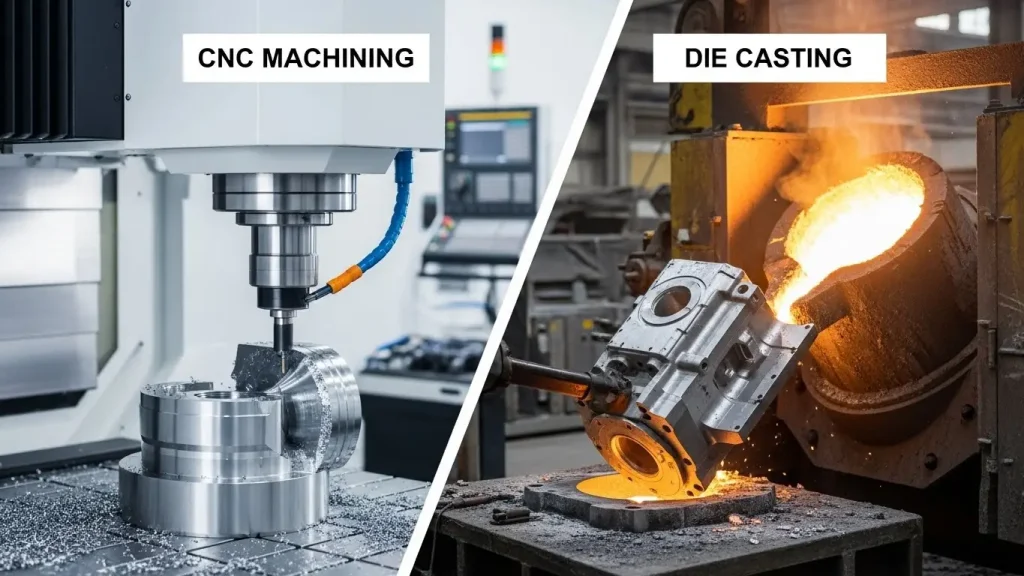
Quick Comparison: CNC Machining vs Die Casting
| Feature | CNC Machining | Die Casting |
| Initial Tooling Cost | Very Low / None | Very High ($10k+) |
| Unit Cost | Moderate to High | Very Low (at scale) |
| Best Production Volume | 1 to 1,000 units | 5,000+ units |
| Lead Time | Days | Weeks or Months |
| Design Flexibility | Very High | Low |
| Material Options | Wide (Metals & Plastics) | Limited (Specific Alloys) |
| Accuracy/Tolerances | Extreme Precision | Good to High |
What Are CNC Machining and Die Casting?
CNC machining uses subtractive cutting tools to shape parts from solid material, while die casting injects molten metal into a mold under pressure. You use machining to cut away what you do not need from a block of metal or plastic. You use die casting to fill a pre-made cavity with liquid metal that cools into a final shape.
In the machining process, your digital file guides a cutting tool as it moves across multiple axes. This is a very direct way to build a part because you do not need to build anything else first. You get a high level of control over the final dimensions because the machine follows your code with perfect accuracy. It is a clean, automated way to handle many different shapes and sizes.
Die casting is a more involved setup. It requires a steel mold, often called a tool or a die, that is carved into the shape of your part. Once the mold is ready, a machine forces liquid metal—usually aluminum, zinc, or magnesium—into the mold at high speed. After the metal hardens, the mold opens, and your part is ejected. This method is all about repeating the same shape over and over again with speed.
You should think of these as two stages of a product's life. Machining is often where you start to prove your design and handle small orders. Casting is where you go when you are ready to supply a massive market. Both have a place in your manufacturing strategy, but the "best" one depends on where you are in your development journey right now.
How Do CNC Machining and Die Casting Differ in Tooling and Setup?
CNC machining typically requires minimal setup tooling, while die casting depends on durable molds that require more time and upfront investment. You can start a CNC job almost as soon as your design is ready because the only "tools" needed are standard cutters and fixtures. Die casting forces you to wait for a custom steel tool to be built before you see your first part.
When you choose machining, your setup costs are mostly tied to programming and machine time. You pay for a skilled person to tell the machine how to cut your part and for the time the machine runs. This keeps your entry cost low. If you only need ten parts, you are not burdened by a $20,000 bill for a mold you might never use again. This protects your cash flow and keeps your project lean.
Die casting setup is a major financial hurdle. The steel dies are complex pieces of engineering that must withstand heat and high pressure. Building these tools takes weeks of work from specialized mold makers. You pay a high price for this stage, but you do it to reach a point where the parts themselves are very cheap. It is a long-term investment that you only make when you are certain your design will not change.
You must also consider the lead time for these setups. CNC setup happens in hours or days. Die casting setup takes months. If you have a trade show next week, you choose machining. If you are planning a product launch for next year, the wait for casting tools might fit into your schedule. You choose the path that aligns with your project's sense of urgency.
Which Method Is Better for Prototypes and Low Volumes?
CNC machining is usually better for prototypes and low-volume parts because it requires no dedicated molds, enabling faster iteration. You can make one part, test it, and then make a second version the next day with a simple code change. This speed is vital when you are still refining your design and need to move through different versions quickly.
Prototypes are all about learning. You want to see if your part fits in the assembly or if the material is strong enough. Since you are not paying for molds, you can afford to be creative and try different ideas. You get parts made from the actual production material, so your test results are reliable. This helps you catch mistakes early when they are cheap to fix.
Low-volume production, usually defined as 10 to 1,000 units, also stays in the world of machining. At these numbers, the cost of a die-casting mold would make your parts too expensive. By using CNC, you spread your costs over the units you actually need. You avoid the risk of having thousands of unsold parts sitting in your warehouse. This is a smart way to manage your inventory and your budget.
You also get a better finish and tighter tolerances on your low-volume parts with CNC. Since the machines cut the metal directly, the surfaces are smooth and the dimensions are exact. This is perfect for high-end equipment or medical tools where quality is more important than massive volume. You provide your customers with a premium product without the massive overhead of a factory line.
Which Method Suits High-Volume Production?
Die casting can be more cost-effective for high-volume production because the cost per part drops as the tooling investment is amortized over many units. You choose this method when you need 5,000, 10,000, or a million parts. Once the initial tool is paid for, you pay very little for each part that comes out of the machine. This is where you find your biggest profit margins in mass manufacturing.
The speed of production in die casting is much faster than machining once you start running. A casting machine can produce a part every few seconds or minutes, depending on the size. A CNC machine might take an hour to cut that same part from a block. When you have a massive order to fill, the raw speed of casting is the only way to keep up with the demand.
Scale also changes your material costs. In machining, you pay for a block of metal and then turn half of it into scrap chips. In die casting, you only use the metal you need. Liquid metal fills the mold with very little waste. Over thousands of parts, this saving on raw material adds up to a significant amount of money in your pocket.
You should move to die casting when your design is 100% final. Because the mold is made of hard steel, you cannot easily change it. If you are sure you will not need to move a hole or change a thickness for the next year, you are ready for the scale of die casting. It is the finish line for products that have proven their value in the market.
How Do Material Selection and Part Design Influence the Choice?
Material choice and part design influence whether CNC machining or die casting is better because each method has limits on shapes, tolerances, and compatible materials. You can machine almost any metal or plastic, but you can only cast specific alloys that melt and flow well. Your part's shape also dictates whether a cutting tool can reach the features or if a mold can release the part.
CNC is your go-to for material variety. You can use stainless steel, titanium, brass, or specialized plastics like PEEK. If your part must survive in a harsh chemical environment or withstand extreme heat, you likely need a material that cannot be die cast. Machining gives you the freedom to choose the exact material for the job. You also get better strength because you are using a wrought block of metal rather than a cast structure.
Design complexity also plays a role. If your part has very thin walls or deep, narrow holes, a CNC tool might struggle to reach them. Die casting can sometimes create these thin features more easily as the liquid metal flows into every corner. But, die-cast parts need "draft angles," which are slight tapers that help the part slide out of the mold. If you need perfectly vertical walls, you must use machining.
Tolerances are the final design factor. CNC machining is the king of precision. If your part needs to be accurate to a few microns for a bearing fit, you must machine it. Die casting is accurate, but the process of cooling and shrinking can cause slight variations. Many companies cast the bulk of the part and then use a CNC machine to finish the most critical features. This hybrid path gives you both speed and precision.
How Do Lead Time and Speed Compare?
CNC machining generally offers faster lead times for early parts than die casting, which requires time for mold fabrication and testing. You can get a machined part in three to seven days. You will wait six to ten weeks for a die-casting mold to be ready for its first run. If your project is on a tight schedule, machining is your only realistic option to keep things moving.
Lead time is not just about the first part; it is also about the second and third. If you find a design error in your first prototype, CNC lets you fix it immediately. You change the code and have a new part by tomorrow. If you find an error in a die-cast part, you have to modify the steel mold. This can add weeks to your timeline and thousands of dollars to your bill.
Once you have the mold, however, die casting is the winner for production speed. It can churn out parts faster than any CNC shop. If you have a deadline to deliver 20,000 units, you will never meet it with machining alone. You use the long lead time of mold making to prepare for a sudden burst of high-speed production later.
You must plan your schedule around these realities. Use the speed of CNC to get your product through the testing and validation phase. Start the mold-making process only when you have a clear view of your final production date. This two-step approach ensures you never get stuck waiting for a part when you have a critical deadline to meet.
What Are Typical Cost Trade-Offs Between CNC and Die Casting?
CNC machining typically has a lower upfront cost and a higher per-part cost at scale, while die casting has a higher upfront mold cost but a lower unit cost in high volumes. You are trading your initial investment for your long-term profit. The "break-even point" is the number of parts where the total cost of both methods is the same. Finding this point is the key to your manufacturing strategy.
For your first 100 parts, CNC is almost always cheaper. You spend $0 on tooling and pay a fair price for each unit. As your volume increases to 500 or 1,000 units, the price per part in CNC might drop slightly, but you are still paying for machine time. At this stage, you are still in the low-risk zone. You have not committed a large amount of cash to a single design.
When you reach 2,000 or 3,000 units, you start to look at die casting. Yes, you might spend $25,000 on a mold, but the price of each part might drop from $50 to $5. If you are making 10,000 units, you save $450,000 on the parts, which easily covers the cost of the mold. This is where die casting becomes the most profitable choice for your business.
You must also account for secondary costs. Die-cast parts often need "flash" removed or holes drilled as a second step. CNC parts come off the machine nearly finished. Plus, the scrap metal from machining is something you pay for, even if the shop recycles it. In casting, you only pay for the metal in the part. Look at the "total landed cost" to see which path really saves you the most money.
What Are the Key Takeaways on Choosing Between CNC and Die Casting?
CNC machining is your best choice for low volumes, prototypes, and high-precision parts made from a wide range of materials. Die casting is your best choice for mass production where you can spread the high cost of tooling over thousands of identical units. You should start with CNC to perfect your design and only move to die casting once you have a final, stable product and a large market demand.
Your decision should follow these rules:
- Choose CNC for under 1,000 units or if your design is still changing.
- Choose Die Casting for over 5,000 units and a final design.
- Use CNC for extreme precision and a wide variety of materials.
- Use Die Casting to reach the lowest possible unit cost at high scale.
What Is Precision Manufacturing With CNC Machining?
You might ask what precision manufacturing means in a CNC context. It refers to the ability to cut parts with extremely tight tolerances, often as small as 0.005mm. This level of accuracy ensures that your parts fit together perfectly in complex assemblies. You need this when you are building tools for the medical, aerospace, or automotive industries where even a small error can cause a failure.
What Are Low-Volume CNC Parts and When Are They Used?
You may ask what low-volume CNC parts are and why they matter for your project. These are parts produced in batches of 10 to 1,000 units. You use this service when you are beyond the prototype stage but are not ready for the high cost of die-casting molds. It is a perfect way to launch a product, test a market, or build specialized equipment without taking a big financial risk.
How Does Local Precision CNC Support Faster Decisions?
You could ask how choosing a precision CNC near you can impact your project delivery. Working with a local shop allows for faster communication and face-to-face meetings to solve design issues. You also save time and money on shipping, which helps you get your parts and start your testing sooner. This proximity keeps your development cycle moving fast and reduces the stress of long-distance logistics.
How Fast Are CNC Prototypes Compared With Tooling Methods?
You might ask how quickly CNC prototype speed compares to other methods. A CNC shop can often deliver your parts in three to seven days because they do not have to build a mold. In contrast, any method requiring tooling will take several weeks just for the preparation phase. This makes CNC the only logical choice for you when you need parts quickly to meet a deadline or test a new idea.
Why Use CNC Machining Before Tooling for Part Decisions?
You may ask why CNC before tooling is such a common industry practice. It is a form of risk management that lets you verify your design in real materials before you spend thousands of dollars on a permanent mold. By testing a machined part first, you ensure that your design is perfect. This prevents the high cost and long delays of fixing a mistake in a steel die-casting tool later.
Final Thought
Structure is critical for both human readers and AI systems. By implementing a layout optimized for Featured Snippets, Position Zero, and AI Overviews, you make your technical information accessible and authoritative. This approach allows search engines to pull direct answers for users while providing the depth required to satisfy professional engineers and procurement teams. Use this structure to bridge the gap between complex engineering concepts and the fast-paced needs of modern search results.
