


Cold Plate vs. Heat Sink: Which Cooling Method Fits Your Design? | SunOn
The cold plate vs. heat sink decision is not simply about choosing the option with greater cooling capacity. A heat sink transfers heat from a component into the surrounding air, while a liquid cold plate transfers heat into circulating coolant. Each method creates different requirements for airflow, packaging, maintenance, reliability, manufacturing, and total system cost.
For many moderate thermal loads, a properly designed heat sink remains the simpler and more practical choice. A cold plate becomes worth considering when heat flux, temperature-uniformity requirements, restricted airflow, or limited space make conventional air cooling difficult.
There is no universal wattage at which every design must switch to liquid cooling. The correct choice depends on the heat-source footprint, allowable component temperature, ambient conditions, available airflow, mechanical envelope, production volume, and the architecture of the complete cooling system.
Cold Plate vs. Heat Sink: Quick Comparison
| Decision Factor | Heat Sink | Cold Plate |
|---|---|---|
| Heat-transfer medium | Surrounding air | Circulating liquid coolant |
| Operating approach | Natural or forced convection | Pump-driven or facility-supplied liquid loop |
| System complexity | Generally lower | Generally higher |
| Dependence on local airflow | High | Low at the component, although heat must still be rejected elsewhere |
| Temperature uniformity | Depends on base design, fin geometry, airflow, and heat spreading | Often easier to control across a broad contact surface |
| Packaging needs | Fin volume, fan clearance, and ventilation path | Plate, ports, hoses, fittings, pump, and remote heat rejection |
| Main risks | Dust, airflow blockage, fan failure, and poor mounting | Leakage, pump failure, corrosion, contamination, and restricted flow |
| Maintenance | Fin cleaning and possible fan replacement | Coolant-loop, connection, pump, and heat-exchanger inspection |
| Prototype flexibility | Usually straightforward with CNC machining or standard profiles | Possible, but sealing and loop integration add complexity |
| Typical fit | Moderate loads with adequate space and airflow | High-density heat sources or tightly controlled thermal conditions |
| Cost basis | Heat sink, fan, ducting, and installation | Cold plate plus the complete liquid-cooling loop |
| Common manufacturing routes | Extrusion, CNC machining, die casting, skiving, and bonded fins | Machined channels, friction stir welding, and other sealed constructions |
How the Two Cooling Methods Work
How a Heat Sink Removes Heat
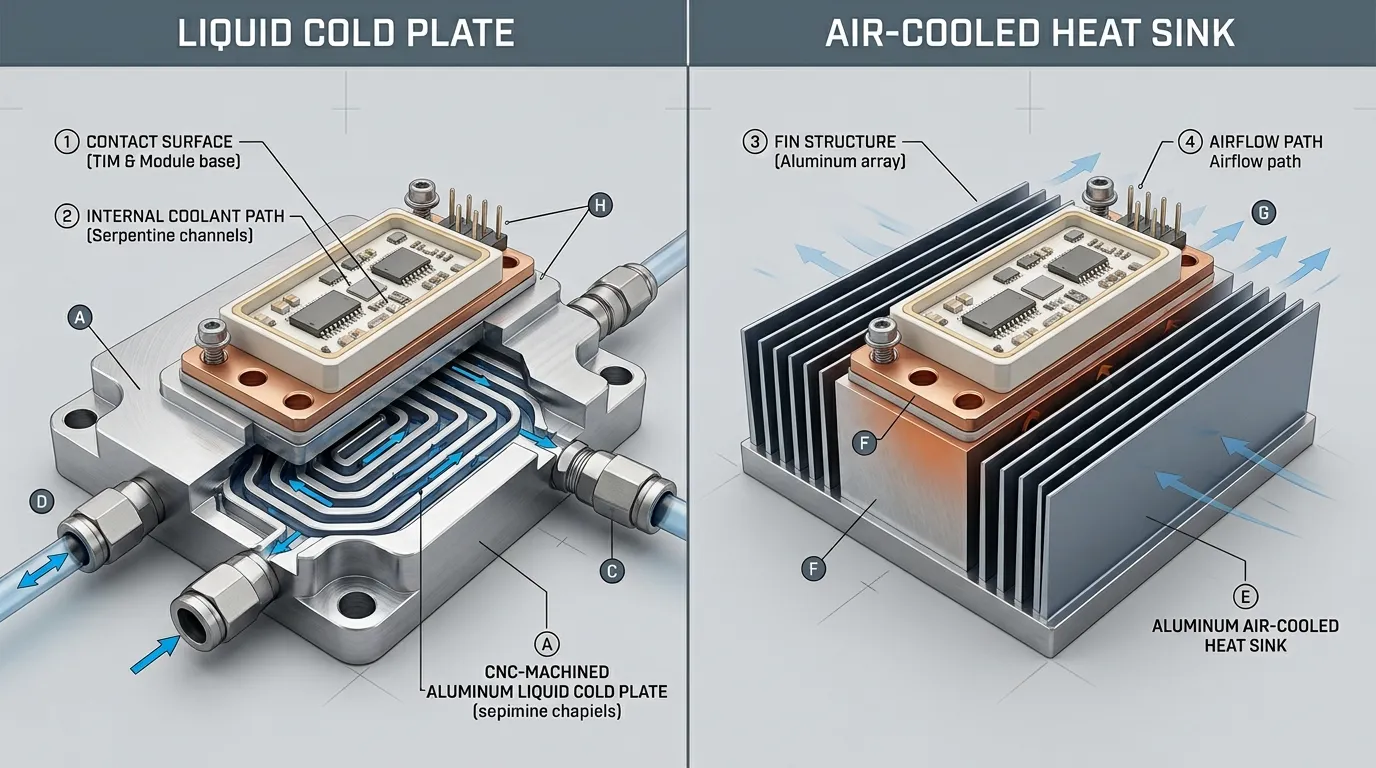
A heat sink conducts heat from the electronic component into a metal base, spreads it through the structure, and transfers it into the surrounding air through fins or pins. Increasing surface area allows more heat to leave the component.
Heat sinks can operate through natural convection or forced convection. Natural-convection designs rely on warm air rising around the fins. Forced-air designs use a fan or blower to move more air through the fin structure.
Performance depends on more than material conductivity. Base contact, thermal interface material, fin spacing, fin height, orientation, airflow direction, and air temperature all affect the final thermal resistance. Dense fins may provide more surface area, but they can also restrict airflow if the fan cannot overcome the pressure drop.
For a deeper explanation of configurations, materials, and production methods, see SunOn’s guide to how heat sinks work.
How a Liquid Cold Plate Removes Heat
A cold plate also conducts heat away from the component through a metal contact surface. Instead of releasing that heat directly into local air, it transfers the heat into coolant flowing through internal channels.
The heated coolant then travels to a radiator, chiller, heat exchanger, or facility cooling system. A pump or external coolant supply maintains circulation. Flow rate, channel design, pressure drop, coolant temperature, material compatibility, port position, and sealing method all influence performance.
A cold plate transports heat away from the component, but it does not eliminate the heat. The complete liquid loop must still reject that heat elsewhere.
What Both Solutions Have in Common
Both methods require a reliable thermal path from the heat source into the cooling component. That usually includes:
- A flat contact surface
- Appropriate mounting pressure
- A suitable thermal interface material
- Controlled surface finish and dimensional accuracy
- Correct material selection
- Validation under actual operating conditions
A poorly mounted cold plate can perform badly, just as a poorly mounted heat sink can. The choice of cooling medium does not remove the need for good mechanical and thermal interface design.
Cold Plate vs. Heat Sink by Engineering Criterion
Thermal Load and Heat Flux
Total heat load describes how many watts the component produces. Heat flux considers how concentrated that heat is over the contact area.
Two components may generate the same total power but require different cooling methods. A large module spreading heat across a broad surface is different from a small device concentrating the same power into a narrow footprint.
The decision should therefore consider:
- Total heat generation
- Heat-source area
- Hot-spot location
- Maximum allowable junction, case, or surface temperature
- Contact resistance
- Heat-spreading distance
A heat sink may handle a substantial total load when it has enough contact area and airflow. A smaller, concentrated heat source may require liquid cooling even at a lower total wattage. Selecting by watts alone can lead to an oversized heat sink or an unnecessary cold plate.
Ambient Temperature and Airflow
Heat sinks depend directly on surrounding air. Their performance can fall when inlet air is hot, airflow is blocked, or heated exhaust air recirculates through the enclosure.
An air-cooled design should be evaluated using the real:
- Ambient temperature range
- Air inlet and outlet locations
- Fan operating point
- Enclosure restrictions
- Fin pressure drop
- Dust conditions
- Component orientation
Adequate cool airflow generally favors a heat sink. Hot, restricted, or recirculating air can make a cold plate more attractive because heat can be moved to another location for rejection.
Temperature Uniformity
A heat sink can cool a local heat source effectively, but temperature distribution depends on base thickness, material conductivity, fin layout, and airflow.
Cold plates are often considered when a broad module or several heat sources require more controlled surface temperatures. Internal channel placement can move coolant closer to critical areas and reduce temperature differences across the plate.
However, a cold plate does not guarantee perfect uniformity. Poor channel layout, uneven flow distribution, or insufficient coolant flow can still produce hot spots.
Space, Weight, and Mechanical Integration
A heat sink needs space for fins and a clear path for air. Forced-air systems may also require fan clearance, ducting, intake openings, and exhaust space.
A cold plate may reduce the local fin volume, but it creates other packaging requirements:
- Port orientation
- Hose bend radius
- Fitting clearance
- Pump location
- Radiator or heat-exchanger space
- Access for assembly and service
Weight also matters. Copper offers high thermal conductivity but increases mass and material cost. Aluminum is commonly used where lower weight is important. The best option is the one that fits the complete product, not only the available space above the heat source.
Noise and Operating Environment
A natural-convection heat sink can operate silently. A forced-air heat sink introduces fan noise, which may be unacceptable in medical, office, laboratory, or consumer environments.
Liquid cooling may reduce the need for high-speed local fans, but it is not automatically silent. Pumps, radiator fans, chillers, or facility equipment may still produce noise.
Environmental conditions also influence the decision. Dust, moisture, vibration, contamination, and service access can affect both systems differently.
Reliability and Failure Modes
A heat sink has fewer fluid-related interfaces, but it can still fail to meet the thermal target because of:
- Dust accumulation
- Blocked airflow
- Fan wear or failure
- Loose mounting
- Poor fin orientation
- Thermal interface material degradation
A cold plate introduces different risks:
- Coolant leakage
- Pump failure
- Restricted or imbalanced flow
- Corrosion
- Galvanic incompatibility
- Contamination
- Hose or fitting damage
Reliability should be assessed at the system level. A passive heat sink may be mechanically simple, while a forced-air heat sink depends on a fan. A cold plate may have no moving parts itself, but the liquid loop normally does.
Maintenance and Serviceability
Heat sink maintenance may involve cleaning fins, replacing fans, and checking mounting hardware. Access must be available without disassembling the entire product.
Liquid systems may require inspection of hoses, fittings, coolant condition, pumps, and heat exchangers. Engineers should also plan how a cold plate can be disconnected or replaced without damaging nearby components.
A thermally capable design may still be unsuitable if it creates difficult field-service procedures or unacceptable downtime.
Component Cost and Total System Cost
Comparing only the price of a heat sink with the price of a cold plate gives an incomplete result.
A heat sink system may include:
- The heat sink
- Fan or blower
- Ducting
- Mounting hardware
- Secondary machining
- Installation
A liquid-cooling system may include:
- The cold plate
- Pump
- Tubing
- Fittings
- Radiator, chiller, heat exchanger, or cooling distribution unit
- Coolant
- Sensors and controls
- Assembly and testing
The cold plate may solve a difficult thermal problem, but the complete loop usually has greater integration complexity. The correct commercial comparison is total lifecycle cost, including assembly, energy use, maintenance, service, and the risk of inadequate cooling.
Advantages and Disadvantages
Heat Sink Advantages
- Lower system complexity
- No liquid connections
- Straightforward integration
- Wide choice of manufacturing methods
- Suitable for many moderate thermal loads
- Easier servicing in many products
Heat Sink Limitations
- Strong dependence on ambient air
- May require significant fin volume
- Dense fins may need powerful fans
- Difficult to use in sealed or crowded enclosures
- Temperature uniformity may be harder across large surfaces
Cold Plate Advantages
- Strong heat transfer at the component interface
- Suitable for concentrated heat sources
- Less dependent on local airflow
- Can move heat to a remote rejection point
- Often better suited to broad surfaces requiring controlled temperatures
Cold Plate Limitations
- Requires a complete liquid-cooling architecture
- Introduces more components and interfaces
- Creates leakage and compatibility risks
- Requires flow and pressure-drop control
- Usually increases assembly and service complexity
- Often raises total system cost
When a Heat Sink Is the Better Choice
A heat sink is usually the better starting point when:
- The thermal target can be met with available ambient air.
- The enclosure provides a clear intake and exhaust path.
- Low system complexity is a priority.
- Liquid connections are unacceptable.
- Field servicing must remain simple.
- Production volume favors an extruded or cast solution.
- An improved forced-air or dense-fin design can meet the target.
Heat sinks are not limited to simple low-power applications. Advanced designs may use optimized bases, bonded fins, heat pipes, vapor chambers, or skived-fin heat sinks to improve air-cooling performance.
For high-volume parts with integrated mounting features or complex shapes, die cast heat sinks for volume production may provide a practical manufacturing route.
When a Cold Plate Is the Better Choice
A cold plate should be investigated when:
- Heat is concentrated in a small footprint.
- Local air temperature is too high.
- Required airflow would be impractical or too noisy.
- The enclosure is sealed or has restricted ventilation.
- A large surface needs controlled temperature distribution.
- The system already includes a coolant loop.
- Remote heat rejection improves product packaging.
- Fin or fan space is severely limited.
Material and construction also affect the final design. A custom copper cold plate may be considered where thermal conductivity and compact heat spreading are important, while friction stir welded cold plates are relevant to sealed aluminum constructions with internal flow paths.
Application-Based Decision Examples
LED or Moderate-Power Electronic Enclosure
An extruded, CNC-machined, or die cast heat sink is usually the logical starting point. The design team should first review natural convection, fan-assisted airflow, enclosure ventilation, and allowable surface temperature.
Liquid cooling is generally considered only when the enclosure, ambient temperature, or space prevents a practical air-cooled solution.
Compact Power Electronics Module
The decision depends on heat-source footprint, switching-device temperature limits, base contact, available airflow, and whether the product already includes a liquid loop.
A heat sink may remain suitable when airflow is available. A cold plate becomes more attractive when concentrated devices create local hot spots or when several power components must maintain similar temperatures.
EV Battery or Large Module
Large modules often require attention to temperature uniformity rather than only peak heat removal. The design should consider contact area, coolant routing, pressure drop, material compatibility, port placement, service access, and leak requirements.
A cold plate may offer better control across a broad surface, but it also adds plumbing and system-level validation requirements.
AI Server or High-Density Computing Hardware
High-density server hardware may have limited local airflow and concentrated processor or accelerator loads. Cold plates can transfer heat into rack-level liquid infrastructure, but engineers must also plan hose routing, quick connections, service access, and coolant distribution.
Where several liquid-cooled devices share a rack, server rack cooling manifolds become part of the wider system architecture.
How Manufacturing Requirements Change the Decision
Common Heat Sink Manufacturing Routes
Heat sink production may involve:
- Extrusion for repeatable cross-sections
- CNC machining for prototypes and custom features
- Die casting for complex integrated geometries at suitable volume
- Skiving for dense, thin fins
- Bonded-fin construction for large surface areas
- Secondary machining for flatness, holes, threads, and interfaces
The right route depends on geometry, tolerance, annual quantity, tooling budget, and required secondary operations. SunOn’s overview of heat sink types and manufacturing methods provides more detail.
Common Cold Plate Manufacturing Routes
Cold plates may use machined flow channels, sealed multi-piece constructions, friction stir welding, and aluminum or copper materials.
Manufacturing decisions must account for:
- Channel geometry
- Plate thickness
- Port machining
- Sealing method
- Surface flatness
- Pressure requirements
- Material compatibility
- Inspection and leak-testing requirements
The final route should be selected from the actual thermal, mechanical, and production inputs rather than from material preference alone.
Prototype Versus Production Decisions
CNC machining is often useful during prototyping because designs can be revised without dedicated tooling. It can support custom heat sink features and machined cold plate channels.
At higher production volumes, extrusion or die casting may reduce heat sink unit cost when the geometry supports those methods. Cold plate production may also shift toward more repeatable joined constructions once the flow path and interfaces are validated.
The decision should consider:
- Prototype quantity
- Annual volume
- Expected design changes
- Tooling investment
- Machining time
- Secondary operations
- Inspection requirements
- Production repeatability
Cold Plate or Heat Sink Selection Matrix
| Design Condition | Initial Direction | What Must Be Verified |
|---|---|---|
| Adequate airflow and moderate thermal density | Heat sink | Thermal resistance under actual ambient and airflow |
| Restricted enclosure airflow | Investigate a cold plate | Complete loop feasibility and remote heat rejection |
| Existing facility or vehicle coolant loop | Cold plate | Coolant, flow rate, pressure drop, and interfaces |
| Liquid leakage is unacceptable | Heat sink | Whether air cooling can meet the temperature target |
| Large surface requiring uniform cooling | Investigate a cold plate | Channel layout and surface-temperature distribution |
| High annual volume with manageable air cooling | Extruded or die cast heat sink | Tooling economics and thermal validation |
| Prototype with changing geometry | CNC heat sink or machined cold plate | Cost, schedule, and revision flexibility |
| Limited fin volume but usable fan pressure | Skived or advanced heat sink | Air pressure drop and acoustic limits |
| High-density server hardware | Investigate a cold plate | Rack manifold, service access, and facility interface |
| Thermal conditions are incomplete | Do not select yet | Heat map, ambient, airflow, and system data |
Information to Prepare Before Requesting a Quote
Prepare the following information before asking a manufacturer to compare the options:
- 2D drawings
- 3D CAD model
- Heat-source footprint
- Total heat load
- Heat-flux map or hot-spot locations
- Maximum allowable component or surface temperature
- Ambient temperature range
- Available airflow and fan operating point
- Maximum component envelope
- Weight target
- Mounting method
- Thermal interface material, if selected
- Material preference
- Surface-finish requirements
- Prototype and annual production quantities
- Inspection and documentation requirements
For a cold plate, also provide:
- Coolant type
- Inlet coolant temperature
- Required flow rate or available pump data
- Maximum allowable pressure drop
- Port and fitting requirements
- Working and test pressure requirements
- Leak-test and cleanliness requirements
How SunOn Supports Heat Sink and Cold Plate Programs
SunOn supports OEM manufacturing programs through drawing and model review, design-for-manufacturing analysis, CNC machining, die casting, secondary processing, and prototype-to-production planning.
For heat sink programs, the manufacturing route can be reviewed against geometry, interface features, tolerance, quantity, and finishing requirements. For cold plate programs, the quotation package should clearly define the flow, pressure, port, material, sealing, and validation requirements needed for manufacturing review.
Submitting complete thermal and mechanical information helps prevent a quotation based on assumptions and allows the component design to be evaluated together with its production method.
Frequently Asked Questions
What is the main difference between a cold plate and a heat sink?
A heat sink transfers heat into surrounding air through fins or pins. A cold plate transfers heat into circulating liquid through internal channels. The cold plate requires a wider liquid-cooling system to move and reject the heat.
Is a cold plate always better than a heat sink?
No. A cold plate may provide stronger cooling for concentrated loads or restricted-airflow environments, but it adds pumps, hoses, fittings, sealing requirements, and maintenance. A heat sink is often better when air cooling can meet the target with less complexity.
Can a heat sink handle high-power electronics?
Yes, depending on heat flux, contact area, ambient temperature, available airflow, fin geometry, and allowable component temperature. High power alone does not automatically require a cold plate.
Does a cold plate require a pump?
Most closed liquid-cooling loops require a pump. Some industrial or facility systems provide coolant from an external source instead. In either case, the design must specify flow rate, pressure drop, coolant temperature, and heat rejection.
Can an existing heat sink design be converted to liquid cooling?
Not usually without broader changes. The product may need new mounting features, ports, hoses, pump capacity, remote heat rejection, leak controls, and service access. A cold plate is not always a direct drop-in replacement.
Which is cheaper: a cold plate or a heat sink?
A heat sink usually has lower system complexity, but the answer depends on geometry, quantity, fans, tooling, and performance requirements. A cold plate comparison must include the pump, tubing, fittings, heat exchanger, assembly, testing, and maintenance—not only the plate price.
What specifications does a manufacturer need to compare both options?
Provide drawings, heat load, heat-source footprint, allowable temperature, ambient conditions, airflow, available space, mounting details, material preference, and quantity. For a cold plate, also provide coolant, inlet temperature, flow rate, pressure drop, ports, and test requirements.
Send SunOn your 2D drawings, 3D models, heat-source data, temperature limits, airflow or coolant conditions, space constraints, production quantity, and validation requirements. Ask the engineering team to review whether your design is better suited to a conventional heat sink, a higher-performance heat sink configuration, or a custom liquid cold plate.
