


Friction Stir Welded Cold Plates: Manufacturing Overview
A friction stir welded cold plate combines CNC-machined coolant channels with a cover plate joined through friction stir welding, or FSW. This construction method is often considered for aluminum liquid-cooling components that require a permanent sealed assembly, controlled flatness, and repeatable production.
SunOn provides precision CNC machining services for custom parts made from customer drawings, including plates, pockets, slots, holes, threads, and thermal-management components. However, friction stir welding is not currently confirmed as an in-house SunOn capability in the available company information. Buyers should therefore verify whether FSW is completed in-house, managed through an approved production partner, or excluded from the quoted scope before placing an order.
For an initial manufacturability review, submit your 2D drawing, 3D CAD model, material grade, channel design, operating conditions, testing requirements, finish, and required quantity.
Custom Friction Stir Welded Cold Plates from SunOn
A custom FSW cold plate normally consists of a CNC-machined aluminum base, internal coolant channels, a matching cover plate, inlet and outlet features, and finished mounting surfaces. The manufacturing scope may also include post-weld machining, surface treatment, dimensional inspection, channel cleaning, and leak or pressure testing.
Depending on the confirmed project scope, typical deliverables may include:
- CNC-machined cold-plate base
- Machined coolant channels and flow paths
- Matching aluminum cover plate
- Inlet, outlet, thread, and fitting features
- Joined cold-plate assembly
- Post-weld mounting-surface machining
- Deburring and channel cleaning
- Anodizing or another specified finish
- Dimensional inspection report
- Leak or pressure-test report
- Prototype or production parts
SunOn’s confirmed strength is drawing-based CNC production. Its aluminum CNC machining services support custom aluminum parts, including heat sinks and thermal plates. FSW joining, equipment ownership, supported plate sizes, and testing capability must be confirmed separately for each cold-plate project.
Is FSW the Right Joining Method for Your Cold Plate?
FSW may be suitable when the cold plate uses a compatible aluminum alloy, has an accessible continuous weld path, and provides sufficient material between the weld path and the internal coolant channels.
The process is often evaluated for permanent cold-plate assemblies because it joins the base and cover without melting the material in the same way as conventional fusion welding. However, suitability depends on the actual alloy, cover thickness, weld land, plate size, fixture design, channel position, flatness requirement, and available production equipment.
Projects That May Fit FSW
A friction stir welded cold plate may be worth considering when:
- The base and cover are made from supported aluminum alloys.
- The joining tool can access the full weld path.
- The channel perimeter has adequate weld land.
- The assembly requires a permanent sealed cover.
- The part geometry is repeatable across production batches.
- Fusion-welding heat input or distortion is a concern.
- Post-weld machining can be used to restore critical surfaces.
- The plate fits the verified machine and fixture envelope.
FSW can reduce some melting-related problems associated with fusion welding, but it does not automatically guarantee zero distortion, zero defects, or zero leakage. Joint design, tool selection, machine control, clamping, surface preparation, and process validation remain important.
Projects Requiring Another Joining Route
Another construction method may be more suitable when:
- The FSW tool cannot access the required joint.
- The coolant channels leave insufficient material around the weld path.
- The internal structure is too complex for the selected cover design.
- The cover must be removable for maintenance.
- The material combination has not been validated for FSW.
- The plate exceeds the available machine or fixture size.
- The design is still changing frequently during early prototyping.
- Brazing, mechanical sealing, bonding, or another method better fits the geometry.
| Design Factor | FSW May Fit When | Review Another Method When |
|---|---|---|
| Material | The alloy is validated for the process | The alloy or material combination is unsupported |
| Weld access | The tool has a continuous accessible path | Features block tool access |
| Channel clearance | Adequate weld land surrounds the channel | The weld path is too close to the channel |
| Plate size | The part fits the verified machine envelope | The part exceeds equipment or fixture capacity |
| Serviceability | A permanent sealed cover is acceptable | The cover must be removable |
| Production stage | Geometry is stable and repeatable | The design is changing frequently |
How an FSW Cold Plate Is Manufactured
A reliable manufacturing plan must connect the channel design, CNC machining process, joining method, post-weld operations, and final acceptance requirements. These stages should be reviewed together before production.
Drawing and DFM Review
The process starts with the customer’s 2D drawing and 3D CAD model. The engineering review should confirm:
- Aluminum alloy and temper
- Overall plate dimensions
- Channel width, depth, routing, and wall thickness
- Cover material and thickness
- Weld land and tool path
- Inlet and outlet locations
- Threads and fitting requirements
- Mounting-hole positions
- Critical datums and tolerances
- Mounting-surface flatness
- Surface roughness
- Coolant type
- Operating pressure and temperature
- Pressure-drop target
- Finish and masking requirements
- Inspection and testing criteria
- Prototype and production quantities
The DFM review should also identify areas where thin walls, tight channel spacing, insufficient weld clearance, difficult tool access, or unnecessary tolerances could increase production risk.
CNC Machining of the Base and Channels
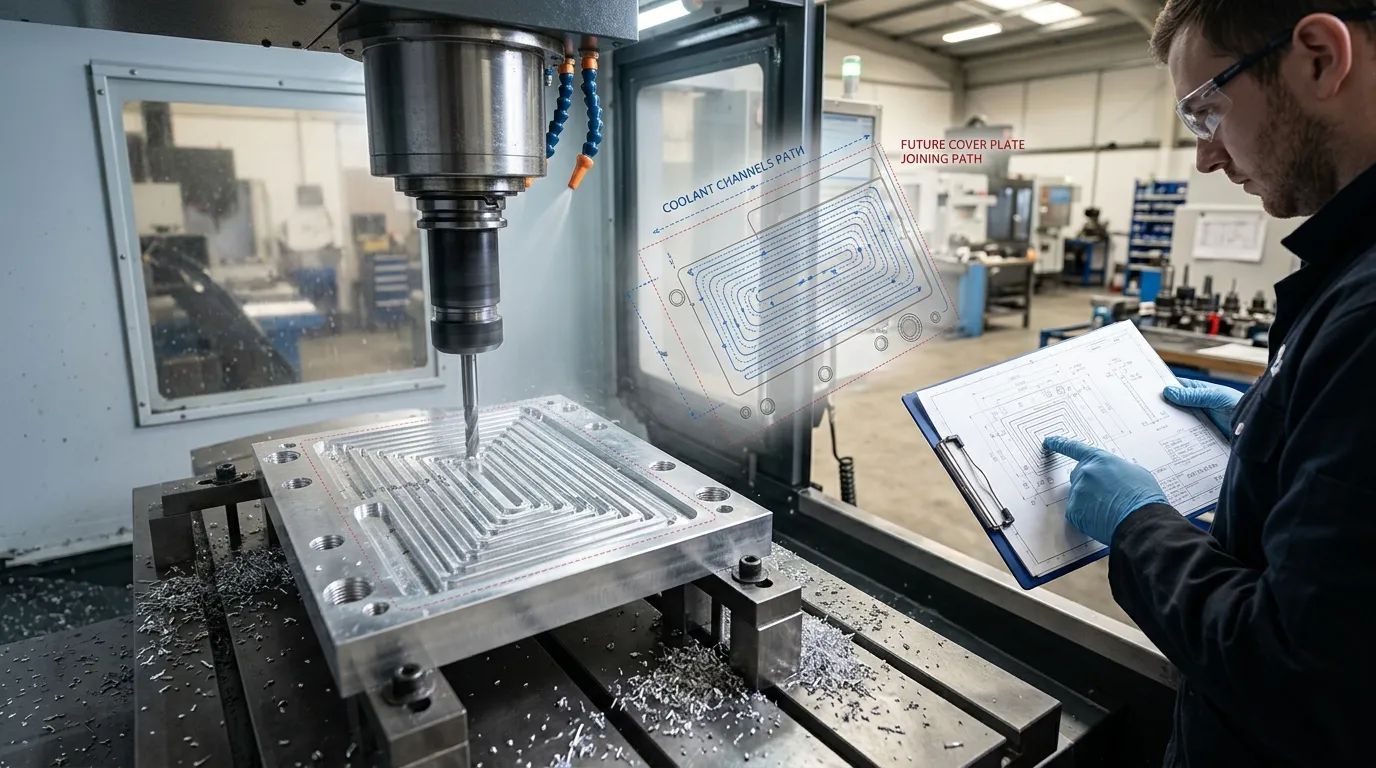
The base plate is machined to create the coolant path and external component geometry. Depending on the design, the machining scope may include:
- Coolant channels
- Pockets and recessed areas
- Flow-distribution features
- Mounting holes
- Threaded ports
- Datum surfaces
- Sealing or joining surfaces
- External profiles
- Sensor or fitting locations
Accurate CNC machining is important because channel position, cover contact, weld-path clearance, and mounting-surface geometry affect later manufacturing stages. SunOn’s precision CNC machining services are relevant to this part of the cold-plate workflow.
More complex channel arrangements may require additional design review. Buyers evaluating dense flow paths can also review micro-channel cold plates as a related construction category, although not every microchannel design is suitable for FSW joining.
Cover Preparation and Fixturing
The cover plate must match the base geometry and provide sufficient material for joining. Before welding, the base and cover are cleaned, aligned, and secured in a fixture.
The fixture must control:
- Cover movement
- Base-plate movement
- Joint contact
- Part alignment
- Support beneath the weld path
- Distortion during joining
- Protection of critical surfaces
Poor clamping or uneven contact can affect weld consistency, dimensional accuracy, and final flatness.
Friction Stir Welding
During FSW, a rotating non-consumable tool enters the joint area and moves along the planned weld path. Friction and mechanical action soften the material below its melting point. The tool mixes and consolidates the material to create the joint between the cover and the base.
Important controlled variables may include:
- Tool design
- Rotation speed
- Traverse speed
- Plunge depth
- Axial force
- Tool angle
- Weld-path position
- Entry and exit strategy
- Fixture support
These values depend on the alloy, material thickness, joint design, machine, and qualification process. SunOn-specific FSW parameters should not be published unless they are verified by actual engineering and production records.
Post-Weld Machining and Finishing
After joining, additional CNC machining may be required to complete the part. Post-weld operations can include:
- Machining the mounting surface
- Correcting final flatness where permitted
- Finishing external dimensions
- Completing ports and threads
- Machining tool-entry or exit areas
- Deburring
- Internal cleaning
- Surface preparation
- Anodizing or coating
- Final visual and dimensional inspection
Finishing requirements should be included in the original drawing because anodizing, coating, masking, and post-weld machining can affect dimensions and surface condition.
Leak, Pressure, and Dimensional Verification
Testing must follow agreed acceptance criteria rather than generic claims. Before quotation, the buyer should define:
- Operating pressure
- Required proof pressure
- Test medium
- Hold duration
- Permitted leakage rate
- Operating temperature
- Flatness tolerance
- Surface-roughness requirement
- Critical dimensions
- Required inspection documents
The supplier should also confirm whether leak testing, pressure testing, CMM inspection, surface measurement, and test reports are available for the proposed project.
Cold-Plate Design Information Required for Quotation
Complete technical information allows the manufacturer to evaluate machining, joining, testing, finishing, and production requirements together.
| RFQ Input | What to Provide | Why It Matters |
|---|---|---|
| 3D CAD model | Complete part and assembly geometry | Defines channels, ports, cover, and external form |
| 2D drawing | Tolerances, GD&T, threads, notes, and datums | Defines measurable acceptance requirements |
| Material | Alloy and temper | Affects machining and joining suitability |
| Overall size | Length, width, and thickness | Determines machine and fixture compatibility |
| Channel design | Width, depth, route, and wall thickness | Affects flow, machining, and weld clearance |
| Cover design | Material and thickness | Affects joint design and structural behavior |
| Coolant | Type and concentration | Affects material compatibility and cleaning |
| Flow requirements | Flow rate and pressure-drop target | Supports channel evaluation |
| Operating conditions | Pressure and temperature | Defines functional demands |
| Test requirements | Proof pressure, leakage limit, and hold time | Defines validation procedures |
| Mounting surface | Flatness and surface roughness | Affects thermal contact |
| Finish | Anodizing, coating, masking, or as-machined | Affects corrosion protection and dimensions |
| Quantity | Prototype, pilot, and production volume | Affects fixtures and process planning |
| Documentation | Material, inspection, and test reports | Defines quality deliverables |
Missing pressure, tolerance, material, or testing information can delay quotation and create uncertainty during production.
Quality Control for Friction Stir Welded Cold Plates
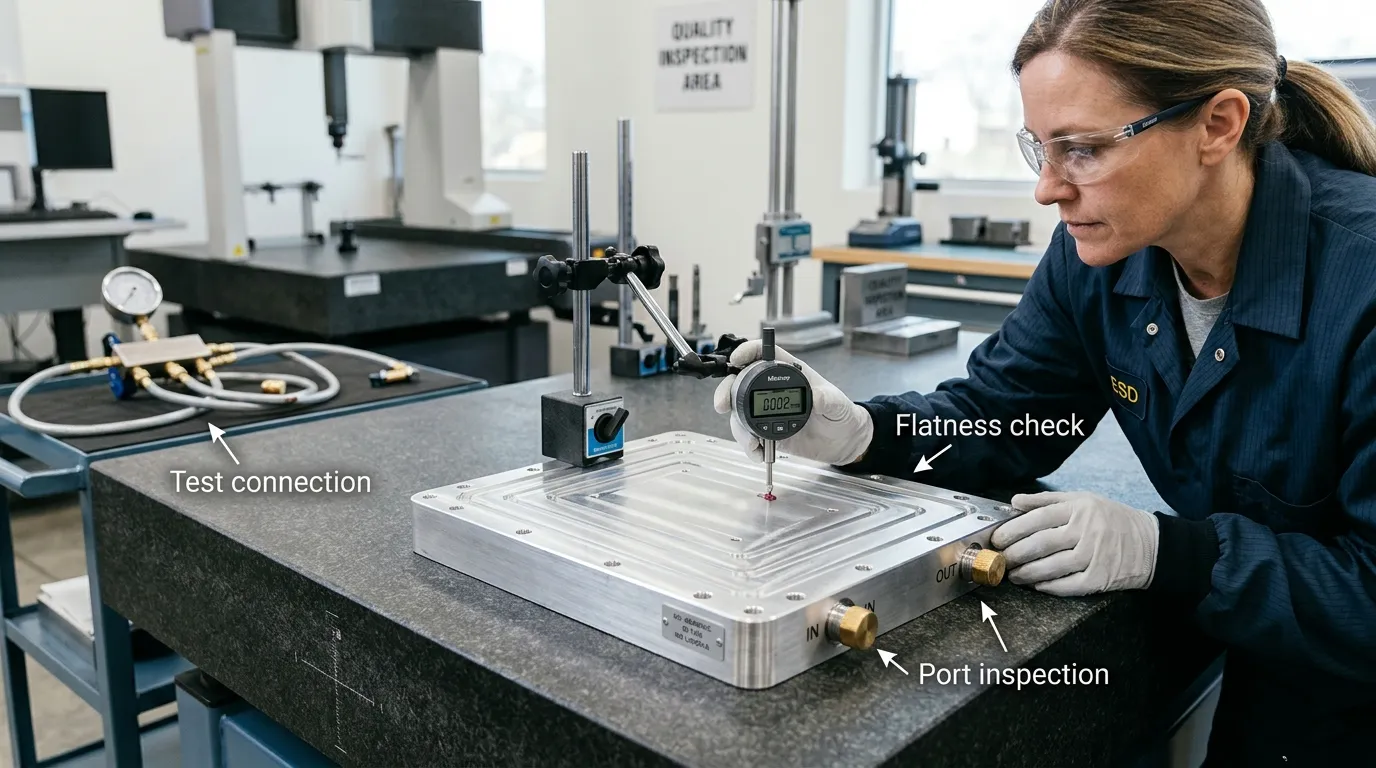
Cold-plate quality control should cover the base material, machined channels, joining operation, post-weld dimensions, cleanliness, and pressure integrity.
A suitable inspection plan may include:
- Material verification
- Drawing and revision control
- In-process dimensional checks
- Channel-depth and wall-thickness inspection
- Cover and base alignment verification
- Fixture and setup checks
- Weld-process records
- Visual weld inspection
- Overall dimensional inspection
- Mounting-surface flatness measurement
- Surface-roughness verification
- Port and thread inspection
- Internal channel cleaning
- Leak testing
- Pressure testing
- Final report review
- Protective packaging
| Characteristic | Requirement Source | Possible Verification |
|---|---|---|
| Overall dimensions | Customer drawing | CMM or dimensional inspection |
| Mounting flatness | Customer drawing | CMM or surface measurement |
| Surface roughness | Customer drawing | Roughness measurement |
| Leak performance | Agreed test specification | Leak test |
| Pressure integrity | Agreed proof requirement | Pressure test |
| Port and thread quality | Drawing and thread specification | Gauges and dimensional inspection |
| Material | Purchase and drawing specification | Certificate or traceability record |
| Surface finish | Drawing and finish specification | Visual and dimensional inspection |
Specific tolerances, pressure ratings, and leakage limits must be based on the customer’s requirements and the confirmed manufacturing capability.
FSW Compared with Other Cold-Plate Joining Methods
The joining method should be selected according to material, channel complexity, production volume, tool access, serviceability, and acceptance requirements.
| Method | Potential Strength | Main Constraint |
|---|---|---|
| Friction stir welding | Solid-state joining of suitable aluminum assemblies | Requires specialized equipment, joint access, and validated geometry |
| Vacuum brazing | Can join complex internal structures | Requires furnace and filler-metal process control |
| Fusion welding | Widely available joining process | Higher heat input and melting-related distortion risks |
| Mechanical sealing | Removable and practical for some prototypes | Requires gaskets, fasteners, and long-term seal management |
| Bonding | Lower joining temperature | Depends on adhesive compatibility and durability |
FSW is not automatically the best method for every cold plate. The decision should be made during DFM review after the channel geometry, alloy, cover, pressure, volume, and testing requirements are known.
Applications for Custom FSW Cold Plates
Friction stir welded liquid cold plates may be evaluated for thermal-management systems used in:
- Data-center hardware
- AI server cooling
- Power electronics
- IGBT and inverter systems
- EV batteries and powertrains
- Energy-storage equipment
- Industrial lasers
- Automation systems
- Medical and laboratory equipment
Application-specific requirements vary. For example, data center liquid cold plates and AI server cold plates may prioritize compact thermal interfaces, flow control, pressure integrity, and repeatable mounting geometry.
Material selection also affects the manufacturing route. Buyers comparing aluminum with another thermal material can review copper cold plates, but copper construction may require a different joining method and process qualification.
Why Work with SunOn?
SunOn supports custom manufacturing projects from drawing review through machining, finishing, inspection, and production planning. For cold-plate projects, the company’s documented capabilities are most relevant to:
- Custom aluminum machining
- CNC milling of channels and pockets
- Multi-face machining
- Holes, threads, and port features
- Thermal plates and heat-sink components
- DFM review
- Surface finishing
- Dimensional inspection
- Prototype and production support
- Broader assembly coordination
For an FSW cold-plate order, buyers should request direct confirmation of:
- Whether FSW is performed in-house
- Machine type and work envelope
- Supported aluminum alloys
- Supported plate and cover thicknesses
- Available joint configurations
- Fixture and distortion-control approach
- Weld-process documentation
- Leak and pressure-test equipment
- Inspection-report availability
- Prototype and production capacity
This verification separates confirmed manufacturing capability from general marketing claims and helps both parties define an accurate quotation scope.
Frequently Asked Questions
What is a friction stir welded cold plate?
It is a liquid-cooling component made from a machined base plate and cover joined through friction stir welding. The internal channels carry coolant while the external surface contacts the heat-generating component.
Does SunOn perform FSW in-house?
In-house FSW capability is not confirmed in the currently available SunOn information. Buyers should request written confirmation of equipment, production location, supported materials, dimensions, and testing before placing an order.
Which aluminum alloys can SunOn friction stir weld?
No SunOn-specific FSW alloy range is currently confirmed. The required alloy and temper should be submitted with the drawing so machining and joining feasibility can be reviewed.
What cold-plate dimensions and thicknesses are supported?
Supported dimensions depend on the available CNC machines, FSW equipment, fixtures, tool access, and joint design. Submit the complete CAD model and drawing for project-specific confirmation.
What files are needed for a quotation?
Provide a 3D CAD model, 2D drawing, material grade, quantities, channel design, cover design, operating pressure, coolant, flatness, finish, inspection requirements, and test criteria.
Can SunOn machine the coolant channels before welding?
SunOn provides custom precision CNC machining, including machining of plates, pockets, slots, holes, threads, and thermal components. The exact cold-plate machining scope should be confirmed during DFM review.
How are FSW cold plates tested for leakage?
Testing should follow an agreed method specifying the test medium, pressure, hold duration, temperature, and permitted leakage rate. Confirm the available equipment and reporting format before ordering.
Can SunOn provide pressure-test and inspection reports?
General inspection support is part of SunOn’s broader manufacturing service, but cold-plate-specific pressure testing and report availability must be confirmed for the project.
Is post-weld flatness machining available?
Post-weld CNC machining may be used to finish mounting surfaces or restore specified dimensions where the design permits it. The final process depends on stock allowance, distortion, tolerance, and surface requirements.
How does FSW compare with vacuum brazing?
FSW uses a mechanically driven solid-state joint along an accessible weld path. Vacuum brazing uses heat and filler material and may suit more complex internal structures. The correct method depends on geometry, material, volume, and performance requirements.
Can FSW be used for copper cold plates?
FSW can be applied to some materials beyond aluminum, but copper requires different equipment, tooling, process parameters, and validation. SunOn’s copper FSW capability is not confirmed.
Can SunOn support prototypes and production quantities?
SunOn supports prototype-to-production CNC manufacturing. FSW prototype quantities, fixtures, validation requirements, and production capacity must be confirmed separately.
Request a Friction Stir Welded Cold-Plate Quote
Upload your 2D drawing and 3D CAD model for a manufacturability and quotation review. Include the material, channel layout, cover design, coolant, operating pressure, pressure-drop target, flatness, surface finish, quantity, inspection requirements, and leak or pressure-test criteria.
Ask SunOn to confirm the CNC machining scope, FSW production responsibility, equipment capability, supported dimensions, quality documentation, and delivery plan before approving production.
