


Industrial CNC Machining: Parts, Materials, Quality, and RFQ Guide
Industrial CNC machining supports custom components used in machinery, automation systems, production equipment, fluid-control assemblies, material-handling systems, and OEM mechanical products.
Unlike a general prototype project, an industrial CNC part normally operates as one element within a larger mechanical or electromechanical system. Its dimensions may affect bearing alignment, equipment motion, sealing, sensor position, load transfer, maintenance access, or assembly repeatability.
For engineers and technical buyers, selecting a CNC supplier therefore involves more than comparing machine lists and unit prices. Material grade, part geometry, functional tolerances, production quantity, secondary operations, inspection, documentation, and replacement-part requirements should be evaluated together.
SunOn supports custom CNC machining services for drawing-based metal and engineering-plastic parts from prototype development through repeat production.
Industrial CNC Machining at a Glance
| Project Requirement | Typical Manufacturing Direction |
|---|---|
| Machine housing, plate, or bracket | CNC milling |
| Shaft, roller, sleeve, or bushing | CNC turning |
| Rotational part with side holes or flats | Turn-mill machining |
| Features located on several faces | Multi-axis machining |
| Lightweight moving component | Review aluminum |
| Corrosion-resistant equipment part | Review stainless steel |
| Wear- or load-resistant component | Review steel or alloy steel |
| Low-friction or insulating component | Review an engineering plastic |
| Prototype or replacement part | CNC machining can avoid dedicated tooling |
| Repeat production | Define process control, sampling, and traceability |
What Is Industrial CNC Machining?
Industrial CNC machining is the computer-controlled removal of material from metal or plastic stock to produce components for industrial machinery and equipment.
Common operations include:
- CNC milling
- CNC turning
- Drilling and boring
- Thread milling and tapping
- Reaming
- Turn-mill machining
- Four-axis and five-axis machining
- Grinding and precision finishing
- Deburring and marking
Industrial projects may involve new equipment, production-line expansion, machine upgrades, replacement components, test fixtures, maintenance tooling, or parts that later enter regular OEM production.
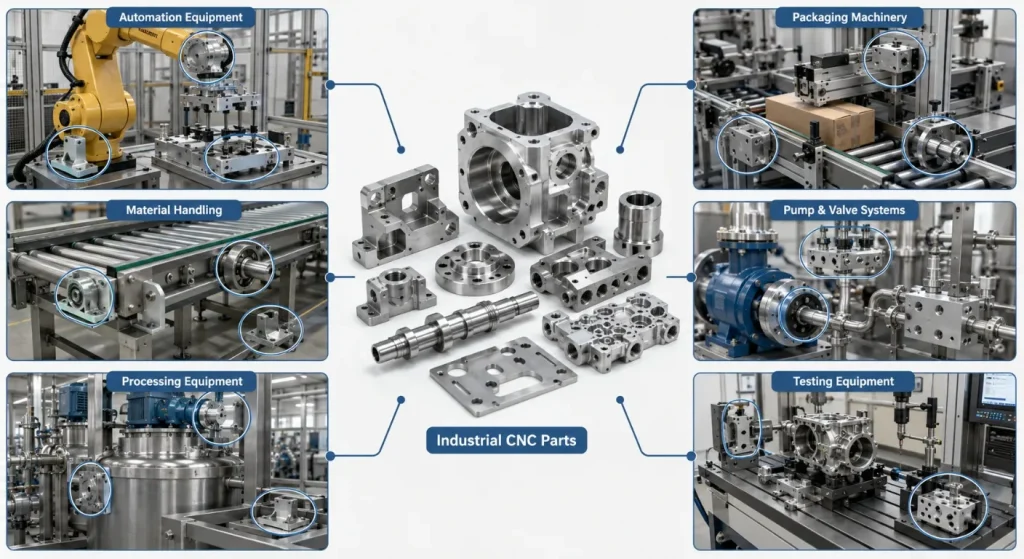
Unlike standard catalog hardware, these components are usually manufactured according to a controlled 2D engineering drawing and 3D CAD model.
Common Industrial CNC Machined Parts
Machine Housings and Covers
Machined housings support or protect motors, bearings, sensors, electronics, gear systems, and fluid-control assemblies.
Important requirements may include:
- Bearing-bore alignment
- Mounting-face flatness
- Connector access
- Internal clearances
- Heat dissipation
- Sealing surfaces
- Service and maintenance access
Brackets and Structural Supports
Industrial brackets locate actuators, sensors, motors, guides, control units, and other machine elements.
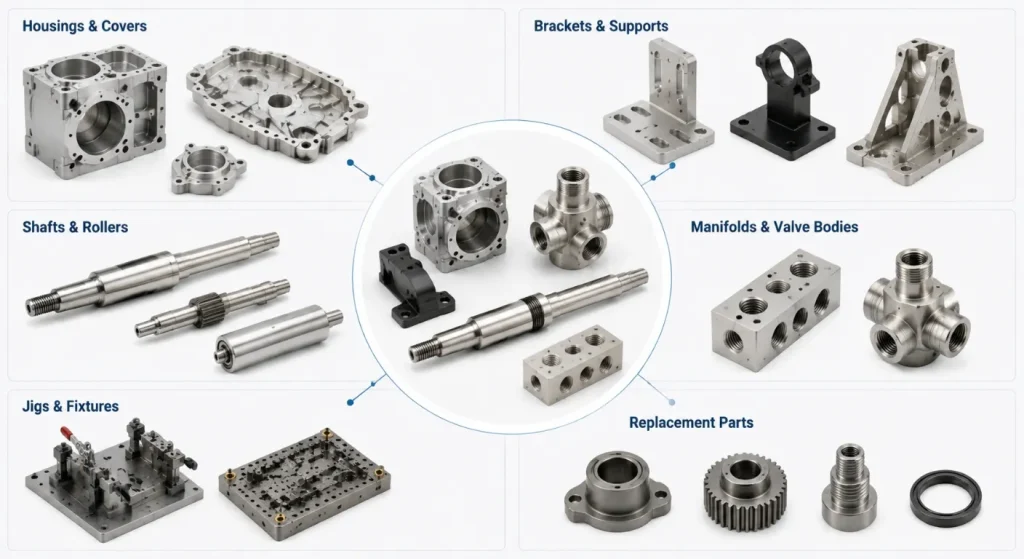
A bracket should be evaluated for more than static strength. Its stiffness, mounting pattern, vibration response, weight, and positional relationship to adjacent parts may also affect equipment performance.
Shafts, Pins, Rollers, and Bushings
Rotational industrial parts commonly require control of:
- Outside diameter
- Bore size
- Concentricity
- Runout
- Shoulder position
- Groove geometry
- Thread quality
- Bearing and seal fits
- Surface finish
These components are often produced through CNC turning, grinding, or combined turning and milling.
Manifolds, Valve Bodies, and Fluid Components
Industrial CNC machining can produce components containing:
- Threaded ports
- Cross-drilled passages
- Sealing grooves
- Mounting patterns
- Valve cavities
- Sensor interfaces
- Flat sealing surfaces
Internal burrs, cleanliness, thread depth, pressure requirements, and fluid compatibility should be defined before production.
Jigs, Fixtures, and Production Aids
Machined fixtures support assembly, inspection, welding, drilling, positioning, and repetitive manufacturing operations.
Fixture design should consider:
- Repeatable part location
- Operator access
- Clamping force
- Wear surfaces
- Replaceable inserts
- Gauge integration
- Maintenance and adjustment
Replacement and Legacy Equipment Parts
CNC machining is also useful when an industrial machine needs a discontinued or unavailable replacement component.
The project may begin with:
- An original engineering drawing
- An existing CAD file
- A physical sample
- Assembly measurements
- Related mating components
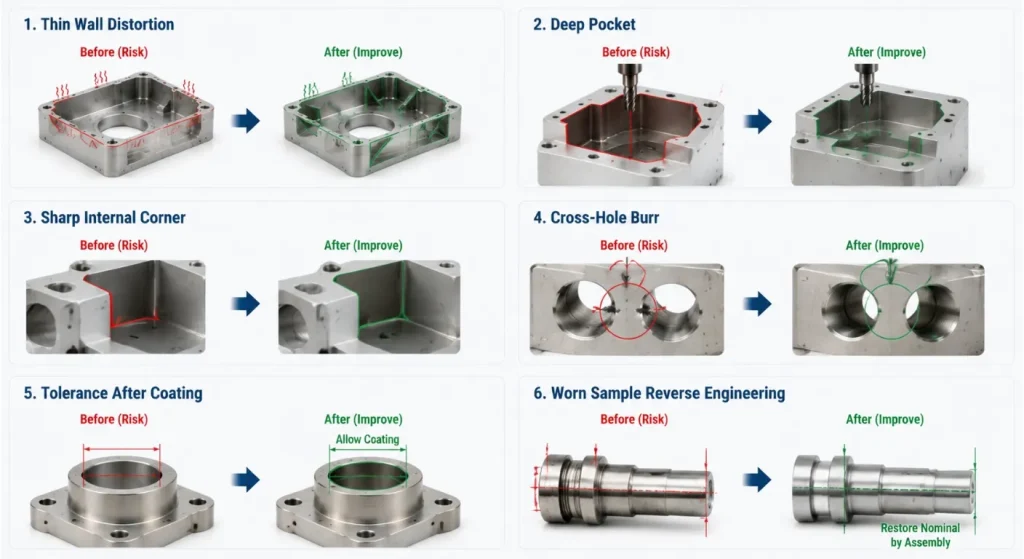
Reverse engineering a worn sample requires care. Wear, deformation, corrosion, and previous repairs may prevent the sample from representing the original nominal geometry.
Industrial Applications
Industrial CNC machining supports multiple equipment categories.
| Application Area | Example Components | Key Requirements |
|---|---|---|
| Automation equipment | Robot mounts, actuator brackets, sensor holders | Position, stiffness, low weight |
| Packaging machinery | Guide blocks, shafts, plates, change parts | Repeatability and maintenance access |
| Material handling | Rollers, bearing blocks, conveyor parts | Wear resistance and alignment |
| Pump and valve systems | Housings, impellers, fittings, manifolds | Sealing, corrosion resistance, flow paths |
| Processing equipment | Mixing parts, mounts, covers, tooling | Cleanability and durability |
| Testing equipment | Fixtures, adapters, frames, reference parts | Repeatable location and inspection |
| Industrial electronics | Enclosures, heat sinks, connector plates | Heat management and interface control |
| Custom machinery | One-off and repeat mechanical parts | Drawing control and assembly fit |
Projects focused specifically on robotic, pick-and-place, and automated production systems can also refer to SunOn’s automation parts CNC machining guide.
Choosing Materials for Industrial CNC Parts
Material selection should begin with the part’s function and operating environment.
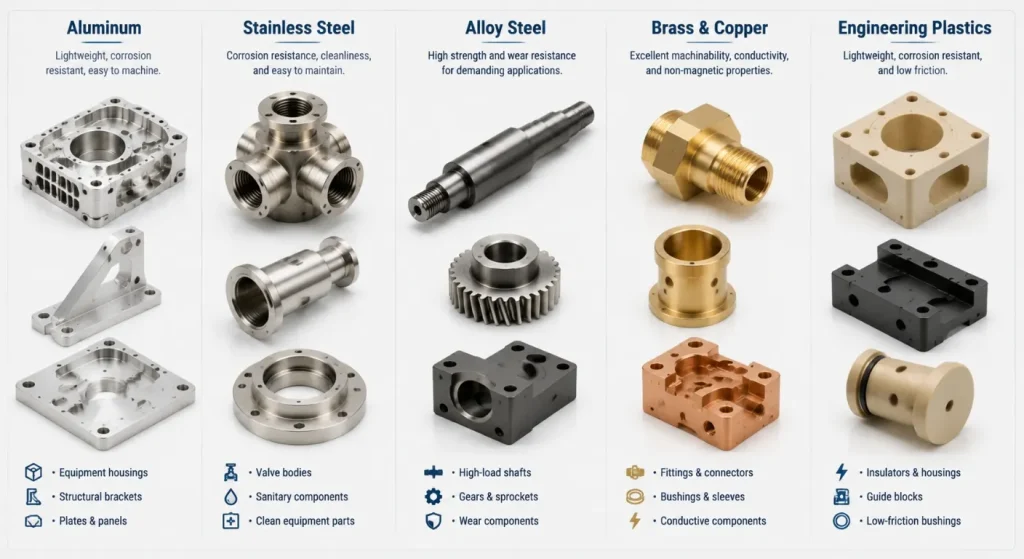
Aluminum
Aluminum may suit:
- Lightweight brackets
- Equipment housings
- Sensor mounts
- Frames
- Heat sinks
- Pneumatic manifolds
- Moving automation parts
It offers useful machinability and weight reduction, but alloy, temper, surface treatment, load, wear, and corrosion exposure still require review.
Stainless Steel
Stainless steel is commonly considered for:
- Food and processing equipment
- Fluid-control components
- Outdoor machinery
- Laboratory equipment
- Corrosion-exposed brackets
- Washdown environments
304, 316L, 303, and precipitation-hardening grades have different machining, corrosion, welding, and strength characteristics. See the stainless steel CNC machining guide for a broader material comparison.
Carbon and Alloy Steel
Steel and alloy steel may be selected for:
- High-load shafts
- Wear plates
- Tooling components
- Gears and drive parts
- Machine bases
- Hardened inserts
- Structural equipment parts
The drawing should identify the precise grade, condition, hardness, heat treatment, and finishing requirements.
Brass and Copper Alloys
Brass and copper may support:
- Electrical contacts
- Grounding components
- Bushings
- Fittings
- Thermal parts
- Low-friction interfaces
The exact alloy matters because machinability, conductivity, strength, lead content, and corrosion behavior differ.
Engineering Plastics
Industrial CNC machining also covers materials such as:
- POM or Delrin
- Nylon
- PEEK
- PTFE
- UHMW-PE
- Polycarbonate
- ABS
Plastic parts may provide insulation, low friction, chemical resistance, reduced weight, or low-noise operation. Moisture, temperature, creep, residual stress, and clamping deformation must be considered separately from metal machining.
Match the CNC Process to the Geometry
CNC Milling
CNC milling is generally used for:
- Plates
- Housings
- Brackets
- Fixtures
- Manifold blocks
- Pockets
- Slots
- Mounting faces
- Multi-hole patterns
CNC Turning
CNC turning suits cylindrical components such as:
- Shafts
- Pins
- Rollers
- Bushings
- Sleeves
- Fittings
- Spacers
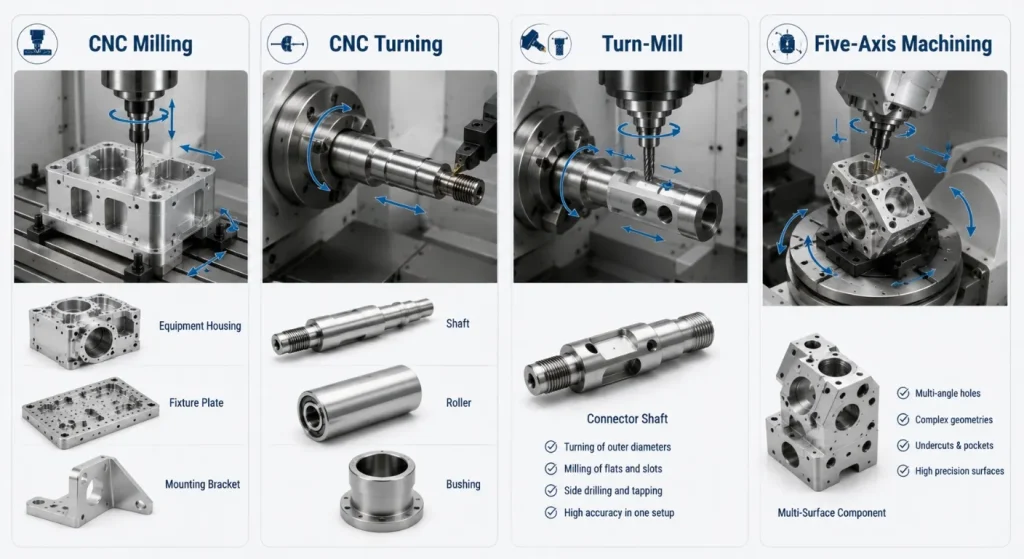
For parts that combine rotational features with side holes, flats, or milled slots, CNC turning and milling may reduce transfers between separate machines.
Five-Axis Machining
Five-axis CNC machining may be considered for angled holes, multi-face parts, compound surfaces, and difficult tool access.
Its main value is not simply greater machine complexity. Reducing setups may help control relationships between features located on different faces.
Key DFM Risks in Industrial CNC Parts
Thin Walls and Unsupported Sections
Thin structures can deform under cutting forces, clamping pressure, heat, or residual material stress. The part may also move after release from the fixture.
Deep Pockets and Bores
Deep features may require long cutting tools, increasing deflection, vibration, heat, chip-evacuation difficulty, and machining time.
Unnecessary Sharp Internal Corners
A milling cutter naturally produces an internal radius. Sharp internal corners may require special tooling, EDM, broaching, or a design revision.
Inaccessible Burrs
Cross-drilled passages, internal slots, blind holes, and intersecting fluid channels may create burrs that are difficult to remove and verify.
Excessive Tolerance Coverage
Tight tolerances should be reserved for features that control:
- Fit
- Sealing
- Motion
- Alignment
- Bearing location
- Assembly position
- Interchangeability
ISO 2768-1 provides general tolerances for certain linear and angular dimensions without individual tolerance indications. Functional features should still receive explicit requirements.
Unclear Datum Relationships
Industrial parts often interact with bearings, motors, shafts, actuators, sensors, and adjacent machine structures.
ASME Y14.5 establishes standardized rules and symbols for communicating GD&T and functional datum relationships.
Prototype, Replacement, and Production Quantities
Industrial CNC machining can serve several production stages.
Prototype and Engineering Validation
Prototypes support:
- Assembly checks
- Motion testing
- Fixture validation
- Load testing
- Operator-access evaluation
- Material comparison
- Design revision
Low-Volume and Bridge Production
Low-volume CNC machining may support pilot equipment, custom machines, limited production, spare parts, and demand before a higher-volume process is justified.
Repeat Production
Repeat industrial orders require more than reusing the original CNC program.
Production planning may also include:
- Controlled drawing revisions
- Material batch verification
- Fixture maintenance
- Tool-life management
- In-process checks
- Sampling plans
- Traceability
- Packaging standards
- Change control
Surface Finishing and Secondary Operations
Industrial CNC parts may require:
- Anodizing
- Plating
- Passivation
- Powder coating
- Painting
- Black oxide
- Heat treatment
- Grinding
- Polishing
- Laser marking
- Thread inserts
- Press-fit components
- Assembly
The RFQ should identify whether dimensions and surface-roughness requirements apply before or after finishing.
For press fits, bearing seats, sealing faces, threads, electrical contacts, and grounding areas, coating thickness and masking may directly affect function.
Quality Control for Industrial CNC Machining
Inspection should match the feature and equipment function.
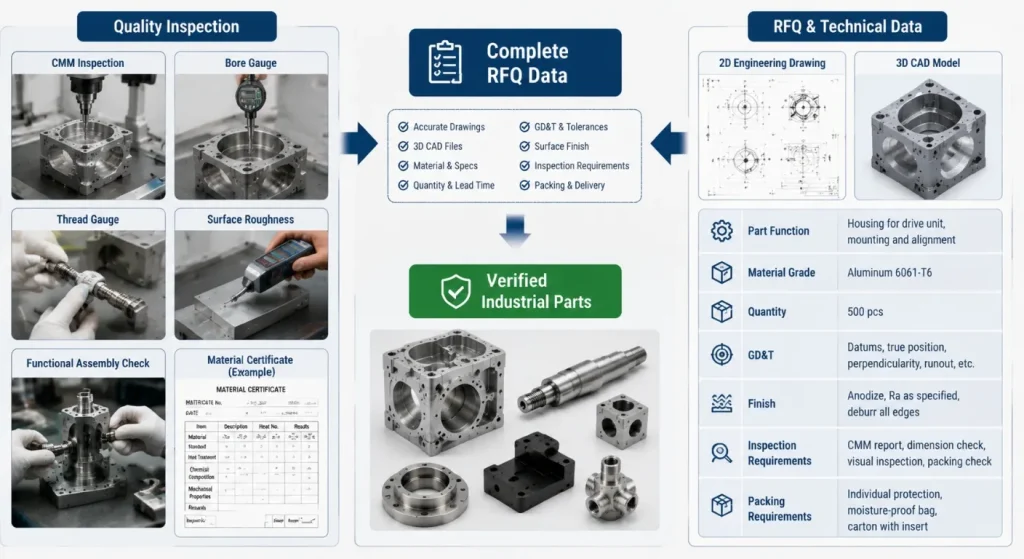
Possible methods include:
- Calipers and micrometers
- Bore gauges
- Height gauges
- Thread plug and ring gauges
- Coordinate measuring machines
- Optical measurement
- Surface-roughness measurement
- Flatness inspection
- Hardness testing
- Material verification
- Functional gauges
- Assembly testing
- Leak or pressure testing where specified
Dimensional measurement can be affected by the part, measuring system, fixture, environment, and temperature. NIST identifies thermal expansion as an important contributor in dimensional metrology, particularly when measurement conditions differ from the reference condition.
Quality management should also extend beyond final inspection. ISO 9001 defines requirements for establishing and continually improving a quality management system, but certification alone does not determine whether a supplier can manufacture a particular part.
Buyers should still review:
- Process suitability
- Material controls
- Drawing revision controls
- Inspection methods
- Calibration status
- Nonconformance handling
- Traceability
- Supplier communication
- Change-management procedures
From RFQ to Delivered Industrial Parts
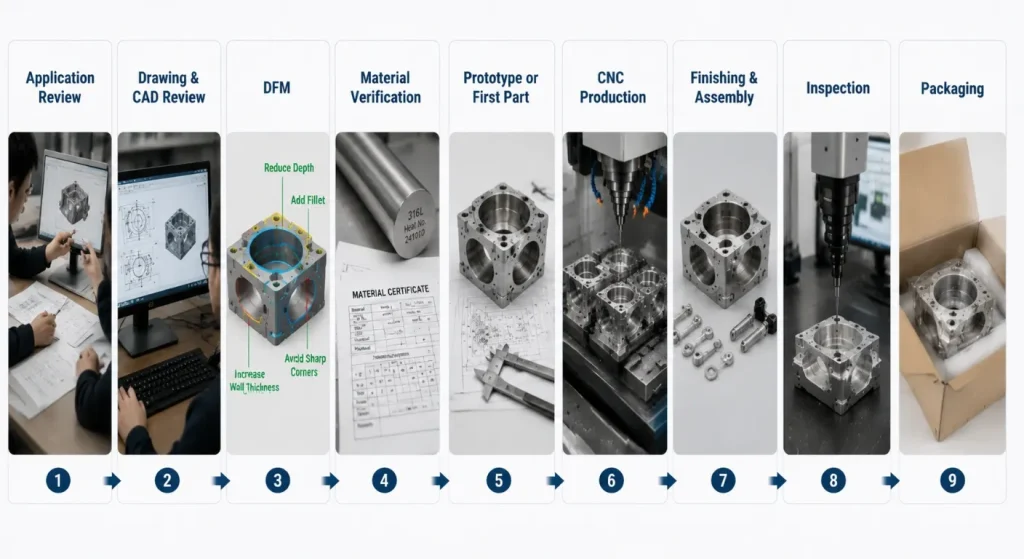
A controlled industrial CNC machining project commonly follows these stages:
- Application Review: Understand what the component does within the equipment.
- Drawing and CAD Review: Confirm revision, geometry, material, and tolerances.
- DFM Review: Identify machining, distortion, burr, finishing, and inspection risks.
- Process Planning: Select machines, fixtures, tools, operation sequence, and controls.
- Prototype or First-Part Production: Verify machining strategy and critical features.
- Repeat Manufacturing: Apply agreed process and in-process checks.
- Secondary Operations: Complete finishing, heat treatment, inserts, or assembly.
- Final Inspection: Verify agreed dimensions, finish, documentation, and testing.
- Packaging and Delivery: Protect functional surfaces and maintain part identification.
What to Include in an Industrial CNC Machining RFQ
Provide:
- Controlled 2D engineering drawing
- 3D CAD model
- Part function and equipment application
- Material grade and condition
- Prototype and production quantities
- Critical dimensions and functional datums
- GD&T and fits
- Surface-roughness requirements
- Threads, inserts, and assembly details
- Heat treatment and surface finish
- Inspection and report requirements
- Material and process certificates
- Replacement-part or reverse-engineering information
- Packaging, labeling, and traceability
- Delivery destination and target date
SunOn’s OEM CNC machining guide provides additional guidance for projects that must move from engineering validation into repeat production.
Frequently Asked Questions
1. What Parts Are Commonly Produced by Industrial CNC Machining?
Common parts include machine housings, brackets, shafts, rollers, bushings, manifolds, valve bodies, fixtures, tooling components, sensor mounts, and replacement parts. The machining process should be selected according to geometry, function, material, and quantity.
2. Which Material Is Best for Industrial CNC Parts?
There is no single best material. Aluminum suits many lightweight components, stainless steel supports corrosion resistance, alloy steel serves high-load or wear applications, and engineering plastics may provide insulation or low friction.
3. Can CNC Machining Reproduce a Discontinued Machine Part?
Yes, a replacement part may be produced from an original drawing, CAD model, or physical sample. A worn sample should be reviewed carefully because wear and deformation may not represent the original nominal geometry.
4. What Tolerances Can Industrial CNC Machining Achieve?
Tolerance capability depends on material, part size, geometry, setups, finishing, and inspection method. Critical functional features should be clearly identified instead of applying tight tolerances to the entire drawing.
5. Is Industrial CNC Machining Suitable for Repeat Production?
Yes. Repeat production requires controlled revisions, stable fixtures, tooling plans, in-process checks, inspection, traceability, and packaging—not only reuse of the original CNC program.
6. What Information Is Needed for an Industrial CNC Machining Quote?
Provide 2D and 3D files, the part function, material grade, quantity, datums, critical tolerances, finish, secondary operations, inspection requirements, certificates, packaging, and delivery needs.
Conclusion
Industrial CNC machining should be planned around the component’s role within the complete machine or production system.
Material, geometry, datums, tolerances, wear, corrosion, surface treatment, inspection, production quantity, and maintenance requirements should be evaluated together. A part that meets isolated dimensions may still fail if its bearing alignment, sealing face, assembly interface, or functional relationship is not clearly defined.
CNC machining is particularly useful for prototypes, custom machinery, replacement components, low-volume production, complex parts, and repeat OEM requirements.
To request a manufacturability review, contact SunOn with your 2D drawing, 3D CAD model, material, quantities, critical requirements, finish, inspection, and equipment application.
