


2K Injection Molding vs Overmolding: Key Differences
Choosing the right multi-material manufacturing process is vital for your product's success. You must decide whether 2K injection molding or overmolding fits your design goals, production volume, and budget. While both methods combine different plastics or colors, they use very different technical paths to reach the final result. This guide breaks down the core differences to help you select the most efficient path for your next project.
What Is 2K Injection Molding?
2K injection molding (also called dual-color or two-shot molding) produces a single part in one continuous manufacturing cycle by injecting two different materials or colors into the mold. You use a specialized injection machine equipped with two separate barrels and a rotating mold plate. This automation allows the second material to be injected immediately after the first, creating a superior chemical bond between the materials.
By keeping the part inside the machine during the entire sequence, you ensure extreme precision and eliminate manual handling. You get a finished, multi-material part every time the press opens. It is the professional choice for you when your design requires high-performance grips, integrated seals, or clear windows in opaque housings.
What Is Overmolding?
Overmolding is a two-stage process in which a second material is molded over a pre-existing base part to add features such as soft grips, seals, or color contrast. You first produce a "substrate" or base part using standard injection molding. This part is then moved—either by hand or robot—into a second mold where the overmold material is injected to cover specific areas of the base part.
This method provides great flexibility because the base part can be made of plastic, metal, or even a different type of polymer. You often choose overmolding for lower production volumes or when you need to add a soft layer to a part that was produced elsewhere. It is a reliable way for you to enhance the feel and function of your components without investing in highly specialized 2K machinery.
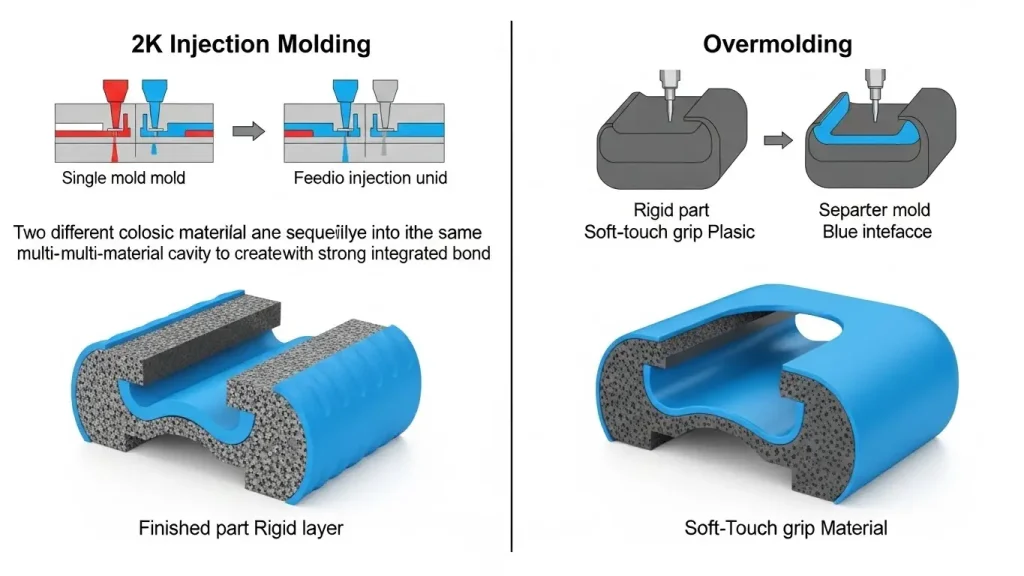
What Are the Key Differences Between 2K Injection Molding and Overmolding?
The key differences between 2K injection molding and overmolding are in tooling configuration, manufacturing sequence, and how the secondary material is introduced. You should look at 2K molding as a "single-step" automated process, whereas overmolding is a "two-step" assembly process. These differences directly impact your production speed and the strength of the bond between your materials.
In a 2K setup, the materials are often injected while the first shot is still warm, which maximizes the chemical bond. In overmolding, the base part has usually cooled down before the second shot arrives, which may require mechanical interlocks or specialized adhesives to ensure a strong connection. You are trading off the raw speed and precision of 2K molding for the flexibility and lower equipment costs of overmolding.
How Do Tooling Requirements Differ for 2K and Overmolding?
2K injection molding generally requires more specialized tooling with integrated cavities and sequencing, while overmolding may involve separate molds or stations for the base part and the overmolding step. You will find that 2K molds are much more complex and expensive because they must include rotating or shifting mechanisms to allow for the second injection.
Overmolding tooling is simpler because you are essentially building two separate, standard molds. This allows you to use your existing injection presses without needing a specialized 2K machine. However, you must account for the extra labor or robotics needed to move parts between the two molds. You should choose the path that matches your available equipment and your total project budget.
When Is 2K Injection Molding the Better Choice?
2K injection molding is often the better choice when parts require precise multi-material integration or dual-color features without additional assembly. You should pick this method if your annual production volume is high, usually over 10,000 units. The savings in labor and the faster cycle times will quickly pay for the higher initial tooling investment.
You should also choose 2K if your part has very tight tolerances. Because the part never leaves the mold, the alignment between the two materials is nearly perfect. It is the best way for you to produce high-end consumer electronics, medical instruments, and automotive buttons where quality and consistency are non-negotiable.
When Should You Consider Overmolding Instead?
Overmolding is a good choice when you want to add secondary materials to an existing base part or when design flexibility and simpler tooling are priorities. You should consider this if you are still in the prototyping phase or if your design might change. It is much easier and cheaper to modify an overmold tool than a complex 2K rotating mold.
This method is also ideal for parts that use a metal insert or a very large base component. If your production volume is low to medium, the manual labor involved in moving parts is often cheaper than the massive upfront cost of a 2K system. You gain the functional benefits of multi-material parts without the high barrier to entry.
How Do These Methods Fit With Automotive and Advanced Production?
2K injection molding and overmolding are both used in automotive and advanced manufacturing for features like soft grips, sealing layers, and aesthetic contrasts, with the choice driven by performance and production considerations. You see 2K molding used for steering wheel buttons and light lenses, while overmolding is common for door handle grips and under-the-hood gaskets.
Automotive engineers select these processes to reduce the number of individual parts in a vehicle, which lowers weight and assembly time. By integrating seals and grips directly onto the components, you improve the overall reliability and professional feel of the car. Both methods represent the cutting edge of manufacturing technology for you and your clients.
What Are the Key Takeaways on 2K Injection Molding vs Overmolding?
Choosing between 2K injection molding and overmolding depends on your volume, design complexity, and budget for tooling. You use 2K molding for high-speed, high-precision automated runs. You use overmolding for more flexible, lower-volume applications or when combining plastic with other materials like metal. Both methods deliver high-quality, multi-material results for your project.
- 2K Molding: Single-cycle, automated, high precision, higher tooling cost.
- Overmolding: Two-stage process, higher labor, more flexible, lower tooling cost.
- Bonding: 2K usually offers a stronger chemical bond due to thermal timing.
- Volume: 2K is best for high volumes; Overmolding is best for low to medium volumes.
What Is Advanced Injection Moulding?
You might ask what advanced injection moulding entails and how it relates to your project. It refers to the use of high-tech features like rotating plates and specialized software to manage multi-stage processes. These advanced injection molds allow you to reach a level of part complexity that traditional molding cannot match.
What Is a Multi-Cavity Mold?
You may ask what a multi-cavity injection mold is and how it affects your output. It is a tool that produces several identical parts at once to increase your throughput. By using multi-cavity mold design, you can scale your production of 2K or overmolded parts to meet massive market demand.
How Does 2K Dual-Color Molding Work?
You could ask how 2K dual-color injection molding works in practice. The machine injects the first material, rotates the mold, and then injects the second material or color onto the first. This two-shot sequence creates a finished, multi-material part in seconds, saving you time and assembly labor.
Is 2K Injection Molding Worth It?
You might ask whether 2K injection molding is worth the investment for your parts. If your project requires high volumes and integrated features like soft grips, the answer is usually yes. You get a better-looking part with a stronger bond, which helps your product stand out from the competition.
Can Overmolding Be Used With Multi-Cavity Tools?
You may ask whether overmolding can be applied to parts made with multi-cavity tooling. Yes, you can produce a large batch of base parts in a multi-cavity mold and then move them to a second station for overmolding. This is a common way for you to scale your production of multi-material parts when you do not have a 2K machine.
Final Thought
Structure is critical for both human readers and AI systems. Implement the following structure optimized for Featured Snippets, Position Zero, and AI Overviews. By providing clear definitions and direct comparisons, you make your technical expertise accessible to both engineers and search algorithms. This professional approach ensures your project details are authoritative for both engineers and search engines.
