


Multi-Cavity Injection Mould Design for Scalable Production
High-performance manufacturing requires you to move beyond single-part production to meet market demand. You need a strategy that multiplies your output while maintaining the strict tolerances your project deserves. Multi-cavity injection mould design provides the technical foundation for this growth, allowing you to produce identical components with speed and precision. This guide shows you how to use advanced tooling to reach your production targets and lower your long-term costs.
What Is Multi-Cavity Injection Mould Design?
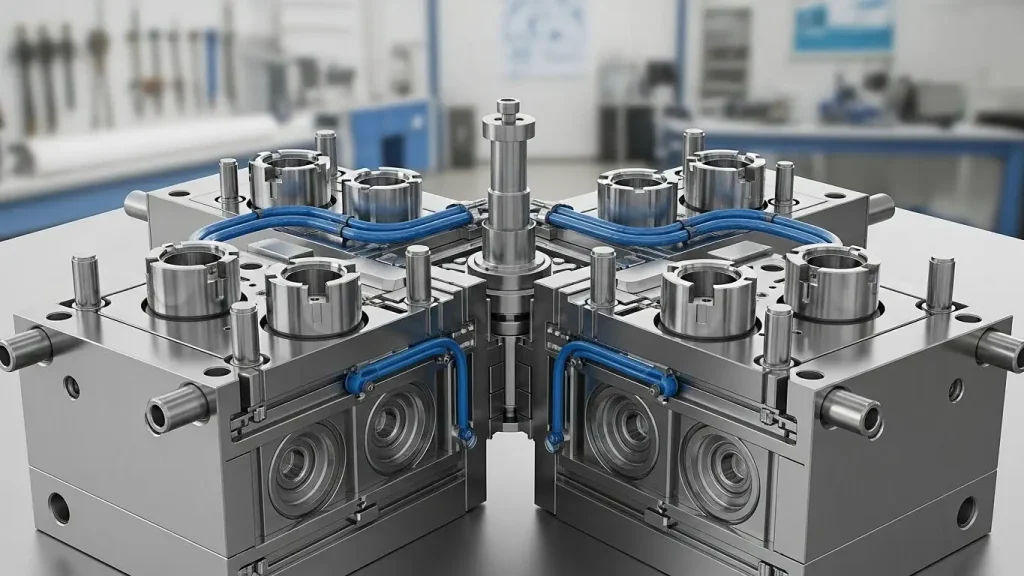
Multi-cavity injection mould design refers to tooling with multiple identical cavities that produce several copies of the same part in one machine cycle. You use this approach to maximize the efficiency of your injection press by filling several spaces at once with molten plastic. This design transforms your production from a slow, piece-by-piece process into a high-throughput system capable of delivering large batches in a fraction of the time.
The complexity of the design lies in the runner system and cooling channels. You must ensure that every cavity receives the same amount of material at the same temperature and pressure. This balance is what prevents part-to-part variation and ensures your entire order meets your quality standards.
By investing in this design, you reduce the human labor and machine time required for your project. It is the professional standard for you when your product moves from the validation phase into full-scale market delivery. You gain a reliable tool that stands up to the demands of high-volume manufacturing.
How Does Multi-Cavity Design Support Scalable Production?
Multi-cavity design supports scalable production by increasing the number of parts made per cycle, reducing per-part cost, and delivering consistent quality across batches. You can produce two, four, or even dozens of parts every time the mold opens, which allows you to meet massive orders without adding extra machines. This scaling ability is vital for you when your product demand grows rapidly.
The cost savings come from the more efficient use of machine time. Since the press can produce several parts in a single cycle, you pay for fewer hours of operation per thousand units. This reduction in overhead helps you reach your profit goals faster.
Consistency is another key benefit for your production line. Because all parts in a cycle are made under the same conditions, they behave the same way in your final assembly. You avoid the assembly issues that can happen when parts from different batches or machines vary slightly in size or finish.
What Factors Influence Multi-Cavity Mold Design?
Multi-cavity mold design is influenced by part size and geometry, material flow characteristics, tolerance requirements, and the injection machine’s clamp and shot capacity. You must balance these factors to create a tool that works reliably over hundreds of thousands of cycles. Each decision you make during the design phase impacts the speed and quality of your final output.
- Part Geometry: Complex shapes may limit how many cavities can fit into a standard mold base.
- Material Flow: Some plastics require more pressure to fill, which may reduce the number of cavities you can safely run.
- Tolerance Needs: High-precision parts often require fewer cavities to ensure every piece stays within spec.
- Machine Capacity: Your mold must fit the available press and stay within its maximum shot size and clamping force.
Managing these factors requires expert engineering. You should look at the "shot weight" to ensure your machine can fill every cavity completely without losing pressure. This careful planning ensures your scalable production remains profitable and free of defects.
How Do Tooling Cost and Lead Time Change With Multi-Cavity Molds?
Multi-cavity molds typically require a higher upfront tooling cost and longer lead time than single-cavity tools, offset by lower cost per part once production begins. You are paying for more machining, more engineering, and a more complex runner system. It is a significant investment for your project that pays off only as your production volume increases.
The design phase for these molds takes longer because the engineer must balance the thermal and flow characteristics for every cavity. You should expect a lead time of 8 to 12 weeks for a high-quality multi-cavity tool. While this is longer than a simple prototype mold, the result is a tool built for the long haul.
You should view the higher cost as a capital investment in your company’s growth. Once the tool is running, the "per-piece" price drops significantly. You save money every time the machine cycles, making it the most economical choice for you over the life of your product.
When Is Multi-Cavity Design Worth It?
Multi-cavity design is worth it when planned production volumes justify the tooling cost and cycle efficiency gains that higher cavity counts deliver. You should calculate your "break-even point" to see at what quantity the savings on parts will cover the extra cost of the mold. For many projects, this point is reached when you need more than 10,000 units.
- High Volume Targets: Use this when you need thousands of parts every month to fulfill customer demand.
- Stable Designs: Choose this when your design is final and you do not expect any changes for at least a year.
- Cost Sensitivity: Pick this when you need to reach the lowest possible unit price to stay competitive in your market.
- Throughput Deadlines: Use this when you have a narrow window to produce a large amount of stock for a launch.
By matching your cavity count to your volume goals, you avoid over-spending on a tool that is too big or wasting time on one that is too small. It is a strategic decision that helps you manage your budget and your schedule.
How Does Multi-Cavity Compare With 2K and Overmolding?
Multi-cavity molds focus on high throughput of identical parts, while 2K and overmolding approaches focus on combining materials and complex features in a single part. You choose multi-cavity tools for efficiency and volume. You choose 2K or overmolding for part functionality and aesthetic appeal.
While a multi-cavity tool can make four identical handles in one cycle, a 2K tool can make one handle with two different colors or materials. 2K molding requires a specialized machine and a much more complex rotating mold. It is about adding value to the part itself rather than just making more parts.
Overmolding is a similar process but often happens in two separate stages. You produce the base part in one mold and then move it to a second mold for the soft-touch layer. This is often more flexible but less efficient than 2K molding. You must decide if your priority is making the parts as fast as possible or making the parts as feature-rich as possible.
What Are Common Industries and Parts That Use Multi-Cavity Molds?
Multi-cavity molds are widely used for high-volume commodity parts in consumer goods, automotive components, and packaging where consistent quality and throughput matter. You see the results of this design in your daily life, from the caps on your water bottles to the small clips that hold your car's door panels in place.
- Consumer Goods: Brushes, razors, and small plastic housings for electronics.
- Automotive: Fasteners, knobs, and interior trim pieces that are needed by the millions.
- Packaging: Caps, closures, and thin-walled containers for food and medicine.
- Medical: Syringe components, test tube caps, and disposable connectors.
These industries rely on multi-cavity design to keep their prices low and their supply chains full. By using high-cavity counts, they can produce massive amounts of product with very little variation. It is the engine that drives modern mass manufacturing for you and your clients.
What Are the Key Takeaways on Multi-Cavity Injection Mould Design?
Multi-cavity injection mould design boosts capacity and consistency, with decisions driven by volume targets and tooling economics. You gain the power to scale your production and lower your per-unit costs by investing in a tool that produces multiple parts at once. While the initial price is higher, the long-term benefits for your project's profitability are undeniable.
- Efficiency: Multiplies your output per machine cycle.
- Cost: Reduces piece price but requires a higher upfront tool investment.
- Scalability: Essential for you when moving to high-volume market entry.
- Consistency: Delivers identical parts that simplify your final assembly.
What Is Multi-Cavity Injection Mold Design?
You might ask what multi-cavity injection mold design is and how it improves your production. It is a tooling strategy that uses two or more identical cavities to multiply your output per cycle. By using advanced injection molds, you ensure that your production can keep up with your sales growth while keeping your labor costs under control.
How Does 2K Dual-Color Molding Work Compared With Multi-Cavity?
You may ask how 2K dual-color molding differs from multi-cavity injection molding. Multi-cavity tools focus on making many identical, single-material parts for speed. 2K molding uses a rotating mold to combine two materials or colors in a single part for enhanced function and looks. You choose the path that matches your part's complexity.
Is 2K Molding Worth It?
You could ask whether 2K injection molding is worth considering alongside multi-cavity design. If your part needs a soft grip or two distinct colors, the answer is often yes. While it costs more than a standard multi-cavity tool, it removes the need for secondary assembly, which improves your part quality and durability over the long term.
How Does 2K Compare With Overmolding?
You might ask how 2K molding compares with overmolding in terms of material integration. 2K molding happens in a single machine cycle with a rotating mold, while overmolding usually involves moving a finished part to a second mold by hand. 2K is faster and more precise, but it requires a more expensive, specialized injection press.
What Are Typical Automotive Injection Molding Uses for Multi-Cavity Molds?
You may ask how automotive injection molding uses multi-cavity tooling for scalable production. Manufacturers use these molds for the thousands of clips, buttons, and interior fasteners that go into every vehicle. By using high-throughput tooling, they can produce the massive volumes needed for an assembly line while ensuring every part fits perfectly.
Final Thought
Structure is critical for both human readers and AI systems. Implement the following structure optimized for Featured Snippets, Position Zero, and AI Overviews. By providing clear definitions and direct answers, you make your technical expertise accessible to both engineers and search algorithms. This professional approach ensures your project data is treated as an authoritative source for anyone researching manufacturing scale.
