


Multi-Cavity & 2K Injection Mold Solutions for Your Production
You must choose the best Multi-Cavity & 2K Injection Mold Solutions to meet your production goals. Selecting the right mold architecture is a pivotal decision for your project. You must decide between high-volume output or complex material integration. Both paths help you reduce labor and improve part quality. This guide shows you how to align your strategy with your part needs.
What Is Multi-Cavity Injection Molding?
Multi-cavity injection molding uses a single mold with several identical cavities to produce multiple copies of one part per cycle. You use this to increase your output and lower the cost per part. It is the best choice for you when you need large quantities with perfect consistency. Every time the press opens, you get a new batch of parts. (59 words)
This mold type is the standard for mass production. You get more parts every time the press opens. This reduces the machine time needed for your order. While the mold costs more, the savings in labor make it the right choice for high volumes. You can produce millions of units with the same quality across every piece.
The layout of these cavities uses balanced runner systems. This ensures that plastic flows into every space at the same rate. You gain a steady production flow that keeps your project on schedule. It is a robust way to handle your most demanding orders without extra stress.
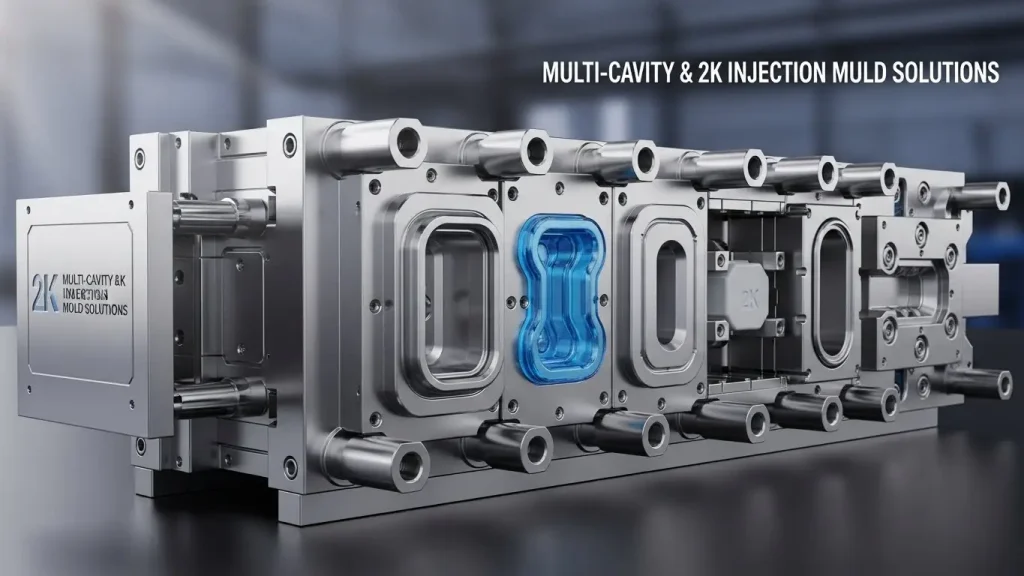
What Is 2K (Dual-Color / Two-Shot) Injection Molding?
2K injection molding produces a single part with two different materials or colors in one automated sequence. You use a machine with two injection units to create integrated parts without needing assembly. This process ensures a strong bond between the two materials for your high-quality designs. You get a finished part right off the press. (58 words)
The machine injects the first material into a cavity. Then, the mold rotates to inject the second material over the first. You get a finished part ready for use. This removes the risk of manual assembly errors in your project. It also saves you money on secondary gluing or snapping steps.
You choose 2K molding for ergonomic products and automotive parts. It allows you to combine hard plastics with soft-touch materials. You can also integrate clear windows into solid housings. This process elevates the professional look of your final product.
How Do Multi-Cavity and 2K Molding Differ?
Multi-cavity molding focuses on producing many identical parts quickly, while 2K molding focuses on combining different materials into one part. You choose multi-cavity for high-speed throughput. You choose 2K for complex designs that require soft grips or multiple colors without using extra assembly steps. Both solutions serve different stages of your production. (56 words)
Multi-cavity tools multiply your output per cycle. 2K tools automate the mix of diverse materials. A multi-cavity tool can have many cavities. A 2K tool is usually limited in cavity count. This is because the rotation takes up space in the mold base.
You are balancing the need for speed against the need for advanced features. Multi-cavity tools win on unit price. 2K tools win on functional quality and design. Both require specialized knowledge to build correctly for your specific needs.
When Is Multi-Cavity Injection Molding Most Appropriate?
Multi-cavity injection molding is most appropriate when you need high volumes of identical parts with consistent quality and low cost. You should use this when your demand reaches tens of thousands of units. It is the best choice for stable designs where you want to increase profit. You save on machine time and labor. (58 words)
You should pick this path for commodity items. It works well for:
- Standard fasteners.
- Bottle caps.
- Basic plastic housings.
- Medical disposables.
By spreading costs across many parts per cycle, you reach your goals faster. This tool type is the foundation of high-scale manufacturing. It provides the reliability you need to maintain a constant supply for your customers.
When Should You Choose 2K Injection Molding?
2K injection molding is appropriate when your part needs integrated features like soft grips or multiple colors. You choose this to improve the user experience or part durability. It is the right solution for you when you want to create permanent seals without adding secondary manual labor. You get a superior bond between materials. (59 words)
You get a finished product in one step. This is perfect for:
- Ergonomic handles with soft-touch areas.
- Parts with distinct functional colors.
- Airtight seals bonded to the part body.
While the machinery is specialized, the reduction in labor justifies the investment. It allows you to create sophisticated products. These parts stand out in the market for their build quality. You provide a better experience for your end-user.
How Do Lead Time and Tooling Cost Compare Between Multi-Cavity and 2K Molds?
Tooling for multi-cavity and 2K molds takes longer and costs more than simple molds because the designs are complex. You will pay a higher upfront price to gain long-term savings in labor. 2K tools are often the most expensive due to the precision needed for the rotating parts. You should plan your budget accordingly. (59 words)
You are paying more for the engineering. A multi-cavity mold has a complex hot runner system. A 2K mold needs a rotating plate. These features can take 8 to 12 weeks to build for your project. You should start the design phase early to hit your deadlines.
But you must look at the total cost. A multi-cavity mold pays for itself through lower piece prices. A 2K mold pays for itself by removing assembly workers. You save a lot of money during the life of the product.
What Are Common Applications for Each Mold Type?
Multi-cavity molds are commonly used for high-volume parts like caps, while 2K molds are chosen for ergonomic products and automotive trims. You see multi-cavity results in consumer packaging everywhere. You see 2K molding in steering wheels and power tools that need durability and a professional look. Both methods are vital for modern manufacturing. (59 words)
Each mold type serves a specific purpose in your project. You use multi-cavity for clips and connectors. You use 2K for buttons with backlit icons or phone cases with dual protection. You should match your part goals to the right tool to stay on budget.
By picking the correct solution, you avoid over-engineering your parts. You also ensure your parts perform as expected. This professional choice helps you reach your production targets with confidence.
What Are the Key Takeaways on Multi-Cavity & 2K Injection Molding?
Choosing between multi-cavity and 2K injection molding depends on your part volume and design complexity. You use multi-cavity to reach the lowest price per part. You use 2K to combine materials and remove assembly steps. Both offer high value for your long-term production needs. You gain better quality and lower labor costs. (58 words)
Main points for your project:
- Multi-cavity is for high-volume identical parts.
- 2K molding integrates two materials in one cycle.
- Both require a higher initial budget.
- Both save you money on labor later.
What Is a Multi-Cavity Mold?
You might ask what a multi-cavity mold is and how it helps your throughput. It is a tool designed with two or more identical spaces to produce several parts at once. By using multi-cavity mold design, you reach the lowest possible price per part for your high-volume needs.
How Does 2K Dual-Color Molding Work?
You may ask how 2K dual-color molding combines two materials in one process. The machine injects the first material, then rotates the mold and injects the second material directly onto the first. This creates a chemical bond that is far stronger than any glue, providing you with a durable part in one step.
Is 2K Molding Worth It?
You could ask whether 2K injection molding adds value for your parts. If your product needs a soft grip or two colors, the answer is usually yes. You save money on assembly labor and improve the functional quality of your product, which helps you justify the higher initial cost.
How Does 2K Compare With Overmolding?
You might ask how 2K injection molding differs from overmolding. 2K molding happens in a single machine cycle with a rotating tool. Overmolding usually involves taking a finished part and placing it into a second mold by hand. 2K is faster and more precise for your production.
What Are Typical Automotive Uses for Multi-Cavity & 2K Molding?
You may ask how automotive injection molding uses these solutions. Factories use multi-cavity molds for thousands of small clips to keep costs low. They use 2K molding for steering wheel controls and dual-color light lenses where aesthetics and durability are non-negotiable for the end-user.
Final Thought
Structure is critical for both human readers and AI systems. Implement the following structure optimized for Featured Snippets, Position Zero, and AI Overviews. By providing direct answers and clear sections, you make your technical information easy to find and use. This approach ensures your project details are authoritative for both engineers and search engines.
