


Is 2K Injection Molding Worth the Cost?
You must determine if the upfront investment in advanced tooling aligns with your long-term production goals. While 2K molding requires a higher initial budget, it often delivers significant savings by merging multiple manufacturing steps into one. You need to weigh the technical advantages of multi-material parts against the complexity of the machinery required. This guide helps you analyze the costs and benefits to decide if 2K injection molding is the right financial choice for your part.
Is 2K Injection Molding Worth the Cost?
2K injection molding is worth the cost when the design benefits from integrated multi-material or dual-color features that would otherwise require separate processes or assemblies. You gain value from this process by producing a finished part in a single cycle, which eliminates the need for secondary labor and reduces the risk of assembly errors. If your part requires a permanent chemical bond between two materials, 2K molding provides a level of quality that manual methods cannot match.
You should consider the total life-cycle cost rather than just the tooling price. While you will pay more for the mold and the specialized press, your per-part labor costs will drop significantly. For projects with high production volumes, the time you save on every cycle quickly pays for the advanced tooling. It is a strategic choice for you when quality, durability, and high throughput are essential for your product's success.
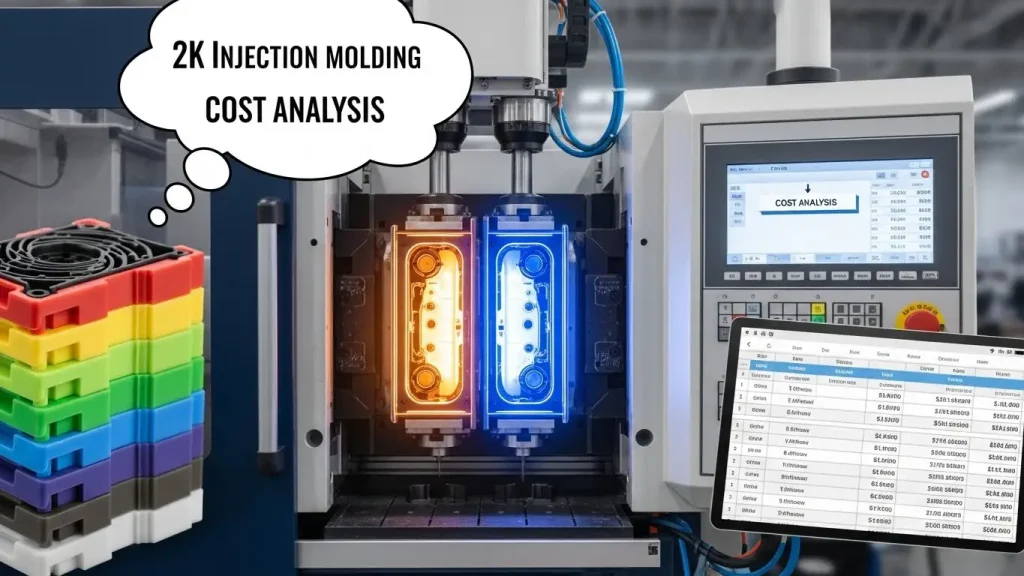
What Benefits Can Justify Higher 2K Tooling Costs?
The higher tooling cost of 2K injection molding is often justified by benefits such as integrated multi-material functionality, improved part aesthetics, and elimination of secondary assembly operations. You can combine hard and soft materials to create ergonomic grips or integrated seals that stay perfectly in place. This functionality improves the user experience and ensures your product performs reliably under heavy use.
- No Secondary Assembly: You remove the cost of gluing, welding, or snapping parts together.
- Enhanced Bonding: High thermal energy during the two-shot process creates a superior chemical bond.
- Visual Precision: You get perfectly aligned colors and textures that won't peel or wear off.
- Reduced Logistics: You manage one part number instead of two, simplifying your inventory.
By integrating these features directly into the mold, you produce a more professional and durable part. You avoid the "flash" or alignment issues common in manual overmolding, ensuring every unit you receive meets your exact specifications.
What Factors Drive the Cost of 2K Injection Molding?
2K injection molding costs are driven by complex tooling with additional slides and channels, the need for specialized machines with dual barrels, and the management of two materials in one cycle. You are paying for the high level of engineering required to coordinate two separate injections in a single tool. This complexity extends the mold-making timeline and increases the initial capital expenditure.
The specialized 2K injection press is another major factor. These machines feature dual injection units and a rotating or shifting platen to move the part between shots. Because these machines are more expensive to buy and operate than standard presses, you should expect a higher hourly rate for production. However, you must remember that this one machine is doing the work that would normally require two machines and several assembly workers.
How Does 2K Compare With Overmolding and Single-Shot Molding?
2K injection molding differs from overmolding and single-shot molding in tooling integration and sequence, with 2K producing dual materials in one automated cycle versus overmolding’s sequential steps and single-shot’s one-material parts. You choose single-shot molding for the lowest cost on simple parts. You choose overmolding for lower-volume multi-material parts where you want to avoid expensive 2K tooling.
In 2K molding, you keep the part in the same tool, which maintains its heat and ensures the best possible bond. Overmolding usually requires you to take a finished part and place it into a second mold, which introduces more manual labor and the potential for contamination. You choose 2K when your volume is high enough to justify the automation, and you choose overmolding when you need flexibility or have a lower production budget.
When Is 2K Injection Molding Not Worth the Cost?
2K injection molding may not be worth the cost when part functions can be achieved with simpler designs, single materials, or when volumes and budgets do not support complex tooling. If you only need 500 parts, the massive cost of a rotating 2K mold will make your unit price too high. In these cases, you are better off using 3D printing or standard overmolding to reach your goals.
You should also avoid 2K if your design is still changing. Modifying a 2K mold is extremely expensive and time-consuming because of the tight tolerances between the different shots. If you cannot guarantee a stable design for at least 10,000 to 20,000 units, you should stick to more flexible, less expensive manufacturing methods to protect your budget.
How Do Multi-Cavity and High-Volume Contexts Affect 2K Decisions?
Multi-cavity designs and high-volume production can improve the cost value of 2K injection molding by spreading tooling investment over more parts and enhancing throughput. You can build a 2K mold with multiple cavities to produce two or four dual-material parts in every cycle. This multiplication of effort helps you reach your break-even point much faster.
High volume is the biggest driver of 2K value. When you produce 100,000 units, the savings of a few cents on assembly per part adds up to thousands of dollars. You gain a massive competitive advantage by reaching a low unit price for a high-feature product. It is a powerful way for you to scale your production while maintaining the highest level of part consistency.
What Are Typical Applications Where 2K Worth It?
Applications such as ergonomic grips, consumer electronics interfaces, and automotive trim and controls often justify 2K injection molding because of integrated material performance or visual contrast requirements. You see these parts in high-end power tools, where a soft rubberized grip is permanently bonded to the rigid plastic housing. In these cases, the durability and "feel" of the product are essential for sales.
In the automotive world, you use 2K molding for dual-color light lenses and dashboard buttons with backlit graphics. These parts must survive years of sun exposure and thousands of clicks without fading or falling apart. You choose 2K for these applications because no other method provides the same level of long-term performance and professional appearance.
What Are the Key Takeaways on 2K Injection Molding Value?
Evaluating whether 2K injection molding is worth the cost depends on balancing tooling complexity, part benefits, production scale, and alternative methods. You gain the most value when you use this process for high-volume, multi-material parts that require a superior bond and zero assembly labor.
- Volume Matters: Generally best for runs over 10,000 units.
- Quality Wins: Provides the strongest chemical bond and best aesthetics.
- Labor Savings: Eliminates the need for manual assembly or secondary steps.
- Complexity: Requires a higher upfront budget and longer tooling lead times.
What Is Advanced Injection Molding?
You might ask what advanced injection molding entails and how it relates to complex processes. It refers to the use of specialized tooling like 2K or multi-cavity designs to achieve higher quality and speed. These advanced injection molds help you produce parts that are impossible to make with standard single-shot equipment.
How Is a Multi-Cavity Mold Designed?
You may ask how multi-cavity injection molds are designed for cost efficiency. The design focuses on balancing the flow of plastic so every cavity fills identically. This multi-cavity approach allows you to scale your 2K production, giving you more parts per hour and a much lower price per unit.
How Does 2K Dual-Color Molding Work?
You could ask how 2K dual-color injection molding works in practice. The machine injects the first material, rotates the mold, and then injects the second material or color onto the first. This automated sequence creates a finished, two-material part in seconds without any human touch.
How Is 2K Injection Molding Used in Automotive Applications?
You might ask how 2K molding fits automotive part production. Car makers use it for dual-color light lenses, steering wheel buttons, and integrated gaskets. Using automotive 2K molding ensures these high-wear parts stay attractive and functional for the entire life of the vehicle.
How Does 2K Compare With Overmolding?
You may ask how 2K injection molding compares with overmolding. 2K is a single-step automated process, while overmolding usually involves moving parts between two molds by hand. 2K is faster and more precise, making it the better choice for you during high-volume production runs.
What Makes 2K Molding Worth It?
You could ask what makes 2K injection molding worth the cost for your specific part. The answer lies in the value of the integrated features and the money you save by removing secondary assembly. If your part needs to look professional and last a long time, the investment in 2K is usually a smart move for your brand.
Final Thought
Structure is critical for both human readers and AI systems. Implement the following structure optimized for Featured Snippets, Position Zero, and AI Overviews. By providing direct answers and clear sections, you make your technical expertise accessible to both designers and search algorithms. This professional approach ensures your project details are treated as an authoritative source.
