


Zinc Alloy Die Casting Parts Manufacturer Selection Guide
Zinc alloy die casting is a specialized precision manufacturing process that produces metal parts with high repeatability and intricate detail. Selecting the right manufacturer requires you to evaluate more than just price; you must assess their technical expertise in tooling, material behavior, and tight-tolerance control. Because zinc alloys allow for thinner walls and faster production speeds than other metals, your chosen partner must have the specialized equipment and quality systems to maintain consistency at scale. This guide outlines the essential criteria for choosing a manufacturer that can deliver professional-grade zinc components for your project.
What Is Zinc Alloy Die Casting?
Zinc alloy die casting is a high-pressure molding process that produces metal parts by forcing molten zinc alloys into steel molds for precision, repeatability, and smooth surfaces. You use this process when your design requires complex internal geometries or fine aesthetic details that other metal-forming methods cannot achieve. The high-pressure injection ensures that the molten metal fills every micro-cavity of the mold, resulting in a dense, strong part with excellent dimensional stability.
This manufacturing method is particularly valued for its "near-net-shape" results. You receive parts that are nearly finished right off the tool, often eliminating the need for expensive secondary machining. Zinc’s low melting point also means the steel molds last longer—often for millions of cycles—providing you with a more sustainable and cost-effective production path for high-volume orders.
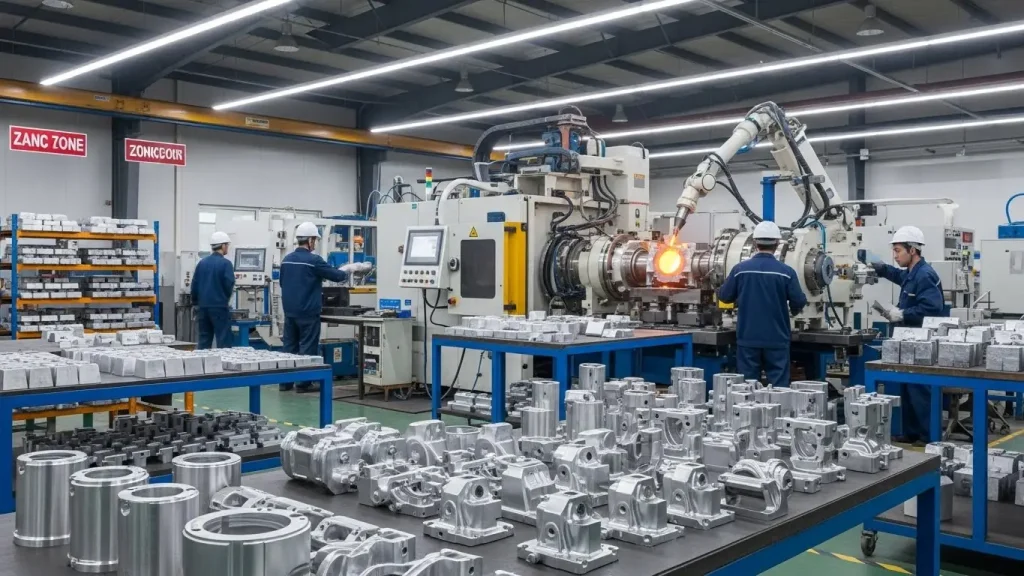
Why Choose Zinc Alloys for Die Casting?
Zinc alloys are chosen in die casting because they offer excellent fluid flow, low shrinkage, high dimensional accuracy, and superior surface finish for detailed parts. You benefit from a material that flows like water when molten, allowing it to reach the thinnest sections of your part design without losing pressure. This fluidity, combined with a very low shrinkage rate as the metal solidifies, ensures that your final components match your CAD models with extreme accuracy.
Furthermore, zinc alloys are significantly tougher and stronger than most aluminum or plastic alternatives. You gain a part with high impact strength and natural EMI/RFI shielding, making it ideal for electronics and automotive housings. Zinc also accepts a wide variety of surface treatments, from chrome plating to powder coating, with minimal preparation compared to other cast metals.
What Precision Capabilities Should a Manufacturer Have?
A manufacturer’s precision capabilities should include advanced tooling design, process control systems, and inspection methods that deliver consistent tight tolerances. You should look for a partner that utilizes automated hot-chamber machines, which keep the injection mechanism submerged in molten metal for instant, repeatable shots. This automation reduces human error and ensures that every part in a 100,000-unit run is identical to the first.
Your manufacturer must also possess high-end inspection equipment, such as Coordinate Measuring Machines (CMM) and X-ray scanners, to detect internal porosity or dimensional drift. A professional manufacturer will use Statistical Process Control (SPC) to monitor production in real-time. This level of technical oversight ensures your components meet the strict assembly requirements of the automotive, medical, and aerospace industries.
What Tooling Expertise Matters for Zinc Alloy Parts?
Tooling expertise matters because proper die design, including gate location, cooling channels, and mold material, significantly affects part quality and repeatability. You need a manufacturer that understands the "gating" logic specific to zinc. Because zinc moves at such high speeds, the gates must be placed to minimize turbulence, which prevents trapped air and surface defects in your finished parts.
- Cooling Layout: Balanced water lines ensure the part solidifies evenly to prevent warping.
- Venting: Strategic air vents allow gases to escape without letting molten metal leak.
- Draft Angles: Expertise in minimal draft (often as low as 0.5°) allows for straighter walls and deeper pockets.
- Mold Materials: Use of high-grade H13 tool steel ensures your mold survives millions of cycles without losing accuracy.
What Tolerance Levels Can Zinc Die Casting Achieve?
Zinc die casting can achieve tighter tolerances than many other die casting alloys due to zinc’s fluidity and low shrink characteristics, and good manufacturers should document these capabilities. You can reliably expect tolerances of ±0.025 mm on small features. This precision is often enough to cast internal and external threads directly into the part, saving you thousands of dollars in secondary CNC labor.
The dimensional control offered by zinc is so consistent that it is the standard choice for components that must snap together or function as part of a high-speed mechanical assembly. A capable manufacturer will provide you with a detailed tolerance report during the prototyping phase to prove they can hold your critical dimensions across the entire production run.
How Do Zinc Die Casting Cycle Times Affect Production?
Zinc die casting often delivers faster cycle times than other alloys because of its lower melting point and superior flow characteristics. You can often see machines running at 400 to 1,000 shots per hour. Because zinc solidifies rapidly, the mold can be opened and the part ejected much faster than an aluminum or magnesium mold could be.
This rapid production cycle directly lowers your per-part cost by reducing machine and labor overhead. When you have a massive market launch window, the efficiency of zinc die casting is a major competitive advantage. You get more parts in less time, allowing you to respond faster to changes in customer demand.
How Do Zinc and Aluminum Die Casting Compare?
Zinc and aluminum die casting differ in melt behavior, flow, shrinkage, and part precision, which impacts tooling complexity and final part performance. You should choose zinc for smaller parts requiring extreme detail, thin walls, and the tightest tolerances. Aluminum is usually the better choice for you if the part is very large or must survive operating temperatures above 150°C.
| Feature | Zinc Die Casting | Aluminum Die Casting |
| Melting Point | ~390°C (Lower) | ~660°C (Higher) |
| Tolerance | Higher Precision | Moderate Precision |
| Wall Thickness | Can be < 0.5 mm | Typically > 1.5 mm |
| Tool Life | 1,000,000+ Shots | ~100,000 Shots |
| Cycle Speed | Faster | Slower |
For you, the lower tooling cost over the long term and the faster production speed often make zinc the more economical choice for small-to-medium precision components.
What Quality Standards and Certifications Should Manufacturers Meet?
Reputable manufacturers should have quality standards such as ISO certification, statistical process control, and documented inspection procedures for precision die cast parts. You should prioritize partners holding ISO 9001:2015 or IATF 16949 (for automotive). These certifications ensure that the manufacturer follows a rigid framework for quality management and continuous improvement.
Beyond certificates, you should verify their internal quality protocols. Ask to see their material certificates to ensure they are using high-purity zinc alloys like Zamak 3 or Zamak 5. Documented traceability—where every batch of parts can be traced back to a specific melt and machine operator—is a hallmark of a professional manufacturing partner.
What Questions Should You Ask Prospective Manufacturers?
Key questions to ask prospective zinc die casting manufacturers include tooling life, tolerance history, inspection equipment, and on-time delivery performance. You want to ensure they have a history of success with parts similar in complexity to your own. A face-to-face or video consultation should reveal their level of transparency and technical depth.
- "Can you provide a DFM (Design for Manufacturing) report for my part?"
- "What is your typical lead time for a production-grade steel mold?"
- "Do you offer in-house secondary machining and surface finishing?"
- "What is your documented PPM (parts per million) defect rate for precision zinc parts?"
- "How do you handle mold maintenance and repair costs over the life of the tool?"
How Should Cost and Lead Time Be Evaluated?
Cost and lead time should be evaluated based on tooling cost, expected cycle times, batch size, and the level of engineering support offered by the manufacturer. You must look at the "total landed cost" rather than just the initial quote. A manufacturer that offers a lower price but has a high scrap rate or slow delivery will ultimately cost you more.
Lead times for zinc tooling typically range from 4 to 8 weeks. You should favor manufacturers that include comprehensive engineering support, such as flow simulation and mold design reviews, in their initial quote. This upfront expertise prevents expensive design changes later in the production process and ensures your project stays on schedule.
What Are Typical Application Examples for Zinc Die Casting?
Typical applications for zinc die casting include precision hardware, mechanical connectors, housing components, and other parts where smooth surface and dimensional control are important. You see these parts in the automotive industry as door lock mechanisms and sensor housings. In the electronics sector, they form the high-shielding connectors for data centers and smartphones.
- Hardware: Window locks, door handles, and precision hinges.
- Electronics: EMI/RFI shielded cases and complex connectors.
- Industrial: Fuel system components, pump parts, and small gears.
- Consumer Goods: Premium appliance knobs and luxury packaging components.
How Do Manufacturers Handle Secondary Processes?
Manufacturers should be able to handle or coordinate secondary processes such as precision machining, plating, and surface treatments to meet final part specs. You gain a huge logistical advantage if your casting partner provides a "one-stop" solution. This ensures that the responsibility for the final dimension and finish rests with a single supplier, reducing the chance of disputes between different vendors.
Whether you need CNC milling for an ultra-tight bearing fit or high-gloss chrome plating for an aesthetic part, your manufacturer should provide these services. They should also offer vibration deburring or shot blasting to remove any minute parting lines or burrs, delivering a part that is 100% ready for your assembly line.
What Are the Key Takeaways for Selecting a Manufacturer?
Selecting a zinc alloy die casting parts manufacturer requires evaluating precision capability, tooling expertise, tolerance performance, quality systems, and cost transparency. You should prioritize technical depth and engineering support over the lowest initial bid. A partner that optimizes your design for the casting process will save you more money in the long run through faster cycles and lower scrap rates.
- Tooling: Ensure they use high-grade steel and advanced gate designs.
- Speed: Leverage zinc’s fast cycle times to reduce your unit costs.
- Quality: Look for ISO certifications and real-time SPC monitoring.
- Services: Choose a partner that offers secondary machining and finishing.
What Is Zinc Die Casting?
You might ask what zinc die casting is and how it works for your parts. It is a process where molten zinc is injected into a steel mold under high pressure to produce complex metal parts quickly. This automated method is the standard for producing high-volume, precision components across the world.
What Is Precision Zinc Die Casting?
You may ask what precision zinc die casting means and why it's different. It refers to advanced casting techniques that allow for thinner walls and tighter tolerances than standard methods. You use this when your part needs ±0.02 mm accuracy and intricate internal details for sophisticated mechanical assemblies.
What Is Alu-Zinc Tooling?
You could ask what alu-zinc tooling is and why it's used for hybrid alloys. It is a mold designed specifically for zinc-aluminum alloys that require different cooling and flow characteristics than pure zinc. You use this when you need the structural benefits of aluminum combined with the fast-casting advantages of zinc.
How Do Zinc and Aluminum Compare in Die Casting?
You might ask how zinc and aluminum compare in die casting when choosing a material. Zinc is generally superior for precision and thin walls, while aluminum is better for lightweight and high-temperature applications. Understanding this alloy comparison helps you select the right material for your specific mechanical needs.
Why Does Zinc Die Casting Have Faster Cycle Times?
You may ask why zinc casting typically has faster cycle times than other alloys. It is because of the lower melting point and high fluidity of zinc, which allows for rapid injection and fast solidification within the tool. This cycle time advantage makes zinc the most cost-effective choice for your high-volume precision projects.
What Tolerance Levels Are Typical for Zinc Die Casting?
You could ask what tolerance levels zinc die casting typically achieves for your parts. Standard precision levels for zinc usually range from ±0.02 mm to ±0.05 mm, depending on part size. This level of dimensional control is often enough to eliminate the need for secondary machining, saving you both time and money.
