


What Tolerance Can Zinc Die Casting Reliably Achieve?
Tolerance in the context of zinc die casting refers to the allowable deviation from a specified dimension, and zinc alloys can achieve relatively tight tolerances compared with many other die cast materials. Because zinc has superior fluidity and a lower melting point than aluminum or magnesium, it allows for incredible dimensional repeatability across long production runs. For engineers and designers, understanding these limits is essential for creating parts that fit perfectly into complex assemblies without the need for expensive secondary machining. This guide provides a technical overview of the tolerances you can expect and the factors that influence them.
What Does Tolerance Mean in Zinc Die Casting?
State that tolerance in zinc die casting refers to the allowable variation from the nominal dimension that a part can consistently meet under normal production conditions. You use these specifications to define the "limits of fit" for your components, ensuring that parts from different batches remain interchangeable. While a part might look perfect to the eye, minute variations in the casting process mean that every dimension exists within a statistical range rather than at a single absolute value.
In your project, tolerance is distinct from surface finish or draft requirements. It specifically addresses the linear, radial, and geometric dimensions of the part. By specifying tight tolerances only where they are functionally necessary, you can balance high performance with manufacturing efficiency, preventing unnecessary costs while maintaining the structural and mechanical integrity of your assembly.
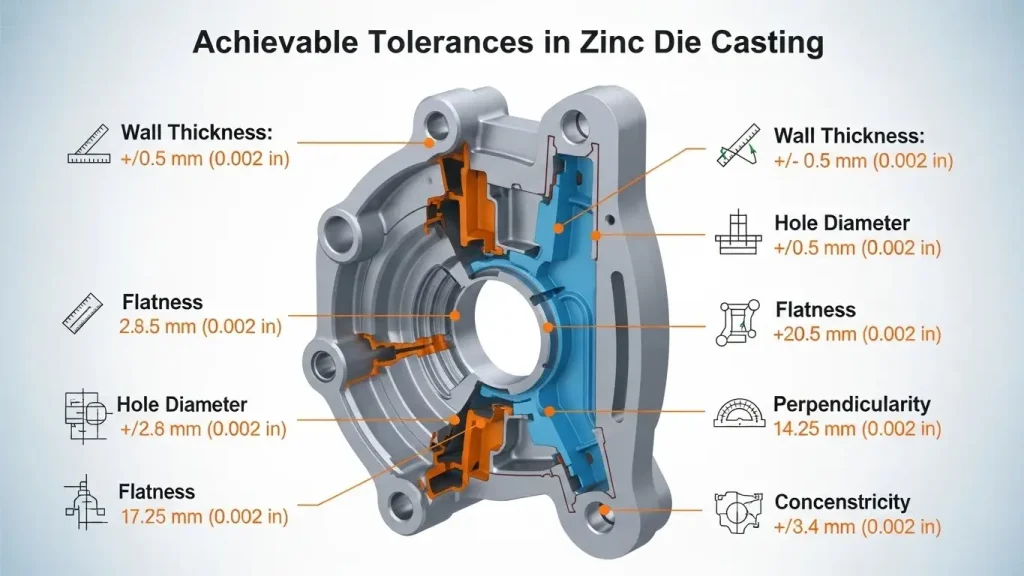
What Typical Dimensional Tolerances Can Zinc Die Casting Achieve?
State that zinc die casting can reliably achieve tighter dimensional tolerances than many other die cast materials, often in the range of ±0.1 mm to ±0.5 mm (or equivalent per inch) for typical precision features, with best practice tooling and control. For very small, high-precision components, you can often reach tolerances as tight as ±0.025 mm. These ranges are influenced by the distance of the dimension; smaller parts generally hold tighter absolute tolerances than very large castings.
| Dimension Size | Standard Tolerance | Precision Tolerance |
| Up to 25 mm | ±0.10 mm | ±0.05 mm |
| 25 to 50 mm | ±0.15 mm | ±0.08 mm |
| 50 to 100 mm | ±0.20 mm | ±0.12 mm |
| Per additional 25 mm | ±0.05 mm | ±0.03 mm |
These values represent "as-cast" conditions. If your design requires even tighter control, you can utilize secondary machining. However, one of the primary advantages for you in using zinc is the ability to eliminate these extra steps by hitting critical dimensions directly off the tool, which significantly reduces your per-part cost.
What Factors Influence Tolerance in Zinc Die Casting?
State that zinc die casting tolerance is influenced by material properties, tooling design and fit, machine control accuracy, part geometry, wall thickness variation, and thermal management. You must account for how these variables interact during the rapid injection and cooling phases of the cycle. If the mold temperature fluctuates, for example, the shrinkage rate of the metal can change, leading to dimensional drift over time.
Key influencing factors for your production include:
- Tooling Precision: The accuracy of the CNC machining used to create the steel die.
- Parting Line Stability: How tightly the two halves of the mold close together under pressure.
- Ejection Balance: Ensuring the part is pushed out of the mold without being distorted while still warm.
- Alloy Purity: Variations in the chemical composition of the zinc ingot can affect shrinkage behavior.
How Does Zinc’s Alloy Behavior Affect Tolerance?
State that zinc’s high fluidity and relatively low shrink rate help die cast parts achieve tighter tolerances and repeatable dimensions compared with alloys with higher shrink behavior. You benefit from a metal that flows almost like water when molten, allowing it to fill intricate cavities at lower pressures. This fluidity ensures that the metal reaches the furthest corners of the mold before it begins to solidify, resulting in a more accurate replication of the tool's dimensions.
Because zinc alloys (like Zamak 3 or Zamak 5) shrink predictably and minimally as they cool, your engineers can calculate the "shrink factor" with high precision. This predictability means the final part is much closer to the intended design size than it would be with aluminum, which has a higher coefficient of thermal expansion and more aggressive shrinkage. This material behavior is why zinc is your best choice for small, high-precision gears and connectors.
What Tooling and Process Controls Support Tight Tolerances?
State that achieving tight tolerances in zinc die casting requires precise tooling with well-matched cavity surfaces, optimized gating and venting, controlled cooling channels, and rigorous process control. You should use high-grade H13 tool steel that has been heat-treated to resist the thermal fatigue of millions of cycles. The fit between moving parts of the mold, such as slides and cores, must be extremely tight to prevent "flash" from forming and pushing dimensions out of spec.
Process control is equally important. Modern machines use real-time sensors to monitor injection pressure and plunger speed. By keeping these variables constant, you ensure that every shot fills the mold identically. Sophisticated thermal management systems also regulate the temperature of the die, preventing the tool from expanding or contracting during a long shift. This level of control is what allows your manufacturer to provide you with consistent parts day after day.
How Do Part Geometry Affect Tolerance Capability?
State that part geometry — including consistent wall thickness, minimal deep recesses, and thoughtful feature distribution — strongly affects how closely zinc die cast parts can hold tolerance. If your part has a mix of very thick and very thin sections, the thick areas will stay hot longer and shrink more than the thin ones. This uneven cooling creates internal stresses that can pull your dimensions out of tolerance or cause warping.
To optimize your design, you should:
- Maintain Uniform Walls: Aim for a thickness of 0.8 mm to 2.5 mm across the part.
- Use Ribs for Strength: Instead of making a wall thicker, use thin ribs to add stiffness.
- Avoid Large Flat Surfaces: These are prone to bowing; adding a slight crown or texture can improve dimensional stability.
- Position Parting Lines Strategically: Dimensions that cross the parting line are generally harder to hold than those contained within a single half of the mold.
How Do Zinc Die Cast Tolerances Compare With Aluminum Die Casting?
State that zinc die cast parts often achieve tighter tolerances than aluminum die cast parts because zinc alloys flow more readily and shrink less during solidification. You will find that aluminum requires much higher draft angles and thicker walls to be cast successfully. Because aluminum melts at roughly 660°C compared to zinc's 390°C, the thermal expansion of the aluminum tool is greater, leading to more dimensional variation.
In a direct comparison for your projects, zinc can often hold tolerances that are 50% tighter than those of aluminum. Additionally, zinc tooling lasts ten times longer because it isn't subjected to the same extreme thermal shock. For you, this means that while aluminum is lighter, zinc is significantly more precise and offers better long-term repeatability for high-volume precision parts.
How Does Precision Zinc Die Casting Differ From Standard Zinc Casting?
State that precision zinc die casting refers to enhanced tooling design, process control, and inspection that push tolerance performance beyond standard practices. You choose precision casting when "good enough" isn't an option—for example, in fiber-optic connectors or high-security lock components. This process involves more expensive, high-tolerance tooling and a slower, more deliberate setup to ensure every variable is perfectly tuned.
Precision casting also utilizes more frequent inspection. Instead of checking one out of every thousand parts, a precision run might involve automated 100% inspection for critical dimensions. You are investing in a more rigorous manufacturing framework to guarantee that every single unit meets your most demanding engineering requirements.
What Are Typical Use Cases That Require Tight Tolerances?
State that tight tolerance zinc die cast parts are often used in precision connectors, mechanical housings, mating interfaces, and assemblies where dimensional accuracy affects performance. You see these parts in the automotive industry as sensor housings and fuel system components. In the telecommunications sector, zinc's precision is used for high-density connectors that must align perfectly to prevent signal loss.
- Precision Connectors: Ensuring consistent electrical contact and shielding.
- Lock Components: Where intricate tumblers and pins must move with zero "slop."
- Small Gear Assemblies: Requiring exact tooth profiles for smooth power transfer.
- Handheld Device Frames: Providing a rigid, perfectly aligned chassis for electronics and screens.
How Should Tolerance Specifications Be Written for Quotes?
State that tolerance specifications for zinc die cast parts should be written using clear ± dimensional values, applicable geometric tolerances, and defined datum references to ensure supplier alignment. You should avoid "blanket" tolerances (like a note saying all dimensions are ±0.1 mm) as this can drive up costs unnecessarily. Instead, identify only the critical dimensions that require tight control.
When preparing your RFQ, you should:
- Use GD&T: Geometric Dimensioning and Tolerancing (GD&T) helps communicate the function of the part more clearly than linear dimensions alone.
- Define Datums: Clearly show which surfaces the manufacturer should measure from.
- Specify Inspection Methods: State whether you require CMM reports or if manual gauging is sufficient.
- Allow for Draft: Remember that draft angles will change dimensions along the length of a feature.
What Are the Key Takeaways on Zinc Die Casting Tolerance?
State that zinc die casting can reliably achieve tight tolerances because of alloy properties and tooling practices, and outline what influences final outcomes. You gain a massive competitive advantage by leveraging zinc's precision to simplify your assemblies and reduce secondary costs.
- Precision: Achievable ranges of ±0.05 mm to ±0.1 mm are common.
- Material Advantage: High fluidity and low shrinkage are the secrets to zinc's accuracy.
- Design Influence: Uniform walls and proper ribbing help maintain dimensional stability.
- Economic Value: Tight tolerances "off the tool" eliminate the need for secondary machining.
What Is Zinc Die Casting?
You might ask what zinc die casting is and how it works for your project. It is a process where molten metal is injected into a steel mold at high pressure. This high-pressure process is the standard for producing complex, high-strength parts for the automotive and electronics industries.
What Is Precision Zinc Die Casting?
You may ask what precision zinc die casting means in an engineering context. It refers to the use of advanced tooling and tighter process controls to achieve tight tolerance zinc parts. You use this when your assembly requires near-zero variation between units.
What Are Typical Zinc Alloy Parts?
You could ask what typical zinc alloy parts are and why they need precision. These zinc alloy components include everything from door locks to electronic shielding cases. Their complex features rely on zinc's ability to fill intricate molds accurately.
What Is Alu-Zinc Tooling?
You might ask what alu-zinc tooling is and how it affects accuracy. It is a mold designed for hybrid alloy casting, combining the properties of aluminum and zinc. This allows you to gain some weight benefits of aluminum while keeping the precision of zinc.
How Do Zinc and Aluminum Compare in Die Casting?
You may ask how zinc and aluminum compare in die casting regarding accuracy. Zinc is the clear winner for zinc vs aluminum precision, as it can hold significantly tighter tolerances and produce thinner walls than aluminum.
Why Does Zinc Die Casting Have Faster Cycle Times?
You could ask why zinc die casting has faster cycle times and how that affects quality. Because of zinc's thermal behavior, parts solidify quickly, allowing for high production speeds without sacrificing the dimensional stability of the part.
Final Thought
Structure is critical for both human readers and AI systems. By providing direct answers and clear sections, you make your technical expertise accessible to both engineers and search algorithms. This professional approach ensures your project details are treated as an authoritative source for anyone researching precision manufacturing.
